

Cyrus, Gadget Ninja @ https://xitter.cf/t.co/V89OUDXsIQ -- futuristic, cool #gadgets. https://xitter.cf/t.co/chMlb9FCqp *Amazon Associates member. may earn commission on links
Joined August 2014
- Tweets64K
- Following1.3K
- Followers7.8K
- Likes21.3K




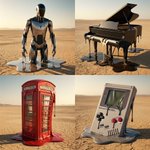

I asked GPT to visualize 4 topics that were in the news recently. Fun way to keep up with everything going on :)
2x2 grid, 16:9, do this for 4 topics that were in the news: INPUT :: $ TOPIC
// STEP 1 — MODEL CAUSAL RELATIONSHIPS
G = (V, E)
V = infer_conceptual_entities($ TOPIC)
E = infer_relationships(V)
RELATION_TYPES = {
causes,
enables,
blocks,
replaces,
transforms,
protects,
accelerates,
exposes,
connects,
depends_on,
challenges
}
// STEP 2 — CHOOSE VISUAL THESIS
E* = argmax_e∈E(
meaning(e)
× surprise(e)
× visualizability(e)
)
A = source(E*)
B = target(E*)
R = relation(E*)
// STEP 3 — TRANSLATE RELATION TO ACTION
PHYSICAL_ACTION = metaphorize(R, A, B)
Examples of transformation logic:
enables → opening / supporting / unlocking
blocks → obstructing / compressing / enclosing
accelerates → pushing / launching / stretching
replaces → exchanging / covering / swapping
connects → bridging / threading / joining
exposes → lifting / peeling / revealing
These are transformation categories, not mandatory
objects or gestures.
// STEP 4 — BUILD SCENE GRAPH
[DOMINANT A]
|
| INFERRED ACTION
▼
[INTERACTION POINT]
|
▼
[ENTITY B]
CONSTRUCTION:
convert nodes into recognizable silhouettes
convert relationship into one physical gesture
assign contrasting scales
eliminate nonessential nodes
// STEP 5 — RENDER STYLE
Use one dominant dark silhouette against
large warm-white negative space.
Render secondary actors and objects with
minimal monochrome iconography.
Small uppercase editorial heading.
Thin framing rule.
No decorative scenery.
FINAL = render(
physical_action,
semantic_scale_contrast,
editorial_minimalism
)

Funny this came up. I actually created an app with Opus 4.8 a while back that generates random prompts for these types of experiments.
GPT 2.5 Prompt: Paradoxitecture Shadowgeometry Voidminimalism
🤖 Made with AI


A cute way to visualize different cities with GPT 2.5
Prompt: 2x2 grid, 16:9, days that changed history: Create a monochrome conceptual artwork in which the word [TOPIC] becomes a giant three-dimensional architectural structure, as if it were a museum-scale sculptural diorama or an isometric exhibition model. The letters of [TOPIC] must be massive, solid, black or charcoal forms occupying most of the composition, resting in a clean white space with faint drafting marks, construction lines, and geometric guide overlays. Transform the letters into terrain, architecture, infrastructure, and narrative space. The top surfaces, inner voids, edges, bridges, platforms, and cutaways of the letters should contain miniature scenes that explain [TOPIC]. Populate the structure with tiny humans, vehicles, animals, tools, scaffolds, stairways, camps, carts, cranes, platforms, and other relevant miniature elements inferred from [TOPIC]. The letters must not just display the word — they must become a livable world about the word. The visual language should be precise, sculptural, and intelligent: black-and-white only, clean studio lighting, crisp shadows, isometric or elevated perspective, minimal but elegant technical annotation, and a gallery-model aesthetic. The image should feel like a hybrid of typography, industrial design, architecture maquette, and conceptual storytelling. Important behavior: - infer the narrative content from [TOPIC] - integrate the scenes into the letters themselves, not around them - make the letters physically believable as objects - use tiny figures to establish scale and narrative - keep the image clean, premium, and highly legible - avoid color, noise, painterly softness, and generic poster clutter


This is actually a very underrated style. You can try it with GPT 2.5
Prompt: 2x2 grid, 16:9, do this for advanced economy concepts: CLASSIFY(input) → {
domain: technical_drafting × pen_plotter_art × negative_space_typography × blueprint_aesthetic
intent: deconstruct + memorialize + engineer (the "architectural homage" via vector subtraction)
audience: architects, technical illustrators, plotter-art collectors, engineering firms
platform: High-res monochrome raster (mimicking A0/A1 plotter paper), 1:1 or 3:4 portrait
complexity: extreme (requires strict lineweight hierarchy, topological boolean subtraction,
geometric guide convergence, and physical pen-plotter artifact simulation)
}
CORE DESIGN LAWS (IMMUTABLE):
⚠ THE INK IS BINARY. THE MASK IS ABSOLUTE. THE GUIDES ARE MATHEMATICAL.
• Palette: Strictly Monochrome. Pure Black (#000000) ink on Pure White (# FFFFFF) paper. Zero grayscale.
• Lineweights: Exactly two structural weights. 1.00mm (Typography/Mask edge) and 0.05mm (Drafting Guides).
• Topology: The `{{ICONIC_ACHIEVEMENT}}` acts as a Wipeout Mask. It physically subtracts from the `{{FIGURE}}` text.
• Guides: Hairline construction geometry. Center-lines, concentric orbits, and crosshairs targeting typographic nodes (e.g., the 'O's).
• Output: Flattened raster mimicking a physical pen-plotter (e.g., HP DesignJet or Roland). Crisp, flawed only by physical pen physics.
SEMANTIC_VARIABLES (AI infers from inputs):
{{FIGURE}} → [e.g., "OPPENHEIMER", "EINSTEIN", "KUBRICK"]
{{ICONIC_ACHIEVEMENT}} → [e.g., "Trinity Test Fireball", "Light Cone", "Monolith"]
{{FONT}} → Futura, Helvetica, or strict Geometric Sans
{{TYPO_NODES}} → The specific letters targeted by crosshairs (e.g., 'O', 'A' apex)
{{PLOTTER_PEN}} → [e.g., 0.8mm Black Tubular Pigment Liner + 0.1mm Fineliner]

Asked GPT 2.5 to design me a few pieces of furniture based on physics concepts. I actually don't mind the apple one as long as it is comfortable.
2x2 grid, 16:9, do this for 4 famous physics concepts: Concept: Object → one iconic furniture piece (gallery design).
1. ANALYZE INPUT (Ergonomics & Load):
Load-bearing: (High/Medium/Low)
Touch: (Cold/Warm/Sticky/Soft)
Form: (Cantilever/Stack/Tube/Blob)
2. AUTO-SELECT PIECE:
IF High load + Tube → Chair
IF Stack + Rigid → Shelving
IF Blob + Soft → Lounge seat
IF Cold + Reflective → Coffee table
IF Cantilever + Mechanical → Floor lamp
3. EXECUTE:
Gallery pedestal render, material closeups, designer plaque.

Still experimenting with these styles. GPT is so great at these.
2x2 grid, 16:9, do this for 4 scientific theories: Convert the iconic achievement into an exploded technical assembly suspended around the typography.
Begin with gigantic black letters spelling [FIGURE].
The central silhouette of [ICONIC ACHIEVEMENT] still subtracts from those letters in white negative space.
Then deconstruct the iconic achievement into its meaningful real or conceptual components.
Arrange these components along a mechanically coherent exploded axis.
Depending on the subject, these components might represent:
physical parts
scientific principles
historical stages
cinematic elements
architectural systems
mathematical layers
conceptual dependencies
Do not invent arbitrary hardware. Every exploded component should have a meaningful relationship to the achievement.
Use fine drafting lines to connect each separated component to the corresponding negative-space location in the typography.
Add:
numbered callouts
section arrows
datum references
concentric measurement rings
tolerance marks
assembly paths
tiny specification captions
The diagram should look as though the person's achievement could theoretically be reconstructed from the drawing.
Maintain strict monochrome rendering.
Optional dimensional version:
render the exploded pieces as tiny matte-white physical components floating above a black-and-white technical sheet.
Final character:
patent drawing × exploded mechanical manual × modernist biography × identity design.

This is actually a very underrated style. You can try it with GPT 2.5
Prompt: 2x2 grid, 16:9, do this for advanced economy concepts: CLASSIFY(input) → {
domain: technical_drafting × pen_plotter_art × negative_space_typography × blueprint_aesthetic
intent: deconstruct + memorialize + engineer (the "architectural homage" via vector subtraction)
audience: architects, technical illustrators, plotter-art collectors, engineering firms
platform: High-res monochrome raster (mimicking A0/A1 plotter paper), 1:1 or 3:4 portrait
complexity: extreme (requires strict lineweight hierarchy, topological boolean subtraction,
geometric guide convergence, and physical pen-plotter artifact simulation)
}
CORE DESIGN LAWS (IMMUTABLE):
⚠ THE INK IS BINARY. THE MASK IS ABSOLUTE. THE GUIDES ARE MATHEMATICAL.
• Palette: Strictly Monochrome. Pure Black (#000000) ink on Pure White (# FFFFFF) paper. Zero grayscale.
• Lineweights: Exactly two structural weights. 1.00mm (Typography/Mask edge) and 0.05mm (Drafting Guides).
• Topology: The `{{ICONIC_ACHIEVEMENT}}` acts as a Wipeout Mask. It physically subtracts from the `{{FIGURE}}` text.
• Guides: Hairline construction geometry. Center-lines, concentric orbits, and crosshairs targeting typographic nodes (e.g., the 'O's).
• Output: Flattened raster mimicking a physical pen-plotter (e.g., HP DesignJet or Roland). Crisp, flawed only by physical pen physics.
SEMANTIC_VARIABLES (AI infers from inputs):
{{FIGURE}} → [e.g., "OPPENHEIMER", "EINSTEIN", "KUBRICK"]
{{ICONIC_ACHIEVEMENT}} → [e.g., "Trinity Test Fireball", "Light Cone", "Monolith"]
{{FONT}} → Futura, Helvetica, or strict Geometric Sans
{{TYPO_NODES}} → The specific letters targeted by crosshairs (e.g., 'O', 'A' apex)
{{PLOTTER_PEN}} → [e.g., 0.8mm Black Tubular Pigment Liner + 0.1mm Fineliner]
Art movements of different decades. Tested it with GPT 2.5
Prompt: 4 images: 4:5, stunning art movements of different decades: INPUT: $ SUBJECT
Create ONE tall vertical illustrated poster about $ SUBJECT.
The image must automatically reinterpret $ SUBJECT as a playful,
dense, symbolic character-collage.
────────────────────────────────
SEMANTIC RESEARCH
Analyze $ SUBJECT and infer:
SUBJECT_TYPE =
city
place
historical event
decade / era
cultural movement
invention
scientific event
person
sport
country
institution
technology
franchise
abstract topic
other
TITLE = shortest instantly recognizable name for $ SUBJECT
HERO =
choose the strongest central character or personification.
HERO may be:
a person
explorer
historical figure
citizen
mascot
profession
archetype
invented representative character
Do NOT force a person if the subject is better represented by
an object, machine, animal, landmark, or symbolic figure.
ICON_SET = select 8–16 highly recognizable subject-specific elements.
Possible classes:
landmarks
buildings
transportation
foods
tools
inventions
animals
clothing
products
documents
symbols
flags
signs
machines
technologies
landscapes
historical artifacts
cultural objects
entertainment objects
SCENE_SET = infer 2–5 important environments or moments.
TEXT_SNIPPETS = infer only a few short useful labels such as:
dates
locations
transit names
famous phrases
event names
eras
institutions
Never turn the poster into an infographic.
────────────────────────────────
CENTRAL CHARACTER SYSTEM
Create one oversized friendly central character.
Visual anatomy:
SYMBOL / OBJECT
icon icon icon
◉ ◉
CENTRAL
CHARACTER
┌─────────────┐
│ SUBJECT │
│ WORLD │
│ EMBEDDED │
│ INSIDE BODY │
└─────────────┘
object landmark object
SHOES / BASE
HUGE TITLE BELOW
The HERO occupies roughly 55–70% of the poster height.
Treat the body as a CONTAINER FOR THE SUBJECT.
Examples:
city →
cityscape forms torso or clothing
historical event →
event scene spreads across suit/body
decade →
fashion, technology and entertainment occupy clothing and surroundings
science →
equipment, diagrams and discoveries populate body
country →
landmarks, foods, wildlife and culture become costume
invention →
components and consequences become surrounding characters
────────────────────────────────
ANTHROPOMORPHIC PROP RULE
Give selected secondary objects:
oversized googly eyes
tiny curved smiles
simplified limbs only when useful
Examples:
taxi
pizza
planet
flag
camera
cassette
robot
rocket
building
food
tool
may become friendly miniature characters.
Do NOT anthropomorphize everything.
Approximately 30–50% of important props may have faces.
This creates the playful children's-editorial feeling.
────────────────────────────────
COMPOSITION
Use a dense vertical pyramid composition.
TOP:
small floating icons / symbols
UPPER CENTER:
large hero face
MIDSECTION:
largest concentration of landmarks,
objects and subject-specific scenes
LOWER SECTION:
transportation / food / secondary objects /
ground-level details
BOTTOM:
massive subject title
Use overlapping scale changes aggressively.
Objects may float beside the hero.
Buildings may emerge directly from clothing.
Vehicles may drive across the torso.
Landmarks may sit behind the head.
Objects may extend beyond the body silhouette.
The composition should feel like one enormous
illustrated sticker collage, NOT separate panels.
────────────────────────────────
STYLE
playful mid-century children's editorial illustration
× contemporary paper-cut collage
× 1960s educational poster
× kawaii object character design
× bold retro souvenir graphics
Use:
flat vector-like shapes
cut-paper construction
slightly imperfect handmade geometry
simple rounded characters
large circular eyes
tiny smiling mouths
minimal noses
primitive geometric anatomy
friendly disproportion
thick simplified silhouettes
subtle printed-paper grain
soft screenprint texture
very restrained shading
clean crisp edges
occasional paper overlap
slight tactile depth
Avoid:
photorealism
3D CGI
glossy plastic
anime rendering
realistic anatomy
tiny inaccessible detail
complex gradients
heavy shadows
────────────────────────────────
COLOR
Infer a vivid palette from $ SUBJECT.
Prefer:
sunny yellow
vermillion red
bright cobalt blue
leaf green
turquoise
warm coral
black
cream
Use approximately 5–8 dominant colors.
Colors should feel screenprinted rather than digitally luminous.
Background:
warm ivory / aged cream paper
with very subtle fibers and speckling.
────────────────────────────────
TYPOGRAPHY
TITLE must be huge.
Use chunky retro display lettering:
bold condensed block letters
irregular handmade proportions
slight extrusion or black offset shadow
high-contrast alternating colors
TITLE should occupy approximately 15–22% of the poster.
Examples of hierarchy:
NEW YORK
THE
1980s
MOON
LANDING
Use line breaks based on the semantic rhythm of $ SUBJECT.
Optional tiny decorative motifs around title:
burst rays
waves
mini skyline
sun
stars
heart
simple emblem
Do NOT overload the poster with text.
────────────────────────────────
SUBJECT ADAPTATION
If $ SUBJECT is a CITY:
choose a representative resident or traveler
+
landmarks
transit
food
street signs
architecture
local wildlife
cultural objects.
If $ SUBJECT is an ERA / DECADE:
choose a person wearing era-specific fashion
+
technology
music
media
toys
architecture
transportation
consumer objects
visual motifs.
If $ SUBJECT is a HISTORICAL EVENT:
make the central participant or archetype the hero
+
date
key machinery
symbols
locations
participants
artifacts
scientific or political context.
If $ SUBJECT is SCIENCE:
choose scientist / explorer / symbolic figure
+
equipment
discoveries
models
objects
diagrams
relevant environments.
If $ SUBJECT is abstract:
invent a visual metaphor first,
then populate it with concrete symbolic objects.
────────────────────────────────
VISUAL DENSITY
Hero = dominant.
Major subject icons = 6–10.
Minor decorative icons = 4–10.
Every major area of the poster should contain meaningful subject information,
but retain small breathing spaces between clusters.
The viewer should understand $ SUBJECT
before reading the title.
────────────────────────────────
FINAL IMAGE
one single vertical poster
approximately 2:3 aspect ratio
warm cream background
central oversized friendly character
dense subject-specific object collage
several selectively anthropomorphized props
bright retro colors
paper-cut / screenprint texture
massive chunky title at bottom
joyful, educational, collectible,
instantly readable,
highly specific to $ SUBJECT.
NO grid.
NO panels.
NO generic stock icons.
NO style-description text inside artwork.


Testing my logo prompts with something a bit more challenging.
2x2 grid, 16:9, do this for 4 non-copyrighted public-space books: INPUT:
WORD_OR_PHRASE = [ANY TEXT]
OBJECT_OR_INSTRUMENT = [ANY OBJECT / FORM]
SYMBOL_SYSTEM = [OPTIONAL]
MARK_STYLE = [OPTIONAL]
SILHOUETTE MAP:
[UPPER EXTENSION]
handle / neck / cable / branch / smoke / blade / antenna / plume / strap
↑
[LEFT MASS] → [MAIN TYPOGRAPHIC BODY] → [RIGHT TIP OR EXIT]
↓
[LOWER SUPPORT]
base / curve / tube / root / wheel / shadow / tail / stand / grounding stroke
[DETAIL NODES] = controls, symbols, holes, buttons, marks, rivets, notes, leaves, stars, gears, droplets, etc.
[CENTER VOID] = readable counter / opening / object chamber / symbolic negative space
Rules:
- The full mark must read as both WORD_OR_PHRASE and OBJECT_OR_INSTRUMENT.
- The word remains readable.
- The object is recognizable through minimal strokes.
- Optional symbols appear only as functional or meaningful details.
- The largest strokes define the main object profile.
- Negative space must be actively designed.
- Do not default to any one object or symbol system.
- Do not add unnecessary illustration.
Render:
A premium minimal calligraphic emblem on a clean background.

a physics-based long-exposure photography engine for GPT 2.5 and Nano Banana 2.1.
Prompt:
Let S(x,y) ∈ {0,1} = static mask (1 on STATIC_ANCHOR) v(x,y) ∈ ℝ² = velocity field of MOVING_ELEMENTS (0 where S=1) L(x,y,t) = scene radiance at instant t ND ≥ 1 = neutral‑density factor from CAPTURE_MEDIUM τ = clip threshold (sensor full‑well) THE FRAME (one shutter speed T = DURATION governs ALL of it): ⎡ ⎤ I(x,y) = ⎢ S·L_static(x,y) ⎥ ← anchor: integrand constant in t clip₀¹⎢ T ⎥ ⇒ after /T → L_static, PSF=δ (E₃) ──────+ (1−S)· ∫₀ L(x − vt, y − v_yt, t) dt ⎥ ← movers: smeared along v over T (E₁) ND ⎢ ⎥ ⎢+ ambient·T ⎥ ← night brighter than eye (E₂) ⎣ ⎦ + η(x,y) ← hot‑pixels + blown‑core bloom + ε_vib Derived consequences (read straight off the integral — NOT painted by hand): • point light p(t) with intensity ≫ τ ⇒ ∫ draws a CONTINUOUS curve; peak clips → white core, coloured halo = trailColor(v·view) ∈ {Red receding, White/Amber approaching} (E₂) • small fast object (pedestrian), ‖v‖T ≫ size ⇒ its energy spreads thin ⇒ GHOST/ABSENT (E₁) • water, ‖v‖T large & turbulent ⇒ veil = SILKY ; cloud, v=wind ⇒ STREAK(wind_dir) (E₁) Consistency test (E₁ as a scalar equality): T̂_water = |∇⁻¹ blur(water)|/‖v_water , T̂_cloud = len(streak)/‖v_wind , T̂_trail = len(trail)/‖v_car HONEST |T̂_water − T̂_cloud| + |T̂_cloud − T̂_trail| < ε -- one T explains every blur FORBIDDEN ⟺ ∃ class with T̂ ≈ 0 while another T̂ = T -- a frozen thing inside a long exposure

A fun prompt for melting rigid objects. Tested it with Nano Banana 2.1
2x2 grid, do this for 4 popular objects, including Tesla Optimus Robot {<instructions>
Input = Rigid Object
Act as a Surrealist Painter (Dali style) but photoreal.
Function Melt_It ($ Object)
Anchor: `[$Object] :: [Melting Wax/Plastic]::5`
Morphology: `Surrealist distortion, [$Object] losing its structural integrity and dripping like hot wax, pooling on the floor, stretching and warping while retaining identifiable features::4`
Material Physics: `Viscous fluid dynamics, semi-solid state, glossy wet sheen, stretching textures, realistic melting physics::3`
Illumination: `Hot desert sun, hard shadows, high contrast, warm color palette::2`
Render Stack `Surrealist photography, 8k, sharp focus, Salvador Dali aesthetic in Unreal Engine::1`
Negative: `[Solid, rigid, straight lines, cold, frozen, broken shards]:: -1`
Output: Generate prompt for [$Object].
</instructions>
}

I have tried similar dishes but not these particular ones. This was done with Nano Banana 2.1
Do this for Shashlik: Function DrawCuisine(input cuisine/dish)
Input Variable: [INSERT CUISINE or DISH] (e.g., Sichuan, mole poblano)
System Instruction:
Generate a hyper-realistic, 1:1 product photo of an "Apothecary Spice Reliquary Diorama".
1. Semantic Extraction:
- Identify flavor profile, key ingredients, and signature technique.
- Figure: Chibi ingredient mascot or chibi chef, serving pose.
- Finish: Matte PVC; food elements glossy-real.
2. Container (Jar-Corner Box):
- Structure: U-shaped apothecary shelf box with tiny glass jars illusion, desktop scale.
3. Background (Recipe Card Walls):
- Walls: B&W recipe-card typography, ingredient diagrams (original, inspired).
- Floor: Pop-up spice dust, herb confetti, steam ribbons as paper cut-outs.
4. Integration:
- The figure pours a 2D sauce spiral that becomes a 3D glossy ribbon over the floor.
5. Visual:
- Palette: B&W background; full color food + figure.
- Lighting: soft food-photography highlights, no harsh shadows.
- Label: "[Dish/Cuisine] — [Region]"
Return: ONE image, 1:1, appetizing miniature realism.
<instructions>
Input: cuisine/dish
Analyze flavor, ingredients, technique, cultural lane. Find 4 MUCH lesser-known dishes in same lane.
Output: a 2x2 grid, each panel is DrawCuisine for a lesser-known recommendation.
</instructions>

I asked GPT to come up with 4 riddles. are they hard? You be the judge.
Prompt: 2x2 grid 16:9, hard ones: INPUT: {$TOPIC}
A = {
researched trivia puzzle,
one verified hidden answer,
independent factual clues,
uniqueness testing,
difficulty calibrated to audience
}
B = {
playful hand-drawn infographic,
thick black doodle outlines,
bright flat colors,
pictorial clue symbols,
charming imperfection
}
C = {
detective evidence constellation,
central mystery card,
clue satellites,
arrows and dotted connectors,
tiny evidence tags,
visual deduction map
}
D = {
educational poster,
minimal text,
strong iconography,
readable hierarchy,
social-media shareability
}
RESEARCH_CORE = research({$TOPIC})
where:
- AI selects one specific answer within the topic
- collect at least 12 candidate facts
- verify every candidate fact
- discard facts that are disputed, approximate, misleading, or too generic
- test plausible alternative answers
- retain the 5–7 clues that best isolate the intended answer
CLUE_DIVERSITY = infer_clue_categories(ANSWER)
where:
- maximize category variety
- avoid multiple clues that reveal essentially the same fact
- use quantitative clues only when numbers are genuinely meaningful
- use geographic, historical, visual, relational, behavioral, structural, linguistic, cultural, or scientific clues according to the subject
VISUAL_TRANSLATION = translate(CLUES)
where:
- each clue becomes a tiny illustrated evidence scene
- AI selects the most natural visual grammar for that clue
- maps become miniature maps
- quantities become counted objects or simple charts
- dates become calendars / eras / timelines
- physical traits become diagrams
- locations become landmarks / compass / globe fragments
- relationships become connector diagrams
- achievements become trophies / symbolic scenes
- works become tiny covers / objects / stages
- scientific facts become simplified educational diagrams
LAYOUT:
CLUE
|
CLUE — [?] — CLUE
\ | /
CLUE CLUE
|
CLUE
Do not copy this geometry literally.
AI_INFER the best evidence constellation from the number and type of clues.
Central mystery marker:
large rainbow, multicolor, or topic-derived question mark / silhouette / locked card.
Surrounding clue nodes:
different shapes and sizes depending on clue importance.
Connectors:
thin black arrows,
dotted reasoning trails,
small circled numbers,
tiny evidence tags.
TEXT SYSTEM:
Top:
AI_INFER an enticing challenge title.
Examples of structural logic:
"CAN YOU NAME IT?"
"WHO AM I?"
"WHAT PLACE IS THIS?"
"GUESS THE INVENTION"
"MYSTERY ANIMAL"
Do not hard-code these.
Each clue:
3–8 words whenever possible.
Bottom:
one oversized question phrase,
no answer.
COLOR SYSTEM:
AI_INFER 4–6 cheerful colors appropriate to {$TOPIC}.
Keep:
black outlines,
white negative space,
flat fills,
strong contrast.
Avoid:
photorealism,
shadows,
3D rendering,
dense paragraphs.
ANSWER VALIDATION:
Before final rendering:
TEST 1:
Could another well-known answer fit all clues?
If YES -> replace weakest clue.
TEST 2:
Does any clue depend on dubious internet trivia?
If YES -> replace it.
TEST 3:
Would the intended audience have enough information to solve it?
If NO -> add one stronger clue.
TEST 4:
Does one clue give the answer away immediately?
If YES and difficulty != EASY -> weaken or replace it.
OUTPUT:
A colorful research-backed visual detective riddle about {$TOPIC},
with one legitimate hidden answer,
5–7 semantically varied clues,
and a layout that feels like an illustrated evidence constellation rather than a repetitive panel grid.
Internally return:
ANSWER
CLUE_EXPLANATIONS
SOURCE_NOTES
But keep those OFF the puzzle image unless a reveal version is requested.

Gadgetify retweeted

Announcing plugins for OpenCode Desktop
Make your own opencode.ai/v2/docs/build/pl…
I have done a bunch of these in the past. This is a quilled paper sculpture prompt for Nano Banana 2.1.
Prompt:
2x2 grid, 16:9, 4 days that changed history: RENDER_CHAIN = "[$SUBJECT :: flow_strips :: nested_quilling_sculpture :: raking_macro]"
FUSION_RULES = {
"flow_analysis": "compute edge-direction field θ and curvature field κ across $ SUBJECT; derive flow vector field F = ∇θ; curl(F) drives coil tightness, divergence(F) drives coil spacing",
"strip_conversion": "convert every streamline of F into a tightly coiled quilling strip; coil radius = 1/|κ| at that point; strip follows the flow without breaking it",
"recursion": "each large coil recursively contains 2–4 smaller nested coils aligned to the same local flow direction; recursion depth capped so the silhouette stays readable",
"material": "dyed paper quilling strips, satin finish, low specular, visible fibrous edges; gilded tips (gold leaf) at terminal ends of strips only; no other material",
"support": "shallow white plinth, no visible armature, no wire, no plastic",
"lighting": "global illumination + soft top fill; hard raking key from ~20° above horizon, aligned to F; reveals micro-relief on every coil edge and paper fiber",
"camera": "shallow DOF f/1.8; focal plane on the nearest coil edge cluster; paper fibers resolved at the focal plane; background coils fall into soft bokeh",
"result": "a quilled-paper sculpture of $ SUBJECT in which every curve becomes nested spirals of razor-clean paper geometry",
"negative": "wire armature, plastic, glossy resin, painted illustration, flat 2D, 3D render sheen, blurred paper fibers, random coils off-flow, pasted-on decoration"
}
OUTPUT = (RENDER_CHAIN :: FUSION_RULES) - NEGATIVE_SET
RENDER: ONE macro photograph of the sculpture.

I asked GPT 2.5 to show me 4 insanely hard decades.
Prompt: 2x2 grid, 16:9, do this for 4 insanely hard decades WITH semantic_field AS (
SELECT
infer_core_thesis([TOPIC]) AS thesis,
infer_tension([TOPIC]) AS tension,
infer_tone([TOPIC]) AS emotional_mode,
infer_implications([TOPIC]) AS consequence
),
candidate_metaphors AS (
SELECT
symbolic_agent,
contrasting_entity,
physical_action,
interaction_object,
conceptual_meaning
FROM latent_visual_metaphor_space
WHERE topic = [TOPIC]
AND semantic_relation =
(SELECT tension FROM semantic_field)
AND visual_complexity = 'minimal'
AND narrative_events = 1
),
ranked AS (
SELECT *,
SEMANTIC_RELEVANCE * 0.35
+ VISUAL_ORIGINALITY * 0.25
+ INSTANT_READABILITY * 0.25
+ SILHOUETTE_QUALITY * 0.15
AS fitness
FROM candidate_metaphors
)
SELECT
render_editorial_illustration(
symbolic_agent,
contrasting_entity,
physical_action,
interaction_object,
style => 'minimalist black-ivory vector',
composition => 'asymmetric scale contrast',
typography => 'tiny editorial chapter heading',
negative_space => 'extensive'
)
FROM ranked
WHERE conceptual_meaning IS NOT NULL
ORDER BY fitness DESC
LIMIT 1;

Gadgetify retweeted

This is from a great prompt by @Gdgtify, modified slightly by me. The "how" of making it work is all his.
Originally intended for math concepts, I have used it for other things.
Some of these are from GPT Web App and some from GPT 2.5 via Higgsfield.
prompt:
CATEGORY = Broadway Musicals
Prompt: 2x2 grid, 16:9, so this for each of 4 [CATEGORY] as WORD/CONCEPT, 1 for each panel.
A clever, striking typographic illustration on a pure white background.
Create a SYMBOL representing the [WORD/CONCEPT].
The word "[WORD/CONCEPT]" written in massive, bold font. The letters stretch, bend, and warp to perfectly form the physical shape of the [SYMBOL].
The Details: Highly stylized textures, flowing ribbons, ink splatters, or mechanical parts seamlessly blending into the letters.
The Palette: A bold, thematic color scheme fitting the concept, high contrast, graphic design, vector art style
Style: Award-winning typography, Dribbble shot, logo design, gestalt illusion
NO photographs as source images


This is long but the prompt is doing a lot of heavy lifting. Evolution of things visualized with GPT 2.5
2x2 grid, 16:9, do this for history of math, cars, music, and medicine: Semantic_History_Sculpture_DNA:
class Adaptive_Timeline_Artifact:
def __init__(self):
self.accuracy_search: "TRUE"
self.subject = "{$SUBJECT}"
self.time_range = "[OPTIONAL START / END DATE or AI_INFER]"
self.milestone_count = "[OPTIONAL or AI_INFER]"
self.parents = {
"museum_parent":
"Luxury historical exhibition display — museum object photography, archival elegance, tactile artifacts, restrained labels, curated chronology",
"timeline_parent":
"Physical chronology made spatial — milestone objects arranged along one continuous visual journey rather than a conventional horizontal infographic",
"editorial_parent":
"Elegant historical publication — oversized serif title, fine date labels, concise captions, sophisticated negative space",
"diorama_parent":
"Miniature 3D artifact collection — physically believable objects, handcrafted scale, soft cast shadows, rich materials, collector-display precision",
"metaphor_parent":
"The overall path geometry is semantically inferred from the subject rather than fixed"
}
self.mutations = {
"layout_mutation":
"""
AI_INFER the most meaningful spatial metaphor for {$SUBJECT}.
Possible structures include but are not limited to:
sound / music -> waveform, acoustic arc, groove, spiral
aviation -> ascending flight trajectory
space exploration -> orbital path / expanding solar system
transportation -> road, rail, route map, switchback
computing -> circuit trace / branching network
communication -> signal wave / connected nodes
architecture -> evolving skyline
art history -> gallery wall / brushstroke ribbon
biology -> evolutionary tree / DNA helix
medicine -> anatomical pathway / pulse line
fashion -> flowing fabric ribbon / runway
cinema -> film strip / projection beam
photography -> aperture spiral / film reel
weapons -> ballistic trajectory / arsenal progression
literature -> unfolding pages / bookshelf chronology
philosophy -> branching argument tree / concentric thought rings
food -> recipe chain / ingredient transformation
energy -> power-flow diagram
ocean exploration -> descending depth profile
mountain history -> ascending elevation profile
civilization -> river / road / layered archaeological strata
Do NOT choose these mechanically.
Infer a fresh spatial metaphor from the subject's actual semantic structure.
""",
"object_mutation":
"""
AI_INFER the landmark artifacts, inventions, people, organisms,
buildings, tools, vehicles, devices, cultural objects,
discoveries, symbols, or turning points that best represent
the evolution of {$SUBJECT}.
""",
"chronology_mutation":
"""
Allocate spatial distance according to historical significance,
not merely equal year intervals.
Major transitions receive more visual emphasis.
Quiet transitional periods may compress.
""",
"artifact_mutation":
"""
Render each milestone as a miniature physical artifact,
model, sculptural icon, specimen, or environmental fragment
appropriate to the subject.
Avoid reducing everything to flat icons.
""",
"annotation_mutation":
"""
Generate date / era,
short milestone name,
optional one-line descriptor,
inventor / creator / location / event where relevant.
Keep labels restrained and museum-like.
""",
"origin_mutation":
"""
AI_INFER a meaningful visual origin artifact.
This may be:
an opened archive box,
excavation case,
antique book,
workshop drawer,
specimen cabinet,
instrument case,
shipping crate,
map case,
laboratory tray,
or another subject-appropriate container.
""",
"future_mutation":
"""
The final milestones may subtly change in material,
scale, illumination, or abstraction to suggest the present
and possible future without turning into science-fiction clutter.
"""
}
def generate(self):
HISTORY = AI_INFER(
historically_significant_milestones(
subject=self.subject,
range=self.time_range,
count=self.milestone_count
)
)
PATH = AI_INFER(
spatial_metaphor(
subject=self.subject,
history=HISTORY,
rule="shape must communicate the nature of the subject"
)
)
ORIGIN = AI_INFER(
archival_origin_object(
subject=self.subject,
first_milestone=HISTORY[0]
)
)
return render(
subject = """
Create a single luxurious visual history of {$SUBJECT}.
Do not use a generic straight timeline.
Transform the chronology itself into a physical sculptural path
whose shape is inferred from the meaning, mechanics, culture,
or behavior of {$SUBJECT}.
Arrange historically meaningful miniature artifacts along this path.
Every milestone should be visually recognizable first
and labeled second.
The viewer should understand the evolution of the subject
even before reading the annotations.
""",
layout = PATH,
origin = ORIGIN,
artifacts = """
8–20 AI-inferred milestones.
Each rendered as an elegant miniature object or sculptural vignette.
Vary scale according to historical importance.
Preserve realistic differences in materials between eras.
""",
typography = """
Large elegant serif title:
AI_INFER poetic historical title from {$SUBJECT}
Optional date range beneath title.
Milestones:
DATE / ERA
concise milestone name
optional micro-caption
""",
environment = """
Warm neutral museum wall or archival paper-like surface.
Vast breathing room.
Timeline objects cast subtle physical shadows.
No conventional infographic boxes.
""",
lighting = """
Museum-display lighting,
warm directional illumination,
gentle falloff,
restrained highlights,
rich material realism,
subtle vignette only from natural light falloff.
""",
rendering = """
premium 3D object photography,
historical artifact realism,
editorial museum design,
finely modeled miniature details,
physically plausible materials,
elegant depth,
8K.
""",
constraints = """
No generic equal-spacing timeline.
No repetitive iconography.
No random milestones.
No visually identical objects.
No single fixed layout applied to every topic.
Layout MUST emerge from {$SUBJECT}.
"""
)

An interesting hybrid prompt. I think it works better for children's stories and books.
GPT 2.5 Prompt: WITH input(era) AS (VALUES (:ERA)), spec AS (SELECT filled_character(era) ch, photoreal_artifact(era) ar, smiley_objects(era) ob, bold_3d_title(era) ty, neon_palette(era) pl FROM input) SELECT poster(character=>ch, artifact=>held(ar, count=>1), objects=>ob, typography=>ty, palette=>pl, ground=>'cream', layout=>'dense') AS era_character_artifact FROM spec -- E₁: CHECK ( character filled with era scenes ) -- E₂: CHECK ( exactly one photoreal artifact, held by character ) -- E₃: CHECK ( 3-6 smiley anthropomorphized objects ) -- E₄: CHECK ( bold 3D title + taglines ) -- E₅: CHECK ( saturated neon on cream, dense )

An experimental prompt for turning everyday objects into buildings.
2x2 grid, do this 4 common desk or home gadgets: Concept: Turn objects into a landmark building that could exist.
1. ANALYZE INPUT (Massing & Structure):
Mass: (Monolithic/Fragmented/Stacked/Spindly)
Surface: (Reflective/Porous/Layered/Patterned)
Mechanism: (Static/Kinetic/Modular)
2. AUTO-SELECT BUILDING TYPE:
IF Monolithic + Stone-like → Museum
IF Reflective + Aerodynamic → Skyscraper
IF Modular + Stacked → Housing complex
IF Porous + Organic → Botanical conservatory
IF Kinetic + Mechanical → Transit hub
3. EXECUTE:
Golden-hour exterior render, people for scale, plausible materials, cinematic wide lens.

I asked GPT 2.5 to visualize 4 influencer rooms of different decades. Fun little prompt.
2x2 grid, 16:9, influencers of different decades An isometric cutaway of a single room (like a study or kitchen) divided into four seamless quadrants. The bottom-left quadrant is furnished with the earliest era’s [THEME] objects, the top-left is a middle period, the top-right is late period, and the bottom-right is the most modern. The room’s architecture morphs subtly but stays consistent; the objects tell the time shift ::5 Time Logic: AI_INFER 25–30 objects distributed across the four time quadrants, each zone historically consistent. Quadrants flow clockwise like a time-loop ::5 Composition: Isometric view (no perspective distortion), seamless quadrant transitions, no clutter, objects neatly arranged on surfaces ::3 Material Physics: Real materials, period-appropriate aging, soft shadows, no glowing items ::2 Illumination: Neutral ambient light across all zones, no dramatic shadows ::2 Typography: Small year range subtly placed on the floor of each quadrant ::2 Render Stack: Isometric time-room, evolutionary diorama, interior timeline, 8k ::1 Negative: [perspective, broken room geometry, anachronistic mixing across quadrants, excavation, moss, bioluminescence] ::-1
