

Helping you break mental loops, let go of control, and build real self-awareness. Documenting the shift from chronic anxiety to emotional clarity.
Joined June 2026
- Tweets1.7K
- Following83
- Followers126
- Likes186


Pinned Tweet
The realization that cured my chronic overthinking:
I used to micromanage every distraction because I thought control equaled safety. Instead, it made me anxious, frustrated, and constantly on edge.
Here is the mental framework I used to break the cycle:
1. The Control Illusion: Accepting that overanalyzing an outcome does not change the outcome. It only creates a second crisis inside your head.
2. The Energy Audit: Realizing that worrying about things outside your circle of influence drains the exact energy you need for things inside it.
3.The Radical Pivot: Shifting focus from "What might happen?" to "How will I respond if it does?"
Worrying doesn’t protect you from the future. It only paralyzes you in the present.
Bookmark this for the next time your mind starts spinning.
Just because someone wronged you doesn’t mean you have to react in anger. Anger can distort judgment, narrow your perspective, and encourage actions that create more problems than the original offense. Deliberation is an important skill to have because it allows you to reassess the situation, examine your assumptions, and consider the consequences before turning emotion into action.
Trust is more than a feeling; it’s a responsibility. As such, ensure it’s not freely handed to just anyone. It’s always easier to lose trust than it is to build it; when people place their trust in you, try not to betray it. A single action can damage trust that was established over months or years, and not every relationship recovers once that damage is done.
Your mind will always suggest ideas, but it’s important to create a habit of questioning impulses before acting on them. Evaluate every thought to see if it’s helping you solve a problem, avoid accountability, or justify a decision you already want to make. Also, your mind feeds off your daily habits, values, principles, and environment; as such, ensure you regularly audit your habits, values, and your circle.
When your partner brings up an idea in your relationship, don’t just accept it automatically; growth happens when ideas are examined rather than blindly accepted. However, when you disagree, do so respectfully and focus on the reasoning rather than the person. Don’t use it as an opportunity to ridicule them. The ability to respectfully disagree creates space for better understanding, stronger reasoning, and a more authentic relationship.
Once your partner chooses to make their feelings visible through repeated behavior rather than communicate when they’ve lost respect, care, or regard for a relationship, if harmful behavior consistently outweighs empathy, respect, and care, take the pattern seriously and prioritize your mental well-being.
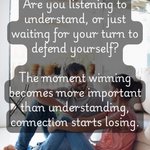
Your partner deserves to be heard when they’re trying to communicate. Rather than let your ego step in the way, or being focused on preparing a response just to protect your ego, consider paying attention to understand the message. Stop building a case the second someone brings up a complaint.

The conversation killer most people don’t realize they’re using:
You’re not listening. You’re preparing a defense.
The second a complaint comes up, your mind starts building arguments instead of hearing them.
As they say, 'The body doesn’t go where the mind hasn’t been.' Cheating is a choice: you think it through, communicate, plan, and then execute. A mistake is rarely planned. And yes, you thought you wouldn’t get caught; you made sure of that in the planning stage.
People take advantage of your kindness when it’s not coming from choice.
Don’t let anyone guilt you into thinking you’re obliged to help.
Kindness should come from choice, not guilt.
Someone who constantly finds ways to minimize your wins, gives you backhanded compliments, withholds approval, or tries to ridicule you publicly isn’t your friend. Their goal is to undermine your confidence so it becomes easier to make you question your judgment and tolerate behavior you would normally reject.
You’re constantly paying too much attention to the fiction your brain is writing; that’s what is stealing your peace. Stop making every single 'what if' a disaster movie with zero evidence. Unless you have proof, don't let it steal your peace.
If you notice that you’re always struggling with delayed decisions, ignored realities, and missed opportunities, you’re not lacking awareness or willingness; you have a fear problem. Fear has a way of making familiar discomfort feel safer than uncertain growth.
Every habit you pick up helps to shape who you become. Your life is hardly defined by major decisions; rather, it’s the daily behaviors that quietly shape it. Habits become patterns, and patterns become outcomes.
Being a good person should come from a place of values, not expectation. It doesn’t guarantee that bad things won't happen to you; life does not distribute outcomes according to what people believe is fair.
Knowing when to remove yourself from a situation, relationships, or circle is an important life skill. The easiest way to compromise your self-respect is trying to gain acceptance in a place where you’re constantly undervalued, tolerated, or unwanted.
The real reason you’re emotionally exhausted:
You’re carrying emotions that don’t belong to you.
Empathy without boundaries becomes self-abandonment.
You’re not responsible for how other adults feel about your boundaries.
Your mind is lying to you.
Not every thought deserves your trust.
Treat it like a GPS, not the driver. You still choose the route.
Gnosis Thoth retweeted

They call it strength when they push everyone away, then wonder why they’re left explaining their pain to empty rooms. Loneliness is the tax.
Life Advice:
While chasing your main goal, be sure to acknowledge your little wins, as they can serve as encouragement to keep you pushing. When you ignore those small victories, you might start to feel like you’re not making any progress and eventually welcome the idea of quitting.