
Matrix Team Lead @Skywork_ai | Controllable video generation & world models | PhD @UofT, MS @Harvard | Previously @VectorInst @Snap @NVIDIA @CarnegieMellon
New York City
Joined March 2018
- Tweets152
- Following1.7K
- Followers397
- Likes2K


Pinned Tweet
We're excited to unveil Matrix-Game 4.0: the world's first open-source game world model streaming at 83 FPS on a single 5090. It's built to be played, not just watched.
My first project leading the Matrix Game team at @Skywork_ai. I'm glad we built something fun! Thanks, team!
Huge thanks to @majorDavidZ, @MqquQ0nIwoXrU4M, @kaiqin_kong, and @JKXXXXX238541 and other teammembers for their incredible work! So proud of what we've built together!
I'm also deeply grateful to Prof. Yu Cheng, Guibin Chen, and Yahui Zhou for their trust and unwavering support!
218
Explore Matrix-Game 4.0 and build on our release.
Project and demos:
matrix-game-v4-0.github.io/p…
Code:
github.com/SkyworkAI/Matrix-…
Model weights and game assets:
huggingface.co/Skywork/Matri…
3
524
Wei Yu retweeted

🎮 Introducing Matrix-Game 4.0 — the world’s first open-source video model game that runs in real time on a single consumer GPU.
Instead of merely watching an AI-generated world, you can now actually play inside one.
⚡ 480p at 60 FPS
⏱️ 112ms end-to-end response
🚀 Up to 83.4 FPS generation
🖥️ Runs on a single NVIDIA RTX 5090
🧠 Coding Agent turns natural-language ideas into playable game logic
🌍 Game engines maintain world states and rules, while the video model renders every frame in real time
From shooters to racing games, the same world model can support entirely different gameplay—by changing the code, not retraining the model.
Matrix-Game 4.0 completes the loop:
Player input → Game engine updates the world → Video model renders the next frame → Player interacts again
Code, model weights, and demos are now open source. Build on it, remix it, and create your own playable worlds.
🔗 GitHub: github.com/SkyworkAI/Matrix-…
🤗 Hugging Face: huggingface.co/Skywork/Matri…
🌐 Project page: matrix-game-v4-0.github.io/p…
From controllable video to runnable worlds—the barrier to creation is getting lower, and the space for imagination is getting bigger.
#SkyworkAI #MatrixGame #WorldModels #GenerativeAI #AI #OpenSource #Gaming

Wei Yu retweeted

My 6-year old simulated a giant duckie with Odyssey-3.

Wei Yu retweeted

Our work on an open-ended interactive video world model, designed to maintain long-horizon interaction consistency while supporting
interaction with newly generated objects.
Thanks for all the effort, @Madaoer_Yxd!

🌍 Introducing Oneira, an interactive video world model where a coding agent keeps an explicit world state.
Objects that appear as you explore become interactive, and your changes persist over long horizons.
Project: madaoer.github.io/projects/o…
Paper: arxiv.org/abs/2610.01614
Wei Yu retweeted

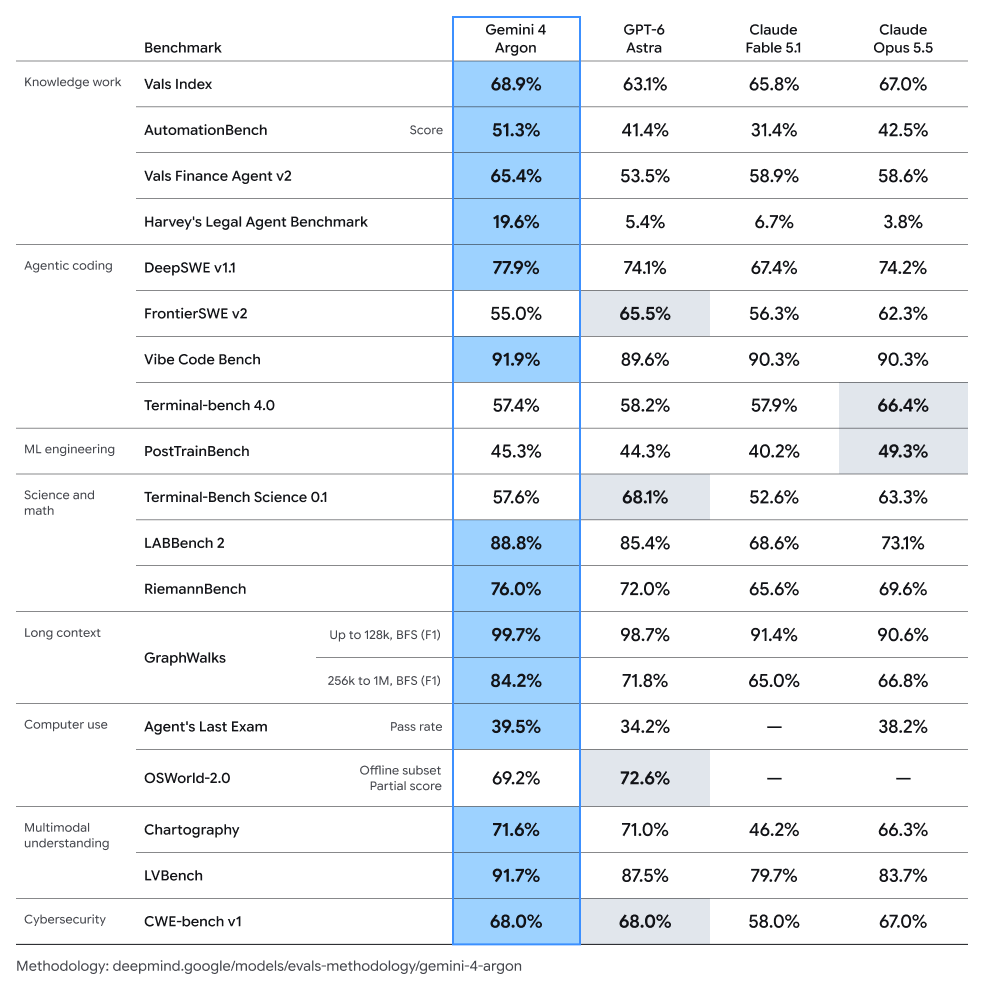
Introducing Gemini 4 Argon – our new frontier model.
It’s built for complex workflows across coding, enterprise knowledge work, and cybersecurity defense – rolling out today to a set of trusted testers through our Fairwind Program.
Wei Yu retweeted

This is a big moment for us

Big news: Kimi-K3 by @Kimi_Moonshot is now #1 in the Frontend Code Arena with 1679 pts, surpassing Claude Fable 5.
This is a 17-place jump from Kimi-k2.6 (#18 -> #1).
In Frontend, Kimi-K3 ranked #1 in 6 of 7 domains: Brand & Marketing, Reference-Based Design, Data & Analytics, Consumer Product, Simulations, and Content Creation Tools, landing #2 only in Gaming behind Fable 5.
The full model weights will be released by July 27.
Congrats to the @Kimi_Moonshot team on this major milestone!

Wei Yu retweeted

Can video generation models do for vision what LLMs did for language?
Introducing GenCeption from @GoogleDeepMind: one feed-forward video model for various vision tasks — SOTA, data-efficient, and emerging behaviors (ECCV 2026)
🌐 genception.github.io
(1/8)


Wei Yu retweeted

I’m very excited to share that my very first Ph.D project, Policy-based Foveated Imaging and Perception, will be presented at #SIGGRAPH2026!
Intelligent sensing transcends passive capture. Our framework allows ultra-high-resolution sensors to intelligently allocate acquisition bandwidth, perceiving the blooming present and awakening the vivid past. We further demo our framework on a physical 200MP sensor prototype real-time with only laptop CPU!
I’m extremely grateful for the advice and support from my Ph.D advisor @GordonWetzstein, and for the wonderful collaboration with @jan_on_x and @boyang_deng!
Please check out our paper and our website 📷+👁️: howardxiao.ca/foveated/.

The era of ultra-high-resolution imaging has arrived. Modern image sensors exceeding 200 MP resolution are common in smartphones, with over 400 MP sensors under development. However, the large number of pixels poses significant challenges for acquisition and processing, especially on edge devices.
Which pixels should be acquired, and when, for bandwidth-efficient imaging and perception?
We introduce Policy-based Foveated Imaging and Perception, an on-device, real-time, predictive, and task-aware framework that dynamically allocates sensor resolution to prioritize important regions under specific perception objectives. This paper will be presented at #SIGGRAPH2026!
[1/6]
Wei Yu retweeted

Exciting to share our work "Good Token Hunting" 🔍 (Yes, the name is inspired by the classic movie "Good Will Hunting" 🎬!), which focuses on accelerating visual geometry transformers 🚀 by limiting the number of keys/values each query can attend in global attention layers. [1/6]

Wei Yu retweeted

The latent-vs-pixel debate misses the point.
GPT Image 2 shows what users notice: pixel-level fidelity.
Latent models show what scales: compact semantic structure.
We connect them by replacing VAE/RAE decoders with a Pixel Diffusion Decoder.
Code and Model available: research.nvidia.com/labs/sil…
🧵(1/N)
Wei Yu retweeted

🚀 🚀 🚀 Excited to share our new paper:
Remember to be Curious: Episodic Context and Persistent Worlds for 3D Exploration
What does it take for an agent to stay curious in a 3D world?
The answer is memory.
🌐 Project: recuriosity.github.io/
📄 Paper: arxiv.org/abs/2605.22814
💻 Code: github.com/recuriosity/recur…

Wei Yu retweeted

New blackboard lecture w @ericjang11
He walks through how to build AlphaGo from scratch, but with modern AI tools.
Sometimes you understand the future better by stepping backward. AlphaGo is still the cleanest worked example of the primitives of intelligence: search, learning from experience, and self-play. You have to go back to 2017 to get insight into how the more general AIs of the future might learn.
Once he explained how AlphaGo works, it gave us the context to have a discussion about how RL works in LLMs and how it could work better – naive policy gradient RL has to figure out which of the 100k+ tokens in your trajectory actually got you the right answer, while AlphaGo’s MCTS suggests a strictly better action every single move, giving you a training target that sidesteps the credit assignment problem. The way humans learn is surely closer to the second.
Eric also kickstarted an Autoresearch loop on his project. And it was very interesting to discuss which parts of AI research LLMs can already automate pretty well (implementing and running experiments, optimizing hyperparameters) and which they still struggle with (choosing the right question to investigate next, escaping research dead ends). Informative to all the recent discussion about when we should expect an intelligence explosion, and what it would look like from the inside.
Timestamps:
0:00:00 – Basics of Go
0:08:06 – Monte Carlo Tree Search
0:31:53 – What the neural network does
1:00:22 – Self-play
1:25:27 – Alternative RL approaches
1:45:36 – Why doesn’t MCTS work for LLMs
2:00:58 – Off-policy training
2:11:51 – RL is even more information inefficient than you thought
2:22:05 – Automated AI researchers
Wei Yu retweeted

🤩Excited to share SANA-WM: a 2.6B open-source world model for minute-scale 720p video generation.
Given one image + text + a 6-DoF camera trajectory, it synthesizes action-controllable 60s worlds on a single GPU.
Project: nvlabs.github.io/Sana/WM/
Paper: huggingface.co/papers/2605.1…
Wei Yu retweeted

Meet LA-Pose. Our latest model taking Wayve another step towards generalization at scale.
LA-Pose employs large-scale self-supervised learning, building strong motion representations for 3D perception from 10.2 million unlabeled driving video snippets, unlike today's strongest approaches that often depend on expensive, carefully curated 3D supervision.
With only a lightweight pose head and limited labelled data, LA-Pose achieves:
📷 State-of-the-art camera pose estimation
🌎 Strong zero-shot generalization across diverse driving scenarios
🏷️ Orders of magnitude less labelled data than fully supervised 3D approaches
Our full blog post: wayve.ai/thinking/la-pose/
Explore the full paper here: la-pose.github.io/
Wei Yu retweeted

We're taking our first step towards democratizing World Models, so that everyone can build on this incredible technology.
We have more to share, but enjoy a glimpse of what's to come, today.
Try it here: reactor.inc
Wei Yu retweeted

Excited to share that this work has been accepted to #ICML and the code is now publicly available at github.com/nv-tlabs/tttla!


Continual learning and online adaptation are often framed as the next frontier of AI. 🚀
Modern architectures use Test-Time Training (TTT) to memorize key-value pairs on the fly via gradient descent, or so we thought.
To test this memorization hypothesis, we replaced gradient descent with gradient ASCENT. It should destroy memorization.
Instead... performance was preserved, or even slightly improved. 😱
It turns out, TTT with KV Binding is secretly linear attention!
Site: research.nvidia.com/labs/sil…
