
Sequoia partner, BC alum, Wyoming native
Bay Area, California
Joined November 2009
- Tweets1.9K
- Following1.2K
- Followers37.6K
- Likes8.4K
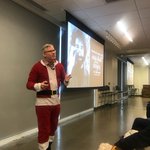


excellent post, and not just because it contains this picture


Got a lot of questions this week about what it’s *really* like to work for @dharmesh and @bhalligan after their refounding announcement.
Here’s the honest truth with no BS: linkedin.com/pulse/working-h…

7
70
13,947
Continual learning is the true north for a lot of the progress in AI. It honors human experience by making it legible to AI, with alignment baked in. Ronak does an awesome job of breaking this down in our latest episode of Training Data.

Models have IQ but no experience.
Frontier models show up on day one with superhuman intelligence but no expertise on the thousands of tasks your company actually does. @trajectorylabs exists to close that gap through continual learning.
@rronak_ trained SWE-1 at Windsurf, then went to DeepMind. His cofounders @MichaelElabd and @QuantumArjun worked on Gemini Robotics and multimodal models for Vision Pro. All three hit the same wall: big labs train one model for everyone, but nobody trains one for you.
The conversation covers:
— why today’s agents are “pseudo continual learning”: we are in the paper road map era, not Google Maps
— “Group Size 1”, a GRPO variant that learns from one real-world rollout instead of replaying the same task eight times, so you don’t need a simulated environment
— how Harvey trained a model 6x cheaper than frontier that took an open-source baseline up by over 4x on its own legal benchmark
— Continual Grading, a meta-grader that turns rubrics on 100 traces into reward for 10,000
— continual learning vs. recursive self-improvement, and why only one keeps humans in the loop
— why continual learning will make product-building more like tending a garden of products
Chapters
0:00 – Introduction
0:45 – Pseudo continual learning: paper maps vs Google Maps
2:48 – Do we need new architectures? Rich Sutton, David Silver, and the missing layer
4:33 – From a $100M consulting model to a product: lessons from SWE-1 at Windsurf
7:36 – Harvey: 6x cheaper than frontier, 4% to 18% on its own benchmark
8:55 – Why "Trajectory": the unit of work is a task, not a token
10:13 – The primitives of continual learning: traces, replayable environments, reward
12:56 – Group Size 1 and the meta-grader: training without an environment or a labeled reward
16:16 – The platform: train, eval and deploy in one click, and who it's for
18:58 – Rogo and intelligence density
20:14 – What's next: curiosity, and why continual learning beats RSI on alignment
24:19 – Research and product under one roof, and the product builder as gardener
27:26 – Why work at Trajectory, and the optimistic case: from 1% to 99%
Anyone can use AI models, but very few people can train them... until now! If you know what good looks like, you can train a model using Trajectory.
When access to powerful new technology is democratized, we tend to be surprised to the upside... we can’t wait to see what people build!

Imagine if everyone had the tools to shape intelligence itself. That day is today.
Today we launch the Trajectory platform - the easiest and most intuitive tool to post-train models of your own. The foundation for continual learning.
With just a few agent prompts, you get access to a full creative suite to train, eval, and deploy trillion parameter models.
On top of that, we believe in a future where you don’t just shape your model once, it also keeps learning on its own from the world around it.
We’re releasing two research previews.
1. Continual grading scales your taste, so your model learns what good looks like from far more than you could ever grade by hand.
2. GS1, a new algorithm that lets models learn directly from what they do in production.
We’ve now raised 60M, with a new round led by @Sequoia at a 300M valuation to democratize the most powerful technology of today - training models - so that the lawyers, doctors, and engineers of the world can own their own intelligence.
You know what good looks like, now go build it. Own your own value function with Trajectory.
I think @getserval is the fastest-growing enterprise system of record in history (I'm not 100% sure, but I haven't been able to falsify the hypothesis).
That's cool, but the real story is why. Why are things working so well?
First and foremost, @jakeserval @AlexAtServal @TatianaBirgisso and the rest of the team have a unique blend of passion, clear-thinking, creativity, and pace... they do the right things with a high degree of craft and quality, quickly.
Second, the product they built is amazing. It has a natural insertion point into any enterprise, and then it just keeps spreading from one team to the next. Easy entry with widespread adoption is a powerful dynamic.
Finally, the market is wide open. IT needs an AI-native platform to call their own, and Serval hit the nail on the head.
It's been a pleasure to work with @getserval alongside my partner @biad_anas, and we are beyond thrilled to double down!

We raised a $150M Series C at a $3B valuation, led by @sequoia. Our third round in 12 months, bringing our total funding to $277M.
Our team has grown 10x in the last 12 months. We now serve Fox Corporation, WPP, Live Nation, Lucid Motors, and Ramp, and many of them are fully replacing legacy platforms with @getserval.
AI coding tools have transformed how engineers work. Serval brings that same power to every team, so anyone can build governed automations across the systems they already use.
We’re hiring 500+ people over the next year and expanding in San Francisco, NYC, London, Austin, and beyond.
If you’re down to take on legacy enterprise systems and transform how teams work, my cofounder @AlexAtServal and I would love to meet you.
It’s Serval now.
MSK-caliber cancer diagnostics for every oncologist… very cool use of AI

Over 85% of oncologists at Memorial Sloan Kettering Cancer Center use OpenEvidence.
Together, @MSKCancerCenter and OpenEvidence have built OncoKB, MSK’s expert interpretation of a tumor’s genetics, directly into OpenEvidence, putting it in the hands of oncologists across the United States.
As Dr. Anaeze Offodile puts it: “Our mission is to end cancer for life.” As of today, we are widening OncoKB’s reach so that patients everywhere benefit from the same rigor as patients at MSK. Watch the story.
extraordinary

Incredible Elon! This will be the largest philanthropic gift in history! 70 M accounts - every citizen under 18 & every child born forevermore now has a free, lifetime investment acct making them an owner in the upside of America & our greatest companies! 🇺🇸🚀🤍@TrumpAccounts @InvestAmerica24


Vélez is elite

David Vélez is the founder of Nubank, a bank with 140 million customers and a market capitalization of $60 billion.
When he started the business in 2013, no one thought it would work, not even his investors. He has faced down regulators, oligopolies, and corruption to build Latin America's largest digital bank. Now he is bringing Nubank to the United States, where he faces his biggest challenge yet.
@gabi_imarques, who grew up four miles from Nubank's headquarters in Brazil, spent time with @velez_david in São Paulo, where the business started, and in Miami, its latest beachhead.
She profiles a man who is no stranger to a fight, having grown up in Medellín, Colombia, when the city was at war with Pablo Escobar. Six-year-old Vélez would pull on layers of sweaters before stepping outside, hoping, as a child might, that the extra padding would cushion any bullets.
colossus.com/article/david-v…

AI for HW!

Flow has raised a $50M Series B at a $750M valuation, co-led by Antonio Gracias (Valor) and Gavin Baker (Atreides) with Sequoia Capital, Roelof Botha (SpaceX, Block), and more.
When I became a mechanical engineer, I wanted to invent. In reality, 90% of the day to day execution work (CAD, excel, sim) was digital manual labour. That’s about to flip. The engineer’s role will change more profoundly than at any point since the invention of CAD, with humans focusing on invention, architecture, tradeoffs and judgement calls, and agents taking the grunt work.
Anduril, Joby, Stoke Space, Rivian & many more - Flow is now the default platform for requirements and verification for frontier hardware teams. But it’s not just next-gen anymore. Industry giants including General Motors PPU and Volkswagen & Rivian’s joint venture (RV Tech) are reshaping their core development practices with Flow’s AI.
The revolution is just starting. Models are getting better quickly at CAD, analysis, simulation, and tool use. In the next year, AI will move from integrating the work to doing the work.
One day, this shift won't just enable us to iterate faster, it will enable us to design a class of products that we could not have dreamt of before.
We’re hiring.
The @BostonCollege Investment Committee (an LP and my beloved alma mater) asked for a few thoughts on what's happening in AI. I recorded a test run yesterday morning and then shared it with my partners, who encouraged me to share it more broadly... so here you go!
This is not a sales pitch, it's just a reflection on what we're seeing. And it wasn't intended to be shared, so please pardon the rough edges.
loom.com/share/c016702964a04…

this is a masterpiece

My conversation with Michael Moritz, one of the great venture investors of the last 40 years.
Michael joined Sequoia in 1986 and co-led the firm with Doug Leone (@dougleone) from 1995 to 2012. His investments include Google, Yahoo, PayPal, and Stripe.
His new book, Ausländer, traces his parents' escape from Nazi Germany and helps explain his lifelong interest in what shapes exceptional people.
We discuss:
- The infamous Steve Jobs profile
- Why Don Valentine hired him
- The question he finds most revealing when interviewing people
- Monomania and the cost of greatness
- Why he has never felt good at anything
- Writing, journalism and AI
- What he learned about himself writing Ausländer
I'd recommend watching this one if you can. Michael was incredibly thoughtful and reflective throughout, particularly when talking about his parents, childhood, and the more difficult parts of his personal story.
Enjoy!
TIMESTAMPS
0:00 Intro
0:53 Family History & Identity
7:03 Survival & Outsider Instinct
18:53 Studying Exceptional People
33:50 Self-Doubt & Success
41:17 Steve Jobs & Obsession
52:50 Joining Sequoia
1:03:22 Leadership & Alex Ferguson
1:08:25 Elon Musk & AI
1:17:12 Becoming Who You Are
it's a great day to be a @sequoia founder... welcome, @dittycheria !

Being a founder is one of the loneliest roles there is. Everyone's livelihood rides on your decisions, but no one else carries the same weight of responsibility. The hardest calls are made in isolation, and you own the outcome either way. The job is only getting harder. AI is changing what companies build, what small teams can do, how they reach customers, and the capital required to scale. The rate of change is accelerating, so the advantage goes to whoever learns and adapts fastest.
Yet the decisions that determine whether a company lives or dies haven't changed. Nailing product-market fit. Constructing an effective go-to-market engine. Building a cohesive leadership team that can scale. Knowing when to raise, and how to allocate capital you may never get a second chance to deploy. Get these wrong, and no technology saves you.
Few firms have helped founders answer those questions longer, or better, than Sequoia. For over fifty years, it has backed founders early and stayed with them as they built enduring companies. What's struck me most, though, isn't the track record. It's the institution. Sequoia has treated the firm as something to be perpetuated, not a vehicle for individual partners. It approached succession with unusual care and reinvented itself as markets shifted. That mindset is why it endured while firms that once stood beside it disappeared.
I've seen how they operate up close. My relationship with Sequoia goes back 16 years. I met Doug Leone in 2010, and for over 11 years I worked closely with Roelof Botha at MongoDB, where Sequoia was our largest investor. I saw firsthand how they behaved when we were winning and when we faced our hardest calls. The advice was thoughtful, the feedback direct, the support consistent. They understood that being a good partner doesn't mean always agreeing with you. It means being honest, staying engaged, and prioritizing the company's long-term interests.
After nearly three decades of building, leading, and investing in technology companies, I'm joining Sequoia as a Senior Advisor. As both an operator and an investor, I've lived through the questions founders face. Helping the next generation answer them is exactly where I want to spend my next chapter.
sequoiacap.com/people/dev-it…

🐐

My conversation with @dougleone, partner at @sequoia.
0:00 How to Dominate for Decades
3:17 Turning Fear Into a Tailwind
5:40 Immigrant Drive, Hard Work & the Beach Club
12:19 Simplifying Life & Choosing Discomfort
14:37 The Homeless Sequoia Partner With No Plan B
16:49 Stepping Down, Coming Back & Starting Over
20:04 Why AI Is Different From Every Previous Technology Shift
22:13 Doug's Three Investment Heuristics
23:52 The Cost of Selling Great Companies Too Early
25:39 Helping Founders Turn Products Into Businesses
28:28 David Vélez, Nubank & the Psychology of Founder Support
32:25 Why Founders Must Remain the Soul of the Company
36:13 Torturing Yourself Into Greatness
39:57 Don Valentine, Succession & the Sequoia School of Hard Knocks
44:28 Staying Grounded & Developing a Sniffer for People
47:46 Hypercompetitive With a Heart of Gold
50:13 Fred Luddy, Israeli Founders & Radical Directness
52:28 Trust Is the Accelerant of Business
59:57 Starting From Zero & Hunting for the Next Great Founder
1:05:59 Architect Your Board Like Your Product
1:10:24 Truth, Disagreement & the Art of Difficult Feedback
1:13:43 Humanity, Introversion & the Value of Relationships
1:18:18 What Doug Learned From Michael Moritz
Includes paid partnerships.
7
67
11,950

Chai is emblematic of the new model for company building… the input is extreme talent density across a variety of domains, and the output is wildly disproportionate commercial progress

Frontier drug discovery programs require frontier capabilities. Today, we’re excited to share that BMS will be using Chai’s models to support the discovery of new therapeutics. Since rolling out Chai-3 to partners at the start of this year, we’ve partnered with @EliLillyandCo, @Novartis, @Pfizer, @argenxglobal, and now @BMSnews. Many of the world’s leading biopharma companies are now using our models to go after diseases.
Scientific discovery is the domain where access to frontier AI matters the most. At @ChaiDiscovery, we’ve seen first hand how our latest model generations can make the difference between discovering a molecule and not. We’re excited to work with @BMSnews to break new ground in medicine and science.
truth-seeking
Yesterday, the founder of a well-known, successful company called me to reference check two people he was considering for a senior role. He wasn’t looking for reassurance. He was genuinely trying to understand them, including anything that might cause him to reconsider either hire. He’s called me before about other hires, including people who wouldn’t even report directly to him. He doesn’t delegate this to others. He calls himself. I'm sure that kind of rigor is part of why his company has been so successful.
The call stuck with me because it happens so rarely. Many people I’ve worked closely with have gone on to senior roles, including C-level positions, at other companies. It’s shocking how infrequently I get called. These are among the most consequential decisions a founder makes, yet companies routinely make them without talking to people who actually worked closely with the candidate.
Part of the problem is timing. Most reference checks happen after the hiring manager has effectively decided to make the hire. You like the candidate, you’ve invested weeks in the process, and you’re under pressure to fill the role. You want the process to be over, so you’re looking for validation rather than truth. That defeats the purpose of doing reference checks.
A real reference check should attempt to disconfirm what you already believe. What am I missing? Where is this person weaker than they appear? What will I wish I had known six months after they start? You aren’t trying to build the case for the hire. You’re trying to find the flaw in the case while you can still do something about it.
I’ve learned a few rules. Start by putting limited weight on the references the candidate gives you. Nobody hands you the name of the boss or colleague who thought they were a disaster. The references that matter most are blind references, so find former bosses, peers, direct reports, and customers who aren’t on the candidate’s list. Each has seen the person from a different angle.
You also have to adjust for human nature. Most people don’t like being brutally honest when they know their words could affect someone’s career. They inflate praise and soften criticism, so my rule of thumb is to discount the positive by 3x and amplify the negative by 3x. That gets you closer to a balanced view.
When someone says, "He's a great leader, although some very good people struggled working for him," the second half of that sentence matters far more than the first. Who struggled, why, and where are those people now? When someone says, "She surrounds herself with people she trusts," ask whether those are the best people for the job or simply people who always agree with her. Hesitations, qualifications, and carefully chosen words often tell you more than the compliments.
Ask questions that make vague answers difficult. What would their direct reports say is the hardest part of working for them? What feedback did you give them repeatedly? What was their biggest blind spot? How do they behave when things are going badly? Tell me about a serious conflict they had and how they handled it. If this hire fails, what is the most likely reason? Would you hire them again?
My favorite is a forced ranking. Of everyone you’ve worked with in a similar role, where does this person rank? Top 1%? Top 10%? Top 25%? Then ask why. Adjectives can be misleading. Rankings force people to make an actual judgment and explain it.
I’ve hired many exceptional people and made some bad hires. The most important lesson I’ve learned is that the goal of a reference check isn’t to prove you made the right decision. It’s to discover why you might be making the wrong one while you can still change it.
55
25,328
Full stack

Introducing Harvey II: smarter agents from the start.
- Featuring Harvey Tenet, our first model trained for legal work
- Built around matters and projects
- Agents start with the files, context, permissions, and history they need
- Assign tasks to lawyers or agents, then track and review the work
- Harvey remembers how you work and writes like you
5
68
17,400
an excellent, opinionated state of the union on AI security

𝗧𝗵𝗲 𝗘𝗻𝗱-𝗦𝘁𝗮𝘁𝗲 𝗙𝗮𝗹𝗹𝗮𝗰𝘆: 𝗪𝗵𝗲𝗿𝗲 𝗜𝘀 𝗔𝗜 𝗦𝗲𝗰𝘂𝗿𝗶𝘁𝘆 𝗚𝗼𝗶𝗻𝗴?
Frontier AI models had a giant performance gain in coding in the Fall of 2025
Then with cybersecurity in April
This is now happening with open-weight models
We are optimistic about the long-term
But outside of a few players, we believe the world is not ready in the short-term


This is an incredible opportunity

Open Evidence is a truly exceptional company
Most doctors in America now use the product
The founders are AI native, having previously founded Kensho
They are hiring an elite+++ young engineer to work with the founders on special projects
DM me or apply online
@OpenEvidence