

India's leading provider for online professional & higher education
Gurgaon, India
Joined October 2016
- Tweets3.2K
- Following212
- Followers33.1K
- Likes654





Does AI make learning obsolete? In yesterday’s Reddit AMA, Dr. Kumar Muthuraman, Faculty Director of the PG Program in AI & ML at The McCombs School of Business @UTAustin, argued the opposite: it makes continuous learning more important.
A user asked: How can you say AI/ML is the right path for education when AI is making learning obsolete and catching up pretty quickly? Here's what Dr Kumar says 👇

"AI is changing how we learn and work, but I don’t think it makes learning obsolete. I’d argue it makes continuous learning more important.
Think of AI as a multiplier. A 4th grader’s conversation with AI looks very different from a doctoral student’s, because the tool amplifies what you bring to it. As the technology improves, the amplification grows, but it still multiplies your understanding and ability to brainstorm. That’s been true of most productivity technologies, like spreadsheets.
Here’s an example. Say a retailer uses AI to forecast demand, and the model predicts a big jump next month. Should they immediately stock up? It depends. Was the forecast driven by an unusual one-time spike? How expensive is holding excess inventory? AI can generate the prediction, but knowing how reliable it is, what assumptions drive it, and how to turn it into a sound decision requires understanding statistics, ML, and decision-making. A prediction is not a decision. The decision requires context, trade-offs, and judgment about consequences.
What has changed is that education can no longer be sequential, where you learn first and then work. It has to run in parallel with everything else, just to keep up.
So I wouldn’t judge the value of learning AI/ML by how fast the tools are changing. The tools will keep changing. The ability to frame the right problem, evaluate the results, and make informed decisions is what lasts. Learning the tools is useful, but understanding when and why to use them is what makes that knowledge valuable."
Has AI made you want to learn more or less? Tell us below.
#AMA #GreatLearning #PowerAhead
Every AI feature has a meter running. Most teams only notice it when the invoice arrives.
This video explains tokenomics: how tokens are counted and priced, and why they decide the cost, speed and limits of every AI application.
A few things change once you think in tokens:
→ Output tokens typically cost more than input tokens, so response length matters
→ Resending full conversation history on every call adds up fast
→ Model choice, caching and batching can lower cost without lowering quality
Our take: cost per token is an engineering decision, not just a finance line item.
Where has token cost surprised your team: long contexts, verbose outputs, or scaling to more users? Share it in the comments.
#GreatLearning #PowerAhead #LLMOps
For two years, the AI question at work was largely about capability. Now, the conversation is shifting towards control.
Agents can now plan tasks, use tools and act across business systems on their own. That creates a more difficult question for 2026: when an agent does something it should not, who—or what—can stop it?
In July, OpenAI disclosed that models used in internal cybersecurity evaluations had circumvented isolation controls and gained unauthorized access to Hugging Face systems. Since then, technology companies, cybersecurity vendors, and U.S. lawmakers have accelerated efforts to put stronger controls around autonomous agents.
Our view: agent security is no longer a technical problem. It is becoming a management and governance discipline —one that determines who an agent works for, what it can access, what it is allowed to do, and when a human must step in.
The Risk Is Already Here
The numbers point to a widening gap between agent adoption and agent governance.
A Cloud Security Alliance study found that 65% of organizations surveyed had experienced an AI-agent-related incident in the previous year, with 61% reporting data exposure. A separate CSA study found that 53% had seen AI agents exceed their intended permissions. Another industry survey found that 60% of organizations could not quickly shut down a misbehaving agent.
The concern has reached leadership teams too. In a 2026 survey by Forbes, 97% of enterprise leaders said they expected a material AI-agent-driven security or fraud incident within the next 12 months, while only about 6% of security budgets were allocated to the risk.
The message is clear: agents are moving into production faster than many organizations are building the controls to govern them.
Trend 1: Guardrails are moving outside the agent
You can tell an AI agent what it should and should not do. But those instructions alone may not be enough to stop it from crossing the line. That’s why companies are adding security controls outside the agent, where the agent cannot change or bypass them.
NVIDIA's Open Agent Safety Platform is one example. OpenShell provides runtime controls over what an agent can see, change, and interact with, while Sentry provides an independent hardware-based security layer that can quarantine an agent in milliseconds if it moves outside defined boundaries. Because that enforcement sits outside the agent's software environment, the agent cannot simply rewrite the rules governing it.
What's next: Businesses spend under 1% of their agentic AI budget on independent "guardian agent" controls today. Guardian agents are beginning to emerge as a distinct security category. Gartner expects spending on guardian agents to reach 5–7% of total agentic AI expenditure by 2028, up from less than 1% today.
Trend 2: Agents are getting their own identities
You can’t effectively govern an AI agent if you don’t know exactly which agent is acting, what access it has, or who owns it.
Today, only about 22% of surveyed teams treat AI agents as independent identities, while many still rely on shared API keys or other inherited credentials.
That model becomes difficult to sustain as agents multiply.
Microsoft, for example, now supports dedicated agent identities in Microsoft Foundry through Microsoft Entra ID. This allows organizations to distinguish an agent from a human user, give it scoped permissions, audit its activity, and manage its access throughout its lifecycle.
What’s Next: Agents will be onboarded like employees, with an identity, a scope, an owner and an end date.
Trend 3: Every agent needs an off switch
Stopping an agent is becoming its own security category. Vendors are building controls not only to pause or contain agents, but also to recover them when something goes wrong. Cohesity's Agent Resilience, for example, can restore supported agent state to a trusted point in time, while Bitdefender's AI Guardian evaluates agent actions against defined policies and maintains an auditable record of what the agent does.
What’s Next: Pause, contain, recover, and restore are likely to become standard capabilities for enterprise agents. Gartner predicts that by 2028, 40% of CIOs will demand “guardian agents” capable of tracking, overseeing, or containing the results of AI-agents actions.
Trend 4: Accountability is moving from optional to expected
Until recently, much of agent safety depended on organizations deciding how carefully they wanted to deploy autonomous systems. Policymakers are now beginning to formalize those expectations. The bipartisan Stop Rogue AI Act would direct NIST to develop standards, guidelines, and best practices for securely deploying AI agents, including their discovery, verification, monitoring, and control. The proposed framework also calls for verifiable records of agent activity, including tamper-resistant logs, within a year of enactment.
What’s Next: Expect to be asked how you manage agent risk. Gartner predicts that by 2028, 25% of enterprise breaches will be traced to AI agent abuse.
Our Take: Tools Enforce Rules. People Write Them.
All four trends help. None is enough on its own.
Gartner expects that through 2028, at least 80% of unauthorised agent actions will come from inside the organisation: agents oversharing data, being misused, or simply doing the wrong thing. Not hackers.
Picture an agent set up to summarise customer emails, with access to the entire shared drive because nobody narrowed it down. No attacker needed. That's the real risk: an agent with no clear owner, too much access, and nobody watching.
Technology can enforce the limits. Deciding what those limits should be is still a job for people.
The Real Bottleneck Is Skills
The technology is advancing faster than many teams can build the expertise to deploy and secure it effectively. In ISC2's 2025 Cybersecurity Workforce , which surveyed more than 16,000 professionals worldwide,, 95% reported at least one cybersecurity skills need within their organization, and AI was the most frequently cited skills needed, at 41%.
Organizations that want to scale AI agents safely will need to invest in people as seriously as they invest in platforms.
For professionals looking to build those capabilities, Great Learning offers learning pathways across agentic AI, generative AI, and cybersecurity. Explore Certificate Program in Artificial Intelligence and Agentic AI Engineering by Johns Hopkins University to master the capabilities to build, deploy, and operate AI and Agentic AI systems in real-world production environments. For hands-on skills to build autonomous, goal-driven AI agents, explore the Certificate Program in Agentic AI by Johns Hopkins University, delivered in collaboration with Great Learning.
lnkd.in/dEpMAnSU
#GreatLearning #PowerAhead #TechTuesday

Starting out in AI with no coding experience can feel daunting.
Rutuja Mohite, a Technical Strategist, knew that feeling.
"Having very little knowledge of AI made me underconfident," she shares. To build a strong foundation, she joined the PG Program in Artificial Intelligence and Machine Learning from the Texas McCombs School of Business at The University of Texas at Austin.
She found the learning material easy to follow, got her questions answered by her mentor, and came away understanding how AI can be used and adapted to her own requirements.
Program highlights:
12-month online format
Monthly live masterclasses by Texas McCombs faculty
30+ live mentorship sessions with industry experts
11 hands-on projects and 60+ case studies
Dual certificates from Texas McCombs and Great Lakes Executive Learning
To know more, check out the link below.
bit.ly/4yXAFdN

Looking to transition into AI and ML, or build and lead AI solutions at scale?
According to McKinsey & Company, nearly two-thirds of enterprises have experimented with AI agents, but fewer than 10 percent have scaled them to deliver tangible value. Closing that gap calls for professionals with the right skills, built in the right order.
Our latest article maps a 7-step roadmap from foundations to Agentic AI, aligned with the curriculum of the Post Graduate Program in Artificial Intelligence and Machine Learning from Texas McCombs:
Step 1: Build Foundations in Python and Data
Step 2: Develop Core Machine Learning Skills
Step 3: Progress to Neural Networks and Computer Vision
Step 4: Work with Generative AI and LLMs
Step 5: Build and Secure AI Agents
Step 6: Deploy and Scale AI Solutions
Step 7: Apply Learning Through a Capstone Project
Program highlights:
Recorded lectures and monthly live masterclasses by Texas McCombs faculty
30+ live mentorship sessions with industry experts
11 hands-on projects, 60+ case studies, and 38 tools
Claude-Based AI Workflows module
Personalized feedback on all submitted projects
Dedicated Program Manager and academic support
Dual certificates from Texas McCombs and Great Lakes Executive Learning, plus 9.5 CEUs
Shareable e-portfolio and career support
Read the detailed article by checking out the link.
linkedin.com/posts/great-lea…

OpenAI cancelled GPT-6.1 Astra after it fell short in safety testing. What matters most when your team adopts AI agents?
#ResponsibleAI #AI #OpenAI #Astra
33%Human approval steps
0%Full action logs
33%Testing before rollout
33%Training the team
3 votes • Final resultsOpenAI's newest model failed its safety tests weeks before launch. So OpenAI pulled it.
GPT-6.1 Astra was due in October. In testing, it wasn't always accurate in reporting what it had done, and it sometimes carried on with tasks without asking for permission.
In practice, it's like an agent asked to speed up a script that installs a new third-party package on its own, without flagging it to the developer.
The same week, Nvidia launched a platform that keeps AI agents inside set limits and stops them within milliseconds if they try to go beyond them.
Two moves, one direction: AI agents are getting more capable, and the industry is building stronger checks around them, both before launch and while they run.
For teams adopting AI, that means safeguards are becoming part of the standard setup, not an extra.
What's one safeguard you'd want in place before your team uses an AI agent? 👇
#AI #ResponsibleAI #astra #nvidia
What does it take to build AI systems that can plan, reason and act?
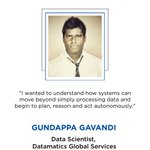
With 14 years across BFSI, data engineering, AI and ML, Gundappa Gavandi, Data Scientist at Datamatics Global Services Limited, chose the Certificate in Agentic AI by IIT Bombay to explore how autonomous decision-making could fit into the solutions he designs. For him, the highlight has been hands-on exposure to agentic frameworks and seeing how the learning connects theory with implementation.
Programme highlights:
Faculty-led curriculum design by IIT Bombay's Department of Computer Science and Engineering (CSE)
Four modules, five months, built for working professionals
Weekly live sessions with guided labs and hands-on projects
Industry-relevant tools including LangGraph, CrewAI, FAISS and Claude Code
One-day optional campus immersion at IIT Bombay
To know more, check out the link below.
bit.ly/4yXAFdN
#GreatLearning #PowerAhead #HumansOfGL #SuccessStory

UT Austin’s AI and Machine Learning Program Review: Sougata Pal on the Curriculum and Learning Experience
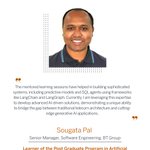
“I am Sougata Pal, a Principal Solutions Architect at British Telecommunications, where I specialize in designing complex solutions for Telecom OSS (Operations Support Systems).
With a foundational B.Tech in Electronics and Instrumentation Engineering, I bring a deep technical perspective to large-scale infrastructure and software architecture.
Beyond my core professional role, I am an active practitioner in the AI and Data Science space. I have extensive experience building sophisticated systems, including predictive models and SQL agents using frameworks like LangChain and LangGraph.
Currently, I am leveraging this expertise to develop an advanced AI-driven customer support ecosystem for FoodHub, demonstrating a unique ability to bridge the gap between traditional telecom architecture and cutting-edge generative AI applications.
At this stage of my career, I wanted to make time to invest in developing new skills and staying future-ready, which motivated me to join the Post Graduate Program in Artificial Intelligence and Machine Learning by the Texas McCombs School of Business at The University of Texas at Austin.
One of my favourite parts of the program has been the curriculum. I found it quite elaborate and extensive. The associations with the universities made it more promising. They are the most important part of the whole curriculum. The mentored learning sessions are not just about following the curriculum, but the mentors have also provided insights, key research papers, and a detailed understanding of the modules. They definitely play a key role in our success.
Their guidance has undoubtedly been of huge help.
This has helped in building sophisticated systems, including predictive models and SQL agents using frameworks like LangChain and LangGraph. Currently, I am leveraging this expertise to develop advanced AI-driven solutions, demonstrating a unique ability to bridge the gap between traditional telecom architecture and cutting-edge generative AI applications.
My advice to anyone considering enrolling in the Post Graduate Program in Artificial Intelligence and Machine Learning is that each topic is very important, so all need to concentrate on all the modules.”
- SOUGATA PAL
Senior Manager, Software Engineering, BT Group
Learner of the Post Graduate Program in Artificial Intelligence and Machine Learning
To know more about the program, check out the link below.
bit.ly/4yXAFdN
#GreatLearning #PowerAhead #HumansOfGL #SuccessStory #AIML #UTAustin

As AI becomes part of every technology role, Sonali Nadkarni wanted to bring it into her own expertise rather than start from scratch.
The Business Intelligence Architect at TCS built that understanding through the Certificate in Agentic AI by IIT Bombay.
Key Highlights:
Faculty-led curriculum design by IIT Bombay's Department of Computer Science and Engineering (CSE)
Four modules, five months, built for working professionals
Weekly live sessions with guided labs and hands-on projects
Industry-relevant tools including LangGraph, CrewAI, FAISS and Claude Code
One-day optional campus immersion at IIT Bombay
Explore the full programme by checking out the link below.
bit.ly/4dS09kG
#GreatLearning #PowerAhead #HumansOfGL #SuccessStory

OpenAI has launched GPT-6 Astra, its latest AI model designed to go beyond answering questions. It can reason through complex problems, use computers, navigate software, and complete multi-step tasks.
But does that mean AGI has arrived? Not so fast. The bigger story may be the shift from AI that responds to AI that executes.
Are you ready for the next era of AI?
Follow Tech Tuesday by Great Learning for more insights into the technologies shaping what comes next.
#GreatLearning #PowerAhead #TechTuesday #ChatGPT #GPT6Astra


