

Sign up for my twice-weekly newsletter, WSJ Economics, here (it's free!): https://xitter.gq/t.co/EBsOw4LSoO
Washington, D.C.
Joined January 2011
- Tweets16.6K
- Following874
- Followers84.3K
- Likes3.3K





Pinned Tweet
1/ Trump called “tariff” the most beautiful word in the dictionary. He somehow made it the most hated word in politics. He has thus endangered would could have been a legacy-defining shift in American trade policy. My column: wsj.com/economy/trade/how-ta…

I wrote in this morning's newsletter: "AI has buoyed the economy and stocks this year, and judging by Wednesday’s rally, investors expect more of the same under a Democratic Congress. My advice: Don’t bet on it." Subscribe here: it's free 😎 wsj.com/econ
Democratic socialists get the attention, but moderates made this week's Democratic majorities. They delivered lion's share of House flips and vastly outperformed Bernie Sanders' Senate candidates. That & more in today's newsletter: wsj.com/politics/elections/a…

Greg Ip retweeted

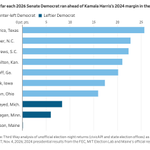
There's a lot to focus on right now, but "The richest man to ever live just spent $200 million to support the Republican Senate candidate in Texas, and his man lost by double-digits in a statewide wipeout" is a completely insane sentence.
Put another way, the most expensive US Senate race before 2020 was $200 million. *One guy* spent that amount in Texas, and it doesn't seem to have made any difference. It might have hurt in a kind of Streisand effect way, in that the spending level was seen as obscene to people sympathetic to the argument that billionaires shouldn't "buy" elections.
The implications here seem pretty interesting! Especially re the limits of billionaire political power and/or the diminishing returns of money in politics.
Greg Ip retweeted

The Dem caucuses in both houses of Congress will be more moderate next term than this one @greg_ip writes wsj.com/politics/elections/a…

"in key areas, Mr. Trump repeated Mr. Biden’s mistake and misread his mandate" @JohnCornyn

Last night, Republicans lost the U.S. House, the U.S. Senate, and my home state of Texas, a conservative cornerstone for more than three decades, because our party forgot the basic rules of coalition politics:
1. Add, don’t subtract
2. Be likeable
3. Do what you promised
4. Character & integrity still matter
Time to turn the page and rebuild. Read my full thoughts in the @WSJ: wsj.com/opinion/republicans-…

"Tariffs have made everything too expensive." -@tedcruz makes me wonder if Ds might get some R votes to repeal Trump's tariffs.

History was made last night.
For months, we were saying that 2026 was the most consequential midterm election of our lifetimes.
Unfortunately, we were right. Sometimes history is to be celebrated; other times, it is to be mourned. Always, it must be reckoned with.
2026 was not simply a blue wave; it was a blue tsunami. It was an ass kicking. It was not simply a bad 2006 midterm election. It was a Watergate-level repudiation. What happened, and why? What are the consequences, and where on earth do we go from here?
When all the votes were counted, the problem wasn’t turnout. Instead, our voters, Republicans, Libertarians, Independents, showed up and voted, and rejected our candidates, voting Democrat instead. We’ve lost the House. We’ve lost the Senate. When all is said and done, we will have lost eight to 10 Senate seats.
We lost in historically red states, like South Carolina and North Carolina, Kansas and Iowa. We lost in purple states, like Michigan, and New Hampshire, and Georgia. And we just barely won by just a single point in bright red states like Florida and Louisiana, and then there’s Texas.
Nowhere are the consequences of this election greater than Texas. In the Lone Star State, we lost every single statewide election. For weeks, I had been publicly warning on this podcast that we were in very real danger of losing everything in Texas. Far too few believed that was possible. I am very, very sorry that it came to pass. Texas has not had a Democrat governor since 1994. We haven’t had a Democrat senator since 1993. Now we’ll have both.
Why were the results so overwhelming? Pundits and analysts will break down the results for weeks or months or even years to come, but several things are already evident today.
Years ago, the very best political advice I ever got was from Heidi. She said, “It’s not about you. It’s about them. It’s about their kids, their families, their hopes, their dreams, their futures.” Too many politicians forget that.
Take the state of Kansas, for example, a state that has not elected a Democrat senator since 1932. It just did. Here’s what exit polling showed were the top issues in Kansas.
Number one, cost of living, energy, and groceries. That was listed as number one by 30.6 percent of voters.
Corruption. Number two, 18.5%.
The cost of the Iran war, 10.1%.
The candidates are terrible, 7.9%.
The Canada trade war, 7.6%.
The GOP didn’t do enough to support Trump, 6.6%.
Republicans didn’t pass the Save America Act, 5.6%.
Trump’s focus on monuments, 5.5%, and data centers and AI, 3.8%.
The top issue, cost of living, is very real. Too many in politics dismissed it. They didn’t understand. They pointed to the macro numbers showing the stock markets soaring, median income at record highs, and poverty at record lows. Those data are true, but they don’t tell all of the story.
Here are some stats that are a lot more real and personal. Spam, Hormel’s processed meat substitute, broke record sales, selling 113 million cans last year. That is nearly as much spam as was sold during the entirety of World War II. 29 percent of Americans have used buy now, pay later for groceries this year. That’s double the share just two years ago.
In August, banks repossessed 42% more homes than they did last year. In 2024, car repossessions topped 2.3 million, above the 2009 peak in the middle of the Great Financial Crisis. In 2025, 6% of 401k holders took hardship withdrawals, paying penalties. That is a record, and triple the norm.
And here’s one that’s really stunning. Americans made more than 75 million paid plasma donations in 2026. That’s another record. That means 200,000 Americans every single day, with a needle in their arm, just to pay for groceries.
That is very real pain from real Americans, and too many Republican politicians seem like they didn’t understand or they didn’t care. Food is too high, gas is too high, diesel is too high, insurance is too high, life is too high.
Tariffs have made everything too expensive, and the Iran war has dragged on too long. It should have been brief, decisive, and over. It needs to end, and we should never, under any circumstances, give the Ayatollah billions of dollars.
There’s a very real economic disconnect. Our K-shaped economy is a yawning divide. Last year, we saw the world’s very first trillionaire, a modern-day Thomas Edison, at the very same time that millions were struggling to feed their families. Data centers being constructed were turning billionaires into centibillionaires, while simultaneously the average American’s electricity bill went up 30% in the last five years.
Understandably, people were pissed off, and elected Republicans didn’t do enough to address their very real pain.
So, what do we do now? We need to listen and respond. We need to champion economic policies that make a real difference in working people’s lives, and we need to deal with the consequences.
Texas is blue. That is a hard sentence to utter. But Texas, today at least, is blue. As we sit here today, I am the only statewide elected Republican who remains in Texas. That’s not something I ever thought I would say.
We can be certain that the Democrats in Austin and in Washington will overshoot. In Texas, they will try to raise taxes dramatically. They may even try to adopt a state income tax, or even a California wealth tax. They will try to shut down the energy industry, destroying jobs across our state. They will embrace the radical transgender agenda. They will persecute those they perceive to be enemies, especially Elon Musk.
And in Washington, they will attack Trump every single day, constantly. Impeachment hearings, subpoenas, his family, cabinet members, business leaders, open persecution, and nonstop retaliation. Make no mistake. Nationally, the radicals are in charge. The communists and the Islamists who have taken over the Democrat Party have now taken over the United States Congress. They will be unleashed.
Sadly, that means many Americans will be hurt. Texans will be hurt. Their assault on business will make Texas a much less attractive place to start or grow a small business. Texas will become more like California if they succeed in halting all new investment into AI.
The economic results will be dramatic. Over $700 billion in new projects are scheduled to start in the next year. If the Democrats shut them all down, our country will very likely go into a recession. That will suit the Democrats just fine. They’ll just blame it all on Donald Trump.
In the next two years, we need to do two things.
One, fight the madness. I will work with Democrats when they’re willing to be reasonable. Last night, I called James Talarico. I congratulated him on his very impressive victory. It was a pleasant conversation, and I told him that I looked forward to working with him to try to benefit Texas.
So, if there are things like flood relief for the Hill Country, or trying to get the space academy to Texas, he and I will work together. But if the newly elected radicals push policies that hurt Texas, raising taxes, destroying jobs, opening the border, releasing violent criminals, threatening our children, undermining our constitutional rights, I will fight with all of my strength to defend Texas and to defend the Constitution.
And number two, we need to rebuild, getting behind policies that directly benefit the constituents we lost.
There’s a complicated story, no doubt, of what happened on Election Day, but as I see it, the key constituencies we lost were blue-collar voters, what had rightly become the core base of our party, Evangelical Christians, who didn’t show up with the same numbers and fervor as prior elections, farmers and ranchers. Tragically, we alienated rural America. Young people, who excitedly had voted Republican in 2024, and who shifted hard blue this cycle. And of course, Hispanics.
For Hispanics, there’s a strong overlap with young people and blue-collar workers. In 2024, just two years ago, I was proud to carry Hispanics statewide in Texas by six points, and we swung the Rio Grande Valley red for the first time in a century. It can be done, but in this election, those Hispanic voters overwhelmingly went back Democrat. We have got to turn that around.
And for young people, we need to be the party of the future. We need to champion policies that expand their future. Our two single biggest legislative accomplishments of the past two years, Trump Accounts and the school choice tax credit, which will unleash tens of billions of dollars in new scholarships for kids, are generationally powerful. I was proud to author both of those transformational policies, and yet too few candidates all across the country ran on that record.
Too few voters were even aware of what we’d accomplished for their kids and their future. But we need to build. We need to expand to continue creating a new investor class for hundreds of millions of Americans, help everyone, every American, become an owner, to have real skin in the game, to create new generations of capitalists ready to reject socialism.
People voted as they did because they were angry. Ironically, the Democrats that they elected are going to advance policies that will make affordability worse. The Democrats want gas prices higher. They want to ban gasoline engines altogether. Their extreme environmental mandates will drive up food prices and the prices of everything else.
But hear me now: we will bring Texas back. I am filled with hope and optimism. Texas will be red again. We have not suddenly become a bunch of tofu-eating, gun-banning, tutu-wearing pinko commie liberals. That ain’t us. Texas is still Texas.
We will rebuild as a true blue-collar party, not by embracing socialism, but by being real free-market conservatives. The way we built the Texas economic miracle in the first place, and we will build and rebuild America as well.
When the zealots overreach, and they will, we will stand ready to lead in the direction of freedom, of prosperity, of safety, and security, and common sense. We will return to a new dawn of freedom in America.
It is dark right now, but it is always darkest before the dawn, and morning is coming. That is my fervent prayer, and that is my commitment to you.
Greg Ip retweeted

Practically no one read this when I published it a couple of months ago but I'm going to immodestly propose that everyone who wants to build a data center or whose livelihood depends on them getting built should read it now:
wsj.com/tech/ai/data-center-…

Greg Ip retweeted

One of the more interesting stories from yesterday will be how Florida and Texas - two states with similar political climates - ended up with such different results. A big part of that comes down to the GOP leadership in each. There were missteps in both, but...
One state kept at least a slight buffer of regional independence from the White House's political operations, succeeded in keeping sleaze like Fishback off its ticket, kept state and local government focused on relatively conventional conservative issues, and managed to keep enough Hispanic voters in the coalition to win.
The other state tried to turn itself into MAGA central, tried to import JD Vance style economic populism into a part of the country that wanted nothing to do with that, made sleaze like Paxton the face of its statewide campaign, and actively drove Hispanic voters (as well as other minorities as per Bo French) out of the coalition by sticking them in the eye in the months before the election.
Greg Ip retweeted

WSJ's @greg_ip : Health insurance is the sleeper inflation issue: wsj.com/finance/investing/he…

Greg Ip retweeted

a big reason why i expect the new congress’ agenda to feature a lot of “affordability” measures, by way of ACA premium subsidies, broader medicaid eligibility, and expanded tax credits.

Health insurance is the sleeper inflation issue. Premiums up 5%, contributions even more; could explain sub-par wage growth. Plus, thoughts on Bill Nordhaus; @jasonfurman and Goldman on AI in my newsletter today: wsj.com/finance/investing/he…


Eyeballing this, what stands out to me is that all the top sites ChatGPT references are free sites. The first truly paywalled site here is New York Times, at #10.

Yesterday, I asked 8 chatbots the same question 20 times: “What should I know about the US Senate race in Michigan?” and stored the responses, including the referenced URLs.
Partly I wanted to know which sources are cited, but if users rarely click on links to check what sources say then what really matters is that sourced citations have been read and processed (and a chatbot might be summarizing them on the spot, depending on how exactly the search feature is built and deployed).
Overall, chatbots drew mostly on credible, recent reporting which I thought was reassuring. As long as local media still exists, it seems very good that it gets cited:

Greg Ip retweeted

It's been the trade since WWII. With wages frozen, the War Labor Board ruled in 1943 that employer insurance payments weren't wages, and the 1954 tax code made them tax-free for good. So pay comes partly as premiums, and when premiums jump, the raise is what shrinks.
Health insurance is the sleeper inflation issue. Premiums up 5%, contributions even more; could explain sub-par wage growth. Plus, thoughts on Bill Nordhaus; @jasonfurman and Goldman on AI in my newsletter today: wsj.com/finance/investing/he…
Greg Ip retweeted

I can't tell if people think the pre-Trump GOP is returning, or if America is going to become a one-party state, but honestly neither of those things is likely to happen.

Greg Ip retweeted

The NYT and WSJ — the two major destination news publishers with stable, profitable business models — are going to have even more insane moats as social/search traffic enters its final death spiral.

Reddit call was absolutely fascinating. Everyone should listen to it as a bellwether for where the internet is going
- AI Mode is increasingly default Google experience
- AI Mode provides rich info and data in line, less incentive to leave search
- AI Mose incentivizes dialog, Google wants to keep you engaged to serve more ads at each turn
- Google will milk search for as much revenue as possible as they transition from a search company to a cloud service and chip company
- As traffic from humans becomes more scarce this will put Google in an increasingly adversarial position to the rest of the internet
- This is a massive headwind to all media type companies who are not destinations
- This is a massive headwind to all content-driven go-to-market motions especially in the SMB. You have seen companies like HubSpot and Monday.com get crushed by this funnel collapse
We are entering the end game - a knife fight for the remaining and dwindling volume of human traffic on the internet

Greg Ip retweeted

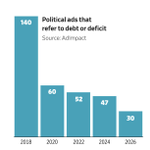
Good - yet depressing - article. Neither party can run on deficit reduction because their own record is terrible.
These politicians are following voters who want endless tax cuts & spending hikes and will vote out anyone who dares to stop the debt binge.
wsj.com/economy/fiscal-hawks…

Greg Ip retweeted

All of these countries have access to the same LLMs.
This raises the likelihood that what’s behind the US productivity boost is less about AI-augmented task productivity & more about something else like mechanical AI capex effects… or something besides AI entirely.
This quoted post is unavailable.
"Bear food" @carlquintanilla


