

Ecological entomology research at Faculty of Science @science_charles and @BiologyCentre, Czech Republic. Led by @RobertTropek #ICEG
Czech Republic
Joined October 2018
- Tweets392
- Following528
- Followers843
- Likes987



Insect Community Ecology Group retweeted

Want to conserve #birds, #mammals and other vertebrates? Then don’t forget their #insects. Our new Nature Reviews Biodiversity paper explores the many ways vertebrates depend on insects, for food, shelter, protection and much more - read about it here: jeffollerton.co.uk/2026/09/3…

An English press release is available here: natur.cuni.cz/en/news/12134
Tiskovou zprávu v češtině najdete zde: natur.cuni.cz/aktuality/1213…
Why does this matter? Climate change can alter where species occur and when plants flower or pollinators are active. We did not test future changes directly, but our results suggest that pollination networks will not all respond in the same way. 8/8

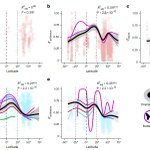
The strongest common thread was climate. Temperature and rainfall were generally better-supported predictors of specialisation than latitude, biodiversity or ecosystem productivity. Yet their effects were nonlinear and differed greatly among pollinator groups. 7/8

Nor was there one pattern for all pollinators. Bees, hoverflies, butterflies, moths and birds showed distinct geographical trends, often with several local peaks and dips. Lumping them together would hide much of this ecological variation. 6/8
The classic expectations were not supported. Specialisation neither consistently increase towards the Equator, nor towards the poles. Network-level and pollinator specialisation often peaked around 20–30° N, near the tropical–subtropical boundary. 5/8

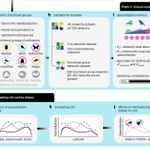
Besides the data size, we treated limits of previous studies: controlled sampling completeness, separated community-wide networks from group-focused ones, and analysed plants and pollinator groups separately. This distinguished broad trends from group-specific responses. 4/8

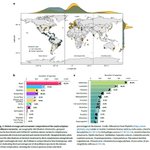
To test this, we compiled 3,415 quantitative networks with >110,000 links among 5,343 pollinator and 6,126 plant species across all major terrestrial biomes. The study brought together 142 researchers from 32 countries. 3/8

Specialisation is an evolutionary bargain. A close match can make feeding and pollen transfer highly efficient, but it also creates dependence on particular partners. Ecologists have long expected such close relationships to be especially common in the tropics. 2/8

New study published in @NatureEcoEvo!
We assembled the largest global dataset of plant–pollinator networks to ask a simple question: do interactions become more specialised towards the tropics? doi.org/10.1038/s41559-026-0…
Study led by @SaileeSakhalkar @RobertTropek 1/8

We (@RobertTropek @MichalBartak2 ) have participated in this huge international study on butterfly range shifts on the global scale. Just published in @NatureEcoEvo, led by @shawan_c
#climatechange #biodiversity #butterflies
xitter.cf/shawan_c/status/208530…

Our new @NatureEcoEvo paper documents range shifts in 1,758 butterfly species across 105 countries, primarily due to climate change.
🦋80% expanded
🦋27% contracted
🦋22% shifted elevation
🦋342 showed multiple shift types.
doi.org/10.1038/s41559-026-0…
@MonashBiol @Monash_Science

Insect Community Ecology Group retweeted

I am very proud and honoured that one more moth species, Sineviella tropeki, was dedicated to me! Together with Sineviella maicheri, dedicated to my former student Dr. Vincent Maicher.


Insect Community Ecology Group retweeted
🏠🐝Hmyzí hotely: pomoc opylovačům, nebo jen dobře vypadající dekorace?🐝
Sepsali jsme o tom delší text na @Ekolist_cz, včetně rad, kde ho (ne)koupit, jak ho nejlíp udělat a umístit.
🧵Odkaz a shrnutí ve vlákně níže⬇️

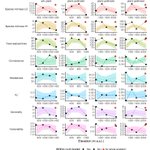
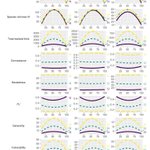
Empirical elevational networks partly follow these MDE predictions, but also show clear deviations.
👉 Mid-domain effect matters, although biology leaves a major fingerprint. Ignoring MDE risks misinterpreting null patterns as biological signals.

Our null-model simulations show that MDE alone can generate strong structure:
- unimodal peaks in realised links, generality and vulnerability
- U-shaped patterns in connectance and often nestedness
All emerging from geometry, not biology...

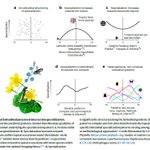
If species overlap most in the middle of a gradient, interactions among overlapping species should too. Under MDE alone, network metrics are predicted to show unimodal or U-shaped patterns, even without any niche differences or environmental filtering.

New preprint on interaction networks!
Do network characteristics peak mid-gradient, similar to species richness, due to simple geometry: the mid-domain effect (MDE).
We test this using simulations and real plant–pollinator and ant–plant networks.
doi.org/10.64898/2026.01.28.…

Insect Community Ecology Group retweeted
Podcast @Akademie_ved_CR o opylování, hmyzu, výzkumu, i mužích na rodičovské dovolené...
avcr.cz/cs/pro-verejnost/akt…
(samozřejmě k nalezení i v podcastových aplikacích)
Take-home message: upslope range shifts under climate warming won’t automatically mean successful reproduction. Near mountaintops, plants face a double bottleneck – fewer pollinators and physiological limits. Pollination + climate must be considered together.