

Adore heavy metal music and Gravity. Period.
Joined October 2018
- Tweets9.7K
- Following418
- Followers154
- Likes1.5K


Cynic Metalhead 🎯 retweeted

Pasajera musulmana: —Disculpe, ¿podría apagar la música?
Taxista:
—¿Por qué?
Pasajera:
—La música es haram (prohibida).
Taxista:
—¿Por qué es haram?
Pasajera:
—Porque no había música en la época del profeta Mahoma.
Taxista:
—Bueno, bájese entonces. Tampoco había coches en aquella época. Vendrá un camello a recogerla.
😂🤭😂


Cynic Metalhead 🎯 retweeted

Pro Pally "current thing" NPC's are asked two simple questions.
Their replies are very telling.

Cynic Metalhead 🎯 retweeted

⭕A short while ago, the IDF & ISA struck a senior Hamas terrorist in Gaza. Details to follow.
Cynic Metalhead 🎯 retweeted

The Voyagers Will One Day Fall Silent. But Their Journey Is Only Beginning
One day the radio signals from Voyager 1 and Voyager 2 will disappear for good. The transmitters will fall silent — not because the spacecraft break, but because the energy still being produced by their plutonium generators will no longer be enough even for a faint signal. The probes themselves, however, will not stop. They will continue flying through the Milky Way for tens of thousands of years.
The last drops of power
Both Voyagers are powered by radioisotope thermoelectric generators. Each loses roughly 4 watts of power per year. After nearly 50 years in space, NASA engineers face an increasingly difficult choice: what else can be switched off so that the rest can last a little longer.
In April, Voyager 1’s low-energy charged particle instrument was turned off. In July, three systems were shut down on Voyager 2, with their functions transferred to more efficient ones. Thanks to these measures, the remaining scientific instruments (the magnetometer, plasma wave detector, and, on Voyager 2, the cosmic ray detector) should continue operating for at least another year.
The cameras have long been dead: on Voyager 1 they were switched off on February 14, 1990, after the famous series of images that included the “Pale Blue Dot.” We will never receive another photograph of Earth from them.
When true silence comes
Contact has already been lost before. In 2023 a memory chip failed on Voyager 1 and the spacecraft sent unintelligible data for months. Engineers rewrote the code into other memory areas and restored communication. In October 2026 the probe missed two scheduled sessions because of a thruster failure — a backup system took over.
From now on, any pause will be a mystery: has the power run out? Has the antenna drifted away from Earth? Or has something else broken? A signal takes almost a full day to reach Earth, so even a simple check takes days.
The eternal journey
When the transmitters fall silent, the spacecraft will not stop moving. Voyager 1 is leaving the Sun at about 61,000 km/h. It will take roughly 300 years to reach the inner edge of the Oort cloud, and about 30,000 years to cross it completely.
In roughly 40,000 years Voyager 1 will pass within 1.7 light-years of the star Gliese 445. Around the same time Voyager 2 will come within a similar distance of Ross 248. Even at the point of closest approach, each probe will still be about 16 trillion kilometers from its respective star.
A message that will outlive the silence
Each spacecraft carries a copper disc coated in gold. On it are images, music, sounds of Earth, and greetings in 55 languages. NASA even included a stylus and instructions for playback. The grooves on these records can preserve their information for thousands of years after the probes themselves have become cold, silent pieces of metal.
Two spacecraft launched in 1977 will one day fly past other stars, carrying with them the sound of Earth’s ocean waves recorded long ago. And even if no one ever finds them, they will remain humanity’s most distant emissaries.
Cynic Metalhead 🎯 retweeted

Wow. Tom Jackson came to ESPN three weeks ago to surprise Chris Berman.
ESPN captured it all.
Berman, in tears: "It was the last time we saw him."
Get your tissues for this. 🥹

Cynic Metalhead 🎯 retweeted
The Voyagers Will One Day Fall Silent. But Their Journey Is Only Beginning
One day the radio signals from Voyager 1 and Voyager 2 will disappear for good. The transmitters will fall silent — not because the spacecraft break, but because the energy still being produced by their plutonium generators will no longer be enough even for a faint signal. The probes themselves, however, will not stop. They will continue flying through the Milky Way for tens of thousands of years.
The last drops of power
Both Voyagers are powered by radioisotope thermoelectric generators. Each loses roughly 4 watts of power per year. After nearly 50 years in space, NASA engineers face an increasingly difficult choice: what else can be switched off so that the rest can last a little longer.
In April, Voyager 1’s low-energy charged particle instrument was turned off. In July, three systems were shut down on Voyager 2, with their functions transferred to more efficient ones. Thanks to these measures, the remaining scientific instruments (the magnetometer, plasma wave detector, and, on Voyager 2, the cosmic ray detector) should continue operating for at least another year.
The cameras have long been dead: on Voyager 1 they were switched off on February 14, 1990, after the famous series of images that included the “Pale Blue Dot.” We will never receive another photograph of Earth from them.
When true silence comes
Contact has already been lost before. In 2023 a memory chip failed on Voyager 1 and the spacecraft sent unintelligible data for months. Engineers rewrote the code into other memory areas and restored communication. In October 2026 the probe missed two scheduled sessions because of a thruster failure — a backup system took over.
From now on, any pause will be a mystery: has the power run out? Has the antenna drifted away from Earth? Or has something else broken? A signal takes almost a full day to reach Earth, so even a simple check takes days.
The eternal journey
When the transmitters fall silent, the spacecraft will not stop moving. Voyager 1 is leaving the Sun at about 61,000 km/h. It will take roughly 300 years to reach the inner edge of the Oort cloud, and about 30,000 years to cross it completely.
In roughly 40,000 years Voyager 1 will pass within 1.7 light-years of the star Gliese 445. Around the same time Voyager 2 will come within a similar distance of Ross 248. Even at the point of closest approach, each probe will still be about 16 trillion kilometers from its respective star.
A message that will outlive the silence
Each spacecraft carries a copper disc coated in gold. On it are images, music, sounds of Earth, and greetings in 55 languages. NASA even included a stylus and instructions for playback. The grooves on these records can preserve their information for thousands of years after the probes themselves have become cold, silent pieces of metal.
Two spacecraft launched in 1977 will one day fly past other stars, carrying with them the sound of Earth’s ocean waves recorded long ago. And even if no one ever finds them, they will remain humanity’s most distant emissaries.
🤖 Made with AI
Cynic Metalhead 🎯 retweeted

AI may have cracked the math problem that towers above all others: the Riemann Hypothesis. Here’s a brief summary of this amazing news.


Cynic Metalhead 🎯 retweeted
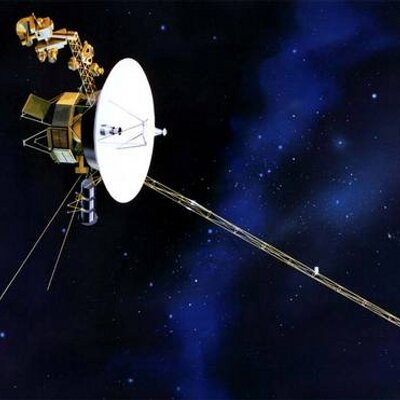
Sister ship Voyager 1 is currently ~24h 00m 00s of light travel time from Earth, or 25,902,000,000 km / 16,095,000,000 mi / 173.145 AU (2026:322:120000:1L) ONE LIGHT-DAY from Earth! …
Cynic Metalhead 🎯 retweeted
For those of you watching and waiting, the time is NOW. Sister ship Voyager 1 reached one light-day distance from Earth at 10:16:07 UTC today, in 2026. V1 will be one light-day _from the Sun_ on February 4, 2027. Why the difference? Because Earth is currently orbiting on the near side of the Sun, and so is closer (for now).
Because Voyager 2 lost speed during the Neptune encounter, it will take longer to reach these milestones: one light-day from the Earth on November 1, 2035, and one light-day from the Sun on November 27, 2035.
Cynic Metalhead 🎯 retweeted

Nov. 18, 2026, 5:16am EST
The Voyager 1 spacecraft has reached a distance of one light-day from Earth.
Cynic Metalhead 🎯 retweeted

Voyager 1 just reached a light-day in space, but Voyager 2 won't do the same until 2035, due to speed choices made throughout their 50-year missions. space.com/space-exploration/…

Cynic Metalhead 🎯 retweeted

On 18 November 2026, NASA's Voyager 1 will become the first human-made object to reach a distance of one light-day from Earth, approximately 25.9 billion kilometres.
Launched on 5 September 1977, the spacecraft's signals will now require a full 24 hours to reach us.

Cynic Metalhead 🎯 retweeted

Today is the day! 💫 Tonight, after sunset, join people around the world in sending a signal skyward to celebrate Voyager 1's incredible journey and its milestone of reaching one light-day from Earth.
Learn more: go.nasa.gov/4zpgtS0

Cynic Metalhead 🎯 retweeted

Let's talk about Voyager 1 and 2!
Join us Nov. 19 for a status update on the twin probes and a discussion of their unique mission. Plus, we'll have a Q&A session and a sneak peek at the upcoming NASA+ Voyager documentary. go.nasa.gov/4k942pz

ALT An artist's concept of the Voyager spacecraft, with its long antenna pointing down and to the right in the direction of Earth. Earth isn't visible in the image, but Voyager is among the stars. In the background, there is also a long, deep blue ribbon of gas and dust stretching from the bottom of the image to the top.
Cynic Metalhead 🎯 retweeted

In 1977 @NASA launched Voyager 1, currently traveling at 38,000 mph. Hailing from beyond all the Sun’s planets, on Nov. 18, 2026, Voyager reaches a distance of exactly 1 Light-Day from Earth.
Before you get too excited by this, the Sun's nearest stars are Light **Years** away.
