

Designers and producers of historical games | Published by @HandGLab | Subdivision of @HCAatEdinburgh based at @EdinburghUni
Edinburgh, Scotland
Joined May 2021
- Tweets435
- Following119
- Followers130
- Likes162




Pinned Tweet
Here is where to find our two Lion Rampant expansions.
You can find samples by following the links to the electronic copies on DriveThruPRG below.
Lion Rampant: A Viking in the Sun. The Mediterranean Adventures of Harald Hardrada:
E-Book: drivethrurpg.com/product/366…
@HandGLab


History and Games Lab Productions retweeted

Afternoon everyone 🙂 This particular Wip Wednesday is now complete and there are only four days left on the Modular Arabic Shrine Kickstarter. Still plenty of time though to get the lower pledge and some add-ons 👍
kickstarter.com/projects/mod…


However, maqams come in all shape and sizes, which is what inspired the modularity of our project.
@HandGLab


The main inspiration for pledge 2, the Extended Shrine, comes from the biblical Rachel's Tomb as it looked between the 11th century and the Ottoman era. The other images below are from the lost maqam of Nabi Samit (destroyed in the 1950s) and that of Nabi Musa.


However, the most famous ones are those attached to biblical figures (thus attracting worshipers across religious divides).
Graveyards often tended to build around them.


They could mark traditional holy places whose origin was lost in time (probably dating back to the pre-Christian and pre-Islamic periods), or mark the tombs of local holy men.
Maqams were often attached to local folk religious practices that did not necessarily belong to one specific religious group.
What is interesting about maqams is that they were usually shrines and were very common in the Holy Land. In rural areas, these were often the only local religious site.
As mentioned in previous posts, these structures take different names in different areas of the Arabic world. The term used in the Middle East is maqam, which means 'station', or 'the place where one stands'.


After Sicily, Maghreb, and Spain, we finally get to the Holy Land, where this project's idea started! After this one, there will be a final post on Iran and Central Asia.
@HandGLab
THE HISTORY BEHIND THE MODULAR ARABIC SHRINE PROJECT 3: MIDDLE EAST AND HOLY LAND
You can find the Kickstarter campaign here: kck.st/44hYf6D


Since it was a new idea, I used some pieces that were not already painted, but that is also useful to show you how the pieces look like when you receive them in August.
Indeed, the plan is for deliveries to be done this summer.
@HandGLab @OSHIROmodels

It's a very good example of the flexible modularity of the project.
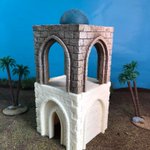
With the add-ons, which include closed walls and a smaller arch-door, one can unleash the imagination and create a variety of different structures that are not necessarily shrines.


I had not thought about that before and it works well! The one with the open arches on top would be perfectly good for fantasy games in general, including a Lord of the Rings-themed one if you remove the dome.


That inspired some toying with the modular pieces of the Kickstarter project, which you can find here: kck.st/44hYf6D
MODULAR TOWER SHRINE!
While writing the post on examples from Maghreb and Al-Andalus, I came across a TOWER shrine from Morocco. #thread
@HandGLab @OSHIROmodels

Apart from medieval wargaming, other popular periods that can use these structures in that area are The Peninsular War and WWII, among others.
@HandGLab @OSHIROmodels
kickstarter.com/projects/mod…
These two structures are quite similar to the Simple Shrine/Pavillion pledge, showing how you can use them both as isolated structures or as part of larger sites, even within a castle!


The other example is from Debdou, in Eastern Morocco, located on the outskirts of the local settlement. It has some scattered tombs around it too.
