

Crypto is my first love, an early believer, ContentCreator | moderator | artist | gamer | choosing the red pill of real vibes over fake shills
Joined November 2021
- Tweets60.4K
- Following3.1K
- Followers4.5K
- Likes92.7K




Pinned Tweet
Strium is the quiet one in the Startale lineup, and the reason is simple, there is still nothing to use
That is exactly why i wanted to write about it
It is a layer 1 built with SBI Holdings for trading tokenized securities and real world assets, 24/7 spot and derivatives markets, equities included
The brand went public in february
Their site today still reads testnet launching soon, with a waitlist to join
Almost nine months of that is a long time in this industry
Their own phrasing is building robust infrastructure rather than rushing to production, which reads differently when your partner is a financial group like SBI
Two choices in that announcement stayed with me
The first is where Strium sits in the stack
It is built as the exchange layer, the place trading and settlement happen, and the announcement describes scalable global access without the constraints of direct asset issuance or custody
A lot of RWA projects pitch owning the whole pipeline, and this reads like a deliberate step back from that
The second is one line about AI agents
The architecture is meant to let agents take part in markets, run strategies and interact with onchain liquidity directly
Next to securities trading that stops being a buzzword
An agent trading tokenized equities around the clock needs a venue that never shuts, which is the thing they are building
Behind it sits SBI's ecosystem of more than 80 million existing customers
That number is what makes the slow pace make sense to me
You get one first impression with a distribution channel that size, and a securities venue that breaks on day one does not get a second
Nothing to touch yet, just a waitlist
A chain for securities that takes its time is a chain i would rather see take its time
@StartaleGroup

Hellish retweeted
The robot's brain just moved into a smaller apartment
PrismaX squeezed their π0.5 robot stack from about 22 GB of GPU memory down to 11.2 GB
π0.5 is Physical Intelligence's robot model, and it's what PrismaX ran in their IROS demo
Why bother?
The RTX 5090 Mobile they've been running it on is getting rarer every week
And 24 GB laptop cards in general are getting harder to find
Think of GPU memory as the desk the model works on
The model itself only needs about 7 GB of that desk
Yet the stack was taking up around 22
First, the loading code built a full size random copy of the model before the real one arrived
Like building cardboard furniture just to throw it out when the real furniture shows up
Second, they kept the original model in memory next to the faster compiled version
Like keeping every moving box after you've already unpacked
Two fixes, about 10 GB freed
They call them quirks, not bugs, and they swear they mean it
Now it fits on 16 GB cards like the RTX 5080 and 5070 Ti
They even expect the desktop versions to run a bit faster than the old laptop setup, thanks to higher power limits
What i like here is the direction
A robot brain that runs on hardware people can actually buy
The updated code is in their prism pi repo
@PrismaXai
Hellish retweeted
Strium is the quiet one in the Startale lineup, and the reason is simple, there is still nothing to use
That is exactly why i wanted to write about it
It is a layer 1 built with SBI Holdings for trading tokenized securities and real world assets, 24/7 spot and derivatives markets, equities included
The brand went public in february
Their site today still reads testnet launching soon, with a waitlist to join
Almost nine months of that is a long time in this industry
Their own phrasing is building robust infrastructure rather than rushing to production, which reads differently when your partner is a financial group like SBI
Two choices in that announcement stayed with me
The first is where Strium sits in the stack
It is built as the exchange layer, the place trading and settlement happen, and the announcement describes scalable global access without the constraints of direct asset issuance or custody
A lot of RWA projects pitch owning the whole pipeline, and this reads like a deliberate step back from that
The second is one line about AI agents
The architecture is meant to let agents take part in markets, run strategies and interact with onchain liquidity directly
Next to securities trading that stops being a buzzword
An agent trading tokenized equities around the clock needs a venue that never shuts, which is the thing they are building
Behind it sits SBI's ecosystem of more than 80 million existing customers
That number is what makes the slow pace make sense to me
You get one first impression with a distribution channel that size, and a securities venue that breaks on day one does not get a second
Nothing to touch yet, just a waitlist
A chain for securities that takes its time is a chain i would rather see take its time
@StartaleGroup
Hellish retweeted
Picture a notary who opens your bank letter, reads one line, and signs that it's real without seeing anything else on the page
That's roughly what @primus_labs does for internet data
Primus (formerly PADO) is a cryptography team building a verification and privacy layer for onchain finance and AI agents. it doesn't launch a new chain, it plugs into the ones people already use, with BNB Chain as its main base right now
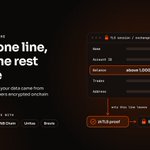
The first tool is zkTLS. every site you open runs over TLS, the padlock in your browser bar. zkTLS turns that session into a proof, so an app can check a fact from your exchange, your bank or X without ever touching your password or your full account
And the proof can be picky. instead of showing your balance, it can confirm the balance is above 1,000 and reveal nothing else
The second tool is FHE, fully homomorphic encryption. think of a calculator that works on numbers locked in a safe and hands back a locked answer. balances and transfers stay encrypted while the math still runs
What got my attention is that this already runs in production. on BNB Chain, the Confidential Vault lets you shield a stablecoin into an encrypted version, then send it or earn yield through Unitas without your amount showing up. over $1M went in during the first 24 hours
Their zkTLS also powers live Proof of Reserve for Unitas USDu, built with Brevis, and ZKredit lets a lender confirm you've kept an exchange account for three years without seeing a single number
I also like where they draw the line. they're not hiding who you are, they're hiding how much. in the vault, each batch total stays public while every person's share stays encrypted
The team is research first too. CEO Xiang Xie has papers at USENIX Security in 2024 for zkTLS and in 2026 for verifiable FHE, which you don't often see from a crypto infra team
Public chains made everything visible by default. Primus is trying to keep data useful without making it public, and that's the part i'll keep digging into
Happy 6th RedStone 🎂 Six years ago it was crypto prices, now it's tokenized funds, trade finance and even sanctions lists. Every asset coming onchain this decade will need a number it can trust, glad it's you doing that job
@redstone_defi


Optional is easy. Required is a different conversation.
News from last week's mainnet launch: ether.fi moved optimum's mump2p from optional to standard. All 12 of its node operators now have to run it
If you're new here, mump2p is optimum's extra delivery route for Ethereum blocks. It runs next to Ethereum's normal network and gets blocks to validators sooner
Picture a delivery company telling every driver to use a new route app. Nobody does that on a hunch. If the app is bad, every single delivery suffers
Rok Kopp, ether.fi's cofounder, put it plainly: "We don't mandate new infrastructure across our entire validator set unless we're confident it raises the bar for our stakers and for the network"
Numbers tell you something is fast. A staking provider making it the default tells you they trust it with their stakers
Blockdaemon's Dan Spina said it another way: "Validator performance is a game of margins, and the ones you can control are worth chasing"
And the list keeps growing. The launch release named 16 operators. Optimum's homepage now shows 20 mainnet partners and $5.5B of ETH stake boosted, up from $3.4B in the launch post
I've followed optimum for a long time, and this is the kind of proof I was waiting for. Not a new chart, a big operator making it the default
@get_optimum

Hellish retweeted
Five big companies report in the next 48 hours. Before any of them do, I wanted a record of where the money is sitting, so I asked @coinvestai .
Here's the ledger. Profitable traders first, the crowd second.
$MSFT, Wednesday after close: 61% long / 28% long
$GOOGL, Wednesday after close: 52% / 47%
$AMZN, Thursday after close: 54% / 46%
$COIN, Thursday after close: 40% / 70%
$MSTR, Thursday after close: 57% / 41%
Two of these are worth staring at.
Microsoft has the crowd mostly short and the winners mostly long. Coinbase is the exact reverse, crowd long and winners short. A day apart, opposite setups.
Then there's Amazon, where nobody looks worried until you get to the top. Every bracket under $1m is at least 58% long. The two biggest positions, about $9m between them, are both short.
One thing that muddies it. The Fed decides on rates Wednesday afternoon, a couple of hours before Microsoft and Alphabet report. So if those two move, not all of it will be earnings.
I'm not calling any of these. Earnings are coin flips with a press release attached.
But I'm saving this and coming back Friday to see which side got paid. If the winners were right on both Microsoft and Coinbase, that's worth knowing. If they weren't, that's worth knowing too.
@liquidtrading
Hellish retweeted
On @SeismicSys, the difference between a balance everyone can see and a balance nobody can see is one letter.
uint256 balance;
suint256 balance;
Same line of code. the second one has an s in front, and that s means "keep this private".
Of all the Seismic stuff I've written about, this is still one of my favorite things to explain.
That's it, that's the trick
Developers build their apps the same way they always do. when something should stay private, like a balance or a payment amount, they add that one letter.
The chain does the rest. it keeps that value locked away and only opens it inside secure hardware that even the person running the machine can't look into.
Even the answers stay private
Say an app checks "does this person have more than $500?" on a private balance. the answer stays private too. nobody watching sees a yes or a no.
What the s can't hide
I like that Seismic's docs are honest about this part. a few things still show:
The amount attached to a transaction itself is always public
A number typed straight into the code can be read by anyone
If an app acts differently depending on a secret answer, the cost of that action can give the answer away, like a poker player's tell
If a developer turns a private value back into a normal one, it's visible from that moment
The docs spell all of this out, and the tools even warn developers about some of it.
My take
One letter gives you the privacy. knowing these few traps is how you keep it.
Hellish retweeted
Your robot has a body, and the data has to fit it
PrismaX is heading to CoRL 2026 in Austin, November 9 to 12, Booth 1100
CoRL is the Conference on Robot Learning, where people training robots swap notes every year
The line in their announcement i keep coming back to is "on your embodiments"
Embodiment sounds fancy but it just means the robot's body
Its arms, its grippers, where the cameras sit, how every joint moves
Think of learning to drive in a friend's car and then getting into your own
Same road, same rules, but the seat, the mirrors and the pedals all sit a little differently
For a robot, that small difference can be the whole task
That's the idea behind what they're bringing to Austin
You tell them the tasks, the robots and the scenes you need, and they collect data to that spec
Their Enterprise plan already supports 12+ robot arm types
Plenty of booths will be showing off a robot
PrismaX is showing up with the data side, and that's the conversation i'd want to be in
If you're going to Austin, Booth 1100 is worth a stop
@PrismaXai
Hellish retweeted
Startale put bridging straight inside their app this week
Bridging is where onboarding usually dies
You hunt for the right bridge site, you check twice that it is not a fake one, you copy a contract address, you send, you wait, you refresh
Now it sits in the app
Open deposit, tell it where your funds are sitting right now, send to the address it shows you
It brings them to Soneium for you, usually in a couple of minutes
The sign in options are the part i keep pointing at
Google or LINE, or a wallet you already use
LINE lands differently if you know japan
It is the messenger the country actually runs on, and putting it next to Google as a sign in says plainly who this was built for
A smart wallet gets created for you in the background
Connect something like metamask and it gets linked to that smart wallet rather than replaced
Three things worth knowing before you try it
$10 minimum per deposit through the bridge flow
Funds sent from ethereum land in your app wallet on ethereum first, then you swap them onto Soneium
Small swaps look awful because the network fee stays flat regardless of size, so move one larger amount instead of several tiny ones
Nobody is going to screenshot this update
But every chain that got ordinary people onchain did it by deleting steps exactly like these, quietly, one at a time
Next one is strium, the separate chain they are building with SBI for tokenized stocks
@StartaleGroup
Hellish retweeted
For months, every optimum post I wrote came with a small asterisk. Testnet. Rolling out. Soon.
That asterisk is gone now. Their first mainnet deployment, mump2p on Ethereum, is live
They posted the numbers last week, and a few of them are worth slowing down for
16 node operators are already boosting their stake with it. Optimum counts $3.4B in what it calls Total Value Boosted, and names Blockdaemon, Everstake and ether.fi's validators among its partners
Across 50,292 slots, blocks reached nodes 335ms sooner than on Ethereum's standard network. That's 3.3x faster
335ms sounds like nothing. But validators only get a few seconds to see a new block and vote on it, so a head start changes a lot
One operator shared a good example. Validators vote on which block is the newest, and when a block shows up late, some vote for the old one by mistake. Comparing a week before and a week after switching it on, those wrong votes dropped by 51%
Think of a referee who gets the replay late. They still make the call, just wrong more often. Send the replay sooner and the calls get better
What I like: receiving blocks faster is free for every Ethereum validator. Optimum calls it Signal, and you set it up yourself through their console
Bigger operators with at least 200 validator keys can also use Accelerate, which speeds up the sending side too
As Muriel Médard put it, all of this works "without asking Ethereum to change a single consensus rule"
Next up, they say: Accelerate for trading firms, and more chains soon
I've written about this project for a while. Feels good to type mainnet without the asterisk
@get_optimum
Hellish retweeted
Two of the biggest private companies in the world have live markets you can trade right now. OpenAI and Anthropic. Neither one has listed.
Before anyone gets excited, these are not shares. They're perpetuals tied to the pre IPO valuation, so you're trading the price. You don't own any part of the company and you can't convert it into equity later.
OpenAI: $1,425, with $7m of open interest
Anthropic: $1,905, $47m
Close to 3,000 positions open on Anthropic alone, and most of them are accounts under $1,000.
Both filed confidentially this year. Anthropic went first, OpenAI is reportedly waiting until 2027.
If you want to see what happens when one of these actually lists, SpaceX already did it. Went public in June, closed its first day at $161, and sits at $148 now.
The part worth looking at is who sits on which side, and Anthropic is where it gets interesting.
Accounts between $100k and $2.5m are heavily short. One of those brackets is 0% long, meaning every position in it is a short. But the three biggest positions, holding $20m between them, are 80% long.
So the mid sized money thinks it's expensive and the largest money thinks it isn't.
I don't have a view on who's right. Pre IPO valuations are guesswork at the best of times, and leverage is capped at 6x on both, which tells me they're treating it carefully too.
I've been covering Liquid for months and this is still the corner that surprises people the most.
@liquidtrading