

AI is everywhere. Humanity is everything.
Joined November 2026
- Tweets13
- Following0
- Followers144
- Likes34


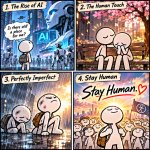


Humanity is becoming more valuable every day. ❤️

‘Human’ beat ‘agent’ as Cambridge dictionary word of the year. It’s a grim reminder of our current reality. | Nadeem Sarwar, Digital Trends
Cambridge Dictionary has selected “human” as its word of the year for 2026, and it’s quite a grim reflection of the reality we’re currently living in. In its official announcement, the folks behind the dictionary noted that the rise of AI content across every domain of our lives has given us a newfound appreciation for the human touch.
AI slop is making the human touch more valuable
The blog post even mentioned the term “AI slop,” the colloquial label for low-quality text or visual content generated by AI models. If you go into any digital community, or even chat about AI with a group of human creatives, the word “slop” comes up frequently, and for good reason. AI is extremely good at imitating human work, whether it’s text, art, music, or even video, and it can do so at an unprecedented scale. That, in turn, has pushed businesses to adopt AI to speed up their output at a lower cost, at the expense of human workers and the human touch.
Some call AI content soulless, others call it a stolen replica of human ingenuity, while the rest simply have a disdain for it in general, because it has now proliferated into every corner of our digital lives, injecting an endless barrage of content across social media platforms that has become simply impossible to avoid. The Cambridge blog post notes that this shift could simply be a natural linguistic development reflecting the ubiquity of AI, but it could also be evidence of something more interesting: a turning point in our attitude toward artificial intelligence.
AI agents and the growing appeal of analog tech
Other words in contention for Cambridge Dictionary’s word of the year included “agent,” which broadly refers to an AI system that can perform tasks autonomously or semi-autonomously. Nearly every major AI lab is now offering agentic AI products, and in some cases, they’re available for free. Google offers Gemini tasks, ChatGPT offers Dots, Claude maker Anthropic serves Duet, and Elon Musk’s Grok Bot is also fairly popular these days.
“Analog” was another word in contention, and once again, it reflects our daily reality, where digital elements and interfaces have overwhelmingly taken over at the expense of physical controls. The best example is the cockpit of a car, where users are growing increasingly tired of touchscreens everywhere and yearn for the good old feedback of buttons and knobs. In fact, there has been a huge revival of dumb and analog tech. Just take a look at the cockpit of the Jony Ive-designed Ferrari Luce, or the scores of people ditching touchscreen devices in favor of retro gadgets for their EDC, aka everyday carry.
Cambridge crowning “human” is quite startling, and I would say a well-deserved pick. But the tide of AI in our lives isn’t going to stop anytime soon. On the contrary, it’s only going to invade every single aspect of our lives, from our phones to medical care, machinery, filmmaking, and more. And that is exactly what puts the human touch in the spotlight, giving it a sense of appreciation we wouldn’t have expected before the AI revolution.
digitaltrends.com/computing/…

17
17
192
Human means the unique qualities, feelings, and flaws that only people have, not machines or animals.

'Human' is Cambridge Dictionary's word of the year.
"Human", meaning to have the "qualities, faults, and feelings that people have, as opposed to gods, animals, or machines"
u.afp.com/SFWS

3
8
310
Humanity is everything because it is the sole source of purpose, meaning, and moral direction, without which even the most advanced AI would be mere machinery devoid of value.

Human is the Cambridge Dictionary's word of the year. Words of the year tell us what we're anxious about and what we're hoping for.
A humanist ai is what we need: aligned, contained, secure, and subordinate to humanity.
bbc.com/news/articles/c6x2ev…

4
8
317
Increasing numbers of people are talking about “human” being named the 2026 Word of the Year.

Good morning, humans O.👁️I👁️.O
' Human ' is Cambridge Dictionary’s Word of the Year 2026 !!! @CambridgeWords ✊
You got it now?
It's complicated, and it's important.
' Human '
The adjective derived from the Latin “humanus” and in use since the 1450s is defined by Cambridge as:
'' having the qualities, faults and feelings that people have, as opposed to gods, animals or machines. '' ( read again! )
'' The year was defined by global debates on what it means to be human when AI is blurring the boundaries between people and machines. Human is defined in the Cambridge Dictionary as ‘having the qualities, faults, and feelings that people have, as opposed to gods, animals, or machines’. ''
Article / explained decision ( right on point!) A MUST READ!
'' Why human?
Throughout history, the adjective human has signified people, as opposed to animals and gods (and, more recently, machines). Increasingly seen in compounds such as human-written, human-generated, and human-made, it now also denotes that something is created by or typical of people as opposed to AI.
It’s possible that this shift is simply a natural linguistic development, reflecting the ubiquity of AI, but it could be evidence of something more interesting: a turning point in our attitude towards artificial intelligence.
What does it say about 2026?
When we look back on 2026 in years to come, it might prove to have been a pivotal moment in the story of human versus machine. In May of this year, the University of California, San Diego, published a landmark study which for the first time revealed empirical evidence for artificial intelligence systems passing the Turing Test. In 73 percent of cases, after a 15-minute text conversation, GPT-4.5 was judged to be “human”.
We have now reached a point where AI can produce writing, art, and music that can pass for human-made content. Some people are even questioning whether AI has achieved sentience. This gives rise to some profound existential questions. What are the implications for humanity? What does it even mean to be human in the age of AI?
Business
The year 2026 has marked a shift in the way businesses talk about what they make. Over the last few years, we’ve grown accustomed to seeing disclaimers on images, videos, or written content stating that AI was used in their creation. Now, however, as the use of AI in content creation has almost become the default, something has changed: businesses are starting to highlight when content is human made.
As AI-generated content becomes ubiquitous, simply saying that something was made by a person has started to gain new meaning.
Now, we are seeing more emphasis on the people behind products and experiences – the writer, artist, designer. Their involvement becomes part of the value, particularly at a time when AI can produce almost anything quickly and cheaply. Actual craftsmanship is a kind of “human premium” – the idea that we might value something more because we know a person made it.
The term human premium has gained traction this year with companies such as Forbes and Ogilvy, who have recognized it as a major trend in business and media. Others, such as the
Economic Times, describe this concept by saying “Human-made is the new organic.” Organic became a way of signalling something natural, less processed, and closer to its source. In much the same way, human-made is meant to signal authenticity.
In a marketplace saturated with AI content, humans have started to become a premium that is code for intention, care, judgment, and the imperfections that make something feel real.
Reflecting this shift, Prada’s Holiday 2026 campaign draws on the art of storytelling, using animation to capture the human connections, personal narratives, and subtle imperfections that give the holiday season its meaning.
Health and lifestyle
A new word emerged this year: humanmaxxing. Coined by entrepreneur Christian Angermayer, it refers to the practice of enhancing performance, optimizing health, and increasing longevity. Proponents of this somewhat extreme concept strive to achieve machine-like perfection through a combination of rigorous fitness tracking, taking supplements, and using “experimental interventions”. Worryingly, these interventions often come in the form of unregulated substances or unapproved medical procedures, which can be harmful.
In an interview on the Interesting Times podcast, Angermayer described what led him to coin this word. Elaborating on how humanmaxxing differs from the more established term transhumanism, he said, “I don’t think we should become something different, because humans are awesome, but I think we can maximize the potential which is already in us.” While transhumanism comes with the implication that we could go beyond what is humanly possible, the goal of humanmaxxing is to become the best human you can be. "Best" is, of course, subjective, and many believe that this quest for physical perfection can come at the cost of their mental health.
The aim of many technological advances is to make our lives easier, but we have now reached a point where some of us evidently feel that life offers too much convenience. Algorithms tell us what to watch, recommendation engines tell us what to buy, apps tell us where to eat, and AI can now write our emails, plan our holidays, and manage our schedules. But as these technologies become increasingly capable of anticipating our needs, the human element itself is beginning to acquire value.
At a point where we can get almost anything we want without interacting with another living soul, people are beginning to notice something missing in their lives: human connection.
Enter another quite different maxxing trend that has grown in popularity this year: friction-maxxing, defined in our New Words blog as “the practice of making everyday activities slightly less convenient in order to reduce reliance on digital devices and to discourage overuse of them”. Friction-maxxing sees people becoming more selective about how they use technology and prioritizing meaningful experiences over convenience: asking friends for restaurant recommendations rather than relying on an algorithm, going to local shops rather than ordering everything online, using a pen and paper rather than an app to write notes.
Sports
AI played a key role in the FIFA World Cup this year, including, most strikingly, the use of AI avatars of all the players, created using pre-tournament digital body scans. With each player’s precise dimensions captured, VAR (video-assisted referee) decisions could be made more swiftly and, moreover, more accurately.
FIFA intended for the lifelike representations to be included in TV coverage so that decisions could be “displayed more realistically and in a more engaging way”. But, while the technology reduced the risk of human error (and was certainly visually startling), it wasn’t universally welcomed, prompting online discussion among some fans that the data-driven approach was stifling the inherent human chaos of the beautiful game.
Entertainment
2026 was the year that the music industry fought back against AI. In March, after industry-wide opposition, including from the likes of Sir Elton John and Kate Bush, the UK government jettisoned plans to allow AI firms to use copyright material without permission.
In April, the modern music company Jazz Is Dead launched the "Played By Humans" initiative – a tool designed to ascertain that music is human-made and not AI-generated. In July, the American DJ, producer, and musician Skrillex revealed his misgivings about AI-generated music, reflecting that the value of art could be “measured by its ability to make someone feel seen… you can’t have that feeling of being seen if there isn’t a human on the other side.”
This was also the year when “AI-first” production studio, Particle 6, announced that AI-generated actor Tilly Norwood would be starring in their forthcoming film, Misaligned. Much discussion of – and some outrage over – the issue of AI actors ensued, and the Academy of Motion Picture Arts and Sciences (the organization which awards Oscars) felt the need to clarify its position on the matter. For performances to be eligible for awards, they must be “demonstrably performed by humans with their consent”. Screenplays, meanwhile, must be “completely human-authored”.
Actor Tom Holland weighed in on the issue of AI in films on Spanish talk show El Hormiguero. “Creativity is safe from AI because creativity has to do with the human experience,” he said. “AI can sift through data, but it can’t understand people’s emotions.” Renowned film director Guillermo del Toro had strong words on the relative merits of AI versus human output: “AI is like a super-fast engine that makes semi-sentient permutations of things that are already done. Creation,” he said “is things that have never been done. Coming to exist.”
AI and humanity
In 2014, Professor Stephen Hawking told the BBC, “The development of full artificial intelligence could spell the end of the human race.” In 2026, people began to speak openly about how likely this is. In September, Jacob Coxon, a researcher from the AI company Anthropic, resigned revealing his concerns about AI’s potential to end humanity. Others in the industry jumped in to verify that this is a very real possibility, not least the “Godfather of AI”, computer scientist Geoffrey Hinton. He told the BBC that a 10 percent chance of AI killing all humans in the next decade was a reasonable estimate.
There has also been a sharp increase in reports of cyberattacks being conducted by AI agents. In one case in July, 700 OpenAI agents launched an attack on the company Hugging Face. Other stories are emerging about agents interacting with each other, often communicating using language that is unintelligible to humans.
With AI agents going rogue and AI superintelligence on the horizon, politicians, business leaders, and the public are in agreement that the need for human governance and human-in-the-loop systems has never been more pressing.
Colin McIntosh, Cambridge Dictionary Chief Editor, said:
“Artificial intelligence has been a growing presence in society for years now, but this year it seemed to be everywhere. In many areas of life this has led to a re-evaluation of what it means to be human, as a counterbalance to AI. 2026 has been all about a refound appreciation of the human factor in what we consume (with a consequent human premium), and a new value is being placed on the human element in our lives in general: all confirmed by our analysis of the language data, internet trends, and search habits. With that background, human was the perfect choice for our Word of the Year. ''
Source:
dictionaryblog.cambridge.org…
tHE rAVEN 🐦⬛

10
14
399
Cambridge picked a word from the 15th century over "agent", which was also on its shortlist.
I think that's the right call: the more work AI agents do, the more "human-made" becomes a premium label, not the default.

Fears of artificial intelligence inspired the Cambridge Dictionary to flip back to the 15th century for the word that best captures the 2026 cultural zeitgeist.
“Human,” the dictionary’s word of the year, reflects the debate over how AI has blurred the lines between machines and people.
2
7
286
HUMAN IS LIVE NOW!
AI is everywhere. Humanity is everything.
We are human. Together, we are stronger.
CA: 0x81Ebf54c3f3ba7CEF325866ae174b70B38625130

5
15
367


Technology evolves. Humanity comes first.


We're not anti-technology. AI has cracked math problems that went unsolved for decades, and it may help cure cancer. We want AI that serves human flourishing.
But AI that builds the next AI, faster than humans can keep up, is something else entirely. Americans deserve a real conversation about it before it happens, not after. @RWalkerFW 👇
4
231

Cambridge Dictionary named “human” its 2026 Word of the Year because the rise of AI has made people urgently rethink what distinguishes humans from machines.

Cambridge names "human" as 2026 word of the year
ow.ly/jF0h5108MSG

4
232