

Stock Screener| OFF THE RADAR DIPS | Finding the next 10x | Vance Roasts included large cap pivots & high spec SMIDS moves. NFA. 📈🚀TN- Go Vols
Johnson City, TN
Joined November 2011
- Tweets12K
- Following2.2K
- Followers21.5K
- Likes199K



Pinned Tweet
Gm x beautiful people. Hyped today bout to go get my package slinging on 5th day in a row changing lives.
Little Ted talk for you to ponder on.
If you want to find the beaten-down winners, off-the-radar opportunities and 1% swings that 99% of FinX isn’t talking about, you need to be in both the X subscription and Telegram.
Telegram is where I bring the highest-conviction opportunities, overlooked swings, hated stocks with fundamentals that haven’t changed, and outside-the-box ideas most people aren’t even looking at.
X subscriptions get you daily and weekly research on different ideas, new stock theses, high-conviction swings, high-speculative plays, and newer IPOs that could become the next rippers.
Different ideas. Different theses. Different opportunities.
Not just the same stocks everyone already knows.
Or keep following 99% FinX to their go-to accounts for the same stocks you already know.
$MSFT $GOOG $META $INTC $AMZN $NVDA $SNDK
Or look into the research and opportunities that could be setting up before the crowd catches on.
$FPS $TTMI $FLEX $FORM $VPG $INIO $MTZ $ENTG $ESAB $UCTT
PAMP IT BABY.
Don’t miss getting into both for just $6 before the market starts ripping again.
Be the 1%.
Keep eyes.
Links in bio.

Guys.
A day was had 😂
I only had 76 stops today finished at 5pm my normal time. They were spread out.
Then had to go drive 45 minutes to go take over someone’s route because they quit
44 more stops….
Just got done still before anyone out of our small fleet of 31 drivers finished.
Who’s your favorite package slinger? 😂😂😂
Amazing Alpa
Follow my dawg Cedric.

$CRDO
As much as I don't like seeing a fourth retest of this $150 support zone, buyers are giving us a bullish reaction nonetheless.
The risk/reward at these levels remains attractive, especially with the yearly open sitting right around $150.
And with signs of life returning to the AI trade, this could become a very interesting bounce to watch.
Still not a fan of the bigger picture with those lower highs, but you can't ignore buyers stepping in at such an important level.

Amazing read. 🔥
FOLLOW THE DAWG @legendtrades45
Definitely gonna be a great account to follow.
Name speaks for itself do yourself a favor and hit that follow button.
All 20k of you.

Anthropic's S-1 bringing light to AI stocks.
Key Takeaways:
- Revenue started to outpace compute spend, generating $2.08 in revenue, up from just 40 cents in the first quarter of 2025 per dollar of compute.
- Adjusted operating margin turned positive.
- Diverse customer base; no single customer accounted for more than 10% of revenue during the first nine months of 2026.
- Balance sheet showing more than $130 billion in cash and short-term investments, with revenue up 1,368% YoY.
- Entered into around 800B of compute agreements and reportedly needs more.
- IPO to be listed under ticker $ANT with five share classes. Founders control 50.1% of voting power.
- Shares unlock in stages about every two weeks, starting on day one for non-founder staff. Some holders are locked up for 365 days.
Strong news for overall the overall AI trade and debt markets, showing CapEx can translate into cash flow.
Evercore ISI: "Frontier-lab unit economics can turn positive at scale"
NFA, DYOR

ALT Credit: Digitimes
$ALOY
The balance sheet behind the rare-earth opportunity.
REalloys has raised substantial capital to advance its North American rare-earth platform, including approximately $50 million gross in March 2026 and another $100 million gross in June.
As of June 30, the company held approximately $122.4 million in cash against just $0.6 million in debt.
Management stated that roughly $58.3 million was committed to funding the SRC processing upgrade and its Heavy Rare Earth Metallization Facility through commissioning, with existing cash expected to cover those announced projects.
That matters because $ALOY is still a development-stage company generating only roughly $2–3 million in trailing-twelve-month revenue while absorbing substantial operating expenses and stock-based compensation.
Its current cash position provides runway for the near-term buildout, but the much larger Phase 2 vision will require additional capital.
The company also has a non-binding ~$200 million EXIM Bank letter of interest, which should not be confused with committed financing.
The longer-term ambition is considerably larger: thousands of tonnes of NdPr capacity, hundreds of tonnes of Dy/Tb metals, and eventual magnet manufacturing targeting approximately 10,000 tonnes annually.
Feedstock diversification includes a 15-year offtake covering 15% of Phase 1 production from Critical Metals’ Tanbreez project in Greenland, alongside other proposed North American and allied sources.
The key is connecting those feedstocks to actual processing capacity, qualified products, and paying customers.
Ownership adds another layer to watch, with reported institutional participation from BlackRock, Citadel, State Street, Vanguard-related entities, and others, alongside significant insider holdings.
Estimates vary by reporting methodology, so the exact percentages deserve verification.
With shares around $7 in late October 2026 and a market capitalization near $480–500 million, the market is already assigning value to the strategic opportunity, but execution will determine how much of that potential becomes real.
$ALOY is a bet on building the missing Western heavy-rare-earth infrastructure.
The cash funds the first steps; commissioning, feedstock, qualification, and future financing determine the ultimate scale.👀
I do not own shares.
This is a paid promotion.
Disclaimer 🔗
tinyurl.com/mr29d787

MORE.
crucial area here at the 385$ 50 ma weekly.
I see curl action. Need to get above it over will get knocked back again.
HODL GANG HODL
JOBS NOT FINISHED
$WDC

$ALOY
The rare earth bottleneck most investors are overlooking.
China controls roughly 90% of rare-earth separation and refining and approximately 94% of sintered permanent-magnet production.
The real chokepoint isn’t just mining rare earths. It’s turning them into usable metals and high-performance magnets.
That’s where REalloys is positioning itself, building a North American mine-to-magnet platform focused on neodymium-praseodymium (NdPr), dysprosium (Dy), and terbium (Tb).
China’s dominance creates a major supply-chain vulnerability, and upcoming U.S. defense procurement restrictions on Chinese-origin rare-earth content beginning January 1, 2027, increase the importance of qualified Western alternatives.
Here’s the niche metric that matters: $ALOY has exclusive preferred rights to approximately 80% of expanded Saskatchewan Research Council (SRC) output, with first refusal on the remainder. The near-term target is roughly 525 tonnes of NdPr metal, 30 tonnes of Dy oxide, and 15 tonnes of Tb oxide annually.
Commercial intake is targeted for Q3 2027, with oxide production ramping in the second half of 2027. Its own Heavy Rare Earth Metallization Facility is targeting commissioning in early 2028.
This isn’t about replacing China overnight. It’s about capturing a strategically critical piece of the supply chain that Western defense and advanced manufacturing cannot easily substitute away from.
If $ALOY executes, qualifies its products, and ramps production, even relatively small volumes could become meaningful in protected markets where non-Chinese sourcing matters most.
The bottleneck is processing. The opportunity is building it outside China.
I do not own shares.
This is a paid promotion.
Disclaimer 🔗
tinyurl.com/mr29d787
Don’t blink. 🇺🇸

I have shouted out before. 💪
@Pep_Invest
But here is probably one of the top three people besides myself that deserves 500k followers for all his work he does with hidden sleepers and underground picks.
Before I started researching hidden gems more in April/May he would have already made a post on many before that.
The alpha he drops for free plus I can imagine what he drops to subscribers.
Definitely worth the 8$ to subscribe too.
Follow Pep.
A MUST FOLLOW AND SUBSCRIBE ACCOUNT X FAM.

$SIVE $CRDO $OUST $INFQ $APLD $FLY
I built pepresearch.tech for investors who want to understand the companies they follow: what they supply, who buys their products and which developments could change the investment case.
The platform covers 52 companies across photonics, AI infrastructure, semiconductors, quantum, space, robotics and more.
Coverage includes my own holdings and widely followed stocks on X.
You can explore company profiles, customers and partnerships, documented supply chains, earnings dates and commercial milestones.
Research includes links to original sources, the investment thesis and the risks worth watching.
Full platform access is included with an active Pep Invest X subscription, alongside my exclusive analysis, trade ideas and alerts.
You can browse the company directory and read two complete sample profiles $AXTI and $ALMU before subscribing.
Take a look and tell me which company you’d like me to cover next 👇
xitter.cf/Pep_Invest/creator-sub…


Well well well well.
It’s Tuesday my time to shine before we go cliff diving on Fridays.
I TOLD YOU IM HYPED TODAY NOW FILL THE LEGAL SERVICES DIVISION UP 😤
@DJ_Tao
@mayaivanoff
@Tape_Vector
@TheMarket_Monk
@deplorabletrdr
@PureLogicWealth
@sportsalert
@InvestifyDaily
@MoonWalkerTrd
@banquetsbetter
@ricktheslick67
Strat game strong 💪
#1 in your Finx hearts as well.


$ALOY
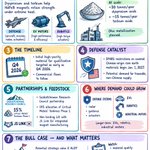
The rare earth bottleneck most of the market is still overlooking.
REalloys is building a North American mine-to-magnet platform focused on heavy rare earths, specifically dysprosium (Dy) and terbium (Tb).
These are critical additives in high-performance NdFeB permanent magnets, allowing them to maintain magnetic strength under extreme heat.
Defense systems, precision-guided weapons, radar, EV motors, and advanced robotics all depend on these materials.
The production targets are what make this interesting. Through its Saskatchewan Research Council (SRC) partnership and related facilities, $ALOY is targeting approximately 30 tonnes of dysprosium oxide and 15 tonnes of terbium oxide annually at scale, with downstream metallization planned in Ohio.
Initial high-purity material for qualification is targeted as early as Q4 2026, with commercial flows to follow.
The company also has feedstock access, an allocation representing 15% of Critical Metals’ Tanbreez Phase 1 project, and a non-binding LOI with South Korean magnet manufacturer JS Link to pursue integrated magnet manufacturing.
This positions $ALOY to connect heavy rare earth supply directly to North American magnet production.
The biggest near-term catalyst is U.S. defense supply-chain compliance. Beginning January 1, 2027, DFARS restrictions on covered Chinese-origin rare earth materials create a major incentive to qualify alternative sources.
Companies like $LMT, $RTX, $NOC, and $GD rely on high-performance magnets across aircraft, missile guidance, radar, and precision weapons, making traceable, non-Chinese materials increasingly strategic.
Now look further out at EVs, robotics, and industrial automation. High-efficiency motors and humanoid robot actuators need powerful, compact magnets, creating potential demand across the $TSLA ecosystem, other automakers, and advanced robotics manufacturers.
Western competitors like MP Materials, Lynas, and Energy Fuels are also pursuing domestic supply chains, but $ALOY’s focus on heavy rare earths and metallization could give it a differentiated position.
This is the unrealized potential with $ALOY. Its targeted volumes are modest compared with global demand, but becoming a qualified domestic supplier of scarce heavy rare earth materials could carry outsized strategic value as defense compliance deadlines approach.
The next milestones are producing consistent high-purity material, completing customer qualifications, bringing metallization online, and converting partnerships into binding offtake agreements.
Execution is everything, but if $ALOY establishes a reliable link between heavy rare earth feedstock and defense-grade magnet manufacturing, it could occupy a critical position in a supply chain the U.S. is actively rebuilding.
Don’t blink. The bottleneck is what matters.
I do not own shares.
This is a paid promotion.
Disclaimer 🔗
tinyurl.com/mr29d787
🤝 Paid partnership · 🤖 Made with AI

THE GAP FATHER retweeted

$RMBS Q3 2026. Record earnings, strong guidance, and another important piece of the AI infrastructure story.
I went through Rambus's latest financial results and earnings call, and what caught my attention wasn't just the revenue growth. It was what management revealed about server memory demand, CPU infrastructure and the next stage of AI development.
I think this company deserves more attention because it operates in a part of the semiconductor supply chain that is easy to overlook.
First, the financial results.
Rambus reported Q3 revenue of $218.3M, growing 22% year over year and beating the $213.2M consensus estimate.
Adjusted EPS reached $0.84 versus $0.79 expected, while GAAP EPS increased from $0.44 to $0.69.
Product revenue reached a record $114.3M, up 22% year over year and 15% sequentially.
Non-GAAP operating income increased to $102.2M, with operating margin expanding from 44% to 47%.
And something I always like to see, operating cash flow reached a record $102.5M.
These are strong results, but I want to explain what is actually driving them.
What does Rambus do?
Rambus develops semiconductor chips and intellectual property that help computing systems move, manage and secure data.
Think about a modern server.
You have CPUs, memory modules, processors, interconnects and many different components that need to communicate reliably at increasingly high speeds.
As server performance increases, moving data between those components becomes more difficult.
That is where Rambus operates.
Its DDR5 memory interface chips help maintain signal timing and integrity between server processors and memory modules. Its supporting chips handle functions such as power management and module information.
Rambus also develops and licenses semiconductor IP used in high speed memory interfaces, connectivity and hardware security.
The company makes money through three main revenue streams.
Product sales generated $114.3M, primarily from semiconductor chips.
Royalties contributed $77M through licensing arrangements.
Contract and other revenue reached $27M, supported by semiconductor IP and engineering activity.
I like this combination because Rambus participates in both physical semiconductor demand and the development of new chip architectures.
But these revenue streams have different economics, so product growth and royalty growth should not automatically be valued the same way.
Now, here is the most interesting part of the earnings call.
Management expects Q4 revenue between $227M and $233M, with adjusted EPS between $0.84 and $0.92.
Product revenue is expected to reach $127M to $133M.
At the midpoint, that represents approximately 34% year over year product revenue growth.
And the important detail is where this growth is coming from.
Not primarily from some future technology that hasn't reached commercial scale yet.
It is coming from existing DDR5 memory interface chips and supporting components.
Rambus is already benefiting from server memory architecture changes, including higher speeds, additional memory channels and increased chip content per module.
Modern server platforms are expanding from traditional configurations with 8 memory channels toward 12 and 16 channels.
More channels can support additional memory modules, which increases the potential demand for Rambus's interface and control chips.
And this brings me to a broader observation.
AI infrastructure is not only about GPUs.
Management discussed how agentic AI and increasingly complex workloads require more CPU processing, orchestration, data management and conventional system memory.
GPUs perform much of the accelerated computation, but the surrounding infrastructure still needs CPUs and memory to coordinate applications, manage workloads and move information.
That is an interesting read-through for $AMD and $INTC, and also for server manufacturers such as $DELL and $HPE.
It suggests that the expansion of AI infrastructure can support conventional CPU servers rather than simply replacing them.
But this is an industry demand signal, not evidence that every company involved will gain market share or grow at the same rate as Rambus.
There is also an important distinction involving $MU and the broader DRAM industry.
Rambus explained that customers are not necessarily reducing the number of memory modules they use.
Instead, some are reducing the capacity of each module because memory has become more expensive.
Think about what that means.
A server can contain more memory modules, creating additional demand for Rambus's interface chips, while the total amount of DRAM installed grows much more slowly.
More modules do not automatically mean proportionally more memory capacity.
That is important when evaluating memory producers such as $MU, Samsung and SK hynix.
It doesn't mean memory demand is collapsing. Strong pricing and constrained supply can still support profitability.
But it does mean we should not assume that every part of the memory supply chain benefits equally.
And what about MRDIMM?
This is another area where management was more cautious.
MRDIMM offers higher memory bandwidth through a more complex architecture, creating additional opportunities for memory interface suppliers.
But adoption is still early, and Rambus expects a slower ramp than some traditional product generations.
This matters because the company's strong near term product growth does not depend on widespread MRDIMM adoption.
I actually see that as an encouraging distinction.
The existing DDR5 business is already generating growth, while MRDIMM remains a potential future opportunity rather than something I would aggressively include in current earnings assumptions.
The semiconductor IP business is another area worth watching.
Rambus discussed new design wins involving next generation HBM, increasing interest in PCIe connectivity IP, and deeper work with customers developing custom silicon.
It is also expanding its portfolio with power management technology for LPDDR6 SOCAMM2 and hardware security solutions for data centers.
That provides an interesting read-through for the broader semiconductor design ecosystem, including $SNPS and $CDNS.
As AI chips become more complex, companies need more sophisticated memory interfaces, connectivity and security functions.
Some of that engineering work happens well before the finished semiconductor enters production.
But a design win is not the same as guaranteed production revenue, and Rambus's wins do not establish new contracts for its competitors.
Now, let's discuss what I don't like or what still needs verification.
First, product gross margin was approximately 60.4%, toward the lower end of management's near term range.
Supplier costs are increasing, and even a company benefiting from strong demand still needs to protect profitability.
Second, the supply chain is tightening.
Rambus is using its balance sheet to secure additional inventory and maintain product availability. That helps protect customer deliveries, but it also increases the importance of inventory management.
Third, management acknowledged that customers are placing orders earlier than before.
This improves backlog visibility, but earlier ordering is not necessarily stronger final demand.
Customers may be securing components because they are worried about future supply availability.
I want to see that backlog consistently convert into shipments and revenue rather than simply extending purchasing timelines.
Finally, valuation matters.
A strong business can become a poor investment if future growth is already reflected in the stock price. I have not completed the valuation and current chart assessment here, so I am not calling this an attractive entry.
My current read on $RMBS.
The financial performance is strong, the product business is accelerating, and Rambus has a meaningful position in the memory infrastructure supporting modern servers and AI workloads.
The most compelling part is that conventional DDR5 interface demand is already producing results. The company does not need every new memory architecture to succeed immediately for its current business to grow.
But I want to follow product margins, supply costs, customer ordering behavior, MRDIMM adoption and how successfully the company converts its technology roadmap into profitable revenue.
My classification: Tracker. Worth deeper fundamental and valuation research.
For me, Rambus is another reminder that some of the most interesting semiconductor opportunities are not necessarily the companies making the most visible AI processors.
Sometimes the important businesses are the ones making the entire computing system work.
AI needs computing power. Computing power needs memory. And that memory needs increasingly sophisticated infrastructure to function.
That is where $RMBS becomes interesting.
My investing journal, not financial advice.

$RMBS KEY READ-THROUGHS FROM RAMBUS Q3 2026 EARNINGS CALL
Rambus’s results strengthen the case that AI infrastructure spending is broadening beyond accelerators into CPU-based servers, conventional memory modules and increasingly complex silicon designs. The most actionable signal is the expected acceleration in product revenue to 34% year-over-year growth in Q4 despite minimal MRDIMM contributions. However, the call also exposes important differences between module demand, memory-bit demand, supplier profitability and actual end consumption. Customers are preserving module counts while reducing module capacity, semiconductor input costs are pressuring Rambus’s margins, and earlier ordering is improving backlog visibility without resolving uncertainty about downstream inventories. The strongest positive implications concern conventional DDR5 interface suppliers, server processors and advanced semiconductor IP. The strongest negative implications concern aggressive MRDIMM adoption assumptions, unconstrained server-DRAM content forecasts and valuations that treat precautionary ordering as equivalent to final demand. Countries below indicate corporate domicile; magnitude refers to the affected business and consolidated earnings exposure, not a forecast share-price movement.
MEMORY INTERFACE SEMICONDUCTORS: CONVENTIONAL DDR5 CONTENT EXPANSION IS ALREADY MONETIZING, WITHOUT REQUIRING MRDIMM (READ-THROUGH 1)
Affected companies: Montage Technology (688008: China) and Renesas Electronics (6723: Japan). Direction: positive. Magnitude: high strategic relevance for Montage’s concentrated interconnect business; meaningful for Renesas’s memory-interface operations but more diluted at the consolidated level.
The critical evidence is Rambus’s expectation of approximately $130 million in Q4 product revenue, up 34% year-over-year, with management attributing the growth primarily to existing RCD generations and companion chips. Seraphin described the outlook as “34% year-over-year growth based on the core, I would say, RCD and companionships.” MRDIMM remains “very modest.” This is evidence that the conventional memory-interface opportunity is generating substantial revenue before the more speculative architectural transitions become material.
The transmission mechanism is a combination of more populated memory modules, higher-speed RCD generations and increased supporting-chip content. Management highlighted the progression from 8 to 12 to 16 memory channels. A move from 12 to 16 channels increases potential channel count by 33%, although realized module demand depends on population rates and platform mix. RCDs, power-management devices, SPD hubs and temperature sensors can benefit from this expansion without requiring proportional growth in DRAM capacity per module. Renesas’s disclosed portfolio spans these categories, while Montage’s operating exposure is heavily concentrated in interconnect chips.
Montage provides unusually strong independent corroboration. Its October 20 preliminary announcement projected Q3 interconnect-chip revenue growth of approximately 49%, identified higher shipments of DDR5 interface and supporting chips, and anticipated further demand growth in Q4. Interconnect chips represented approximately 98% of its preliminary quarterly revenue, although that category is broader than RCDs alone. Rambus therefore confirms an already-disclosed industry expansion rather than providing the initial evidence for a Montage earnings surprise.
The margin comparison is particularly important. Rambus attributed its approximately 60.4% product margin primarily to supplier-cost pressure, while Montage projected an interconnect gross margin of 68.0% to 68.5%, improving both sequentially and year-over-year. Product mixes and accounting definitions differ, so the figures are not a clean competitiveness comparison. Nevertheless, they demonstrate that Rambus’s margin pressure should not automatically be extrapolated across the entire interface-chip group.
The near-term catalyst is Q4 shipment conversion and the next disclosures on higher-generation RCD mix and companion-chip adoption. The longer-duration driver is rising interface content per server as platforms add channels and memory speeds increase. The cross-portfolio implication is favorable for qualified interface suppliers across China, Japan and the US, but the call does not establish regional share shifts or identify a beneficiary of any specific customer allocation.
MEMORY INTERFACE SEMICONDUCTORS: MRDIMM ADOPTION SHOULD BE MODELED MORE CONSERVATIVELY THAN THE ADDRESSABLE-MARKET NARRATIVE (READ-THROUGH 2)
Affected companies: Renesas Electronics (6723: Japan), Montage Technology (688008: China) and Micron Technology (MU: US). Direction: negative for aggressive adoption and product-mix assumptions. Magnitude: moderate for MRDIMM-specific revenue expectations; limited for immediate consolidated earnings where current contributions remain small.
Management’s clearest qualification was that “the ramp will be shallower in our opinion than the other generations of products.” The reasons were platform-specific introductions, uncertainty about the proportion of systems adopting MRDIMM rather than conventional DIMMs, customer qualification requirements and unfavorable memory economics. Rambus’s strong Q4 growth explicitly does not require a substantial MRDIMM contribution.
The transmission mechanism is delayed monetization of richer module content. MRDIMM introduces multiplexing and additional buffering functionality, creating opportunities for higher interface-chip revenue and differentiated high-bandwidth memory products. However, suppliers realize that opportunity only when compatible processors ship, system vendors qualify the configurations and customers select MRDIMM over conventional alternatives. A large addressable market cannot substitute for those adoption steps.
Renesas has direct exposure through its MRCD and multiplexed data-buffer portfolio, alongside supporting PMICs and other module components. Its July announcement placed production availability for its third-generation MRDIMM chipset in H2 2027. Rambus’s commentary does not contradict that schedule or establish a delay to Renesas’s announced plan. It does reduce confidence in scenarios that assume rapid, broad-based adoption across platforms before customer economics and qualifications are established.
For Montage, the implication is to separate the already-strong conventional DDR5 franchise from incremental MRDIMM upside. For Micron, it argues for caution around the timing of premium server-module mix benefits rather than a reduction in aggregate memory demand. Revenue can remain strong in conventional modules while the richer architecture develops more slowly.
The competitive question is unresolved. An analyst noted that a competitor had secured the initial MRDIMM platform, but Rambus’s response emphasized market timing rather than demonstrating that it had displaced that supplier. Consequently, the call provides no basis for assuming an immediate competitive loss at Renesas or Montage. Equally, early participation in a platform does not guarantee that the entire market will adopt MRDIMM rapidly.
The near-term trading implication is reduced justification for capitalizing a steep MRDIMM ramp into 2027 estimates without shipment evidence. The longer-duration opportunity remains intact. Relevant catalysts are production qualifications, disclosed module shipments and actual adoption across successive CPU platforms during 2027. This is a timing caution, not evidence of canceled platforms or a formal reduction to peer guidance.
DRAM PRODUCERS: MODULE GROWTH IS NOT MEMORY-BIT GROWTH, AND HIGH PRICES ARE ALREADY CHANGING CONFIGURATIONS (READ-THROUGH 3)
Affected companies: Micron Technology (MU: US), SK hynix (000660: South Korea) and Samsung Electronics (005930: South Korea). Direction: negative for unconstrained conventional server-DRAM content assumptions, while near-term pricing can remain positive. Magnitude: potentially meaningful within server DRAM, but not sufficient to establish a consolidated earnings downgrade.
The most important quotation is: “it’s not that people decrease the number of modules, but they tend to decrease the capacity of each one of these modules.” Management attributed that behavior to memory economics. This is a direct indication that customers are protecting bandwidth-oriented configurations while reducing capacity to manage system cost.
The transmission mechanism differs materially between interface-chip suppliers and DRAM producers. Interface-chip demand is substantially linked to the number and configuration of modules. DRAM-bit demand also depends on capacity per module. More modules can therefore support strong RCD shipments while generating much less memory-bit growth. Illustratively, 20% growth in modules combined with a 15% reduction in average capacity produces only 2% growth in installed bits. Those percentages are a sensitivity, not an estimate of the observed market.
This is not a high-conviction outright bearish call on memory earnings. Lower capacity growth can coexist with strong pricing, richer product mix and rising profitability when supply remains constrained. The read-through is specifically negative for models that simultaneously assume unrestricted bit-content growth, rapidly rising prices and no customer adaptation. It also should not be transferred to HBM, whose configurations and demand drivers differ from conventional CPU-attached memory.
The novelty is limited but useful. Micron’s September earnings call had already described strong server-unit growth accompanied by a modestly lower rate of content growth than previously expected because of tight memory supply. Rambus provides independent, module-level corroboration of that adjustment. It is therefore stronger evidence for the mechanism, not a newly discovered reason to cut Micron’s already-reported quarter.
Near-term catalysts are SK hynix’s October 28 results and Samsung’s October 29 earnings discussion, particularly their commentary on conventional DRAM shipments, server configurations and pricing. Samsung’s preliminary profit guidance is already public; the incremental information is the underlying volume, mix and outlook discussion. For Micron, the relevant catalyst is the next update to fiscal 2027 shipments and content assumptions.
The longer-duration implication is that memory spending and useful installed capacity may diverge materially during a tight supply cycle. Across a portfolio, interface-chip strength should not be treated as an interchangeable confirmation of DRAM-bit growth. Conversely, lower capacity per module should not be interpreted as evidence that server deployments or AI infrastructure investment are collapsing.
SERVER PROCESSORS: AGENTIC AI IS EXPANDING CPU-ATTACHED MEMORY DEMAND RATHER THAN SIMPLY REPLACING CPU INFRASTRUCTURE (READ-THROUGH 4)
Affected companies: Advanced Micro Devices (AMD: US) and Intel (INTC: US). Direction: positive. Magnitude: meaningful for EPYC and Xeon demand; moderate incremental consolidated read-through because pricing, market share, supply and other businesses remain important.
Rambus identified orchestration, persistent workloads, tools management and memory management as drivers of higher CPU requirements. Seraphin stated that “the majority of the growth is coming from CPUs with, with standard memory subsystems.” He also described the CPU-to-GPU ratio as moving in Rambus’s favor.
The transmission mechanism is additional CPU-based infrastructure around accelerated workloads. Agent execution requires coordination, data preparation, application logic and access to memory outside the accelerator’s local HBM. Those requirements can increase CPU deployments and favor platforms with greater memory bandwidth, more channels and stronger performance under memory-intensive workloads. AMD and Intel monetize the processor demand; their qualified memory ecosystems help determine how quickly that demand becomes deployed systems.
The distinction between head nodes and the broader CPU estate is important. Rambus characterized LPDDR-based configurations as a smaller portion of the market and conventional DIMMs as the dominant source of growth. This weakens the assumption that growth in specialized accelerator-associated CPU configurations necessarily displaces the broader conventional server opportunity.
However, standard DDR memory is not exclusive to x86. The call supports the end market served by EPYC and Xeon; it does not establish that Arm-based server processors are losing share. Nor does it establish an AMD-versus-Intel share outcome. Rambus’s 34% product-growth outlook also cannot be translated into 34% CPU shipment growth because memory channels, chip content and supplier share contribute to its revenue.
The signal corroborates existing company commentary. AMD’s August release described accelerating EPYC demand, while Intel’s July release reported strong Data Center and AI growth and highlighted agentic infrastructure deployments. Rambus adds a later observation from the memory subsystem, strengthening confidence that the CPU opportunity is supported by actual platform requirements rather than only processor-vendor positioning.
The most immediate catalysts are Intel’s October 29 earnings and AMD’s November 3 earnings. The key variables are CPU demand, shipment capacity and the 2027 outlook, rather than headline data-center revenue alone. AMD’s data-center business also contains accelerators, while Intel’s consolidated outcome includes foundry and other exposures. Over the longer term, the structural positive is a broader CPU workload base; the limiting factors are utilization improvements, workload consolidation and offload to other processors.
ENTERPRISE SERVER HARDWARE: PHYSICAL MEMORY-SUBSYSTEM DEMAND SUPPORTS THE REFRESH CYCLE, BUT DOES NOT VALIDATE HEADLINE REVENUE GROWTH AS UNIT GROWTH (READ-THROUGH 5)
Affected companies: Dell Technologies (DELL: US) and Hewlett Packard Enterprise (HPE: US). Direction: positive for conventional server demand, with important limits on revenue and margin extrapolation. Magnitude: moderate at the server-business level and more diluted at the consolidated level.
The supporting commentary is Rambus’s observation that module counts are increasing even as capacity per module declines, combined with its expectation that conventional CPU systems will generate most of the growth. These are physical configuration signals, not merely higher dollar spending on memory.
The transmission mechanism is demand for complete CPU-based systems used in enterprise refreshes, orchestration and inference-related infrastructure. Dell and HPE can monetize that demand through servers, configuration options, support and related infrastructure. Their exposure is downstream through the server ecosystem; Rambus did not identify either company as the recipient of a particular order or establish a direct customer relationship.
The non-consensus distinction is between genuine infrastructure demand and the magnitude of reported dollar growth. Rambus’s evidence makes an explanation based entirely on memory-price inflation less persuasive. Nevertheless, higher channel counts can increase modules per server without an equivalent increase in server units. The call therefore supports physical infrastructure activity but cannot independently establish OEM unit growth.
This distinction matters against already-reported results. Dell’s September release showed traditional servers and networking revenue increasing 122% year-over-year. HPE also reported strong server growth, and its earnings discussion identified both robust demand and supply constraints. Rambus corroborates the market direction, but provides no basis for applying its own growth rate to those companies or treating their revenue increases as shipment increases.
Margin transmission is also conditional. Higher memory prices can be passed through, absorbed or managed through configuration changes and procurement arrangements. HPE’s recent profitability improvement demonstrates why a blanket conclusion that memory inflation must compress OEM margins would be incorrect. Conversely, continued supply tightness can delay shipments and increase working-capital requirements even when pricing is effective.
The near-term catalysts are the upcoming results covering the October 2026 fiscal quarters, especially unit commentary, traditional-server order conversion, gross profit per system and component availability. The longer-duration positive is a broader role for conventional servers within AI-enabled enterprise infrastructure. The principal cross-portfolio risk is that OEM dollar growth, component shipments and end-system deployment are different measures and should not be counted as independent confirmations of the same growth rate.
SEMICONDUCTOR IP AND DESIGN SOFTWARE: CUSTOM SILICON CREATES EARLIER MONETIZATION OPPORTUNITIES THAN PRODUCTION CHIP SHIPMENTS (READ-THROUGH 6)
Affected companies: Synopsys (SNPS: US) and Cadence Design Systems (CDNS: US). Direction: positive. Magnitude: meaningful for advanced interface and memory IP; modest to moderate at the consolidated level because these are broader businesses and competitive allocation remains unknown.
Rambus reported additional Tier 1 next-generation HBM design wins, increasing interest in PCIe controller and switch IP, and deeper architectural engagement before standards are finalized. Management described customers as “designing increasingly differentiated architectures and tailored silicon optimized for their own environments.” The CFO placed silicon IP growth toward the upper end of the previously communicated 10% to 15% range.
The transmission mechanism is increased demand for validated design building blocks and verification as customers develop more complex custom systems. HBM interfaces, high-speed connectivity, security and integration must be addressed before a chip can reach production. Synopsys and Cadence have direct product exposure to these requirements, rather than merely sharing a broad AI label.
The timing advantage is important. IP licenses and associated engineering activity can monetize during design, before the customer’s finished chip reaches meaningful shipment volume. Design spending can therefore remain strong even while system adoption is constrained by memory supply or platform qualifications. However, licensing terms differ, and design wins should not automatically be treated as recurring royalties on every future chip shipment.
The opportunity is reinforced by previously disclosed peer performance. Synopsys’s August results described a return to year-over-year growth in Design IP and specifically identified memory-interface, wired-interface and security IP within the business. Cadence released its Q3 results on October 26, reporting strong double-digit growth across product categories and record backlog. Rambus is consequently corroborating an established design-demand cycle, not predicting Cadence’s already-announced quarter.
There are clear limits to the read-through. Rambus’s wins could represent competitive displacement in individual programs, so they do not establish that Synopsys or Cadence won the same business. The 35% growth in Rambus’s contract-and-other line is also not an appropriate growth assumption for the entire IP industry, since Rambus’s IP revenue spans multiple accounting categories.
The near-term catalysts are Synopsys’s fiscal Q4 results and subsequent 2027 outlooks, with emphasis on IP bookings, program breadth and integration intensity. The longer-duration positive is greater engineering content per custom system. Rambus’s ChipAgents collaboration does not establish displacement of incumbent EDA tools or a quantified reduction in industry design spending; neither conclusion deserves financial credit from this call.
CROSS-PORTFOLIO SUPPLY-CHAIN RISK: EARLIER ORDERING IMPROVES PLANNING BUT DOES NOT PROVE STRONGER FINAL CONSUMPTION (READ-THROUGH 7)
Affected companies: Rambus (RMBS: US), Montage Technology (688008: China) and Renesas Electronics (6723: Japan). Direction: negative for the evidentiary quality of backlog-based growth assumptions, not evidence of an imminent demand decline. Magnitude: moderate for visibility and valuation; potentially more material for focused interface-chip suppliers if ordering later normalizes.
The decisive exchange concerned downstream inventories. Management acknowledged, “It’s very hard to determine,” before explaining that customers are placing orders earlier. Seraphin summarized the distinction as: “we don’t see people building inventory, but we see people placing backlog.” That is narrower than confirmation that downstream inventories are lean.
The transmission mechanism is a change in order timing. Customers responding to longer supplier lead times can extend procurement horizons without increasing the same proportion of final consumption. Suppliers then see stronger backlog and may build inventory or reserve capacity. If customers subsequently shorten those horizons, bookings can weaken even while underlying end demand remains healthy. Precautionary ordering can therefore amplify both the apparent upturn and a later normalization.
Rambus’s own actions illustrate the balance-sheet consequence. Inventory increased approximately $12 million during Q3, another increase is planned for Q4, and management is using liquidity to protect supply. This strategy has worked operationally: management stated that supplier constraints did not affect Q3 or the Q4 outlook. The negative read-through is therefore not a reason to assume an immediate supply-driven miss. It is a reason to distinguish current execution from the durability of the visible order book.
The risk cannot be transferred mechanically across suppliers. Contract terms, cancellation provisions, customer deposits, product breadth and inventory ownership differ. In particular, memory producers’ disclosed longer-term supply commitments should not be treated as equivalent to Rambus’s unspecified product backlog. Nor does Rambus’s limited visibility prove that Montage or Renesas has the same customer behavior.
The near-term catalyst is the Q4-to-H1 2027 transition, when seasonal patterns, inventory coverage and earlier orders begin to interact. Shipment conversion, cancellations and inventory efficiency will be more informative than backlog growth alone. Over the longer term, suppliers that can maintain availability without excessive inventory commitments should earn better returns on capital. The cross-portfolio implication is to avoid counting stronger CPU demand, higher module shipments and longer component backlogs as 3 fully independent signals when they can reflect different stages of the same procurement cycle.

BONER CANDLES ARE BACK X FAM
YOU KNOW WHAT THIS MEANS RIGHT?
(As the 7 year olds would say)
$WDC

$ALOY
The unrealized potential explained.
Most investors are looking at the rare earth space through $MP, $USAR, and $UUUU.
But $ALOY (REalloys) is building something different: a North American heavy rare earth supply chain focused on the metals that make high-performance magnets work.
Dysprosium (Dy) and terbium (Tb) are critical additives used in high-temperature, high-coercivity magnets for defense, EVs, robotics, and advanced industrial applications. I’ll dig here next.
China dominates this supply chain, controlling approximately 98% of heavy rare earth mining, 97% of separation, 95% of metal refining, and roughly 90% of permanent magnet production in various industry estimates.
China’s export restrictions have also pushed some non-Chinese Dy/Tb prices to around 5x domestic Chinese prices.
The upcoming defense sourcing restrictions create a major incentive to establish compliant Western alternatives. $ALOY is positioning itself directly in that bottleneck.
The near-term opportunity is not even dependent on its own mine. 👀🔥
Through its Saskatchewan Research Council partnership, $ALOY is targeting approximately 525 tonnes of NdPr metal, 30 tonnes of Dy oxide, and 15 tonnes of Tb oxide annually, with rights to roughly 80% of the expanded output. Qualification material is targeted as early as Q4 2026, with commercial deliveries in 2027.
Its Ohio facility is already operating, while its Heavy Rare Earth Metallization Facility is targeting commissioning in 2028. That’s a path toward becoming a supplier of critical materials before its own mine is producing.
Then you have Hoidas Lake in Saskatchewan, the longer-term unrealized upside. The October 2024 resource contains approximately 2.15 million tonnes of measured and indicated material grading 1.906% TREO, representing roughly 41,000 tonnes of contained rare earth oxides.
Historical metallurgical work showed approximately 70% recovery, implying around 28,000–29,000 tonnes of recoverable TREO from the measured and indicated resource alone, before considering inferred material.
It is not permitted or producing yet, but it could eventually provide meaningful allied feedstock and reduce reliance on third-party supply.
The magnet opportunity is where things get interesting. A non-binding LOI with JS Link is aimed at evaluating an integrated North American magnet platform, with plans pointing toward approximately 3,000 tonnes of annual magnet capacity ramping from 2029.
Longer-term company plans have discussed scaling toward 18,000 tonnes annually by 2035. 🧲
Phase 2 concepts also target substantially larger heavy rare earth metallization capacity, potentially around 200 tonnes of Dy metal and 45 tonnes of Tb metal annually.
If successful, $ALOY could move from processing and metallization into higher-value finished magnets. Meanwhile, its Euclid and Tooele opportunities add another layer of strategic positioning around domestic defense supply.
$MP remains the established leader, $UUUU has significant processing capacity, and $USAR is building a magnet-first platform with longer-term mine optionality.
But $ALOY is carving out a different niche: heavy rare earth metallization, defense-compliant materials, and a potential path from feedstock to finished magnets.
The opportunity is especially compelling because China still dominates the processing and refining stages, leaving a major strategic gap for Western producers.
The unrealized potential is that $ALOY doesn’t need Hoidas Lake producing tomorrow to advance its business. Its funded midstream projects could establish commercial relevance first, while the mine and magnet platform add further upside later.
The company reported just $1.5 million in revenue for the first six months of 2026, so this is still a future platform being built rather than a mature revenue-generating business.
I do not own shares.
This is a paid promotion.
Disclaimer 🔗
tinyurl.com/mr29d787
Don’t blink. Don’t miss
🤝 Paid partnership · 🤖 Made with AI

$FLEX
if this flushes another 20% off good earnings like $TTMI did you all better eat those dips for breakfast lunch and dinner.
I for see numbers being solid but how markets react are the true mystery here this AM.
One of my top conviction bets.
Weekly is close to curling with momentum.
$STX also reports later I’m pumped.
