



ICC Watch retweeted

SECRETARY RUBIO: The ultimate question of our time is whether Americans have a moral right to exist as a distinct nation and a distinct people, and thus to demand a government that defends and pursues our interests above all else.
ICC Watch retweeted

The ICC "is not really a court. It uses the language of law, but it's really a political body."
NGO Monitor Pres @GeraldNGOM discusses 🇺🇸 sanctions on the ICC with @LidarGL on @ILTVNews.
ICC Watch retweeted

'The arrest warrants against Netanyahu are the only thing the ICC has ever done, it's betting everything on that case'
Eugene Kontorovich (@EVKontorovich) joins @BenitaLevin on #TheRundown
ICC Watch retweeted

Today, the Trump Administration is sanctioning the ICC.
This action should encourage our Allies within the Court to work for solutions to end this threat to U.S. sovereignty forever.
ICC Watch retweeted

The International Criminal Court is a criminal entity unto itself. ICC should have no status or power anywhere. @SecRubio is right to ban ICC judges from the US. amgreatness.com/2026/09/25/s…

ICC Watch retweeted

"Nonetheless, the prosecutor’s dismissal will harden views in many developing countries, particularly in Africa, that the court is more willing to bring cases against their citizens than against those of powerful countries. They are not wrong."
economist.com/middle-east-an…

ICC Watch retweeted
.@SecRubio: "The International Criminal Court is an illegitimate international organization that claims even if you are not a member of that court, that they can come after you."
ICC Watch retweeted

The picture that is revealed is not merely murky. It undermines any claims that the ICC and its counterpart, the ICJ, have to being impartial arbiters of truth. In reality, they are tools used by states to help pursue their policy agendas.
In the specific case of the allegations about Khan, it seems clear that Qatar has been seeking to use the ICC to further its own agenda towards Israel – which is especially concerning given that Qatar positions itself as a mediator in the Gaza conflict and broader Middle East.
✍️ Stephen Pollard
Article | spectator.com/article/whats-… | @stephenpollard

ICC Watch retweeted

Chad withdraws from the Rome Statute of the International Criminal Court (ICC) 🇹🇩 #Tchad


ICC Watch retweeted

Por instrucciones de la presidenta encargada @delcyrodriguezv, Venezuela comunicó al secretario general de la ONU,@antonioguterres, su decisión firme e irrevocable de denunciar el Estatuto de Roma e iniciar su retiro definitivo de la CPI, conforme al Artículo 127.
Venezuela considera que la actuación de la Corte responde a un sesgo geográfico demostrado, que ha concentrado su labor de manera desproporcionada en países africanos y latinoamericanos, en detrimento del Sur Global. Este patrón revela una justicia internacional que, lejos de aplicarse con equidad, ha sido instrumentalizada para profundizar las desigualdades entre los pueblos y desconocer su derecho a la autodeterminación y a la soberanía.
Este sesgo no es una simple coincidencia procesal, sino el reflejo de una institución que ha puesto sus mecanismos al servicio de intereses ajenos a la justicia y a los pueblos que dice proteger. Por ello rechazamos esta dimensión de lawfare, que perpetúa la persecución contra el pueblo venezolano y agrava las desigualdades que la justicia internacional debería corregir. Reiteramos nuestro compromiso con una justicia genuinamente equitativa, respetuosa de la soberanía y la autodeterminación de los pueblos.
ICC Watch retweeted

In his effort to challenge the ruling by at least two-thirds of the 21 state members of the International Criminal Court Executive Bureau that he committed “serious misconduct,” chief prosecutor Karim Khan falls back on sophistry. He claims that the original claim against him was of non-consensual sexual misconduct, but the Bureau found him to have committed serious misconduct by virtue of having had a sexual relationship with a much more junior employee, because “in the context of that power imbalance a sexual relationship could never be appropriate.” Khan purports to believe that those are fatally different. Yet the entire reason that a sexual relationship between a boss and a subordinate is broadly prohibited is because it is so difficult for a subordinate to offer her free consent. That is probably why Khan went out of his way to deny having had any sexual relationship with the complainant despite overwhelming evidence in the U.N. (OIOS) investigative report that he did. The Bureau was fully within the requirements of due process to decide as it did, and the 125 member states of the ICC should follow up by voting to dismiss Khan.
ICC Watch retweeted
Op-Ed from @SecRubio: Why We’re Dismantling the ICC
wsj.com/opinion/why-were-dis…

ICC Watch retweeted
The International Criminal Court seeks to become the unaccountable arbiter of a new global law — empowered to prosecute and arrest our citizens at will and existentially threaten American sovereignty.
We will teach the ICC the full meaning of American resolve.
ICC Watch retweeted
The International Criminal Court's Executive Bureau found beyond a reasonable doubt that chief prosecutor Karim Khan engaged in a sexual relationship with a subordinate employee that “in the context of the power imbalance could never be appropriate.” In other words, it did not matter whether the relationship might be deemed consensual. Hence, the Bureau found Khan to have engaged in serious misconduct and recommended his dismissal.
One of Khan's defenders now argues that it is unfair to condemn Khan on these grounds, because the allegations against him were of non-consensual conduct. But sex between a boss and a subordinate is always improper because it can never be entirely voluntary.
Khan now denies having had a sexual relationship with the complainant, but he was more cagey before the UN OIOS investigators when he thought she might have a tape of their activities. He was apparently given many opportunities to give a definitive answer as to whether he denied sexual conduct with her, and warned that not answering risked an adverse inference, yet he still declined to deny a sexual relationship, saying only that he never engaged in any prohibited conduct or inappropriate behavior. Only when he learned after the OIOS investigation was completed that she had no tape did his denial become firmer. No wonder the Bureau rejected the credibility of his denial.

ICC Watch retweeted

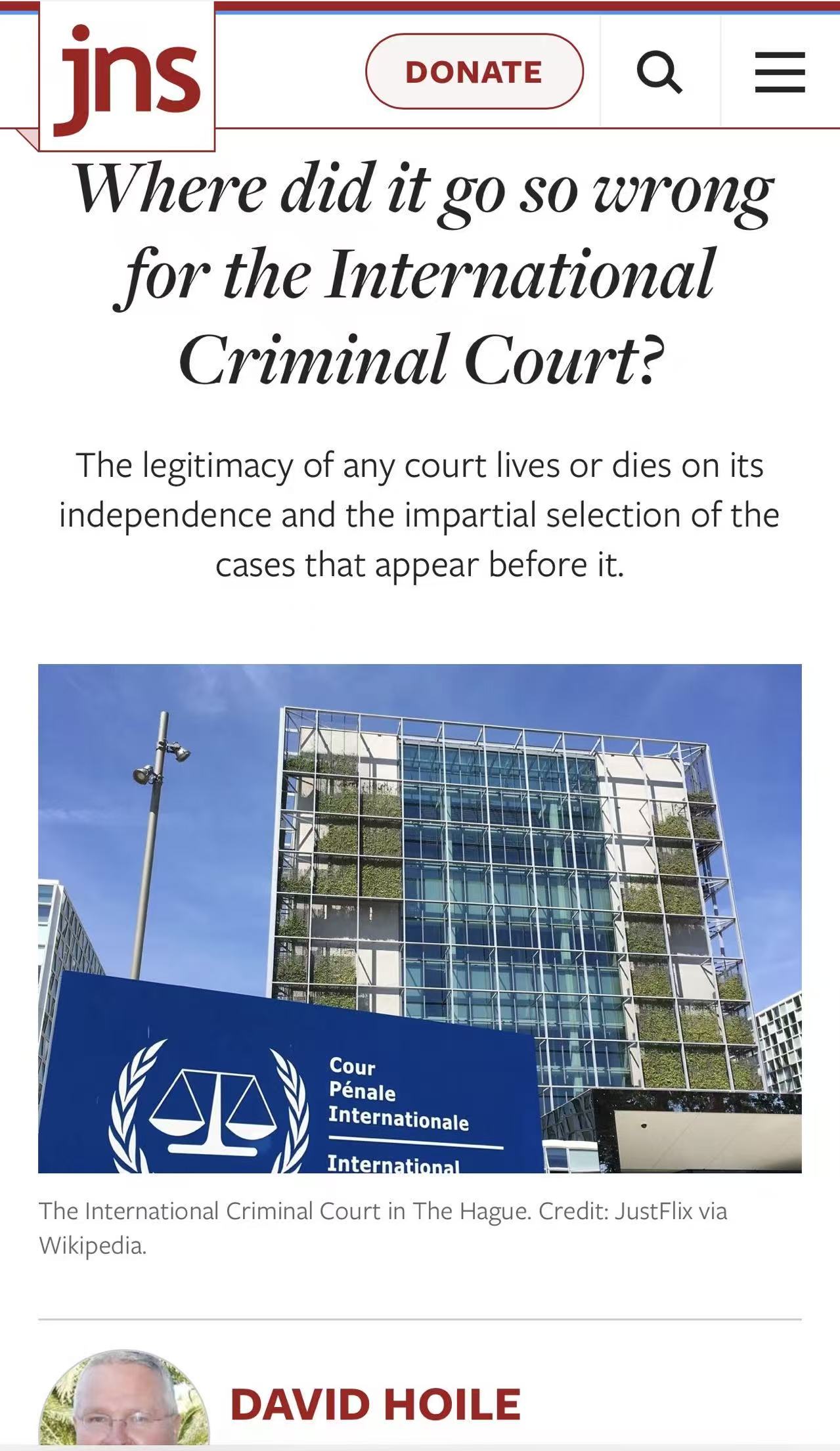
Where did it go so wrong for the International Criminal Court?
By: David Hoile, the author of Justice Denied: The Reality of the International Criminal Court.
February 21, 2026
The legitimacy of any court lives or dies on its independence and the impartial selection of the cases that appear before it.
The doyen of international jurists, Georg Schwarzenberger, writing in the wake of the Nuremberg and Tokyo military tribunals, observed that international lawyers suffered from a “professional disease against which other members of the legal profession are remarkably immune”: an overzealous legal evangelism that failed to distinguish between commendable values and existing realities.
The most mistaken lawyers, he observed, were those who believe in the existence of an “international criminal law.”
H. L. A. Hart, whose contribution to analytical jurisprudence shaped the landscape of legal philosophy in the Anglo-American sphere and beyond, also believed international law to be problematic inasmuch as its ill-defined nature means that it does not have all the elements of a fully developed judicial system, especially with regard to procedural safeguards that ensure the due process of law.
The International Criminal Court in The Hague, established by the 1998 Rome Statute and which opened its doors in 2002, was nevertheless the product of a tide of legal evangelism that marked the 1990s.
Public international law scholar Professor Christine Schwöbel observed: “The branding of [international criminal law] is one of a discipline fighting impunity, a beacon of global justice, and the heroic few internationalists who dare to fight big power-players.”
Many saw the court, charged with prosecuting individuals for genocide, crimes against humanity, war crimes and the supreme crime of aggression if and when its member states were unwilling or unable to do so, as the shining apex of international justice and adjunct of global liberal governance. The ICC has been projected as “speaking in the name of” the international community and taking action on behalf of victims of injustice and impunity, victims of the most serious of crimes “for the sake of humanity.”
Amnesty International, for example, has referred to the court as “prosecuting crimes in the name of international justice,” a glittering legal citadel.
The legitimacy of any court lives or dies on its independence and the impartial selection of the cases that appear before it. Accusations of “victor’s justice” and the retroactive criminalization of aggression had dogged the post-war Nuremberg tribunal.
Subsequent international criminal courts have been in the spotlight over certain cases they select. This concern was said to have been addressed in the Rome Statute through the creation of an independent prosecutor. Article 15 (1) of the Statute provides that “the prosecutor may initiate investigations proprio motu [at his or her own discretion] on the basis of information on crimes within the jurisdiction of the court,” as opposed to opening an investigation following a formal referral by an ICC member state (Article 14 of the Statute) or by the U.N. Security Council (Article 13 (b) of the Statute).
The reality is that regardless of how robust the statute’s procedural safeguards may or may not be on paper, they are all for naught if the structure in place is in the hands of questionable prosecutors with a political agenda and/or, to be generous, a questionable grasp of judicial procedures. This is further exacerbated if the checks and balances one would normally expect to be in play on the bench are absent because of questionable judges with little or no real judicial expertise or courtroom experience, themselves the result of vetting by unaccountable non-governmental organizations and approved by corrupt vote-trading.
Far from a shining example of judicial brilliance, the court has had prosecutors who appear to be unaware of the inconvenient concept of the presumption of innocence and willing to hide exculpatory evidence from both judges and the defense in trials described by the pro-ICC Economist as “bumbling,” “chaotic” and “near-farcical,” and by legal bloggers as “slapstick comedy.”
Prominent legal blogger and ICC enthusiast Professor Mark Kersten has observed that far from being independent, “The court demonstrated a bias towards both major Western powers as well as despots.” He has further noted that “a string of controversies and unnecessary failures always seemed to follow the ICC … Staff were wrongfully dismissed. Cases collapsed under weak evidence.” One of the ICC’s godfathers, legal scholar Professor William Schabas, even placed on record that the ICC has convicted people of crimes they never committed.
The ICC has well and truly fallen short of the claims made on its behalf. The result has been a fatally flawed court that has paid ineffectual lip service to the crime of aggression; prolonged conflict rather than deterred it; entrenched impunity for despots and its own European funders; afforded immunity to powerful states and funders; and, in serving as an instrument of European foreign policy, has engaged in racial profiling of black Africans on a continental scale.
It is a court that has flouted cornerstones of customary international law, such as the 1961 Vienna Convention on Diplomatic Relations regarding immunity for Heads-of-State and the 1969 Vienna Convention on the Law of Treaties. Politicized ICC rulings have been dismissed by leading international law scholars, including Britain’s International Court of Justice candidate Professor Dapo Akande, as “extremely controversial,” “inconsistent,” “stunning,” “deeply misguided,” “very dangerous and unwise,” and “very poorly reasoned.”
When did it start to go wrong? The answer is from the very beginning.
Schabas, a key participant observer in the creation of the ICC, also candidly admitted that “[t]he final version of the Rome Statute [establishing the ICC] is not without serious flaws.”
These are the last words one would wish to hear about a body presented as a shining legal Camelot. Here we have the irreparable hole in the heart of the ICC since its establishment in 2002. The combination of legal evangelism, a seriously flawed statute, and lackluster jurists has been fatal to this vision of international justice.
Link: jns.org/where-did-it-go-so-w…
ICC Watch retweeted

Credit must be given where it is due, so here is a brief piece on the Trump administration's campaign against the International Criminal Court. The functioning of the ICC has been seriously disrupted and there is the prospect of destroying it: kyleorton.com/p/donald-trump…

ICC Watch retweeted

My first publication is out! This article critiques the carceral logics of the ICC. I offer this critique alongside abolitionist tools to show how we can start to move away from harmful, carceral justice, beginning with the abolition of the ICC.
tandfonline.com/doi/full/10.…

ICC Watch retweeted

The ICC’s decision is yet another example of judicial overreach from a foreign court.
The only beneficiaries are Hamas and Iran.
If the ICC is to regain legitimacy, it must change its leadership.


ICC Watch retweeted

US can't accuse Putin of war crimes without joining the ICC, the only supranational venue that tries war crimes. US hypocrisy is undermining the meaning of "war crimes," turning the term into mere rhetoric. .nybooks.com/articles/2022/05… via @nybooks