

Public policy research and education boldly advancing peaceful, prosperous, and free societies grounded in a commitment to human worth and dignity.
Oakland, CA
Joined February 2009
- Tweets38.6K
- Following8K
- Followers33.8K
- Likes9.8K





Pinned Tweet
When Political Stability Comes at a Cost
What happens when a political crisis is resolved through a bargain that trades long-term principles for short-term stability?
In this episode of History of the Future, Jonathan Hofer and Caleb Petitt examine the disputed 1876 election and the political deal that became known as the Corrupt Bargain of 1877.
With the country facing the possibility of renewed political violence, Southern Democrats agreed to accept Rutherford B. Hayes's presidency in exchange for a series of concessions, including the withdrawal of federal troops from the South and an end to Reconstruction.
But the consequences went far beyond resolving a contested election. The compromise effectively gave Southern states greater freedom to determine their own racial policies, helping create the conditions in which Jim Crow would take hold.
The episode raises a difficult historical question: when political stability depends on compromise, what happens when the costs of that compromise are paid by people who have little say in the deal?
🎧 Listen to the full episode of History of the Future: youtube.com/watch?v=Yttv8JIu…

What does it take to sustain a free and flourishing society?
Robert Higgs explored how property rights, individual freedom, voluntary cooperation, and institutional incentives shape human behavior and prosperity.
Discover more in The Indispensable Robert Higgs: A Reader. Get your copy today. | @ccoyne1

CEQA’s costly reviews and legal challenges obstruct new housing, worsening California’s housing shortage. Reducing these regulatory burdens would open the door to more homes and greater opportunity.
Read more: buff.ly/YBlswnW


How can Congress reclaim its constitutional powers?
Hosted by The Committee for the Republic, join Independent Institute, Ivan Eland, and Doug Bandow of @CatoInstitute for “Restore the Republic: Make Congress Great Again.”
🗓️ Wednesday, November 4 at 7 p.m.
📍 Metropolitan Club, Washington, D.C.
This event is FREE, but RSVP is required! Link in comments.

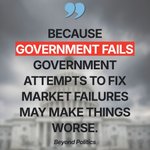
The existence of a problem does not automatically prove that government intervention is the best solution.
Beyond Politics examines the incentives, information limitations, and institutional realities that can cause political solutions to produce unintended consequences.


The best way to put the sheer size of the national debt into human terms is to divide it equally among all 137,100,000 households in the U.S. When you do the math for the national debt in 2026, it comes out to $293,011.12 per household.buff.ly/DrgQ0Xq

Long-lived civilizations thrived by welcoming global trade and talent, while self-imposed isolation routinely triggered their decline. buff.ly/MrLv6U7

Historical tradition from the American colonies and early states demonstrates that the predicate for banning weapons by the public at courts, legislative assemblies, and polling places was the government’s provision of real protection in fact. buff.ly/PweD0Mu

Everyone knows the math is getting worse. Americans are living longer. Birth rates are falling. Fewer workers are supporting more retirees.
The Social Security trustees project the program’s trust funds will be depleted in the early 2030s, leaving payroll taxes insufficient to pay all scheduled benefits unless Congress acts. buff.ly/0QEMEhl

The Department of Agriculture (USDA) is a giant agency with a $481 billion budget, 65 percent of which goes to the food stamp program. As the 2026 farm bill nears passage this autumn, the public is watching a bitter partisan debate over food stamps. But few people—other than insiders—are scrutinizing the rest of the bill. buff.ly/wXrqoL6

On Gov. Newsom’s watch, the University of California built a vast DEI bureaucracy. UCLA created a vice chancellor for “equity, diversity, and inclusion” with a salary of $440,000 and UC Santa Barbara offered $430,000 for a DEI administrator. buff.ly/Om3oKaC

Measured in nominal dollars, that is, without adjusting for inflation over time, hardly anything is as “affordable” now as it was 20, 40, 60, or 80 years ago. But measured in inflation-adjusted dollars, almost everything is more “affordable” now.
More importantly, when measured in hours of work needed to earn the money to purchase it, essentially everything is more affordable now than at any time in the past. buff.ly/ZqcXAqU

Mr. President, I want to express my admiration for your ability to find time, amid trade wars, the threat of an AI apocalypse, and escalating global conflicts, to address what you consider America’s most pressing issue: purging Hispanic roots from the nation’s map.buff.ly/YwcjYac

Zelenskyy can at least argue that his war is needed for national survival; Trump cannot make the same argument for his dubious war of choice. buff.ly/se9HSKC

The trade war with Canada is as electorally toxic as it is economically destructive.
buff.ly/Bi5xPAC

Democrats are running ads accusing Republicans of cutting Biden-era health care subsidies. Fortunately, there is a powerful Republican response. It consists of four Trump administration ideas. buff.ly/44MjQCj

The wealth tax is a bad idea that just won’t die. Perhaps the main problem is that bad policy proposals are being driven by bad economics, with the imprimatur of high-profile scholars. buff.ly/dw4FSoP

