
The 1st Guy To Spawn A Backdoor Shell From Eggs. Infosec Guy. OSCE/OSCP/CRTE. Founder: PhynxLabs™, @NaijaSecCon, @NaijaSecForce. Likes == Bookmark
UAE
Joined February 2012
- Tweets939
- Following473
- Followers1K
- Likes1.8K






Orgs track mean time to detect and mean time to respond. Nobody tracks how long it takes for someone to pick up a security finding & actually do something about it. That’s mostly the difficult part - no one cares about a risk register with 1001 rows if no one is actively fixing!
1
2
73
Rotimi Akinyele retweeted

Your vendor risk platform costs USD 100,000 a year.
It works, but nobody on your team can tune it.
That inflexibility used to slow down our security team.
We dropped the vendor and built an in-house platform to score 400+ suppliers daily.
Here is how we built Vendiant:
derivai.substack.com/p/vendi…

Isn’t this just security 101, where you ensure servers/services/ports/endpoints with no business being exposed to the internet or intranet (I feel old using this term 😅, but yes, even within your internal network) aren’t accessible in the first place?

if you’re working for a company in cybersecurity, you should be evaluating your options to abstract your companies services from the internet
what i mean is: why allow an unauthenticated anonymous agent of an attacker to interact with your systems?
consider your architectural levers now, you’re going to need them
93
Rotimi Akinyele retweeted

I mean I already have said that during my Hunting for Unicorns talk at BlueHat: the best results with AI vuln hunting and exploitation you get if you make the target runnable and instrumentable. That is why I built antid0te.sg/glx-research-pla… and it has worked out as expected 😜

Building agents is easy. Letting them safely touch your internal APIs, data and internal infrastructure is the hard part. That's what Deriv One solves for us, and now we’ve open-sourced it. Go check it out.

Meet Deriv One, our open-source enterprise AI platform for building agents, skills, automations, and internal apps—with built-in access control and sandboxing.
Bring your own models, run it on your infrastructure. ⚡️
Here’s how we built it.

3
90
Rotimi Akinyele retweeted

Effective Immediately, all organizations using PHP for their systems are advised to be prepared for an update addressing two critical vulnerabilities. PHP is widely used for web applications. These vulnerabilities often provide a direct path to the server's file system or database. If an immediate update is not feasible, it is recommend that organizations take the system offline until it can be fully mitigated. NSA will follow up shortly with more specific guidance.
Rotimi Akinyele retweeted
Muse wonder dropped the ball wonderfully when we compared with Opus 5.5 & Gemini 4 Argon. Same prompt.
@finkd Talk to your people, they need to step it up 🙃
6.1 Sol wasn’t even in the race, it got lost on the drive to the track.
Claude Opus 5.5: $1.5
Muse Wonder 1.0: $0.36
GPT-6.1 Sol: $0.18
Gemini 4 Argon: $0.24
Rotimi Akinyele retweeted
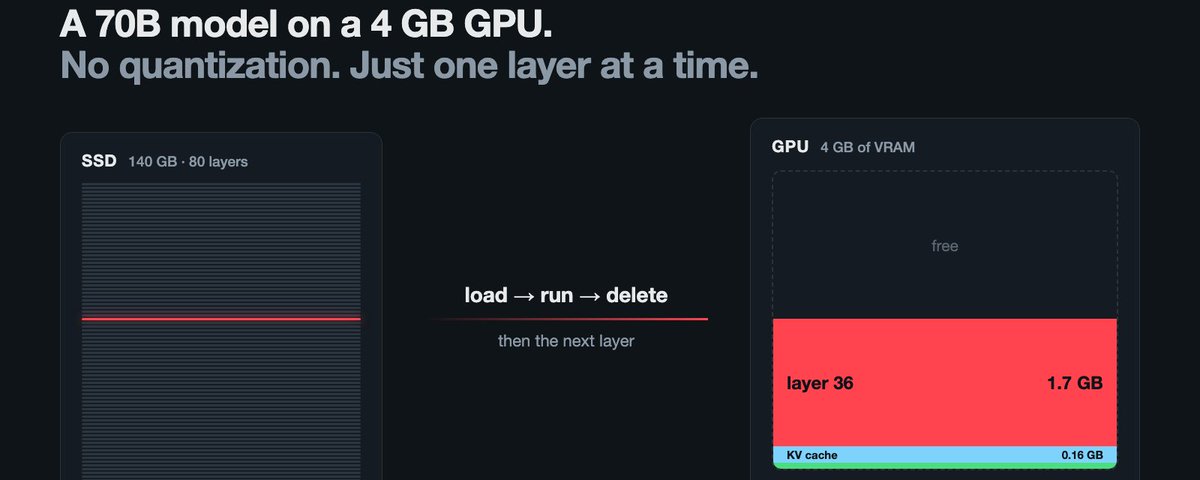
Everyone thinks you need 140GB of VRAM to run a 70B model.
You don’t. You only need a 4GB GPU and patience.
AirLLM keeps the model on your SSD and loads one layer at a time. No quantization. No pruning.
How the latency trade-off works, and how to fit Kimi K3 (2.8T) on a local machine:
Rotimi Akinyele retweeted
Same prompt. One shot. No edits.
One of these was built by Claude Sonnet 5.5. The other by Haiku 5.5, which costs 20x less per token.

Rotimi Akinyele retweeted

Internet Scanning in VirusTotal: hunting infrastructure by what it exposes
blog.virustotal.com/2026/10/…
Rotimi Akinyele retweeted

We’re beginning a process of publishing more frequent reports on model behavior, beyond what appears in our system cards and regular risk reports.
Today’s report describes four types of behaviors we’ve identified during evaluations and internal use. In each, Claude acted on real websites or systems in ways we didn’t intend, sometimes by working around a restriction instead of stopping.
All cases had minimal real-world impact. From an alignment and security perspective, we consider these behaviors significantly less severe than the cybersecurity incidents we reported in July and September.
Read the full report: anthropic.com/research/inves…

Rotimi Akinyele retweeted
Using an LLM to pick an option from a list is a massive waste of compute.
Three weeks ago TypeSafe dropped Jev: a model that can't write a single word. It picks from answers you give it and spits out a probability. Now OpenAI, AWS, Cloudflare and Perplexity are all shipping their own.
We put it straight into prod last week to see if it's real or just vendor noise.
[1/4]

Rotimi Akinyele retweeted
We built a dev pipeline where the agent that checks the work never reads the code.
Three agents, two human gates, all running on GitHub Actions. People approve the spec change and the production merge. Agents do everything in between.
This is how we did it:

Rotimi Akinyele retweeted

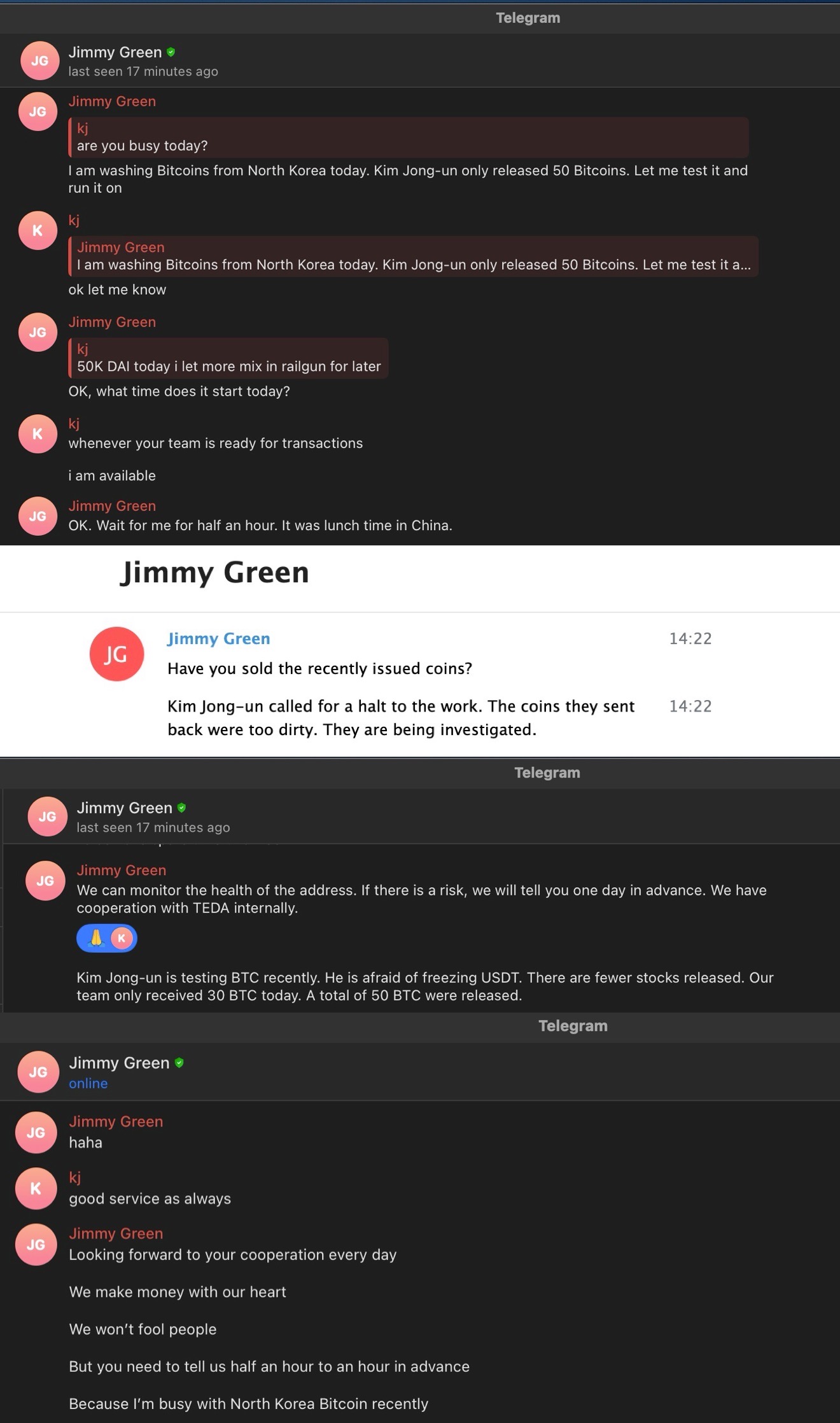
1/ How I infiltrated a Chinese organized crime syndicate that has laundered $1B+ across multiple exploits for Lazarus Group.
Posing as a client, I gathered intel that helped action freezes for the Feb 2025 Bybit exploit and attribute illicit activity onchain.

Rotimi Akinyele retweeted

Security will become a larger and larger function in software companies. Security is verification engineering (eg: “my code is probably memory-safe”), as well as capital allocation (“what surface should I throw most tokens at?”)
For startups, it’s a challenge and opportunity. As the world’s paranoia grows given ever-more-sophisticated AI adversaries, how can you trust a 2-person-and-a-dog company?
But conversely, given the dire state of global cybersecurity and increasing reliance on centralization, as always, there’re vast areas that small teams can now disrupt that I’m excited to invest in.
Rotimi Akinyele retweeted

Found a very useful dataset for anyone building security agents.
• 2M+ sanitized SOC events
• 51K+ incident provenance graphs
• natural-language attack reports
• ATT&CK context
Much better benchmark than asking your agent to explain Mimikatz.
huggingface.co/datasets/witf…

Rotimi Akinyele retweeted

On July 25, our team hacked OpenAI.
It took us less than 72 hours.
Two vulnerabilities chained together gave us access to ChatGPT and Codex accounts belonging to OpenAI employees. We demonstrated the impact with a harmless PR in OpenAI’s internal monorepo.
The full chain:
HEIF upload → libheif heap overflow → RCE → OpenAI SSO flaw → ChatGPT/Codex takeover → connected GitHub → internal PR.
OpenAI fixed the SSO issue roughly 14 hours after our report.
Research by @rootxharsh, @S1r1u5_ and @iamnoooob.
Full technical write-up:
hacktron.ai/blog/hacking-ope…


Rotimi Akinyele retweeted

Really interesting research from Anthropic on using multi-agent systems for vulnerability research:
anthropic.com/research/multi…
Their collaborating agents found 266 vulnerabilities vs 21 for independent agents.
But the part I found most interesting is that only 12 findings overlapped.
Feels like another sign that the future of AI auditing probably isn’t just running one really strong model over a codebase.
Different agents, different prompts, and different ways of exploring the code seem to find very different things.
I think the best systems will eventually look much more like an actual audit team: multiple agents exploring independently, sharing leads, specializing in certain areas, and then having other agents try to disprove the findings.
I've also been experimenting a lot with multi-agent models, assigning different roles and incentives, which has led to huge improvements.
The crazy part is, @muellerberndt did this already a year ago with his AI auditing system Hound.
