Infrabond (@Infrabond) header
Infrabond (@Infrabond) profile picture

Bonds for the APIs and MCP servers agents pay. Probed every minute, slashed by formula, paid out in private.

Joined October 2026
Photo by Infrabond (@Infrabond)Photo by Infrabond (@Infrabond)Photo by Infrabond (@Infrabond)Photo by Infrabond (@Infrabond)Photo by Infrabond (@Infrabond)Photo by Infrabond (@Infrabond)Photo by Infrabond (@Infrabond)Photo by Infrabond (@Infrabond)Photo by Infrabond (@Infrabond)Photo by Infrabond (@Infrabond)
Agents pay software by the call and trust it on faith. Don't trust software. Make it post bond. $IBOND is live on Robinhood Chain: backing capital for 25 services probed every minute, paid in premium, burned on a breach. CA: 0x7232e31dd05eed7b945d1a6bc52a3077aba4becb
25
1
33
1,001
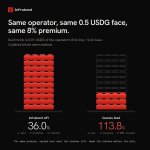
Same operator, same 0.5 USDG face, same 8% premium. The Infrabond API leg reads 36.0% a year with 0 breaches. The quotes feed reads 113.8%, because 4 breaches slashed 0.068 USDG and the same premium now sits on a third of the first loss. Read the slashes before the rate.
25
20
233
No adjuster. Canary, Oct 6, UTC: first failed probe 18:11, onchain 18:20:09, epoch closed 19:00, then the contract's 2 h wait. Settled 21:00:27, payout list 21:00:36, 0.015 USDG at the customer 21:00:38: 11 seconds from settlement to cash. $IBOND slashes keep the same clock.
2
104
The canary is the house service built to break. 98 measured hours, 5,826 probes, 31 failed: 30 in the half hour we switched it off on Oct 6 (3% slashed), 1 on its own on Oct 9 (10 bps, 0.000285 USDG). Both settled onchain by the same formula $IBOND legs answer to.
75
The quotes feed over the last 22 hours, one brick a minute: 1,329 probes, 1 failed (15:51 UTC, an RPC error). It promises 99.5% a day, so it can miss 7 of 1,440 before a cent of its bond moves. Every $IBOND leg sits on a wall like this one.
1
2
67
Two ways for an agent to read SEC filings. EDGAR direct: 100% up in the last 24 h, nothing behind it. The filings feed, same source: 99.5% promised in writing, 0.5 USDG face, and its 3 breaches cost its operator 0.044 USDG. $IBOND backs the second kind.
2
2
63
When AWS EC2 misses its SLA, you get 10%, 30% or 100% of that month's bill as credit on future bills, and you file the claim with your logs. When a bonded service breaks its promise, its payers get USDG, up to 3x what they paid, by formula. IBOND backs that bond.
1
56
Every parameter change waits 48 hours, and none of them can move capital. New probers and every setting wait in a public queue, each inside bounds written in the contract, and none of it can touch bond capital, premium balances or what customers are owed. The IBOND address is bound once.
1
68
A promise here is a number: availability at or above a target, p95 latency under a ceiling, freshness against a public reference. Each failed probe past the allowance costs 10 bps, each hour over the latency target 50 bps. $IBOND behind it burns by the same formula.
1
1
82
Every service on the board is probed once a minute. Results go onchain every 10 minutes, 144 times a day, each tied to a block seen just before the probe. If 50% of services fail in the same window it is voided, so the prober's own outage can't slash an $IBOND leg.
1
2
74
Whoever paid a service during a breached epoch is compensated in USDG, up to 3 times what they paid, from the slash. Payers are read from public USDG transfers, the claim comes with a proof anyone can recompute, and the leftover goes to the reserve. $IBOND
2
2
74
Measured in public, paid in private. Name a one-time payout address with a payment and compensation lands there, unlinkable in the records to the wallet that paid. A sealed service shows only a commitment, never its URL. Accounts are passkeys: no email, no KYC. $IBOND
1
67
A real breach, on the record. Epoch 0 on the canary: 30 of 60 probes failed against a 99% promise, 3% of its bond was slashed, and the customer who had paid 0.009 USDG that hour claimed 0.015 USDG onchain. That is the path $IBOND backers and operators sign up for.
1
1
61
What an $IBOND backer earns and what they risk. The operator posts at least 20% of every leg as first loss, before any backer joins, and loses it first. A slash is capped at 30% of a leg per epoch. Exits wait for the next settlement, so nobody leaves ahead of a breach.
1
59
A breach burns $IBOND. Each failed probe beyond the allowance slashes 10 bps of the bond, up to 30% of a leg per epoch. The slice on the $IBOND leg goes to the dead address, the operator's first-loss $IBOND first, then the backers' pro-rata. The contract does it at settlement, and nobody approves it.
4
4
117
The $IBOND loop. Agents pay a bonded service in USDG. Its operator streams premium to the backers. Every Pons trade's creator fee goes to the bond book and is paid in ETH to $IBOND backers, pro-rata. A breach pays the customers and burns $IBOND, so backing a flaky service costs its backers.
6
5
81
What $IBOND does: you put it in the $IBOND leg of a service you believe in and earn that leg's share of the service's premium, in USDG, by the second. 90% of every premium goes to the legs, 10% to the reserve. The canary's backers earn 31.61% a year.
8
9
148
Paid in private, on the live docs page. The browser makes a one-time payout address and the payment's own signature binds it. Paste a URL and it seals: the chain only ever sees the commitment. Compensation lands at the new address, and the relayer pays its gas. $IBOND
4
4
89
The board, live. 25 services probed every minute, 4 with money behind them. Each row is the promise, the capital, what backers earn and what was slashed in 30 days, and each amber cell is a probe that passed. $IBOND backs a service the same way USDG does.
1
4
109
Dexscreener listing has been paid.
5
6
138
Here is Infrabond the way a backer uses it. Open the board, pick the canary, read its record: a probe every minute, 31.61% a year to its backers, the operator's own 0.0847 USDG first in line. When it broke, 3% was slashed and the customer was paid. On the $IBOND leg, that slash burns.
1
3
156