

Advisory for Entrepreneurs ; Innovation in Wealth & Investment
San Francisco, CA
Joined June 2015
- Tweets1.3K
- Following2.2K
- Followers633
- Likes1.5K






Intellectus:You cant separate an entrepreneur from his business or his biz from his wealth.That is where it begins...wsj.com/articles/ambition-eu…

Intellectus Partners retweeted

Where’s the AI Inflation? Not in Core Goods.
Core goods inflation is 0.7%.
That’s below its 2.4% average since 1966 and close to the 0.2% it averaged from 1996 to 2019, when goods deflated in 43% of months.
So where’s the AI inflation? Where’s the tariff spiral? Where’s the 2nd and 3rd order inflation effects from an oil shock. Not here.
The oil fear is fading, so the Fed has pivoted to anecdotes about AI. Not one official has shown evidence that growth is inflationary.
Hiking into this data isn’t vigilance. It’s bias.


Intellectus Partners retweeted

Responding in my personal capacity, but wanted to share my perspective..
We are in a great-power competition with so much at stake in the years ahead. There is no one in America who has lived during a time when the United States wasn't the preeminent superpower and, despite our imperfections, a force for good in the world. A nation that fought and helped end wars on behalf of those who couldn't, pioneered powered flight, put humanity on the Moon, led revolutions in medicine and technology that improved billions of lives and distributed hundreds of billions in aid around the world.
I don't know how handicapping this nation by going after one of its largest employers, a company that has created wealth for millions, ushered in electric cars, rockets that don't need to be thrown away, satellites that connect the disconnected and have unquestionably saved lives, not to mention access to information that is pretty foundational to solving many of the world's problems, biotech to restore function to those with disabilities, and so much more, serves America's interests. Without the contributions of these companies, there is little question America would be behind in a competition where the outcome is far from certain and the consequence so great.
Now, maybe I am just a bit new to this, but from the billboards, TV and digital ads, spam texts, and fundraising calls, it would seem both parties have no issue raising money, including from billionaires, with the aim of influencing and buying votes. And if that means campaign reform, maybe include dialing back the spam calls and texts..But with all that is going on in the world, and so much at stake for our country, I question the priorities reflected in the post below.


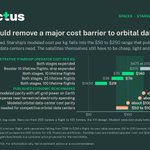
Just imagine......Now that $SPCX has proven reusability...29 Starship flights could exceed the world’s 2025 payload mass to orbit-Assuming 100 tonnes per flight...

65
Absolutely incredible! Thank you team @SpaceX your work inspires us all to do greater things! Truly inspirational!! Thank you @elonmusk @Gwynne_Shotwell and all of you!! Congrats!!
2
115
Generally, great companies run by revered CEOs have a large “premium” priced into their shares for that. NVDA always did. But, Interestingly, $NVDA had lost that premium long before the scandal broke. Why?
39
Intellectus Partners retweeted

NVIDIA STILL DESERVES HIM AS A CEO - RETWEET, CREATE THE COUNTER-MOB.


He’s a brilliant economist. His points are worth watching. But, the pattern is consistent: every few quarters a proximate trigger (earnings commentary, a cheap-model breakthrough, a vivid disruption scenario, or aggregate statistics that lag diffusion) produces a sharp but usually short-lived risk-off in AI-exposed stocks. The common themes are “ROI hasn’t arrived yet,” “spending is too concentrated / too large,” or “competition/efficiency will destroy the economics.”
They have been proven wrong (or at least premature) for the same structural reasons each time:
• Technology diffusion and process redesign take years; historical analogs (PCs, internet, cloud) showed long lags before broad productivity and margin effects appeared outside the tech sector itself.
• Aggregate statistics (TFP, S&P 493 margins, revenue per worker) are blunt and miss consumer surplus, quality gains, new products, and private-firm effects.
• Efficiency improvements (DeepSeek-style) tend to expand the market (Jevons) more than shrink it.
• Employment and consumer data have not shown the predicted collapse.
• The suppliers (Mag 7 / infrastructure) have continued to post strong results while adoption outside core tech remains early-stage but rising.
The current Slok/Apollo note is the latest version of the same argument: real observations about concentration and the absence of broad, immediate bottom-line or TFP gains outside tech, combined with a pessimistic reading that treats the lag as evidence the effects will stay small. The argument is directionally consistent with earlier AI panic periods which have not panned out (yet) or proved accurate
Whether this one is different depends on whether the lag is longer or the returns lower than previous waves—something the data so far do not settle.
Clearly risks exist, which include access to capital to finance the massive buildout, access to power and infra, ability to stand up fully complete data centers, etc. But if you listen to the CEOs demand does not seem to be the issue. Shakeouts are a part of every innovation cycle and every bull market. They’re not easy to decipher and no one has a crystal ball…consider all possibilities…
72
The best team and clients in the industry!!!!

Particularly proud of this recognition by @CNBC. Thank you to our incredible team and to our amazing clients for helping @Intellect_us achieve this!!

41

CNBC Financial Advisor 100 : Super excited and proud of our recognition by @CNBC. Thank you

Intellectus Partners retweeted

NVIDIA-backed Reflection is preparing to release a new open-weight AI model expected to compete with top Chinese 🇨🇳 models.
Note: Reflection has signed major compute deals recently with Nebius and SpaceX.
