

Founder, PhoenixRize Consulting | Culture risk and inclusion advisory | Producer advisory for screen and arts | PhD researcher, University of Portsmouth
Ireland
Joined June 2009
- Tweets648
- Following549
- Followers492
- Likes948
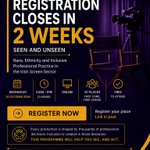




Two weeks to go.
SEEN AND UNSEEN explores how everyday professional decisions shape inclusion, representation and opportunity in the Irish screen sector.
📅 14 October | 10am–1pm
💻 Online | Free
🎟️ Places are limited
Register: forms.cloud.microsoft/e/Ep7v…
@ScreenIreland

Adaku Oliver-Nnona retweeted
SEEN AND UNSEEN is a free online programme exploring race, ethnicity and inclusive professional practice in the Irish screen sector. 14 Oct | 10am–1pm | Online | 30 places Register now: forms.cloud.microsoft/e/Ep7v… This programme is supported by @ScreenIreland

SEEN AND UNSEEN is a free online programme exploring race, ethnicity and inclusive professional practice in the Irish screen sector. 14 Oct | 10am–1pm | Online | 30 places Register now: forms.cloud.microsoft/e/Ep7v… This programme is supported by @ScreenIreland
Most inclusion conversations in casting happen too late to make a difference.
By the time a team is “considering more diverse options,” the outcome is largely fixed.
A thread on why timing matters more than awareness ↓
If inclusion is entering the conversation late, it’s not a values issue.
It’s a decision timing issue.
Worth asking your team:
In your last production, when did inclusion enter the casting conversation?
Before the role was substantively written?
Or after it was already moving toward casting?
If after, it happened too late to do the work.
#InclusiveCasting #ScreenIndustry
A colleague asked me recently: “How do you actually measure psychological safety?”
Here’s what I look for - not surveys or sentiment, but behaviour.
3. Who gets heard when they speak up, and who gets ignored? If only certain people can safely challenge things, you don’t have psychological safety. You have hierarchy.
Psychological safety isn’t a feeling. It’s what consistently happens when people take the risk of speaking.
What would your organisation score on these three tests?
#PsychologicalSafety #OrganisationalCulture #Leadership #TrustAtWork
January is usually full of “new year, new me”. Organisations do it too. Posters go up, pledges are made but the system stays the same
3) INCLUSION
Who was in the room when policies and decisions were shaped and who was missing? If inclusion is an afterthought, the system will exclude by default.
