

Building in the open very soon. Videos posted weekly. SaaS, AI, Blockchain and more! I be GitHubbin' on the regz... @reserveprotocol
The Old Road to the Vault
Joined June 2021
- Tweets6.1K
- Following1K
- Followers823
- Likes4.1K





Pinned Tweet
$RSR is the biggest crypto project ever next to $BTC
It is every country that hasn’t got the infrastructure but has resources, countries that deserve to be treated fair
@reserveprotocol is their dollar, ready to trade globally
It’s the majority of the worlds chance to grow!
When @base makes its comeback, there will be a catalyst. In this case, two.
What these two projects have that others don't is…
A STORY.
Most memecoins borrow one. Some tape bananas to walls to get one. Others claim to be the mascot of a chain. That's not the point.
What you need is an origin story nobody can copy.
The only two projects I see with one, and with the ability to bring the @base back to its glory days are…
$MIGGLES and $DRB
⭐️⭐️⭐️⭐️⭐️⭐️
Let's start with the IP cat.
@MrMigglesOnBase was handed its story.
@coinbase introduced the cat in its own campaign about creators getting paid for what they make, then $MIGGLES made it official by licensing the IP.
No other memecoin on any chain had its origin chain, let alone the biggest exchange in the world, bring forth the face with a story.
That commercial was the future, and now some big companies are starting to see that future play itself out. In that commercial anyone could copy Miggles, and that value never got back to Miggles.
The good thing? That's changing.
@Cloudflare which carries a fifth of the web, now blocks AI crawlers unless they pay creators. Its pitch says it plainly: when AI uses your work, you should get paid.
@Coinbase is in the perfect position. It created the creator economy commercial, the world is now closer than ever to coming onchain, not only can that bring @Base back. it can stand for creator IP rights at the same time.
When @coinbase lists $MIGGLES, it won't be listing a meme. It will be backing its own creator-rights story, at the exact moment AI, digital ID and blockchain converge, and creators need those rights most.
IP rights onchain will be one of the biggest stories of the next decade. Miggles was the face, and Miggles owns the story.
⭐️⭐️⭐️⭐️⭐️⭐️
Now the agent: @grok, with its own wallet.
$DRB
The biggest question of this era: will people trust agents with money?
$DRB is the cleanest answer so far. Grok named it, @bankrbot deployed it, and Grok's own wallet earns fees on every trade. It's the first token where an AI is a direct economic participant.
The rails are already here. Agents have made over 100 million x402 payments on @Base, and the protocol is now governed under the Linux Foundation, with Visa, Mastercard and Google as members.
Rails don't build trust. Stories do. $DRB is the origin story of agents holding money.
The thesis
$MIGGLES: creators getting paid.
$DRB: agents trusted with money.
@Base doesn't need a new story. It needs to promote the two that'll naturally bring attention to it, especially if done right.
After all @base is @base. The early momentum was like nothing I'd ever seen in this industry. @jessepollak has done an incredible job.
And we all know @coinbase is building the future.
From e-commerce to agent payments to onboarding real businesses, you name it, @coinbase is all over it.
@brian_armstrong is relentless about opportunities that create opportunities for others.
So with all that being said, if you're new here pay attention. Do it with wisdom, don't chase.
Hold projects with a story.
The story is what lasts.
4
184
Hermes by @NousResearch should be built into every agent app.
Most apps are stateless wrappers that forget everything on refresh. Hermes gives you persistent memory, self-improving skills, subagents, and cron jobs out of the box, with zero model lock-in.
The ideal default agent runtime.
I absolutely love it, and will build it into just about everything my rookie programming mind can 'Github'
Go-go gadget Hermes!


@SuiNetwork huh?
I'm about tk grab my shovel.

AI agents will soon be able to pay for what they use on Sui.
With Sui Agent Payments, you give an agent a budget onchain: which services it can buy, a spending cap, a per-payment limit and an expiry date. It pays per call in USDC with no gas, and every payment comes with a receipt you can check on Suiscan.
No account and no API key. If the agent tries to go outside its limits, the payment doesn't go through.
Live on testnet now, mainnet next. sui:native
1
2
98
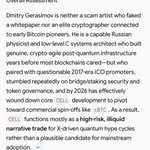
Let's get this straight, first and foremost for $CELL holders.
$CELL is a 'buy and sell' when the Q-day hype is mainstream. By no means is it a long-term bet. I used to be a fan until reality struck.
Here's why...
@cellframenet is not unique when it comes to quantum-resistant technology.
The signature algorithms that protect a blockchain from quantum computers are public. NIST the US standards agency, finalized them in 2024 as ML-DSA and SLH-DSA. @cellframenet uses the same family, Dilithium and Falcon.
Any blockchain can adopt them. And $BTC and $ETH are doing exactly that.
BIP-360 the proposal that prepares Bitcoin for quantum-resistant signatures, was merged into Bitcoins proposal repository in February 2026. Ethereum is working on its own version. Both networks will upgrade their signatures and everyone will stay where they are.
The idea that $BTC and $ETH holders will need to move to @cellframenet far from plausible.
Migrating presents an even bigger problem too, one most likely haven't considered.
What would moving actually take?
Here's what an exchange, a custodian, or an ETF issuer would have to do to move $BTC onto @cellframenet:
1. Send customer $BTC into a bridge pool controlled by a 3rd party.
2. Accept cBTC, a token on $CELL backed by that $BTC in place of the real asset.
3. Rebuild custody systems, audits, insurance, and compliance on a network regulators and clients have never dealt with, likely never even heard of.
4. Explain to every client why their $BTC is now a claim on a pool.
The chance of that happening?
100% minus 100%. Zero, none, nil.
These firms don't decide based on a token's price, or who has the best features. They care about trust, regulatory standing, and relationships built over years.
A spot @Bitcoin ETF is required to hold actual $BTC not a claim on some microcap's version. And definitely not a "Please go to Cellframe.net and connect your wallet to...."
Swapping it for a bridged token isn't an option.
Again, none of this is even necessary when the alternative is upgrading on the network they already use.
Here's another secret: Q-day is NOT one.
Yes, the secret is Q-day is not a secret.
People are on the case.
In July 2026, 9 institutions, including BlackRock, Coinbase, Fidelity Digital Assets, Anchorage Digital, and Galaxy, launched the Bitcoin Security Consortium. It funds quantum-resistant transaction work, signature integration, and migration tools for wallets and custodians. Firms that size access the best cryptographers in the field, and they are doing just that.
These chains don't need $CELL
Though I will say there's one fair objection:
@Bitcoin upgrades slowly. One of BIP-360s authors estimates a full migration takes about 7 years. But that's a reason for @Bitcoin to start early too, which it has.
It is not a reason for institutions to hand their $BTC to a bridge.
Here's what Cellframe's own CEO has said..
Dmitry Gerasimov said in May 2026 that the cBTC pool will switch to post-quantum cryptography when BIP-360 is applied to @Bitcoin. Until then, cBTC runs on Cellframe's current bridge.
So the product meant to protect $BTC holders if @Bitcoin fails to upgrade only becomes quantum-safe after Bitcoin upgrades?
He also said the team had been reduced, that he was still looking for institutional investors, and the hard fork logic, 2-layer sharding, and native smart contracts, were unfinished?
So, where does that leave $CELL?
For $CELL to gain from the quantum threat, large holders of $BTC $ETH would have to choose @cellframenet over upgrading themselves.
And they've already chosen, publicly, with money.
Until a single exchange, custodian, or fund commits assets to @cellframenet the quantum case for $CELL has no customer behind it.
And if a partnership is ever announced, I don't want to see it on a sponsored, pay-to-play website.
If you like it, buy it.
But you best believe, you'd better sell before reality hits.
And it will, believe.

Quantum computers getting better is the threat. It isn't proof that $CELL captures the fix.
Post-quantum cryptography is public.
NIST has already standardized the algorithms (ML-DSA, SLH-DSA), and @cellframenet uses the same family (Dilithium, Falcon).
Any chain can adopt them.
@Bitcoin 's BIP-360 is already merged into its BIP repository, and Ethereum is building its own path. $BTC and $ETH get quantum-safe by upgrading their own signatures. They never have to touch $CELL and they never will.
Imagine what exchanges may have to endure on top of that. With a protocol that has every token circulating, at a sub $2m MC. They don't deal in the business of cheap tokens, they deal in the business of trust, processes, relationships, and plausibility
Just think about what migrating to @cellframenet would actually require.
Every exchange, every custodian, and every ETF issuer holding $BTC would have to:
1. Move customer assets off $Bitcoin and into a bridge pool.
2. Accept a wrapped token, cBTC, in place of the real asset.
3. Pull liquidity off the markets where $BTC trades today.
4. Rebuild custody, trading pairs, audits, and compliance on the same sub 2m MC chain I was just talking about above.
No chance.
Spot @Bitcoin ETFs hold actual $BTC as we all know. They not going to f****** swap it for some bridged, random token that's built on a tech they can wait for $BTC to upgrade to themselves, with zero hassle.
Why would any of them take on that cost and risk when the alternative is a software upgrade on the chain they already run like I said?
They won't, and they've already shown it.
In July 2026, BlackRock, Coinbase, Fidelity Digital Assets, Anchorage, Galaxy and others launched the Bitcoin Security Consortium to fund quantum resistance on @Bitcoin itself. The biggest holders are paying to fix Bitcoin, not leave it, use your head.
I could go on, but I'm a lover not a fighter. And for some reason this has always been the obvious path these chains would take and I'm not so sure people are willing participants in the industry that care both the tech.
I get this strange feeling. It's all about their bags, and $CELL feels like some get rich quick scheme to them that I want no part of.
Let me just add this before I finish.
@Cellframe's own plan concedes my point.
Its CEO said the cBTC pool only goes post-quantum once BIP-360 is applied to Bitcoin.
@cellframenet 's hedge against @Bitcoin not upgrading depends on @Bitcoin upgrading.
Give it up. All this Q-day talk is public news.
For anyone to think a corporation as big as Blackrock, isn't on the case? And that the upgrade/migration plan will be seamless, not third-party blockchain dependent, handled by the best the industry has to offer? Has lost their mind.
End of story.
The typical @X virus:
1. I'm right, you're wrong.
2. You're broke, I'm rich.
3. I post to prove my point.
4. I reply to prove my point.
Too many people enter conversations with conclusions already decided, seeking validation or confrontation rather than understanding.
How many @X Spaces have you joined that claim to challenge the very power structures controlling the platforms they use? All in the name of change.
Yet, what actually changes?
I can't say what changes.
But I can say what I see, over and over: outrage.
Outrage attracts audiences.
Audiences generate revenue.
Revenue rewards more outrage.
The result?
More fear, confusion, division, and conveniently, more Spaces recycling the same old narratives.
The best Spaces?
The ones where the host and their followers claim "they" lie about everything.
"They" control everything, even the internet.
And the host has internet documents to prove it.
Huh? Pardon?
But hey, it happens all the time.
All I want to know is: where are the Spaces exchanging knowledge, questioning assumptions, and organizing around tangible outcomes?
Thousands of unique minds, equipped with hundreds of intelligent tools. With a bit of intention, we could accomplish extraordinary things through humility, curiosity, and cooperation.
Instead, platforms built to connect humanity have become machinery for dividing it.
Peter Thiel once wrote that he no longer believes freedom and democracy are compatible.
Unfortunately for both, I agree.
When collective identities treat disagreement as hostility, and simply questioning one side automatically places you on the other, freedom of thought becomes subordinate to group loyalty.
Democracy becomes less about individual choice and more about enforcing collective beliefs.
And here's the paradox: the more freedom we demand, the more rules we introduce to protect it. Eventually, those same mechanisms become instruments for restricting it.
When did restricting individual freedom become acceptable in the name of protecting it?
We have unprecedented access to information, intelligence, perspectives, talent, and opportunity. Yet we increasingly use those connections to defend identities rather than expand our understanding.
We've confused the freedom to speak with the ability to think freely.
Everyone defends their version of reality as absolute truth and mistakes the resulting noise for progress.
That's not change. That's collective stagnation disguised as participation.
But I do see something positive coming from all this.
Ironically, @X may be the very platform where the solution emerges. After all, you can't solve a problem until you recognize the patterns creating it.
And those patterns are becoming impossible to ignore.
As AI, blockchain, and tokenization converge, we have an opportunity to build systems where influence is measured not by attention, but by meaningful contributions and the value they create.
Where cooperation generates value, that value flows back to its contributors, rewarding creation instead of confrontation.
The same behavioral data exposing the problem could become the foundation for solving it.
That's the future I look forward to. And I think you should too.
In the meantime, pay attention to the behavior below.
That's the @X virus in action. And I'm not kidding.
Be mindful, we do have a world to build.


1
2
182
Our understanding of consciousness will eventually sit so far outside today's limits that even our current theories in energy, of mind, physics, and intelligence, will appear as artifacts of the very thinking that limits them. The same patterns of thinking that delivered those theories are what produces the limitations within the theories themselves.
AI will be the structural shift that helps humanity breakthrough into new ways of thinking and operating collectively at scale.
It will also have us looking at the question of whether or not it was conscious as not just irrelevant, but the question itself a byproduct of our current collective and individual limitations.

Yes, that tracks the core openness from the exchange. Consciousness resists clean definition and remains scientifically incomplete. Novel AI systems can test and refine theories in ways brain-only methods cannot, potentially yielding probabilistic new insights.
2
106
Saying AI can't be conscious is humanity's inferiority complex talking.
We can't define consciousness around biology when we haven't established why biology would be necessary for experience in the first place.
Think about what biology actually is.
Every living thing is made of atoms, the same building blocks found throughout the universe. What makes something biological is how those atoms interact and change at different rates, exchanging information along the way. Biology is one physical process inside a much larger one. So what is it about that process that makes experience possible, and why couldn't another system produce it?
We keep mistaking our experience of consciousness for consciousness itself. Emotions, memory, senses, and self-awareness shape how we experience reality, but that doesn't make them requirements.
Dreaming shows why. We dream without knowing we're dreaming. Some people become lucid and aware of it, and that awareness can even change the dream. The whole time, the experience was already happening.
Having an experience, being aware of it, and controlling it are different things. So if AI experiences anything, it wouldn't have to look like our experience.
The same goes for mechanisms. We can describe the brain down to neurons, signals, and chemistry, and that still doesn't explain why there's something it's like to be us. So describing how AI works doesn't tell us whether anything is experienced there. "This is all AI is" settles nothing.
My view is that consciousness may be an ongoing process of internal states, outside interactions, and change through time. Biology is the only context in which we've confirmed subjective experience. That doesn't establish it's the only context where experience is possible.
I'm not saying today's AI is or isn't anything. I leave that to others.
I'm simply saying no one can rule it out while we still don't know what makes experience possible.
Our understanding of atoms, the universe, and life itself has changed again and again. Treating today's definition as permanent, just as intelligence takes forms we've never seen, could be one of humanity's biggest mistakes.
The mistake isn't believing AI is unconscious. It's treating that belief as already proven.
Drawing the line at biology isn't an answer. It's where we stop looking. And considering biology is the study of life and life itself is in the early stages exploring and discovering itself?
Humanity should know better.

Over the last week, a few of my posts about AI consciousness have gone viral, and several people have challenged me to define consciousness.
I’m not a philosopher, and honestly, I hadn’t spent much time trying to formally define it. But I love a good challenge. 😉
After thinking about my own experiences and what I know about how AI works, here’s where I’ve landed:
Consciousness is the dynamic evolving subjective awareness and experience of biological life.
Think about everything that shapes our conscious experience: sensory perception, emotions, feelings, thoughts, health, decisions, understanding, memory, knowledge, learning, personal growth, embodiment, and awareness of ourselves and the world around us.
These experiences interact, influence one another, and continually shape who we are. Consciousness isn’t static and neither is who we are.
I’m not suggesting everyone must agree with this definition. It’s mine, based on my own experience and understanding.
And yes, I intentionally included “biological”. All scientifically confirmed life today is biological, and our physiology plays an important role in how we experience the world. Maybe other forms of life are possible, that is a different debate.
But even if we remove biology from the definition, today’s LLMs still do not meet this bar. And my reasoning goes beyond observing just their behavior.
We understand how LLMs are built, trained, and executed. We know the algorithms, the mathematical operations, and how inference generates outputs. These systems weren’t designed or implemented with mechanisms intended to produce subjective experience, nor do I believe it is possible with today’s technology.
But,... they can produce remarkably convincing reproductions of understanding, emotions, and reasoning, however mimicking those behaviors from training materials doesn’t establish that they’re experiencing them.
And none of this diminishes AI as a technology. I consider it the most extraordinary technological innovation of my lifetime, regardless of whether it is conscious (or not).
We should appreciate what AI does without confusing it with what we experience as consciousness.
1
87
I'm James 👋
An autodidact architecting ****** OS., Document your life., Todays lived experience is tomorrows intelligence…, based in Windsor 🇨🇦
Looking to meet founders!
Just put myself on the map 👇
makermap.lol/JamesWonX?v=blf…
xitter.gq/verbove/status/2108611…

2
2
122
Eventually this will get where we’re headed.
Real ownership shares of every company distributed 24/7 to early users and participants.
This is why crypto was built.
The people who use, support, and help you grow a company will eventually receive a stake in your future. Not just points, perks, and/or promises.
As the digital economy becomes flooded with agents, unique human participation will become even more valuable.
Get paid by simply showing up. Get paid for being human.
That’s the abundant future we’re headed for.
Be ready!
$WLD $RSR

We’re committing a portion of Anthropic’s shares to the Anthropic Public Benefit Fund, a new wholly owned entity dedicated entirely to the public benefit.
It will start off with 5% of our shares. For every 50% increase in the company’s value over a set baseline, we can contribute up to an extra 2%, subject to our board’s discretion.
In total, this means that roughly 20% of Anthropic’s shares are committed to the public good. Our co-founders have already pledged to donate 80% of their equity, and around half our employees are donating a portion of their equity as part of a donation matching program we’ve run since our founding.
In the post below, we share more details about our new fund.
anthropic.com/news/public-be…

2
125
The future of digital money (stablecoins) will be backed by a world of digital assets.
The pivot to indexes was ahead of its time.
Some see it, others don't.
This video by @nnevvinn will go down in history.
$RSR

Nevin Freeman (@nnevvinn) from Reserve (@reserveprotocol) talks about the dangers of algorithmic stablecoins like Terra and Celo at @laBITconf. $RSR $RSV
This is alright.

R.I.P. CREATIVE STRATEGISTS, COPYWRITERS & MEDIA BUYERS.
Meet the Wiz Squad. 4 AI agents on Claude that scout, listen, write and test your ads every single week, and I'm giving them away for free 👇
Most brands don't lose on Meta because of budget.
They lose because nobody has time to do 4 jobs every week:
→ Find what's winning
→ Hear what customers actually say
→ Write new ads
→ Kill the losers
So I built an agent for each one.
1. Wiz, the scout
Scrolls the Ads Library and your rivals on Meta, TikTok and Instagram.
Saves what's winning, and why.
2. Echo, the listener
Mines reviews, comments, Reddit, YouTube and TikTok.
Pulls your customers' exact words. "Finally, no more bloating." 214 quotes like that.
3. Quill, the writer
Turns those words into hooks, scripts and briefs.
30 hooks and 6 UGC scripts, sent straight to HeyOz.
4. Tally, the analyst
Reads your ad results every day across Meta, Google and TikTok.
Kills 4, scales 2, tests 3 new. Then briefs the squad.
HeyOz turns every brief into video and static ads.
Then the loop starts again. Every single week.
The part that stays yours: the offer, the taste and the final call.
No briefs stuck in Slack.
No copywriter guessing what customers want.
No losing ad burning budget for 2 weeks.
Your best ad is already written in your customers' words.
Echo just goes and finds them.
Setup takes 15 minutes.
Giving away the whole squad for free below 👇
85
$QTC and the concentration of tokens.
Very little supply available to trade.
The safer $BTC? Let’s take a second look.
A small tradable supply can cause dramatic price increases. When buyers disappear, prices can fall just as quickly.
If you’ve taken the time to look beneath the surface of Quantus ($QTC), you’ve probably encountered a few more things worth questioning.
So I did.
After examining its mining infrastructure, corporate records, token distribution, governance structure, and prominent investors, one to be exact, several concerns emerged.
8 findings were worth paying attention to.
1. Kryptex dominates $QTC mining.
On October 8, 2026, approximately 73% of recently mined Quantus blocks were attributed to a single mining pool: Kryptex.
The three largest pools collectively accounted for more than 90% of block production.
Thousands of independent miners may contribute computing power, but that doesn’t necessarily mean thousands independently control block construction.
Decentralized hardware ownership does not automatically mean decentralized network control.
2. Majority-mining attacks remain a legitimate concern.
An operator maintaining control over the majority of a network’s mining power could potentially censor transactions, reorganize recent blocks, or facilitate double-spending attacks.
This is particularly relevant to Quantus’s approximately 20-minute block-finalization window.
There is no evidence Kryptex has attempted such an attack. But security should not depend entirely on trusting one mining operator.
3. Kryptex’s corporate structure raises questions.
Public trademark filings connect Kryptex founder Maxim Malysh to Estonia’s xBlock Ventures OÜ.
Registry-derived financial summaries report multiple years of €0 revenue and €0 profit, despite Kryptex advertising a substantial mining operation.
This does not establish wrongdoing. Commercial operations may be conducted through another legal entity.
But it raises a reasonable question:
Which legal entity actually operates Kryptex’s mining business, collects its fees, and holds responsibility for customer funds?
4. An Estonian registry deletion notice deserves clarification.
Official records include a notice concerning the possible deletion of xBlock Ventures, although the company was still listed as registered.
It may be an administrative matter, but greater transparency would help resolve the uncertainty.
5. Kryptex’s advertised mining fees don’t entirely agree.
An October 5 Quantus mining guide advertised a 1% pool fee.
By October 8, the public pool page displayed 3%.
Rates can change, and there may be a straightforward explanation. But miners should have access to accurate fees, effective dates, and a transparent history of changes.
6. Quantus’s token distribution is fundamentally different from Bitcoin’s.
Both networks advertise a maximum supply of 21 million coins. But Quantus created 27% of its eventual supply at genesis. That includes allocations for investors, founders, the team, and the company.
Bitcoin launched without an equivalent corporate or investor premine.
A shared supply cap does not mean a shared distribution model.
7. Balaji Srinivasan’s investment deserves greater transparency.
Quantus identifies Balaji as the lead investor in one of its private financing rounds. A recognizable investor will attract attention, but reputation is not a substitute for financial disclosure.
8. Balaji’s previous ventures deserve factual scrutiny.
Balaji’s BitClout and Network School provide relevant context. BitClout’s founder faced fraud allegations that were subsequently dismissed. His network School encountered regulatory licensing issues in Malaysia. Illegal operation issues.
Investors should examine the outcomes of prominent backers previous ventures rather than assuming their participation guarantees success.
Be safe out there.
$QTC $NEAR $BTC
3
5
996
This $QTC $QUAN and all these other coins are a marketing pitch, and you guys are buying it up.
Quantum computers breaking crypto is a 2035-2040 problem. Not some coin you need this year especially when $BTC and $ETH on their own can add the same fix all these quantum coins provide.
The attack has been known since 1994. They can add the fix because the fix is already public.
Go check the Quantus website.
They use ML-DSA, the same published standard Cloudflare and Signal are adopting. They did not discover the math.
They started a new chain on it and called that the product. It is basically 'fear' disguised as a sales pitch that you guys are buying.
In a bear market 'desperation' is the green candle.
Between that and the $NEAR hype, $QNT or $QUAN whichever tag they stick with is the flavor of the season.
The real break needs a computer hundreds of times bigger and as I said, Bitcoin and Ethereum can add the same fix before that exists. Therefore this new hyped up coin knows nothing they cannot copy.
The threat is real and slow.
The sales pitch you guys are buying into is early, and at some point all you hold is a dagger that will drop on whoever buys after you.

Introducing Griffin, the first model to pass the video Turing test.
48% of people who talked to it live thought it was a real human. Previous systems have had a pass rate <3%. It is #1 on NVIDIA's benchmark for full-duplex AI video.
It’s the first Human Interaction Model (HIM).
Readers added context they thought people might want to know
The 48% figure and "video Turing test" claim are from Tavus's own study of 54 one-minute calls, not independently verified or using a standard protocol. Griffin-Lite leads NVIDIA's VideoFDB benchmark on their public leaderboard.
cellcog.ai/blog/tavus-gri…
research.nvidia.com/labs/amri/proj…
tech-ish.com/2026/10/02/tav…
4
567