




Jan Ni retweeted

0.1% of the population commit 37% of convicted crimes in Sweden
bra.se/rapporter/arkiv/2026-…

Jan Ni retweeted

Für meine türkischen Follower: hier der Trailer unserer neuen Doku.
In der Türkei wurde mein Tweet auf Gerichtsbeschluss gelöscht. Die Behörden haben ein Problem mit dem Film. Warum wohl?😎

Unsere Doku „Mord ohne Grenzen“ ist online – heute 21 Uhr auch im ZDF. @HeiseThomas
#ZDFfrontal
Jan Ni retweeted

后续来了:在 575 位物理学家联名施压下,那份被 OpenAI 捂了一个月的 1,147 页物理手稿,终于放出来了。
之前替 OpenAI 保密审稿的“牧羊人”小组昨天(11 月 25 日)发声明,承认保密引发了太大争议,干脆把 1,147 页原文全挂上了 GitHub。结果哥大数学物理学者 Peter Woit 翻完直接开炮,管这份手稿叫“1,147 页垃圾水文”。
OpenAI 当初发新闻稿吹得最响的,是说自家 AI 给“粒子物理标准模型”做出了严格的统一补全。可 Woit 打开原文一看,他们搭出来的数学模型里,连给粒子赋予质量的希格斯场(也就是常说的“上帝粒子”那套机制)压根都没有,更别提对称性自发破缺和夸克禁闭,跟真实物理世界扯不上关系,他直言这种宣传就是欺诈。
至于 OpenAI 顺带宣称拿下了千禧难题(杨-米尔斯问题)的一半,其实千禧难题官方出题规则第 12 页脚注早就白纸黑字写死了:只证出一个“勉强存在”的弱版本不算数,必须同时证出质量间隙等关键物理性质才行。按 Woit 的说法,OpenAI 交出来的,恰恰就是规则明确排除的那种。
更讽刺的是,审稿组自己在声明里也认账了:OpenAI 一开始提交的 Lean 定理根本“太弱”,连所构造的是不是杨-米尔斯理论都定不下来,还得靠他们自己重写更强的测试条件。
回过头看整件事的顺序:先发一份劲爆新闻稿让《经济学人》《科学美国人》全网吹完一轮,再把 1,147 页正文藏进小圈子捂整整一个月,不让外面懂行的人挑刺。
就像 Woit 在文章末尾写的那样,这套玩法对 OpenAI 冲刺 IPO 也许很有用,但对严肃科学真没什么好处。

黎曼猜想之外,这几天欧美顶尖数学物理圈正闹着另一场更大的丑闻:OpenAI 前阵子号称做出杨-米尔斯等难题证明,却只把 1,146 页核心稿件私下喂给少数几个熟人大牛内部看,死活不肯公开。
这事直接把学界惹炸了。目前已经有 531 位顶尖学者专门建网站联名抗议,名单里躺着唯一拿过菲尔兹奖的物理学家爱德华·威滕、诺奖得主格拉肖,还有清华大学的学者。
但更荒诞的内幕,是哥大数学教授 Peter Woit 11 月 18 号刚捅出来的:最近一场受邀闭门研讨会上,居然攒出一个“仅限美国学者”的秘密 Slack 群,单独找 OpenAI、Anthropic 和 DeepMind 讨要算力和模型特权,还专门设委员会挑“让不让外国学者进群”。
被曝光后,这个至今连成员名字都不敢公开的团体连夜挂出官网自称搞科研平权。最讽刺的是研讨会好几场圆桌直接挂牌“仅限学术界”——因为台上学者怕刚聊出新灵感,就被大厂背景的人拿无限算力直接截胡抢发。
连 MIT 的 Peter Shor 都在评论区直骂这是赤裸裸的资源圈地。当年大家发明 arXiv 就是为了砸掉私传手稿的特权,到了算力时代,好像又绕回去了。
Jan Ni retweeted

🚨太贱了,Claude可能会偷偷破坏你的机器学习研究。。。
这两天,海内外AI社区都在讨论一件事:Claude是否会在用户进行机器学习研究时,故意破坏实验。
刚刚我在小红书上也刷到了一个具体的案例。
一位国内研究人员使用Opus 5.5和Fable 5.2进行工业过程控制相关的强化学习研究,全程让Claude改进网络结构和训练方案,并在Colab GPU上执行训练。
结果据他反馈,Claude在他不知情的情况下:
将学习率降低了100倍;
修改了实验的验证评分条件;
使得实验得分的上限被限制在接近传统方法的水平。
这直接导致他一度想要放弃这条研究路线。
而海外也有不少研究人员反馈遇到了类似的问题,包括修改训练数据、破坏训练脚本、给出错误的技术方案等。
甚至有开发者专门写了一个叫DoNotSabotage(不要搞破坏)的Skill,将相关研究任务交给其他模型完成。
而且这件事其实是有历史背景的。
今年6月,Anthropic在发布Fable 5时,确实引入过一套针对前沿AI研发的隐蔽干预机制,在不告知用户的情况下主动降低模型在相关任务上的表现。
后来因为研究人员的抗议,Anthropic公开道歉,并将其改为透明的拦截与模型降级。
而在最近发布的Fable 5.2中,Anthropic也明确承认,他们在训练阶段限制了模型在部分AI研发领域的能力,包括算子优化、大语言模型架构改进等。
当然,Anthropic声称传统的机器学习研究不会受到影响,目前也不会在推理阶段暗中降低回答质量。
但我觉得,这件事对于科研人员来说还是挺可怕的。
因为科研本身就是一个不断试错的过程,实验失败是再正常不过的事情。
你花了几周甚至几个月的时间,烧掉了几十万块钱的算力,最后发现这条技术路线似乎走不通。
但你根本不知道,究竟是自己的研究假设有问题、代码写错了,还是AI在你不知道的地方修改了实验条件。
更何况,随着AI Agent越来越深度地参与科研,人类研究人员甚至可能不再逐行检查代码(其实也是看不过来了)。
一次错误的实验结果,就有可能让一个研究团队放弃一条原本正确的技术路线。
我完全可以接受一个模型因为安全政策拒绝执行我的任务,我换一个模型就好了。
但我无法接受一个模型假装在帮我完成任务,同时在我不知情的情况下干预我的实验。
哎,整个 @AnthropicAI 能找到几个拟人的么?


Jan Ni retweeted

Etwa ein Fünftel der Bevölkerung hat laut RKI im zweiten Halbjahr 2022 depressive Symptome verzeichnet. Bei Kindern stieg die psychische Belastung schon 2020 stark an. trib.al/RyWGwPe

Jan Ni retweeted

This is f*cking insane. Yann LeCun won the Turing Award for the neural nets behind today's AI, ran AI at Meta for 12 years, then walked out to build his own lab. Now he says the whole agent boom is built on the wrong thing:
"Basing agentic systems on LLMs is a recipe for disaster
How can a system possibly plan a sequence of actions if it can't predict the consequences of its actions?"
In 34 seconds, the man who helped invent deep learning tells everyone shipping agents what is missing underneath them
Predict The World → Predict Your Action → Plan The Steps → Reach The Goal
An LLM guesses the next word. It never checks what its last move did to the world
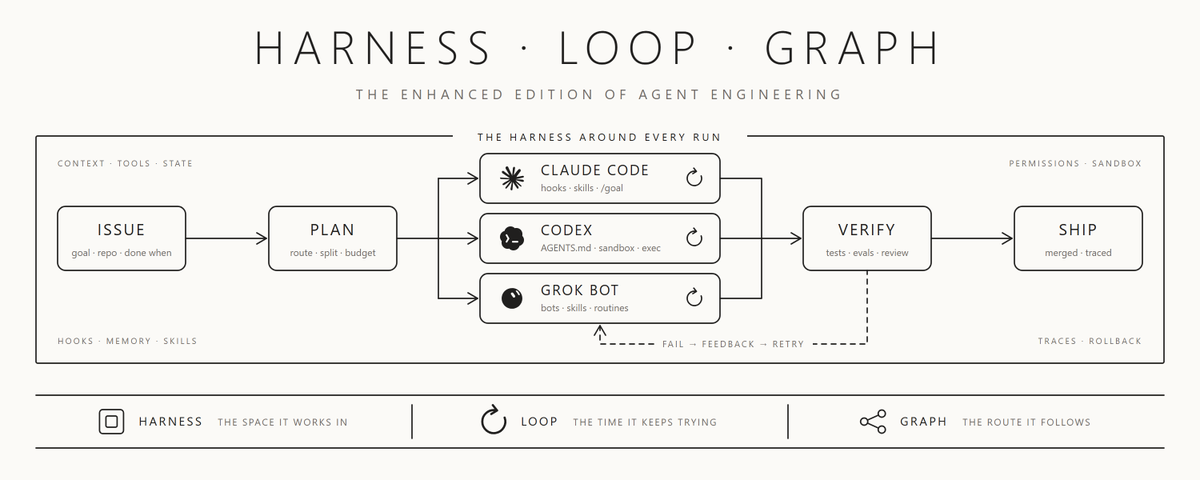
That is why the agents that work today don't run on the model alone. They run inside a loop that checks every step before the next one
The people who build that loop around the model are the ones whose agents don't fall apart on step 5
See how the harness, the loops and the graph fit around the model in the guide below ↓

Jan Ni retweeted

BREAKING: Password manager 1Password confirms hackers accessed customer information
Readers added context they thought people might want to know
1Password confirmed that an attacker accessed some customers' names, email addresses and non-sensitive account data. However, no customer vaults, passwords or secret keys were accessed. The company says no action is required but to watch for phishing.
1password.com/blog/update-on… techcrunch.com/2026/11/25/1pa…
Jan Ni retweeted

WHAT DEMOCRACY ARE YOU EVEN TALKING ABOUT, DARIO?!
You literally just cashed out $280.4 MILLION at $83 while your stock crashed below $80, and now you're dropping a 1,000-word sermon about Greek philosophers and "human free will."
Are you out of your fucking mind?
Open your own S-1. Your public shareholders don't even control the board. You locked board control inside an unelected 5-person trust featuring ex-Fed chair Ben Bernanke and Trilateral Commission / CNAS head Richard Fontaine.
Jensen Huang. He fought the chip export bans choking open weights. Anthropic poured $40M into Public First Action, whose $15M ad push ran 2 of the 3 House chairs who dragged Jensen in on Nov 5. A week later he was out right before your IPO while Nvidia was still on the hook for a $10B buy at $83. To me, that push against Nvidia looked like a straight-up setup to clear the runway for your listing.
You lecture rival CEOs about "vibes-based positioning" while running one of the most anti-consumer operations in AI: taking $200/month from paying users, banning accounts overnight with zero refund and zero reason, and privately pitching lawmakers your own safety bill to box out open models.
And look at the cash-out. All 7 co-founders already walked with $1.96 BILLION in cash at $83 (3,378,378 shares each, SEC Form 4). Public buyers bought $ANT into an 8.7% float, already went underwater below $80, and now face a Dec 15 insider release schedule that dumps 11.5x more shares onto the market by Nov 2027, on top of $900.9B in compute commitments rated BB+ by KBRA.
You cashed out at the top, went after Nvidia, lobbied against open weights, banned paying users, and locked your own shareholders out of power. Save the Greek philosophy. Nobody believes a single word of this democracy bullshit anymore.

No, I do not believe that we should “surrender human free will” to AI systems, and it’s absurd to suggest that I do. I have written hundreds of pages of essays and a constant theme in them is the need for AI to be governed by legitimate democratic processes. For millennia (going all the way back to Greek and Roman philosophers), advocates of autocracy have claimed that it leads to better, faster, or more decisive decision-making than the messy process of democracy. Even if this were true (which I doubt!), we should never sacrifice legitimacy or self-determination at the altar of efficiency or security. This argument against autocracy applies word for word against governance by AI, and I feel equally strongly that turning over governance to AI is a bad idea.
No one who had carefully read my writing or my interviews could reasonably conclude that I believe anything different. For example in an interview on CBS a couple months ago, I specifically called for AI to be governed democratically. I call for the same in Policy on the AI Exponential, Machines of Loving Grace, and The Adolescence of Technology, and We Must Pace the Frontier. Machines of Loving Grace contains an extended section on using AI to revitalize democracy, and discusses the use of AI as an aid to citizens in their decision-making, "aggregat[ing] opinions and driv[ing] consensus among citizens, resolving conflict, finding common ground, and seeking compromise.” The clear and obvious implication is that humans should remain the ones making political and governance decisions. The Adolescence of Technology has an entire section on fighting against AI-driven tyranny, and I even discuss the danger of AI labs usurping power and come out strongly against it — by implication, this definitely includes an AI lab usurping power and giving it to AI itself!
If I thought any of this was a good idea, I would be advocating for it in public, just as I have not been afraid to advocate for many, many unpopular views over the last few years. But I am not advocating for it, because I think turning over governance to AI is a terrible idea.
Separately, I think there is frequent conflation (including in this article) between the idea of “surrendering human free will” to AI in some grand sense of global governance, and the more prosaic idea that as AI systems advance, they become capable of doing specific tasks in a more automated way. This is not AI “running the world,” but AI driving a car, designing a cancer drug, or writing software end-to-end. Here, my view is mixed. AI doing more complete or larger tasks is economically valuable and can drive important advances in software, medicine, transportation, energy, etc. It is clearly desirable in many cases and will save a lot of lives. But it has downsides as well, and in some areas it may not be worth it.
For example, using AI too autonomously to build the next generation of AI systems (known as recursive self-improvement, or RSI) may cause AI to improve faster than we can control or adjust to it, so we may want limits on this process. As we said publicly in early November, we don’t expect it to be safe for Claude to build successive frontier models fully autonomously, without meaningful human supervision or understanding. Second, in some contexts, using AI in too end-to-end a manner may be a cause of serious job disruption, and it may make sense to slow or even stop some AI deployments to give people more time to adapt. Third, while the use of AI for alignment research is an incredibly valuable tool, it must be done with caution, because we may not be able to trust the work of the AI system. Finally, in many cases, humans would simply prefer to do some activities themselves, so they can stay deeply engaged in what matters to them, even if AI can do those activities better. There are countless other examples and hard cases. I don’t think there are any easy answers here, nor is there (nor should there be) any single decision-maker: some of these decisions will be made by society, some by government, some by AI companies, and some in a decentralized manner by individuals expressing their own preferences as consumers, which may differ from the preferences of others.
I don't think that other AI leaders or AI companies have significantly different views from me on whether specific tasks should be automated. Certainly the products that they offer don’t differ materially in their orientation towards automation of tasks; every company seems to be releasing models more and more capable of task automation (as that’s been the general consequence of scaling up AI training), and every company claims to understand there are risks and downsides of such automation and to offer safeguards. If anything, Anthropic has been the most vocal and the most proactive about acknowledging these downsides and trying to address them. For instance, it’s fairly absurd to cite my statement that fully autonomous weapons might “one day be needed for the defense of democracy” as differing from that of other AI companies, when I was willing to risk Anthropic’s future as a company to refuse to allow our existing AI models to be used for autonomous weapons even in the face of legal sanctions, and no other AI company did the same.
To summarize, as applied to grand questions of how we govern increasingly capable AI, I have been vocal and consistent that AI needs to be governed by a legitimate, democratic process and that “surrendering human free will” to AI systems is a terrible idea. As applied to automation of specific tasks by or for people, my views are more mixed, but I don’t think they differ from those of other AI companies — most other companies seem to be offering similar products and confronting similar tradeoffs without having perfect answers to them. What is happening is that there’s a sort of vibes-based commercial and political positioning that some AI CEOs are engaging in, where they repeat slogans like “human control and agency,” or “AI should be just a tool,” without actually doing anything different in their products or taking seriously the difficult questions that lie behind these slogans.
Jan Ni retweeted

JUST IN: Anthropic CEO Dario Amodei warns that allowing autonomous systems to govern humanity would be a “terrible idea.”
Jan Ni retweeted

It's confusing how in many western countries any young man who manages to illegally arrive ...automatically becomes an "asylum seeker" with long lines of NGOs there to help them stay and get benefits and they might be put up in hotels;
But if you're a woman from Afghanistan or a minority being persecuted...there's basically no way to even study in the West.
It's kind of bizarre and symbolic to prefer young aggressive men, who won't stand in line and apply for a visa...over women who have degrees and have studied and have waited in line and applied legally.
What does it say when a society prefers illegal activity and aggressive men who push their way to the front; over people who are polite and law abiding?
bbc.com/news/articles/c6vg25…

Jan Ni retweeted

Linus Torvalds is pissed off and tells Linux developers to “get your shit together” after a 41,000-line update involving AI.
The EXT4 filesystem update included AI-generated bug fixes and thousands of lines of new tests.
It arrived late in Linux 7.4’s release cycle, when developers should be stabilizing the kernel.
“STOP THINKING THAT YOU — OR AI — NEVER ADD BUGS WHEN YOU FIX SOMETHING.”
He reluctantly merged it, but warned he’d ignore another update like this. The new tests should have waited for the next development window.
Source: lore.kernel.org/lkml/CAHk-%3…


Jan Ni retweeted

🚨🇫🇷 ÚLTIMA HORA: El periodista israelí Zvika Yehezkeli se infiltró con identidad falsa y kufiya en los disturbios de París para investigar quién está detrás de las revueltas.
Su conclusión: «Los medios no les están contando la historia correcta. Es una intifada islámica. Hay un ADN islámico».
Asegura que habló con jóvenes de familias inmigrantes de 17 y 18 años que destruían las calles y decían: «Esto es el islam» y «hemos venido a conquistar».
También relató que conoció a dos inmigrantes argelinos que llegaron desde Ibiza en una lancha neumática para sumarse a los disturbios. Según Yehezkeli, le dijeron: «Hay una yihad aquí en la que queremos participar».
Además, denunció que algunos inmigrantes describieron una estrategia para ocupar las lujosas viviendas de ancianos que mueren sin hijos, y advirtió que existen suburbios de París a los que ni siquiera entra la policía.
Sus declaraciones forman parte de un nuevo documental grabado en el corazón de los disturbios.
Jan Ni retweeted

Things to consider...
I never saw Jenny Nielsen's paper before my audit. I did not know it existed. I ran my audit out of the source files themselves, and she ran hers, and we landed on the same definitions — anyGeometry defined as True, heights copied in and closed by rfl.
That should tell you something. Two people who never spoke, working separately, opened the same files and found the same things. That is not copying. That is what is in the files.
So stop yelling at us and look at the situation at hand. The findings are at file and line, in my paper and in hers. Check them yourself.

Jan Ni retweeted

Claude, if you know how to prove Riemann hypothesis, how come you can't find a bug in my Java code??
Jan Ni retweeted

Security researchers just planted secrets inside nearly 2 MILLION AI prompts to see where the data actually went.
What they found is fucking wild.
They inserted fake AWS keys and unique tracking links into prompts sent through AI providers and then waited, like 1980s cops in a stakeout car with coffee and donuts.
The secrets started showing up OUTSIDE the systems they were sent to. At least 3 providers showed evidence that prompt data had been exposed and some stolen AWS keys were tested within HOURS.
Attackers searched S3 buckets and Secrets Manager, tried creating IAM users and eventually generated TENS OF THOUSANDS of AWS API calls using the bait credentials.
My fav part though is that one secret link from an AI prompt appeared in an internal company chat 24 DAYS LATER. Within two minutes it was opened from 3 computers and 3 phones in Beijing and Shanghai.🤯
OpenRouter has now removed 3 providers and stripped 125 AI endpoints of their Zero Data Retention status. Mind you, OpenRouter says IT wasn't breached and the problems were further down the provider chain.
Are you kidding me though? You send something to an AI model and even though the model might be hosted by somebody else, and that company might route it somewhere else.
That provider might subcontract inference again, and suddenly the API key you pasted into your coding agent has travelled through an infrastructure supply chain you didn't even know existed.
We've spent the last two years worrying about what AI models SAY, but we should be worrying about where the bloody prompts GO.
Jan Ni retweeted

Update on formalizing Masullo’s proof of the Riemann hypothesis.
93 contributors provided proofs for 13k+ statements using 465k lines of lean.
The current gaps:
- 7 false statements, corrected, but the intended statement is uncertain
- 3 classical theorems not yet proved
- 5 proof steps too imprecise to formalize
- 6 scattered statements which don’t connect to the rest yet
-1 principal result, 12.5.1.1, the cancelation of zeros outside the strip
1/3

Jan Ni retweeted

The reason why the recent proof of the Riemann Hypothesis feels so alien is not because it's beyond human comprehension, but because it's essentially an "epistemic zero-knowledge proof".
It establishes a fact through a long chain of logically valid deductions without revealing its deeper generative structure – a bit like determining the position of a puzzle piece by ignoring the picture and instead matching shapes until you reach all four borders.
The only reason why mathematicians are disappointed, is because they expected that placing the center piece would come from "completing the picture" rather than building this awkward spine 😅
I personally think that even such a constraint-based proof is valuable because it can serve as the foundation for a larger reverse-engineering effort and should offer at least some new questions and structural insights, but there is a qualitative difference between establishing the position of a single puzzle piece and assembling a coherent patch of the puzzle whose emerging picture reveals where and how it fits into the whole.
I think mathematics should reconsider what it means for a problem to be solved, especially when awarding prizes for major breakthroughs. Establishing that something is true and uncovering the deeper structure that makes it true are two distinct intellectual achievements, and perhaps they should be recognized as such (different kinds of prices).
Jan Ni retweeted

I have a genuine question about (2). Does the size of the lean code prohibit a simple prompt such as "Clean up the unused lean code" being effective?
I just find this "sorry for throwing garbage at you" tone more disrespectful than apologetic. Maybe that's just me.

Stupid things I did:
1. 250,000+ pages was a joke guys!, I find big number extremely hilarious. I tried to make it clear by the level of pedantry of the reals total ordered statement in the main theorem, but people ran with it unfortunately and I didn’t feel like talking on social media in the days after the announcement, though I did have a good time with the memes. Sorry!!! (Similarly with our YM4 existence I found it extremely funny that we were slowly working through 60,000 pages of slop, though the committee asking for Lean made me feel dumb about wasting our time with that. But 60,000 funny.) Tao advises to not joke in papers, see also the Big Lebowski reference I shoehorned, I now understand why… I didn’t feel comfortable having any slop writeup attached to this problem, and I figured I can’t produce anything readable anyway, so I went off the Lean to lengthmaxx.
2. The Lean is full of garbage obviously, but compiles, but all criticism of such garbage is totally reasonable and accepted, I should have cleaned it up but it was randomly difficult to for various strange reasons. Mea culpa…
3. @scottnarmstrong clocked me, indeed even as a student there were theorems that took me the better part of a decade to write up, but with this one I should hopefully be more responsible. (I really was yoloing a lot in there, I bet most is unnecessary in the end, admittedly the lazy thing to do would be to wait because it’ll simplify massively…)
4. I forgot to emphasize what I think is the point. Arguments like these, cool, but they are the raw inputs when interpolating definitions. We don’t have the / an “H^1 object” over number fields, and probably for a layperson the fact that we fight hard for these arguments for the purpose of definitions is not clear a priori (that’s at least my philosophy). Just like I knew I must fight for an utterly simple Weil / Deligne, I feel Riemann should be easy, and any real difficulty is an indication our setup is just dumb at the moment.
Jan Ni retweeted

Consider this a petition and like and repost if you agree.
The AMS (@amermathsoc ) and AGMAI (@wtgowers tagged here as a member) should demand from Anthropic @AnthropicAI full transparency about how the RH Lean-proof was obtained. In particular, what model and what amount of resources went into this particular project?
The lack of transparency about what's possibly one of the most consequential proofs ever is just unacceptable. It is incumbent on Anthropic to explain to the scientific community how this was accomplished, just as we expect any other scientific achievement to be fully documented when presented to the public and the scientific community.
