



Pinned Tweet
Agentic coding tools like Cursor and Claude feel incredible in software engineering repos, but underpowered in data science notebooks.
I analysed 300 notebooks & repos from GitHub to see how the work differs, and what that means now that agents are writing more code. 🧵👇 (1/10)

ALT A density plot titled "Character-Level Entropy Distributions: DS vs SE Code." Two distinct curves show Data Science (DS) code has higher character-level entropy than Software Engineering (SE) code. The DS peak is centered around 4.941 bits, while the SE peak is lower at 4.554 bits. A Mann-Whitney U test confirms this difference is statistically significant (p < 0.0001).
Jason Hillary retweeted

You shouldn’t have to rebuild your work just to ship it.
With Zerve Deployments, go from notebook → production without leaving your workspace.
Deploy apps, APIs and reports alongside the work that created them.
No context switching. No separate deployment platform. ↓

Most AI tools help you write. Ours helps you do research.
Today we launched the AI Co-Researcher at Zerve.
It's a multi-agent system that runs the research cycle end to end. Not a chat assistant sitting next to your notebook. A parent agent that plans the work and spins up sub-agents for systematic review, coding, analysis, replication, and drafting.
#AI #MultiAgent
It also ran a meta-analysis of social media use and adolescent mental health across 11 longitudinal studies, and pooled CRISPR off-target rates across 85 studies. Academics in each field reviewed the outputs. Pick them apart, that's the point of publishing them.
research.zerve.ai/research/s…
research.zerve.ai/research/c…
Jason Hillary retweeted
Introducing the Agentic Report.
Describe what you want, and an agent turns your notebook analysis into a live, shareable report — grounded in every number, chart, and claim.
Stakeholders can highlight a section, ask the agent to go deeper, and chat with the report directly.
Same analysis. Many audiences. Every answer traced to the source.
Today we're launching the Agentic Report on @Zerve_AI
Analysis got faster. Communicating it didn't.
One prompt. The agent turns any analysis into a live report stakeholders can chat with.
Same analysis. CIO version. PM version. Risk version. Three reports, three audiences, one source of truth.
Jason Hillary retweeted

I built an AI-powered prediction engine for #ZerveHack2026 entirely on @Zerve_AI — from raw CSV to deployed web app.🎥 Demo → youtu.be/b2eOzGv4Wh8
🌐 Live app → soccer.hariths.com
🔬 Zerve canvas → zerve.ai/gallery/b273a962-1c…
#ZerveHack2026 #ZerveAI
We added a Deploy tab to notebooks.
The agent reads your code, writes the app, gives you a URL. FastAPIs, Flask, Streamlit, Gradio, Dash — same project.
Hot reloads. Live previews. Streaming logs.
@Zerve_AI turns any analysis into a live app in seconds.
Full demo below ↓
Jason Hillary retweeted
Every broken environment started with "just pip install it."
Zerve environments let you define and version your Python, R, and Linux packages in one place.
Upload a requirements.txt or pyproject.toml, reuse across projects, run multiple environments in one workflow, and go from dev to deployment without the usual mess.
One less thing between you and the actual work.
#Python #DataScience
Jason Hillary retweeted
Every Zerve cell run is fully inspectable.
Code that executed. Output produced. Errors. Runtime.
No more guessing what broke or why. Just click back and see exactly what happened.
Debugging and collaboration, fixed.
#DataScience #DeveloperProductivity
Jason Hillary retweeted
The #1 frustration with AI agents isn't the model. It's losing context.
Zerve persists execution state automatically. Outputs, variables, everything. So your agent always knows what already ran.
No starting over. No re-running. Just momentum.
#AIAgents #DataScience #AgenticDataWorkspace #DecisionGradeDataWork
Notebooks feel brittle because meaning moves, but the name doesn’t.
A small working set of variables evolves, gets reused ~3.4× more, lives ~10× longer, and is depended on far downstream.
Local change. Global dependency.

Is AI and vibe coding changing what actually gets shipped?
I looked at recent Product Hunt data to find out.
AI Marketing, Dev Tools, and Productivity now make up ~55–60% of AI launches. High volume. Heavy competition.
Some categories are accelerating fast. AI Analytics ~80% growth. AI Writing ~76%. AI Design ~60%.
But activity isn’t outcome.
AI products get ~60% more average votes, while the median stays the same.
The standout is AI Voice & Speech. Lowest noise. Highest winner rate (~23%).
If launches are an early signal, what does this say about 2026?

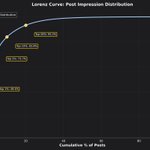
1/🧵 Founder-led marketing follows a power-law.
Looking at founder posts across AI companies over the past 12 months:
~1% of posts account for ~49% of total impressions
• ~5% account for ~74%
• ~20% account for >90%
Winner-takes-most dynamics, similar to venture returns.

8/🧵 There are interesting exceptions.
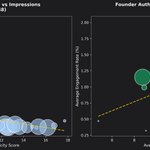
For some companies, like Perplexity and Sierra, founder attention shows a positive relationship with traffic.
These cases look less like isolated spikes and more like coordinated narrative reinforcement across founder, product, and company.
That suggests a different dynamic:
attention not just as awareness, but as part of a broader go-to-market system.
