

Investor at G2VP. Former founder. I write at https://xitter.gq/t.co/1B594WLKQY. Views are my own.
San Francisco, CA
Joined January 2011
- Tweets125
- Following319
- Followers266
- Likes854





My prediction in light of Anthropic's IPO: it will become the most volatile mega-cap.
A discounted cash flow model is a standard framework for valuing a company. It works best when the business can be projected forward with reasonable confidence. Anthropic's economic engine will change rapidly, making those forward projections unusually difficult and the stock unusually volatile.
Today, Anthropic is largely a model and token business. Its prospectus describes usage-based pricing as the substantial majority of revenue.
The next phases will look different.
Frontier capability will move through increasingly controlled distribution channels as safety, security, and distillation risks rise. Anthropic will move from selling intelligence to selling tasks and outcomes. It will ultimately operate entire business processes. In some industries, it will run entire companies with only a small human team supervising objectives, exceptions, and accountability.
That transition resets the variables that investors rely on: unit economics, capital intensity, margins, customer relationships, competitive set, regulatory exposure, and the risk of competing with current customers.
A conventional DCF projects a relatively stable business model forward. Anthropic will require a sequence of different DCFs for different phases of the company.
Revenue can keep compounding through each phase. The stock will repeatedly reprice as the market works out what cash flows it is actually buying.
1
63
AI infrastructure looks unprecedented against a narrow slice of history: railroads, highways, or one asset class.
The relevant record is global, multi-decade supercycles: electrification, oil, cars and roads, aviation, renewables.
At 3 years in, AI is early in the comparison.

23
GPUs get the headlines. Data infrastructure gets the commitments. VAST reports $10B+ committed by 14 customers for software and supporting hardware. AI’s buildout is much bigger than chips. vastdata.com/press-releases/…

1
56
Jasper Platz retweeted

We need a new Plaza Accord, to revalue the yuan. China's exploding trade surplus hurts everyone else, but it ignores pleas to pivot from exports to consumption. A yuan revaluation, backed w/threat of tariffs, may be the only solution. My latest: wsj.com/economy/trade/why-th…


The source of all market volatility in one chart

This is for 2030 which is 3.5 years away! 100GW gap between forecasts. For folks not in the loop that is:
-$5 trillion of capital between the high and low end (@ $50bn/GW)
-larger than ALL of texas peak power (~85GW)
-~25% of the global nuclear fleet (380-400ish GW)
Why there is such a gap between bulls and bears, because quite literally there is a universe of difference between the two when you're underwriting 2030+.
"There is now a spread of over 100GW between the lowest and highest forecasts, underlining the level of uncertainty around how much capacity will get built"

3
90
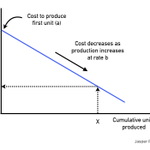
In 1936 Theodore Paul Wright published a paper called “Factors Affecting the Costs of Airplanes”. His key observation is that we “learn by doing”. The more we do something, the better we get at it. Unlike its famous sibling, Moore’s Law, which predicts prices as a function of time, Wright’s Law predicts prices to decrease as a function of total production to date.
In this post I explore the implications for new technologies that have to find a path to scale production to drive down costs. Founders, investors and policy makers need to assess the slope of learning curves to predict if new technologies have a shot at outrunning incumbents' learning curves.
jasperplatz.com/post/using-w…

1
100
Pricing carbon
Benjamin Graham famously said: “In the short run, the market is a voting machine but in the long run it is a weighing machine.”
The EU carbon market will work the same: in the short term, prices will gyrate, and movements may be hard to explain. Over longer time horizons the price will be determined by rational players making decisions to maximize their profits. In this set of upcoming posts (jasperplatz.com/subscribe) I’ll explore the key forces that will move the price of carbon.
Let’s dive in.
A single-supplier market
The ETS is a market created by government policies. Any changes to these rules will impact carbon prices. A decrease in supply of allowances will drive up prices, and vice versa. The chart below shows the impact of the “Fit-for-55 package” that was adopted in 2023. The linear reduction factor (LRF) - i.e. by how much allowances are reduced each year - was increased from 2.2% to 4.3% which accelerates the path to a zero cap from 2058 to 2039. The red line charts the path to a zero-carbon cap economy. The carbon price will be the arbiter to keep us on track. If we’re behind, prices will increase to incentivize investment in decarbonization efforts. If we’re on track or ahead of the curve, prices will move sideways or decrease.
The single-supplier nature of this market is worth highlighting further. The supply side is purely determined by policies and known by all market participants. In most other markets, participants can decide to increase supply by e.g. increasing production. As such, the European ETS market is more akin to a currency market where the supply is determined by a central governing body - in that case a central bank.
Having a predictable, fixed supply is a cornerstone of a cap-and-trade system. With that knowledge, each market participant can plan their actions. Emitters can abate emissions or buy and sell credits. Their actions will determine the demand side of the market which we’ll cover in the next post.
The role of the Market Stability Reserve (MSR)
The MSR is a fairly complex, but critical mechanism that allows the EU to react more flexibly to market shocks. In a nutshell, 24% of all ETS allowances are placed into the MSR each year. Depending on the total allowances in circulation, the mechanism then removes allowances from the market or distributes them by adjusting the auction volume in subsequent years.
The MSR is a regulatory innovation born out of the oversupply of allowances in the first phases of the ETS that nearly killed the market’s credibility. In the early years, many companies built up allowance reserves which led to a glut of allowances and was a big factor why the carbon price was irrelevantly low for many years. When the MSR was introduced in 2018/2019, it had the intended impact on the carbon price lifting it from ~€5/ to ~€20/t. After its introduction, someone said: “The MSR was politically important to demonstrate that the doctor had not given up on the patient.”
Interestingly, the MSR release mechanics are not directly linked to the carbon price but to the number of permits “banked” by participants, i.e. the permits held by companies for future use at the end of each year. Given the novelty of the MSR - and the ETS market as a whole - the impact of the MSR on prices is not well understood yet. Some researchers believe it will indeed increase allowance scarcity in the long run as designed but at an uncertain scale. They believe, however, it may, in fact, increase, not decrease price volatility and increase the market’s vulnerability to speculation and manipulation.
The MSR’s impact on the ETS is still unknown and will continue to be a hotly debated topic. As we learn more about the overall impact of the MSR on prices and market stability, I would not be surprised if we see changes made to the MSR over time.
Subscribe (jasperplatz.com/subscribe) for Part 2 which explores the demand side of the market and how emitters will decide whether to abate or buy credits.

1
75
We are on the cusp of creating a new economy. And it is the most important economic experiment of our lifetimes.
Humans are emitting 60Gt of CO2-equivalent each year - that's 60 billion tons. Let’s say we put a price of $100 on each ton of CO2, the GDP of the carbon economy would be $6 trillion making it the third largest economy in the world. For a long time, economists have proposed pricing emissions into our economic activities to fairly capture the damage they cause to others. The time might have finally come. Over the past 20 years the EU has slowly built the largest carbon market in the world. At first it was irrelevant and mostly ignored because the price was laughably low. The latest regulatory tweaks in 2023 tightened supply sufficiently that it is being taken seriously. And it will impact most industries in Europe and countries doing business in Europe.
William Gibson said “The future is here, it's just not evenly distributed.” The European carbon market may just be the future that others will follow.
This time will be different
It's a bit of a joke among venture capitalists to proclaim that "This time will be different!". It usually isn’t. So feel free to take the other side of this argument. And I totally get the skepticism: we've been talking about a price on carbon, cap-and-trade, carbon tax, and similar ideas for FOREVER. Economists have been lecturing about emissions being a negative externality for decades; in fact they’ve used it as the canonical example of failed markets: if emissions aren’t priced into our economic activities they will therefore be ignored by rational market participants. In theory, they told us, all we need to do is create a pricing mechanism for emissions. But it's been just that - a theory taught to bright-eyed and bushy-tailed undergrads that has never made it out of textbooks into the real world.
Until now. This time will be different. Here is why:
1. The ETS is tightening supply
The European Union Emission Trading System (EU ETS) has been around for almost 20 years, but has been largely irrelevant until now. Changes in 2021 and 2023 significantly tightened the available allowances, creating scarcity of emission credits and therefore establishing the largest market for emissions in the world. What is the ETS, you might wonder? The details are complicated, but in a nutshell, it’s a cap-and-trade system in which emission allowances decrease annually until they hit zero by 2039. The idea is to price-in emissions and let the market figure out the most efficient approach to reduce them over time and get to a net zero economy.
Until recently, the ETS didn’t matter much. Emitters were given more than enough free allowances to go about their day. The first 16 years of the ETS were like playing musical chairs with more chairs than kids. Now we've gone past the point of equilibrium and there are not enough allowances for all the emissions in the EU. You can see it in the ETS price development in the last few years below...the cost of emission permits has surged from a stagnant €5 for over a decade to fluctuating between €60-100 in recent years.
2. CBAM will stop leakage
In 2023 the EU added another lovely-named regulation called the Carbon Border Adjustment Mechanism (CBAM), an important complement to the ETS. Without it, the risk (and likely outcome of the ETS) is carbon-intensive industries relocate outside Europe to avoid the ETS and then import their goods back into the EU. The CBAM is plugging that hole by requiring a border tax on carbon-intensive imports covered under the ETS. The price of that tax is linked to the ETS to create a unified market for carbon abatement.
The CBAM is going through a transitional phase until 2026 at which point the importers of all those energy-intensive products will start paying the import tax to level the playing field with the ETS. By 2030 all sectors under the ETS will be covered by CBAM. No more carbon import loophole - at least that's the theory.
There you have it - the EU will have created the largest Carbon Economy in the world. Pretty incredible if you think about it. We've talked about it for decades and it might finally be happening.
A word on regulations
I can already hear the free-market aficionados shouting, "We don't need more regulations!" Sure, if you’re of the mindset that carbon emissions don’t cause harm, these blog posts are not trying to convince you otherwise. However, if you think we need to reduce emissions and believe in free market solutions, a well-functioning Carbon Economy is the most efficient way to get there. Far better than having government officials deciding how to spend billions (or trillions!) in subsidies on an arbitrary set of initiatives. Programs like the IRA (just like the American Recovery and Reinvestment Act from before it) all fizzle out at some point. Without a long-term, market-based approach to find the lowest-cost carbon reduction solutions, we'll waste a bunch of private and public money.
Final thoughts
A well-functioning carbon market creates predictable incentives for the best technologies and companies to emerge and thrive. The ETS has profound implications on nearly all industries in Europe. And it goes well beyond Europe: any company selling into Europe should know its impact. The implications are fascinating and complex which I’ll explore in future posts. My goal is to keep the boring policy and regulation minutiae to a minimum - instead I’ll focus on what the ETS means for startups, investors and industry incumbents and how they can best position themselves in this new carbon economy.
I write about the Carbon Economy - follow along and subscribe at jasperplatz.com


2
311
Not all Opex is created equal. If Opex is needed to keep the current products going, it's more COGS than Opex. Eg much of software R&D is often used to keep existing products running and at parity with the competition. Same with with support and customer success functions.
Investors need to look below the gross margin line to understand the true operating leverage of a business.

In “Do software companies actually have good margins?”, Benn Stancil makes a case for a counterintuitive point : Software companies are much less profitable than they might seem.
Why?
Because the research & development costs associated with software should be part of their cost of goods sold. Software companies don’t invest once in R&D & then sell copies of the software as we did in the 90s on CDs.
It’s software-as-a-service. So the costs of developing & maintaining the software are ongoing.
If that argument is correct, then the average gross margin of a software company in the public domain would fall from 72% to 47%. Quite a stark difference.
Profitability for software companies isn’t straightforward. Different accounting rules govern revenue & cost recognition. In 2017, the industry migrated from ASC 605 to ASC 606, which are financial arcana as esoteric as it reads. Overnight, some companies were more profitable & others were not.
So let’s set profitability aside for a minute, & look at free-cash flow yield.
Free cash flow yield offers investors or stockholders a better measure of a company’s fundamental performance than the widely used P/E ratio. Investors who wish to employ the best fundamental indicator should add free cash flow yield to their repertoire of financial measures.
FCFY is a metric that measures this : how much of a company’s revenue, after funneling through every cost imaginable, is left over in its bank account at the end of the year. That’s my mental model for it, anyway.
Software companies top the charts at 3% over the last 20 years, according to data from New Constructs, a financial research firm. For a period from December 9, 2009, to approximately March of 2016, technology companies produced nearly 5% free cash flow yields on average.
There are times when other sectors yield more. For example, energy tops the list at the moment, primarily driven by the fluctuations in those markets. But over two decades technology tops the list.
And if AI fulfills anywhere close to its promise, we should expect that trend to continue.
Despite the enthusiasm from Investopedia, I think it’s important to say that no financial metric is perfect & all of them are proxies for the ultimate performance of a business. Free cash flow yield has its imperfections & nuances like any other metric.

118
Jasper Platz retweeted

I decided to outsource my entire personal financial life to GPT-4 (via the @donotpay chat we are building).
I gave AutoGPT access to my bank, financial statements, credit report, and email.
Here’s how it’s going so far (+$217.85) and the strange ways it’s saving money. (1/n):

Mind still boggled how good this is. Writing product documentation is not a lot of fun. Having @OpenAI do most of the work is huge


Congrats to @ConductorOneInc on their $5M seed round. Excited to be joining a great group of investors to support @alexbovee @pquerna and team on their mission to secure the world’s adoption of SaaS techcrunch.com/2021/04/05/co…
8
There is so much capital out there trying to get into deals. And not enough written about how startups should think about capital adequacy at each stage. This is great 👇

1
Was fun talking with @pdstafford on his WOSV podcast about the impact of Figma on (content) design teams, how tooling and process can bring designers and engineers closer together to create great products, and much more. Check it out!

🚨 NEW PODCAST 🚨 In this episode of Writers of Silicon Valley, I speak with @JasperPlatz, the CEO and founder of @stringsHQ, about how democratizing design software will empower content designers, what design-led PMs might look like, and more!
writersofsiliconvalley.com/e…
