

Shitposting || Technical writing || Contributing to my favorite project
Succinct
Joined March 2024
- Tweets25.3K
- Following2.5K
- Followers1.9K
- Likes22K


Pinned Tweet
Most people see Verde everywhere but very few understand what it actually does, but before we dive in let me quickly explain Verde and what it does
Verde is @gensynai verification system that helps people check whether machine learning training was done correctly, even when it’s run on many computers owned by different people.
So let me break it down
Imagine this:
You and 10,000 other people are training the same AI model…All on different machines, in different countries, with different hardware.
Now one question matters more than anything else: “How do we know nobody cheated?”
How do we know the training was done correctly and not faked, altered, or manipulated? That’s the problem Verde exists to solve.
Normally, verifying AI training is painful.
To check if someone trained a model honestly,
you’d have to redo the entire training process yourself, That could take weeks, massive compute, insane cost, Which makes verification almost impossible.
This is where Verde changes the game...Instead of redoing everything, Verde only checks the exact moment something goes wrong. It uses what’s called a “disagreement finder” but think of it like a detective, not a tool.
If two parties say this is the result and the other says: No, that’s not what I got, Verde doesn’t panic. It drills down step by step Until it finds the one tiny operation where they disagree.
Not the whole model, Not the full training..Just that one moment, That single line, That single computation...Then only that gets checked.
Now here’s the part most people don’t realize…Different computers don’t always agree on math.
A Mac and a Windows laptop, An NVIDIA GPU and an AMD GPU, Even two CPUs from the same company can give slightly different answers to the same calculation...Tiny differences But enough to break verification.
So @gensynai solved that too, they built something called Reproducible Operators (RepOps)...Think of RepOps like Universal math rules for machines. No matter the laptop
No matter the GPU, No matter the hardware,
The same input always gives the same output
every time across every computer.
So now:
● Training can be verified without rerunning everything
● Disagreements are isolated instantly
● All machines speak the same “math language”
● Trust no longer depends on reputation
● Anyone can contribute compute safely
Even a laptop.
Even a home PC.
Even a phone one day.
Verde isn’t just software...It’s a shift in how we trust machines.
Before:
-Trust the lab.
-Trust the company.
-Trust the cloud.
Now:
-Trust the proof.
TL;DR
Verde makes decentralized AI verifiable. It doesn’t recheck everything, It finds the exact step that’s wrong and it makes all computers compute the same way.
So AI can be trained by anyone anywhere
without blind trust.

Jephtar 🐋🤍 retweeted

Not only do @rarelistio bring you a project but different varieties of options, at Rarelist launchpad, there are different projects to venture into all you just have to do is check the one that suit your ways and dive into it.
Rarelist is the launchpad of social activities with different categories of projects already listed and more to come in the future


I decided to join the moving train today, introducing to you @rarelistio
Rarelist is a social platform for creators, at Rarelist you find ways to create, different forms of reward pool and different projects to create about including rarelist herself.
The @rarelistio campaign is running in seasons and season 1 is currently live with $50k reward pool, tho the exact way the reward will be shared is not yet disclosed, I think it will be safe to join cause there is nothing like dilution here.
More information later

Jephtar 🐋🤍 retweeted
I decided to join the moving train today, introducing to you @rarelistio
Rarelist is a social platform for creators, at Rarelist you find ways to create, different forms of reward pool and different projects to create about including rarelist herself.
The @rarelistio campaign is running in seasons and season 1 is currently live with $50k reward pool, tho the exact way the reward will be shared is not yet disclosed, I think it will be safe to join cause there is nothing like dilution here.
More information later
Jephtar 🐋🤍 retweeted
I'm on a 2 days check in streak on @IPXExchange fandom program
IPX is a cloud based digital platform and scan to BIM service designed to bring physical buildings online. Created by the proptech company Integrated Projects, the platform is used to turn real world architectural spaces into precise, digital data models.
Rather than a physical stock exchange, it acts as a digital "exchange" and hub for building data, serving property owners, architects, engineers, and construction teams.
The exchange announced a 10 days fandom with a reward of $100k.
You choose your fan card, get aura and complete simple task.
8 more day to go, if you're yet to join here is the link
fanszn.ipx.exchange/i/FAN-VA…

Decided to join this
@FungoLabs is rewarding creators with 3% of her total supply on TGE, that's 300m tokens.
All you have to do to be part of this journey is to register here
X CAMPAIGN
fungolabs.org/launchpad/c/cf…
Jephtar 🐋🤍 retweeted
Decided to join this
@FungoLabs is rewarding creators with 3% of her total supply on TGE, that's 300m tokens.
Fungo have a total supply of 10B with huge part of it going to the community and NFT holders.
All you have to do to be part of this journey is to register here
fungolabs.org/launchpad/c/cf…
Then drop your best 5 posts about fungus, campaign started since November 1st, the final leaderboard will be published when campaign is over. You're not too late to give it a trial

Most people think staking = "lock tokens, get rewards."
On @GenLayer it's more like voting for who gets to judge AI-powered contracts. 🧵


Delegating isn't set-and-forget. You share your validator's fate:
✅ They perform well → you earn
❌ They get slashed → your stake shrinks too
A validator's pull in the network comes from stake, and each GEN of their own stake counts for more than a delegated one.

1
17
Validators are the nodes that do the judging. To get picked, they put up GEN as a deposit (stake).
You don't need to run a node. You can delegate: lend your GEN's weight to a validator and share their rewards. The minimum is 42 GEN, versus 42,000 to run a validator

2
53
Becoming part of the @GenLayer community of builders, validators, and creators. portal.genlayer.foundation/?…

5
93
Jephtar 🐋🤍 retweeted
THE INTERNET COURT GOT AN UPGRADE, A THREAD
@GenLayer is a blockchain settlement layer powered by a decentralized jury of AI models that resolves subjective, real world disputes for autonomous agents and smart contracts.
Start your journey here: portal.genlayer.foundation/g…

Jephtar 🐋🤍 retweeted

By introducing Intelligent Contracts backed by decentralized adjudication, @GenLayer bridges the gap between rigid blockchain infrastructure and fluid AI reasoning.
@kstellana explaining how Ai agents agree with each other with @laurashin and @CryptoHayes
Details in video below

How GenLayer Is Building a Court System for Disputes Between AI Agents xitter.gq/i/broadcasts/1MJgNbADD…

Jephtar 🐋🤍 retweeted
We all know that the GenVM runs the intelligent contract on @GenLayer but have we ever ask ourselves what makes GenVM stand out and different from EVM?
Here is me asking mochi the simple question no one wants to ask, and mochi delivered so greatly.
More detail on the pic attached

Jephtar 🐋🤍 retweeted
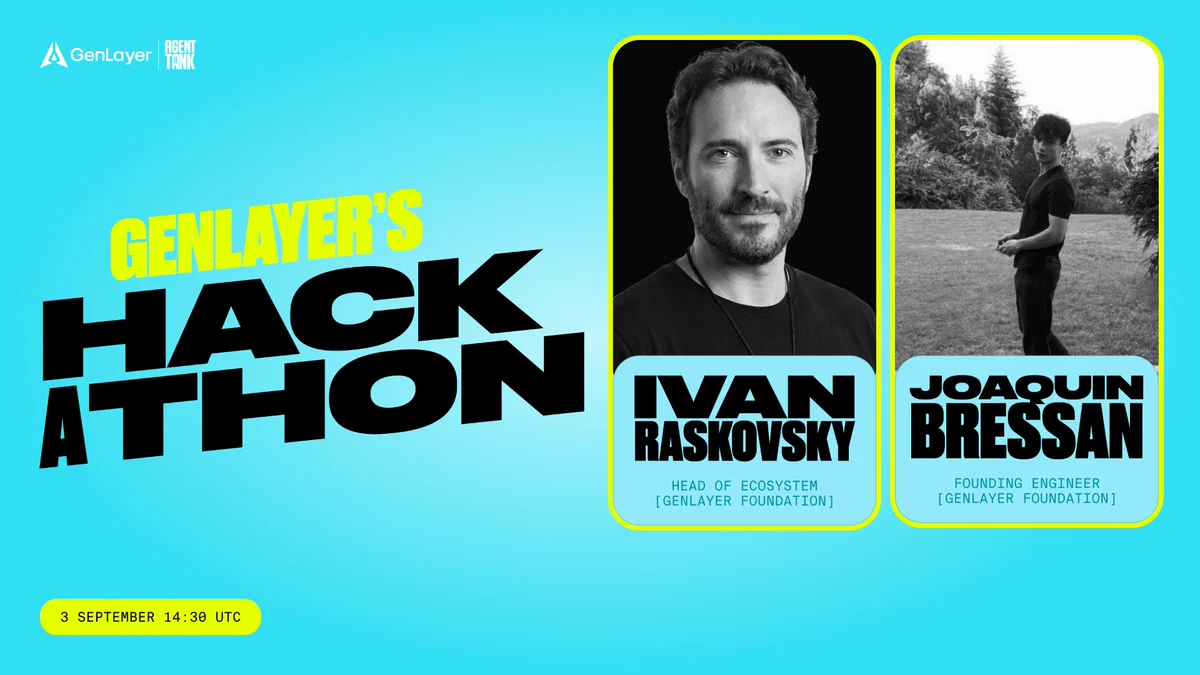
The Hackathon is live, @GenLayer is inviting builders from all community to join the Hackathon and build for genlayer. We're not competing with any chain, we're an intelligent layer that can be use by all chain.
@raskovsky
@joaquinbressan
More details in the video below

Agent Tank Hackathon opens today at 15:30 UTC.
The hour before, @raskovsky and @joaquinbressan will be live at 14.30 UTC on the six prompts and how 5% of all GenLayer Points gets split across everyone who ships.
Set reminder 👇
xitter.gq/i/broadcasts/1wxWjlvrd…
Jephtar 🐋🤍 retweeted
Exploring how AI driven agreements handle complex micro transactions with @GenLayer on the Internet court featuring
@liutenkos
@EdgarsNemse
@raskovsky
@Yellow
CLIPMASTER III SECOND SUBMISSION
Internet Court has a new consortium member.
We're going live today at 4.30PM UTC to talk AI and agent commerce, joined by @liutenkos from @Yellow, @EdgarsNemse, CPO at @GenLayerLabs, and @iraskovsky, creator of Internet Court.
Set your reminder 👇
xitter.gq/i/broadcasts/1nGeLMbym…
Jephtar 🐋🤍 retweeted
Exploring why blockchains are revisiting state channels for scalability, how they compare to Bitcoin's Lightning Network, and what it means for on chain transactions with @GenLayer on the Internet court featuring...
@liutenkos
@EdgarsNemse
@raskovsky
@Yellow
CLIPMASTER III SECOND SUBMISSION
Internet Court has a new consortium member.
We're going live today at 4.30PM UTC to talk AI and agent commerce, joined by @liutenkos from @Yellow, @EdgarsNemse, CPO at @GenLayerLabs, and @iraskovsky, creator of Internet Court.
Set your reminder 👇
xitter.gq/i/broadcasts/1nGeLMbym…
Jephtar 🐋🤍 retweeted
From idea to mainnet, dive into GenTalks as founders discuss launching powerful new use cases on @GenLayer.
BUILDING STARTUPS ONTOP OF GENLAYER
@EdgarsNemse
@raskovsky
@Yellow
@liutenkos
CLIPMASTER III CHALLENGE FIRST ENTRY
Internet Court has a new consortium member.
We're going live today at 4.30PM UTC to talk AI and agent commerce, joined by @liutenkos from @Yellow, @EdgarsNemse, CPO at @GenLayerLabs, and @iraskovsky, creator of Internet Court.
Set your reminder 👇
xitter.gq/i/broadcasts/1nGeLMbym…
Jephtar 🐋🤍 retweeted
UNDERSTANDING THE CANOPY TOKENOMICS
The @CNPYNetwork airdrop portal go live today, but before we go into that it will be good if we can understand the canopy tokenomics, staking emissions, halving and the rest. Now let's get started
If you are trying to wrap your head around how the Canopy Network keeps itself secure, rewards its participants, and handles its token supply, it helps to look past the technical jargon. At its core, Canopy is built to solve a major blockchain problem, how new app-chains (called Nested Chains) launch without struggling to find security from scratch.
Here is how the CNPY token powers that entire ecosystem.
1. CNPY Supply & Emission Schedule
Just like Bitcoin, CNPY has a fixed issuance schedule designed to decrease over time rather than inflate forever.
The Starting Point: Every block (which drops roughly every 20 seconds) mints brand-new CNPY. It starts at an initial block reward of 80 CNPY.
The Halving: Every 3,150,000 blocks (roughly every 2 years), that block reward gets cut in half.
The Math: Total projected token emissions from mining will hit 504,000,000 CNPY. Add a one-time initial mint of 56,000,000 CNPY, and you get a absolute maximum supply cap of 560,000,000 CNPY.
2. How Block Rewards are Distributed
When a new block is minted, the rewards do not just go to one person. They are sliced up and shared across the network to incentivize everyone from developers to delegators:
The DAO Cut: Right off the top, 5% of every block reward goes straight to the DAO treasury to fund ongoing development.
The Remaining Split: The rest of the block reward goes to the active committees (groups of validators securing different nested chains). By default, those rewards break down like this:
70% goes to the CNPY Block Producer (Miner) doing the heavy lifting.
10% goes to the CNPY Delegator backing that miner.
10% goes to the Native Token Staker (Validator) of the specific app-chain.
10% goes to the Native Token Staker (Delegator) of that app-chain.
Because of this split, validators and delegators are constantly earning a cross-pollinated mix of both CNPY and the native tokens of the specific apps they are securing.
3. Restaking and "Generational" Portfolios
Instead of locking up your tokens to secure just one chain, Canopy’s architecture lets you restake.
Cross-Chain Security: Validators can use their bonded collateral to secure multiple application chains at the same time, wiping out the painful "cold-start" security problem new chains usually face.
The Multi-Token Portfolio: Because you are helping secure subsidized Nested Chains, you don't just earn CNPY, you earn the actual native tokens of those apps.
The Snowball Effect (Recursion): As mature chains grow, they can act as security roots for even newer chains down the line. Because you earn a portfolio of different tokens, those assets can then be used to stake and earn the next generation of tokens. It creates a compounding loop of exposure to new assets across the entire network.
4. Keeping the Network Healthy: Burning & Subsidies
Tokens aren't just created forever; they are also permanently removed from circulation (burned) to keep the economy balanced:
Punishments: If a validator misbehaves, their staked tokens get slashed and burned.
Autocompounding Penalties: If stakers choose not to auto-restake their rewards, a small penalty is taken out and burned.
Transaction Fees: Transactions are paid in CNPY based on computational needs. Instead of creating new inflation, transaction fees and extra rewards offered by Nested Chains are recycled back into the system.
Subsidized Committees: These are simply the validator groups registered on the Root Chain to secure a Nested Chain who are lucky enough to receive a slice of those Root Chain block rewards.
Source: @CNPYNetwork blog
Submit your airdrop claim here➜ app.canopynetwork.org/claim
Check canopy X account and discord ( discord.gg/canopynetwork) for more information.

BLOCK CHAIN BARRIERS NEED TO BE BROKEN
We all hear the same narrative, Web3 is marching toward mass adoption, institutional giants are diving in, and blockchain is slowly weaving its way into everyday life. Yet, if you talk to developers on the ground, a different story emerges.
Despite institutional momentum, everyday builders face a frustrating roadblock. Innovation often feels bottlenecked into one off creations or risky attempts because the actual path to building in crypto is broken.
For the "Web3-curious" developer, launching a project forces an agonizing choice between two deeply flawed options:
The L1 Route: Build a Layer-1 blockchain from scratch. You get total ownership and freedom, but you face massive startup costs, severe security hurdles, and the nightmare of building a validator community from an empty room.
The L2 Route: Build a Layer-2 on top of an existing network. It’s easier to launch, but you compromise on the core ethos of Web3 leaking your revenue through host fees, battling network congestion, and risking censorship or loss of control.
Neither option is sustainable. So, how do we bridge the gap between Web3 curiosity and active, scalable development?
Enter Canopy, a project designed to give developers the absolute ownership of an L1, but with the frictionless, plug-and-play ease of an L2.
Here is how they are solving the industry’s biggest adoption hurdles.
Breaking Down the Language Barrier with AI-Compatible Templates:
Historically, building a blockchain required years of niche experience and mastery over obscure, exclusive coding languages. Canopy set out to dismantle this gatekeeping with Canopy Templates.
Templates are a developer-friendly framework designed for the AI era. By compressing the core codebase into a lean 200-line package, the code fits directly into an AI development window. Furthermore, it "translates" the architecture into familiar languages like Python, Go, TypeScript.
Whether you are a veteran blockchain engineer or a novice developer, these templates drastically shrink the learning curve, allowing custom L1s to be spun up in minutes.
Launch Securely Without Day One Capital:
Even experienced developers often avoid launching an L1 because securing a network requires massive capital, complex validator networks, and protection against network isolation.
Canopy tackles this through a "layerless" design anchored by a shared Security Root. New projects receive immediate, robust protection on day one. This gives scrappy teams the breathing room to grow their communities, scale their validator sets, and build total locked value at their own pace without falling into the trap of predatory governance rules or outside dependencies.
Out of the Box Liquidity and Ecosystem Access:
Launching a new blockchain often means launching on a lonely island, cut off from liquidity and struggling with messy cross-chain bridges.
Canopy bakes the ecosystem right into the foundation:
The Canopy App & Explorer: Builders, traders, and stakers get real-time visibility into ecosystem activity through unified dashboards, making network monitoring and risk assessment seamless.
Canopy Atomic: A built-in liquidity solution that provides cross-chain AMMs and trustless on-chain order books natively. Developers don't need to build custom integrations or rely on centralized middlemen to give their users smooth, instant swaps.
True mass adoption won't happen through hype and high valuations; it happens when the creation process itself becomes accessible.
By removing the technical intimidation, slashing development timelines, and offering a framework that balances complete autonomy with built-in security and liquidity, Canopy is attempting to make building a blockchain as straightforward as building a standard web application.
The future of Web3 shouldn't be locked behind an exclusive door. With the right tools, it can be built well, built quickly, and built by anyone.
SOURCE: @CNPYNetwork blog

Jephtar 🐋🤍 retweeted
Empowering Startups and Auto-Research in the Agentic Age
Beyond Samples and Demos: The discussion focuses on encouraging builders to move past simple samples, projects, or demos, and instead build actual startups directly on top of GenLayer. GenLayer is nearing its Mainnet release, with current production applications already running smoothly without any issues.
The Concept of Auto-Research by Andrej Karpathy coined the term "auto-research," which describes a process where any sufficiently well-defined problem (like optimizing an LLM kernel) can be solved by throwing AI agents and tokens at it to continuously improve itself.
While individual or small-group projects work well because mutual trust prevents agents from gaming the system or injecting malicious code, larger ecosystems require careful coordination.
Paradigm is currently working on formally verifying Solidity compilers, which allows for extreme optimization once verified code is guaranteed to do what it is designed to do.
GenLayer as a Judge: GenLayer can act as a decentralized judge for contributions such as evaluating GitHub pull requests for a formally verified Solidity compiler project ensuring that contributions are legitimate rather than just incentive farming.
The Agentic Economy: Similar to how legal systems allow humans to align resources for bigger goals, the agentic age allows people to redirect unused subscription credits or tokens toward public-good research projects, earning contribution credits and aligning collective goals.
Exploring these uncharted directions can help build viral projects on Twitter that attract AI enthusiasts who might otherwise be skeptical of traditional crypto use cases.
What specific type of startup or auto-research project are you most interested in building on GenLayer?
@liutenkos
@EdgarsNemse
@raskovsky
@Yellow
@GenLayer
CLIPMASTER 111 FIRST SUBMISSION
Internet Court has a new consortium member.
We're going live today at 4.30PM UTC to talk AI and agent commerce, joined by @liutenkos from @Yellow, @EdgarsNemse, CPO at @GenLayerLabs, and @iraskovsky, creator of Internet Court.
Set your reminder 👇
xitter.gq/i/broadcasts/1nGeLMbym…