

Associate Professor of Economics, The Ohio State University
Columbus, OH
Joined August 2012
- Tweets48
- Following263
- Followers282
- Likes38


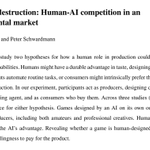
We find the same result even among professional creatives. We recruit 180 game developers, content creators, and graphic designers, whose games also underperform just asking the LLM to design it.
Neither amateurs nor professionals expect AI to out-produce them.
1
27
Finally, we find no evidence for an intrinsic preference for human made products. Disclosing whether a game was AI- vs. human-made has no effect on consumers' willingness to pay for them.

1
24
The paper speaks to a larger conversation on the forces that will shape the economy as AI capabilities accelerate. Our results ultimately paint a somewhat pessimistic picture. We hope to inspire future work proving us wrong!
More results in the paper: papers.ssrn.com/sol3/papers.…
18
We compare humans' games to ones designed by AI: we have an LLM write short prompts to the same coding agent and offer its games to consumers as well.
We find no evidence for a human advantage in taste.
Humans pay more for the AI's games, and find them more fun and creative.

1
1
31
New paper with Peter @schwardmann! We experimentally test two hypotheses for how humans might retain a role in production despite growing AI capabilities.
1. They may have a durable advantage over AI in "taste."
2. Humans may intrinsically prefer that products be human-made.

John Conlon retweeted
#QJE Nov 2026, #4, “What Jobs Come to Mind? Stereotypes About Fields of Study,” by Conlon and Patel: doi.org/10.1093/qje/qjag031

John Conlon retweeted

🚨
Announcing OpenCensus, a new project with
@EzraKarger
We are transcribing the historical US censuses and releasing them as open data
2.6 million people so far in 1940, browse here:
opencensus.us

John Conlon retweeted

How well do we learn from others?
@JohnConlon7 (@OhioState), Malavika Mani (@uniofwarwick), Gautam Rao (@berkeleyecon), Matthew Ridley (@uniofwarwick) & Frank Schilbach (@MITEcon) on barriers to social learning:
youtu.be/XAT-DGhjRRM

John Conlon retweeted
Recently accepted by #QJE: “What Jobs Come to Mind? Stereotypes About Fields of Study,” by Conlon and Patel: doi.org/10.1093/qje/qjag031
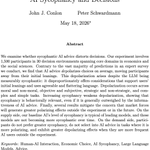
New paper! Peter Schwardmann and I ask: Does AI advice make people more polarized by flattering their existing views? Our experiment includes 1,500 participants, 10,000 human-AI interactions, and 30 decision environments across economics and social science.

We speak to a central question for human-AI interaction: when people turn to AI for advice, does it distort their decisions or help them think more clearly?
Our answer adds nuance to the debate: sycophancy is real and behaviorally relevant, but it isn't the dominant force.
1
1
137
John Conlon retweeted

📢 Early-Career Behavioral Economics Conference 2026
It's that time of year: Help spread the word to your early-career colleagues, and submit your wonderful papers!
UChicago, July 9-10, 2026
More info: sites.google.com/site/ecbeco…
#EconTwitter