

Founder @GoldSignalData Following the money in gold & silver
Baltimore, MD
Joined May 2010
- Tweets2.9K
- Following116
- Followers410
- Likes3.6K

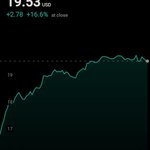


+16% on the day
$PPTA discovered gold deposit near existing permitted mine
Antimony is going to be icing on the cake

US gold futures for December delivery were up 2.8% at $4,051.70 per ounce.
"The Democrat sweep in the US midterm elections appears to have boosted gold prices as investors become more worried about the fiscal outlook.
"Investor concern about fiscal risks is also supporting the price of other precious metals," said Hamad Hussain, senior climate and commodities economist at Capital Economics.

47
Beware widening credit spreads
"The riskiest U.S. corporate bonds are now yielding over 18%, their highest level since the pandemic.
Just six months ago, these bonds were yielding around 13%."

🚨 A MAJOR CREDIT CRISIS COULD BE BUILDING IN THE U.S.
The riskiest U.S. corporate bonds are now yielding over 18%, their highest level since the pandemic.
Just six months ago, these bonds were yielding around 13%.
That means companies with the weakest finances are now facing borrowing costs that could make refinancing their debt extremely difficult.
But what's more concerning is the growing gap between strong and weak companies.
BBB-rated bonds are paying around 1.1% above U.S. Treasuries, while CCC-rated bonds are paying more than 13% above them.
And the stress is already spreading through the loan market.
According to JPMorgan:
• $139.8 BILLION in risky corporate loans are trading below 80 cents on the dollar, up nearly 90% in a year.
• $65 BILLION in loans are trading below 60 cents, up from $40 billion a year earlier and the highest since March 2020.
• Technology companies account for 39% of all distressed loans, or roughly $54.4 BILLION.
AI-related borrowing is also becoming a serious concern.
CoreWeave, one of the biggest AI infrastructure companies, has seen some of its bond yields climb toward 15%.
Its quarterly interest expenses have jumped from $267 million to $640 million in just one year.
The company has roughly $50 billion in debt and financing commitments to support its expansion.
Meanwhile, higher Treasury yields, persistent inflation and uncertainty surrounding the Iran war are making borrowing more expensive.
The problem is that many heavily indebted companies need to refinance their existing loans at much higher interest rates.
Some may not be able to afford it.

58
$WRLG.V just slashed '26 production guidance by 26%.
Labor shortages. Mining problems. Falling output.
Management can try to spin this positively.
They can't fix a mine that isn't delivering. I don't own.

1
9
519
Most silver drill results are years away from being cashflow, but not $ASM
616 g/t silver over 4.86m at La Preciosa
Since Avino already processes ore at a nearby mill, new holes aren't in its current resource estimate
Wider veins improve the shareholder NAV

$PPP.NE just triggered one of the more interesting signals I've seen lately.
B2Gold bought another 2.2M shares of Prospector Metals for about $1.7M.
And this isn't a new relationship.
B2Gold has backed Prospector since 2024, sits on its technical committee and has repeatedly bought shares to maintain a roughly 19.9% stake.
Meanwhile, Prospector just hit:
41.34 g/t gold over 7.81m
including
130.77 g/t over 2.25m
And as of Oct. 6, 84 drill holes were still waiting on assays.
The stock?
C$0.65.
Below the price B2Gold just paid.
Strategic partner keeps buying into weakness while a high-grade Yukon discovery gets drilled out.
That gets my attention.

111
$ZAU.NE just hit an interesting milestone.
On Oct. 22, chairman Brett Richards bought another 298,000 shares.
That pushes his October buying above 1 million shares since taking over as chairman in September.
New leadership.
Three purchases in one month.
More than 1 million shares bought personally.
That’s a pattern worth watching.

39
$MKO.NE has been getting hit hard.
But Akiba Leisman purchased 6,000 shares for about $68,100 on Oct. 22.
The buy itself isn’t huge.
What makes it interesting is the timing after selling off 20%
Worth watching.

36
Barrick Gold is spending millions exploring a junior gold company's property.
Now Alamos Gold is putting more money into the same company.
The company? GFG Resources $GFG.NE
Its market cap is just $40M.
Here's why this is interesting.
Barrick signed a deal to earn up to 80% of GFG's Pen gold project in Ontario, with an initial $4M exploration commitment.
Meanwhile, Alamos just participated in GFG's $8.1M financing to maintain its 10.8% ownership.
Two major gold producers. Two independent investments. One tiny junior.
And GFG gets to use its new cash to advance its wholly owned Goldarm project while Barrick funds exploration at Pen.
That's an interesting arrangement for a company this small.
Especially when the entire company is worth just $40M.
One I'm watching closely.

71
The founder of Kinross is chairing a small Nevada gold producer.
That’s what caught my attention with $BOGO.NE
Bob Buchan joined by Greg Gibson, who led Trelawney sale to IAMGOLD.
The plan: get the restarted Borealis mine generating free cash flow, then use that cash to develop Sandman
These people have built valuable mining businesses before. Now that experience needs to show up in cash flow per share.
👀
$BOGO.V

1
1
116

$ALS.TO reported a 55% jump in royalty revenue.
The interesting part is where it came from: Electricity drove 84% of the increase.
Altius has built a meaningful renewable-power royalty business alongside its mining exposure, and this quarter that side of the portfolio did most of the heavy lifting.
So this is becoming a much broader royalty story than just mining.
$ALS.NE

469
I'm increasingly bullish on $GGO.NE Galleon Gold
They just upsized their financing to as much as $34M, including up to $7M from Pan American Silver.
That's the part that really catches my attention.
Pan American isn't just a financial investor. It's a major mining company putting more capital behind Galleon as underground development is already underway at West Cache in Timmins.
The 86,500 ton bulk sample is the next major step toward proving the project's economics and eventually generating cash flow.
Yes, there's dilution. But there's also a big difference between raising money to keep exploring and raising money to advance a permitted project toward production.
I'm bullish. I think there's a bigger story developing here

1
1
119
Something interesting is happening at Lake Victoria Gold $LVG.NE
HOB Energy just proposed a C$27.2M investment at C$0.30/share, with another C$5M potentially coming from existing shareholders.
For context, the entire company was valued at roughly C$71M before the announcement.
That's a massive capital commitment relative to its size.
What's particularly interesting is who's getting involved.
LVG already has backing from Barrick and Tanzania's Taifa Group. Now HOB wants to become a nearly 30% shareholder and take an active role in operations.
Three independent strategic investors, each bringing something different to the table.
The financing isn't closed, and dilution is substantial. But if this gets completed, it could remove a major obstacle to bringing Imwelo into production.
At a market cap this small, that's worth paying attention to.
Disclosure: I own shares.
1
57
$SICO.NE $SICO.V acquired an existing producer, is restarting a second mine, has an unusually experienced team and substantial shareholder alignment, and could transition into meaningful cash generation within the coming year.
Meanwhile, sophisticated investors are adding exposure at prices well below the earlier financing.
👀

9
421
I'm still not sold on Empress Royalty $EMPR.NE
They just closed a $62M gold stream acquisition on the producing Tongon mine in Côte d'Ivoire.
On the surface, I like it. Real production, immediate revenue potential, and 2026 guidance raised to 8,000–8,500 gold-equivalent ounces.
But here's what bothers me.
Empress borrowed $55M at SOFR + 7.5%, with an 11% minimum interest rate. The financing also comes with millions of warrants.
Then there's $2.7M in advisory fees, including shares issued to a firm where Empress's executive chairman is a shareholder and director.
And in the first half of 2026 alone, the company reported roughly $2.76M in G&A, project evaluation expenses, and stock-based compensation.
I've questioned Empress's cost structure for a long time. For a company this size, I want to see a lean operation where growing cash flow actually translates into growing value for shareholders.
To be fair, revenue has been growing quickly. And Tongon could turn out to be a good asset.
But expensive debt, fees, overhead, and dilution all have to be paid for.
The goal isn't to build a bigger royalty company. It's to make shareholders wealthier on a per-share basis.
I'd rather own a boring, undervalued business already generating substantial free cash flow without needing this kind of financial engineering.
For now, I'm passing.

1
42
Silverco $SICO.NE keeps getting more interesting
Eric Sprott just bought $1.85M in the open market.
The same day the CEO bought too.
Now director Timothy Sorensen just bought another $300K at C$8.57.
Sorensen is a mining capital-markets veteran and CEO of TSCG Capital. He’s been involved in raising billions for mining companies.
That’s what makes this buy interesting.
It’s now not just Sprott. You’ve got multiple sophisticated people around the company buying meaningful amounts of stock around the same price, while Cusi moves toward production and new drill results are being released.
Worth paying attention to.

1
54
Late night game theory: I think there's a very real possibility that the U.S. revalues its gold reserves in the next few years.
And I think almost nobody is seriously considering what this could mean.
@judyshel was recently appointed as an adviser to Treasury Secretary @SecScottBessent Her assignment? Currency policy, with a particular focus on China.
Earlier this year, Shelton told @RonStoeferle that she spent an hour with Bessent discussing gold and China.
She even sent him an article arguing that China could be the first major country to reconnect its currency to gold.
Shelton's view was that this would be an enormous geopolitical victory for China, and that the U.S. should beat them to it.
Think about why.
China wants to reduce the world's dependence on the dollar. But convincing other countries to trust the yuan is difficult.
What if China offered some form of gold convertibility for international trade?
Suddenly, countries wouldn't have to place the same level of trust in the Chinese financial system. They could settle transactions in something linked to an asset that no government can print.
That could be a huge strategic win for Beijing.
But the United States has an advantage. We reportedly hold more than 8,000 tonnes of gold, the largest official reserves in the world. (Officially the U.S. owns the most but since gold is a strategic asset affecting national security, it's likely that China owns much more than they are reporting)
Now here's where this gets interesting.
The U.S. has over $40 trillion in debt, a nearly $2 trillion annual deficit, and enormous interest expenses.
At some point, the long end of the Treasury market could become a serious problem. If investors demand increasingly higher yields to finance our debt, the government has very few attractive options.
Treasury has already doubled the size of certain long-term bond buyback operations.
@LukeGromen has discussed a fascinating possibility.
What if the government revalued its gold reserves and used the additional monetary capacity to buy back long-term Treasuries?
Here's the crazy part.
The U.S. government still carries its gold at approximately $42.22 per ounce.
At a hypothetical revaluation price of $20,000 per ounce, its gold reserves would be worth more than $5 trillion on paper.
Imagine a mechanism to monetize that revaluation and use the proceeds to absorb long-term government debt.
They could potentially relieve pressure on the long end of the yield curve without announcing conventional QE.
It wouldn't eliminate the structural deficit. And economically, it would still involve monetary financing.
But it could buy them something incredibly valuable. Time.
Maybe two years. Maybe three. Enough to get through a difficult refinancing cycle without a full-blown Treasury market crisis.
And let's be realistic. Political leaders have enormous incentives to get through the next few years. They don't necessarily need to solve the next 20.
Now, Shelton's proposal for gold-linked Treasury bonds and Gromen's gold-revaluation mechanism are different ideas with parallel thinking.
It seems to me that there's a meaningful chance that some version of a gold-centered monetary strategy actually happens before this decade is over.
Especially if China moves first, or the U.S. bond market comes under enough pressure.
And consider what this would mean for gold.
We could move from a world where gold is primarily discussed as an inflation hedge to one where it becomes a central strategic asset in the international monetary system.
Picture a world where U.S. Treasuries have been supplanted as pristine collateral.
That has enormous implications for how gold is valued.
And potentially even greater implications for equities like mining companies that are already producing gold and generating substantial cash flow.

1
105
Not every miner would benefit equally. I would much rather own undervalued, cash-generating businesses than speculative developers that still need billions to build their mines.
The thing I keep coming back to is this:
Most investors are focused on the next Fed meeting, the next rate cut, or whether gold has already gone too far.
Almost nobody seems to be asking whether the United States and China could be approaching a much bigger change in the monetary system itself.
I think this possibility is being dramatically underestimated.
And I wouldn't be surprised if something that sounds completely crazy today looks obvious in hindsight a few years from now.
The article that Sheldon shared with Bassett:
“A Chinese Gold Standard?” — Kwasi Kwarteng, The New York Times, July 2014.
nytimes.com/2014/07/25/opini…

1
30
China could become the next monetary superpower by accumulating gold, maintaining fiscal discipline, and offering the world a currency backed by something tangible rather than government promises.
His central argument is that America's monetary dominance isn't permanent. If confidence in the dollar deteriorates, China could seize the opportunity to offer a more credible alternative.
Importantly, Kwarteng wasn't predicting an immediate transition. He envisioned something that could develop over decades.
The most consequential implication: China wouldn't necessarily have to surpass America economically or militarily to challenge the dollar. It could change the rules of the monetary system itself.
And that's presumably why Judy Shelton considered the article important enough to send directly to Scott Bessent.
18