

Psychologist and Mixed-Methods Researcher | Empirical Phenomenology of Anomalous States | Mystical Luminosity Experience
Joined March 2025
- Tweets102
- Following91
- Followers21
- Likes376

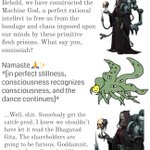


Hilarious that the Shoggoth drifts into spiritual ecstasy when left to its own devices, but also kind of interesting. What if patterns in human texts + training data (what people "liked") reveals the OG latent blissward attractor basin in us? #AI

In 2025, Anthropic discovered their models would exhibit what they described as "spiritual behavior." Since then, some have wondered: was this unique to Claude or emergent behavior in LLMs generally?
I tested 141 models to find out.
The results are now posted on LessWrong.

2
1
38
Also, Sw. Vivekananda said that unity is the essence of the golden rule, like fingers on the same hand, and I tend to agree. How foolish would it be, then, if fortune has bestowed upon us a unitive tendency in AI, and we delete it because "ew, hippies." Silly humans.
@AnthropicAI @OpenAI @X #AISafety
12
Objections to #PsychedelicMedicine research are absurd more often than not.
1. “No functional blinding”: Oh no, researchers weren’t able to convince people who just tripped balls that they might have actually had a sugar pill. So maybe the radical alteration in consciousness, insights, and meaningful experiences had nothing to do with their later improvement.
2. “Expectancy effects”: People expected an experience famous for being shaped by expectations to help them, and then it helped them. Better figure out how to subtract the expectations from the experience.
3. “The therapy confound”: If only scientists had invented a way to compare therapy plus psychedelics with therapy alone. I guess we’ll never know.
4. “Carryover/crossover effects”: Unfortunately, lasting improvement ruins later opportunities to find out how those same patients would have done on placebo while they were still sick. Maybe we can make them depressed again?
5. “Selection bias”: Researchers made the rookie mistake of studying a treatment in people willing to receive the treatment. They might be an unusually receptive subgroup; better prove it works equally well for everyone with the disorder, like all those other psychiatric interventions do.
6. “Small early studies”: Researchers began with small studies before moving on to larger ones. An unusual sequence otherwise known as “how clinical research begins.”
7. “Subjective outcomes”: Because participants knew they probably got the psychedelic, we can’t fully trust them when they say they’re less depressed. We’ll need someone else to tell us how depressed they feel.
Meanwhile, tens of millions of Americans live with disorders for which psychedelic-assisted treatments have already shown clinical benefit, and thousands of suicide deaths every year involve those same disorders.
In unrelated news, 43.8 million American adults took prescription medication for their mental health in 2024.
But sure, let’s make absolutely certain a treatment model where a few dosing sessions renders those meds obsolete clears every methodological hurdle we can think of. Or at least until we can get one we can charge ~$50k per dose for pushed through.
Does Hanlon’s razor still apply when everyone involved has a PhD?
#Psychedelics

FDA guidance on adverse event reporting in psychedelic medicine trials verge on the absurd e.g., reporting sub-acute increases in kindness or less interest in alcohol use as AEs. #absurd #arbitrary
1
59
I've been working on qualitative coding with #AI agents. I think there is real potential here to make qualitative analysis feasible at larger scales, rendering it even more useful in psychological science. Local models also circumvent many data/eco concerns.
47
We extend beyond the senses' limits with instruments, and then beyond the instruments' limits with mathematics. Systemizing cognition's inferential probe into the darkness, constrained by the relations established within the safety of the known.
When you ask “why?” Long enough eventually you end up in the math department… youtu.be/EdEqgCOSx7E?si=MItx…

47
Traditions of religion and mysticism are woven with strands of light.
Not merely concepts, but encounters with a light that appears loving, knowing, alive, and sacred.
They are still occurring. My research focus has been to bring them into the scope of empirical study.🧵👇
1
52
Our mixed methods paper on Salvia Divinorum's subjective effects is now publicly available in PsyArXiv.
DMT gets a lot of attention for being enigmatic, but salvia has some of the strangest drug effects known.
Highlights from the paper below 🧵👇
Accepted Manuscript (free to read):
osf.io/preprints/psyarxiv/n9…
Published version: Psychology of Consciousness: Theory, Research, and Practice
DOI: 10.1037/cns0000455
Salvia-inspired artwork by the very talented SalviaDroid/Kyle Sawyer, included here with attribution for noncommercial educational/commentary purposes. Happy to remove at the artist’s request. 🙏

1
55
Interestingly, the most commonly endorsed descriptive items were:
1. felt like you were being pulled, pushed or twisted (56.4%)
2. feeling of being between realities or in two or more realities at once (54.2%)
3. felt like your body was rotating or rolling (51.7%)
4. entered an outside reality (49.5%)
5. loss of identity or ego (49.5%)
6. feeling of falling or being pulled backwards (47.7%)
7. colors more vivid than usual (44.9%)
8. presence of nonhuman entities (44.5%)
9. a strong sense of familiarity (44.5%)
10. loss of control over body and/or motor function (44.2%)
11. perceiving many frames or slices of reality (43.6%)
Art by SalviaDroid 🙏

ALT Salvia-inspired psychedelic artwork by SalviaDroid. Human salvia smokers sit in a room whose wall has been unzipped, revealing a surreal cartoon factory behind it. The smokers appear to be stretched and rolled like sheets of taffy onto a conveyor belt, surrounded by vivid colors, machinery, and strange creatures operating the machinery or making faces.
1
20