

Options Seller | Made $19,112.57 in Sep |CEO of multimillion $ company. Saved by Grace through Faith in Jesus Christ-Ephesians 2:8-9 ↓ Join for live trades!
NFA, Educational Only
Joined November 2023
- Tweets44.8K
- Following899
- Followers23.5K
- Likes30.5K



Pinned Tweet
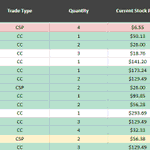
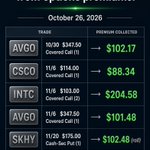
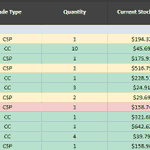
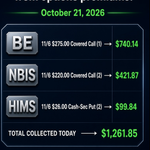
Josh's Results from the week of 11/6/2026
I made $4,001.61 this week selling options.
Another tough week! The AI trade is under extreme pressure right now. We've got some deep ITM puts to manage this week, likely taking assignment on some.
*Total Trades closed: 15
*Closed Winners: 13
*Rolled: 1
*Assigned: 1
*Losses: 0
Want to learn how? Join me! whop.com/discover/selling-op…
I traded great names that include:
$AAOI $CSCO $OXY $ASTS $BE $HIMS and many more.

What do you actually get in my Discord on a day like this?
Yesterday was a wild one. The Nasdaq fell 5.52%. The VIX jumped. Today the jobs report lands at 8:30 AM ET.
On days like this, many people feel alone with their screen. They wonder if they should sell a put, wait, or do nothing.
Here is what Discord gives you. It is $27.99 a month.
- The same live trade activity I share on Paid X.
- A place to ask questions and get feedback.
- Resources and tools to learn the process.
- Channels for different topics, so you can talk it through with other traders.
You see how I think on a red day. I wait for support. I keep size small. I do not chase premium.
If you only want the alerts, Paid X is $9 a month. No chat. Just my live entries and exits.
Neither one tells you what to buy. Neither promises a result. Every trade has risk. Selling options is lower risk than buying them, but you can still lose money. You make your own choices.
Want to start free? Follow me and read the free posts first. No pressure.
If Discord sounds like a fit, send me a message and I will point you the right way.
Options have risk. Not financial advice.
Why I do not panic when the VIX jumps.
Yesterday the VIX closed at 28.18. That is a big jump. Many new sellers see a number like that and freeze. Some sell too much because the premium looks huge. Both are mistakes.
The VIX is a fear gauge. It shows how much traders expect the market to move. When it goes up, option prices go up. That is because the risk of a big move is higher.
For a seller, that means two things at once.
First, you get paid more. If you sell a put or a call, the cash you collect is larger. That is the good news.
Second, the stock can move more. A bigger payment is the market telling you the ride is rougher. You are not getting a gift. You are being paid to take more risk.
Here is how I think about it.
I ask: do I want to own this stock at this price? If yes, a put can make sense. If no, the premium does not matter.
I ask: has the drop slowed down? Selling into a fast fall is like catching a knife.
I ask: how big is the position? Small size lets me stay calm. If the stock keeps falling, I can wait. I am not forced to sell.
I take profit early on many trades, around 50-70% of the premium. That frees up cash and cuts risk.
High fear days can be great for patient sellers. But patience comes first. Size comes second. Premium comes last.
Options have risk. Not financial advice. Selling options is lower risk than buying them, but you can still lose money.
You can always join us for free to trade alongside us: whop.com/discover/selling-op…

Evening Market Wrap for Friday, Nov 6.
The big story: stocks bounced after Thursday's AI sell-off. The Nasdaq closed up about 1.1%. The S&P 500 gained about 0.3%. The Dow slipped about 0.5%.
Remember Thursday? The Nasdaq fell about 5.5% and the S&P 500 fell about 4.4%. Friday gave back a small slice of that.
Strong jobs news helped too. The U.S. added 165,000 jobs in October. Experts expected far fewer. The jobless rate fell to 4.1%.
What moved and why:
$IREN jumped about 20%. The company said its AI cloud sales hit $200 million. That is almost triple the last quarter.
$LRCX rose after its board approved a $25 billion buyback. It was one of the chip names hit hard on Thursday.
The chip group bounced, but only part of Thursday's drop came back. Fear of tougher AI rules is still in the air, and that can bring more big swings.
Broader tone: calm compared to Thursday, but not safe yet. The week still ended rough. The S&P 500 had its worst week since June. Strong jobs also push up rate worries. Reports say a Fed rate hike in December looks likely. The 10-year yield ended near 4.86%.
What to watch next week:
- October inflation data (CPI) on Tuesday
- Earnings from $NBIS, $CRWV, AMAT, and Cisco
- Does the chip bounce hold, or fade?
My take: a big up day after a big down day does not mean the storm is over. I keep my size small and wait for price to settle before I sell a put. Fear pays well, but patience pays better.
Do you think the chip bounce holds on Monday?
Follow @joshtradeoption for more daily market notes.
Not financial advice. Do your own research
Fridays teach you the most mistakes. Here are 5 habits that hurt option sellers on days like Thursday.
Yesterday the S&P 500 fell 4.36%. The Nasdaq fell 5.52%. The VIX jumped to 28.18.
Days like this show what you do under stress.
1. Selling puts into a falling knife. A red day is not the same as a bottom. I wait for price to slow down first.
2. Chasing fat premium. High fear means high premium. It also means the stock is moving hard. The premium is the risk talking.
3. Going too big. One bad day can wipe out many small wins. Small size keeps me in the game.
4. Ignoring the calendar. Jobs data is out at 8:30 AM ET today. I do not want to be surprised by a headline.
5. Forgetting the plan. I write down the stock, the level, and the size before I click anything.
Fear days are not the enemy. They are where patient sellers get paid well. But only if the account can take the hit.
I am not rushing today. I want the stock to come to me.
Which habit has cost you the most? Tell me below.
Bullish trade idea.
Premium-Funded LEAP Idea
Sell 5 contracts $INTC Dec 18, 2026 $50 puts. Collect $1,550 in premium.
Buy 1 contract $INTC Jun 16, 2028 $70 calls. Cost $1,450.
The leftover premium buys about 1 share outright.
If $INTC never gets above $70, the calls can expire worthless.
If $INTC stays above $50 by Dec 18, 2026, the puts expire and you keep the cash.
Risk? If it trades under $50 on Dec 18, 2026, you buy the shares at $50 each.
Potential upside?
$INTC at $88 = calls worth $1,800 to $3,685.
$INTC at $105 = calls worth $3,500 to $5,062.
$INTC at $140 = calls worth $7,000 to $8,135.
What do you all think?
It’s been rough! Someone needs to hear this.
Getting assigned is not the problem. What you do the next morning is.
Most sellers have a plan for the put. Almost none have a plan for the shares.
Real numbers. You sell the $95 put for $2.00. Stock drops to $78 and you are assigned. Your basis is $93 on a $78 stock. You are down $1,500 per contract and the first instinct is to fix it fast.
So you sell another $75 put for $1.60 to "lower your basis." If that gets assigned too, you now own 200 shares, your average basis is still in the mid $80s, the stock is below $75, and one name now owns a big piece of your account.
That is not a repair. That is doubling the bet at the moment the market told you the bet was wrong.
Assignment did not create a new opportunity. It revealed the size of the old one.
Three rules for the morning after assignment:
1. Judge the shares as a fresh stock position. Would you buy 100 shares here today, with no put history attached? If not, sell the shares and book the loss. History is not a thesis.
2. If you keep them, sell calls at a strike you would accept as an exit, not a strike that magically gets you back to even. A call at your basis that pays $0.30 is not a plan. It is a wish. If you have strong conviction, sit tight. Sell a call once it pops.
3. Never sell a second put on the same name until the first position is resolved. One assignment is a position. Two on the same ticker is concentration.
The wheel only works when assignment is part of the plan, not a surprise you try to trade your way out of.
Selling a put on $AVGO after a big red day. Here is how I think about it.
Yesterday $AVGO fell 10.43%. Chips were hit hard across the board.
The idea: A cash-secured put. I pick a price below the stock where I would be happy to own it. I get paid cash up front. If the stock stays above that price, I keep the cash. If it falls below, I buy shares at my price.
Why this setup: Fear is high. The VIX hit 28.18. When fear is high, option premium is higher. That can pay a seller more for the same trade.
Possible outcomes:
- Stock stays up: I keep the premium.
- Stock drops a bit: I may own shares at a price I chose.
- Stock drops a lot: I own shares, and I am down. That is the real risk.
My rules:
- I do not sell into a falling knife. I want the drop to slow down first.
- I pick support, not a guess.
- I size small. One bad day should not hurt the account.
- I check the jobs report first. It comes at 8:30 AM ET today.
Lower risk than buying shares with margin or buying calls. Not no risk.
Would you sell a put here or wait for a calm day?
Options have risk. Not financial advice. Do your own research.
$LRCX: what a $25 billion buyback tells us.
Lam Research makes machines that chip makers use to build chips. On Thursday its stock fell 16.36% in a chip rout. Then the board approved a new $25 billion buyback and a $0.33 quarterly dividend (SEC filing dated 2026-11-05).
Three facts:
1. A buyback means the company can buy its own shares. It does not have to. The filing says it can stop at any time.
2. The stock fell hard with the whole chip group. It was not a Lam only problem.
3. Chip stocks had their worst day in years. Fear about a slower data center build-out drove it.
Bull case: Chip makers need tools to build more chips. A big buyback shows the board feels the price is cheap.
Bear case: If AI spending slows, orders for these tools can slow too. A buyback does not fix that.
Simple checklist before I sell a put on a name like this:
- Has the stock stopped falling?
- Do I know where support is?
- Is the premium worth the risk if I am assigned?
Bottom line: great business, scary tape. I watch and wait.
Would you own $LRCX here, or wait?
Not financial advice. Do your own research.
$APP did the opposite of the market yesterday.
While the Nasdaq fell 5.52%, $APP jumped about 31% after earnings. Reports say it beat profit estimates (EPS $4.30 vs $4.04, Cappnotes, verified 2026-11-06). Almost no other stock rose like that.
Why it moved: Earnings were better than expected. Buyers came in on a day when most people were selling.
The level I watch: Where it closed yesterday. If it holds near that level, buyers are still in control.
The failure level: If it gives back most of that jump, the move was a one day pop. Big gap ups can fade fast.
As an option seller, I do not sell a put after a 31% jump. The stock is extended. A sharp gap can fall back. I would rather wait for it to cool and come to me.
Premium looks big on days like this. But big premium means big movement. That is risk, not a gift.
Do you think $APP holds the gap, or does it fade?
Not financial advice. Do your own research.
Why $AMZN on a day when tech got crushed?
Yesterday the Nasdaq fell 5.52%. Chips fell hard. $AMZN closed down 2.19% (StockTitan, verified 2026-11-06). That is a lot better than most big tech.
Key positives:
- AWS is one of the biggest cloud businesses in the world. It sits right in the AI build-out.
- Shopping and ads give it more than one way to earn.
- It held up better than the chip names in a rough sell-off.
What I watch:
- Does it hold up if the Nasdaq keeps falling?
- Does the market keep fearing a slower data center build-out? That fear hit the AI names hard yesterday.
- What happens after the jobs report at 8:30 AM ET.
Main risk: AI spending worries are not gone. $AMZN spends a lot on data centers. If the market keeps doubting that spending, it can fall too. A relative winner can still go down.
My plan: I do not chase. I want a calm day and a level that holds. Then I think about owning it, or selling a put at a price I picked.
Do you think $AMZN keeps holding up better than the chip names?
Not financial advice. Do your own research.
4 stocks I am watching today as an option seller.
It was a rough Thursday. The S&P 500 fell 4.36%. All 11 sectors closed lower. The jobs report is out at 8:30 AM ET. I am not chasing anything. I want the stock to come to me.
$GEV: CSP candidate. It fell 7.48% on fear of a slower data center build-out. I like the business. If it settles and holds support, I would think about a put at a price I picked. Only if I am happy to own it.
$LLY: Covered-call watch. Health care fell less than tech yesterday. If I own shares, I look for a green day to sell a call. Calm names are good call sellers.
$VST: Watch only. It reports earnings before the open today. I do not sell puts into earnings. I will see the numbers, see the reaction, and decide later.
$CRWV: Watch only. It fell 9.83% yesterday. AI headlines can move it hard in both directions. The premium looks big, but that is the risk talking. I want to see it calm down first.
My rule is simple. Red days are for selling puts, but only after the fall slows. Green days are for selling calls. Patience is the edge.
Which one are you watching today?
Market Read for option sellers: the AI rout and what it means for puts.
What happened: Thursday was ugly. The S&P 500 fell 4.36%. The Nasdaq fell 5.52%. Tech was the weakest sector, down 8.00%. The VIX jumped to 28.18. The cause was fear that a slower data center build-out could hurt AI spending.
What it means for a put seller:
- Premium is richer when fear is high. That is real.
- But the stocks are moving fast. That is the cost of that premium.
- A big red day is not a green light. I wait for the fall to slow.
What I watch today:
- The jobs report at 8:30 AM ET. Reports said the market expects about 60,000 jobs.
- Rate talk. Traders see a rate hike in December as likely, per CME FedWatch. That is a surprise to many.
- Oil. Brent is near $100.
My process stays the same.
1. Wait for support to hold.
2. Avoid names that just ran up or just gapped down on news.
3. Skip earnings week for stocks I do not want to hold through the report.
4. Keep size small.
$SPY and $QQQ will set the tone. If they steady, sellers get better entries. If they keep falling, cash is a fine position.
Fear can pay well. Patience pays better.
How are you playing this? Waiting, selling, or sitting out?
Not financial advice.