

Economist working on #economicgrowth, #growth #econometrics & macro development || Associate prof Webster Vienna || #Firstgen graduate
Vienna, Austria
Joined July 2014
- Tweets3.6K
- Following916
- Followers960
- Likes18K






Pinned Tweet
I am excited and honored to receive an "Impact Award" from our faculty for my research on economic #growth and the policy impact it created.
linkedin.com/pulse/impact-ca…

Konstantin M. Wacker retweeted

⏳ 10 days left! Submit your working paper to the 19th @CentreFiw Research Conference “International Economics”
🗓 11–12 Feb 2027, @WU_econ , Vienna
🎤 Keynote: @FelixTintelnot (Duke)
💶 Two awards, €1,000 each
Deadline: 26 Oct 2026
Details: fiw.ac.at/event/19-fiw-resea…
#CFP

Konstantin M. Wacker retweeted

Just as with recessions, I can predict Woodford will get it but I cannot predict when.
"We can't give it for growth/macro again, can we?" - -
.
.
"Wait, what if we award it for "microeconomic foundations.." 😂😂"

BREAKING NEWS
The Royal Swedish Academy of Sciences has decided to award the 2026 Sveriges Riksbank Prize in Economic Sciences in Memory of Alfred Nobel to Robert E. Hall and Michael Woodford “for microeconomic foundations of macroeconomic stabilisation.”
#NobelPrize

Exciting opportunity to work on Development Strategy at
@UNDPasiapac: estm.fa.em2.oraclecloud.com/…

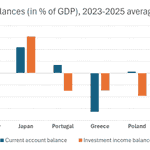
Almost two thirds of Germany's current account surplus is due to investment incomes, not trade. In Japan, the current account balance effectively is the investment income balance.
The excessive policy focus on trade misses a key aspect of current global imbalances.

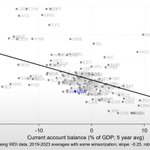
Global #imbalances receive a lot of policy attention. Most of the debate focuses on #trade. In this LSE Business Review piece, I argue that's missing a key point: imbalances are increasingly driven by financial income flows.
blogs.lse.ac.uk/businessrevi…

The public debate on sustainable development is increasingly trapped between two camps. Rather than choosing between growth and degrowth, policy should focus on a re-adjustment of growth models -- #regrowth.
globalpolicyjournal.com/blog…
A #gravity model for #FDI?
Yes, but what does distance actually capture then?
In a new @ecb
working paper we document substantial heterogeneity of the distance elasticity across sectors. ecb.europa.eu/pub/research/a…

Konstantin M. Wacker retweeted

I wanted to hate this article.
I consider the degrowth movement harmful for achieving social justice and improving the human condition.
The movement is predicated on two inconsistent assumptions:
1. All the bad things associated with growth are so fundamental features of the economy that they cannot be tackled directly. Inequality. Pollution. They are caused by growth. Better to limit growth so as to limit harm.
2. All the good things associated with growth across countries and over decades are just coincidence. They are not caused by growth. We can reduce growth without taking away better health outcomes, increased longevity, better sanitation, improving gender norms, you name it.
Your ideology may influence whether you put more weight on the good correlates of growth or the bad correlates of growth. But, intellectually, you should consider both.
There are many faults of this opinion piece, but it is not advocating for degrowth. It is pushing the "beyond growth" agenda, which is urging policy makers to tackle societal problems directly, in addition to improving material outcomes.
This is not a wrong position to hold. In fact, it is a position with which no reasonable policy maker would disagree. Tackling societal problems? It's their literal job description.
But the op-ed is a teachable moment of reasoning fallacies.
1. Argument from authority. "We economists"? 350 signatories including some we name because they seem more important than the other 340? Surely you must be right then.
2. Strawman argument. "For decades, the recipe was simple: grow the economy, and poverty would gradually disappear." Are you saying that economists and policy makers have not been trying to tackle the challenges you describe? Have you not heard of the Sustainable Development Goals agreed on in 2012?
There is nothing to hate here.
Keep pushing for better policies. But use actual arguments for what works, what doesn't; costs and benefits.
You know, the kind of things economists do.
theguardian.com/commentisfre…

Still time until Monday to submit your paper or abstract on #automation, #robots, or #AI to #CORA26 - great conference, and September is an excellent time to be in Kiel.
Website and submission link: zbw.eu/de/ueber-uns/veransta…

Konstantin M. Wacker retweeted

#SUERFpolicybrief “When foreign banks bring cash: How financial FDI boosts investment" by Tim de Leeuw and @KM_Wacker (University of Groningen)
📄 tinyurl.com/mbtcnsfc


🙌🏼 We have a new way to estimate interaction terms with panel data 🙌🏼, which is better than the standard approach. #cite
Thread on the idea 👇 , more on implementation to follow (1/6).
onlinelibrary.wiley.com/doi/…


Konstantin M. Wacker retweeted
🙌🏼 We have a new way to estimate interaction terms with panel data 🙌🏼, which is better than the standard approach. #cite
Thread on the idea 👇 , more on implementation to follow (1/6).
onlinelibrary.wiley.com/doi/…
🆗 🆒, what about the interaction effects now?
1. If they are time-varying, just add this interaction on top of unit-specific x effects.
2. If they are not time-varying, project unit-specific coefficients on interaction variable in a second step OLS regression.
(5/6)