

GOAT COMMUNIST - DISCUSSION PLACE
on-chain
Joined December 2024
- Tweets2.2K
- Following766
- Followers1.2K
- Likes2.2K




KelpDAO $rsETH Exploit stands out as arguably the largest DeFi exploit in Q2 2026 so far,
with 116,500 @rsETH minted without backing worth roughly $292–293.7M at the time.
What makes this case particularly important is that the root cause was not a flaw in KelpDAO’s smart contracts,
but a weakness in the security configuration of the @LayerZero_Core V2 OApp stack.
A 1-of-1 DVN setup, combined with a compromised or spoofed validator,
allowed the attacker to forge a cross-chain message and invoke lzReceive to mint $rsETH without any real backing.
With the unbacked $rsETH in hand, the attacker moved quickly,
using it as collateral across @aave V3, Compound V3, and Euler to borrow real $WETH/ETH.
This ultimately left behind $200M+ in bad debt,
spreading systemic risk across multiple lending protocols.
The incident highlights a major shift in DeFi risk,
where vulnerabilities are no longer limited to on-chain smart contracts.
Configuration choices, message verification layers, DVNs, oracles, and off-chain infrastructure
are increasingly becoming the weakest links in protocol design.
A misconfigured security stack alone
can be just as catastrophic as a full smart contract exploit.




Karl Marx OnChain retweeted

hybrid vault for eth has passed governance and is finally live!
you can participate in a new chapter of @yieldbasis
we are still so early.
join the story
yieldbasis.com/earn/hybrid/0…

Karl Marx OnChain retweeted
The Driff protocol hack isn’t as straightforward as it seems.
Let’s walk through what actually happened:
The attacker exploited the durable nonces feature to pre-sign transactions weeks in advance, tricking the Security Council (multisig) into approving them. This ultimately allowed the attacker to seize admin control, modify withdrawal limits, and drain several major vaults. Specifically:
1, Created a wallet and pre-signed transactions using durable nonces to deceive the multisig into approving them
2, Submitted two pre-signed transactions → took over admin privileges
3, Drained more than 15 different tokens (JLP, SOL, USDC, etc.) within minutes (~$270–285M)
4, Converted assets into USDC
5, Bridged funds to Ethereum via Wormhole with Backpack also suspected to be involved in the laundering flow
6, Swapped a portion into ETH (~19,913 ETH ≈ $42.6M)
7, Funds were then routed through multiple addresses linked to potential laundering activity
Looking back at 2022, Driff also suffered from a logic flaw in realized PnL accounting, which resulted in a $14.5M loss.
While the technical root causes differ, both incidents share the same underlying issue:
failures in operational security and flawed system design leading to vault drains despite multiple audits and claims that no critical vulnerabilities were found.
Honestly, audits these days are pretty questionable to me!
Karl Marx OnChain retweeted

We are at final phases of testing the HybridVaults for @yieldbasis (as you can guess by looking at GitHub).
The plan is to have this small with the current pools - starting with WETH pool (to test the approach and help crvUSD peg), and really SCALE when we have new pool code


Karl Marx OnChain retweeted
From liquidity competition to power war, the game has changed a lot..
But the winner was never on the battlefield.
@CurveFinance @ConvexFinance
From liquidity competition to power war, the game has changed a lot..
But the winner was never on the battlefield.
@CurveFinance @ConvexFinance
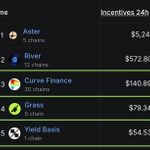
. @CurveFinance and @yieldbasis both landing top 5 on 24h incentives: one with scale, one with precision.
Not just emissions doing the work, flows are actually sticking.
Curve eco demand is still very real.

“Depeg” of @yieldbasis : Yield Basis is working as it’s designed.
Most users approach YB like a vault or savings account: deposit an asset, withdraw it 1:1. But that’s not what this system is.
When you deposit asset like WBTC, the protocol doesn’t simply hold it. It transforms it into a leveraged position: using it as collateral, borrowing against it, and looping to optimize yield.
What you receive is no longer raw WBTC exposure, but a leveraged, managed position. So when ybWBTC trades below NAV, it’s not a failure of the system, it’s working exactly as designed.
The friction appears when you try to exit. @yieldbasis is different from trad setup: debt needs to be repaid, positions reduced, and the pool rebalanced. The cost of this process is reflected in the price you receive.
The “-10%” many point to is the market pricing the cost of liquidity in a leveraged system. The uncomfortable truth is that you cannot simultaneously have high yield from leverage and instant, lossless exits.
If you could, the system would be structurally unstable under stress.
Where the discussion becomes more nuanced is in how the system reacts to market conditions. When price moves quickly and internal parameters adjust more slowly, imbalances persist, and TRD becomes more pronounced and longer-lasting.
This is a question of mechanism design, not a flaw in the core model. Even with improvements: smoother adjustments, better rebalancing incentives, the fundamental trade-offs remain. Yield, stability, and exit efficiency cannot all be maximized at once.
Waiting for @newmichwill and best YB version!


Karl Marx OnChain retweeted
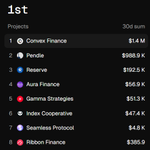
🥉 Third Place (1,000 CVX):
@KM_crypto1
A full-blown history lesson on Convex — from the Curve Wars to market crashes to its comeback era. If you want to understand how power really moves in DeFi, this is required reading! 🎨✨
xitter.gq/KM_crypto1/status/2026…
