
I like to build things || Principal Researcher @moonmathai
Joined January 2022
- Tweets883
- Following533
- Followers299
- Likes2K



Karthik Inbasekar retweeted

1/ Here’s a demo showing how I generated tokens for free on @OpenRouter using the @FireworksAI_HQ endpoint for GLM-5.3

Karthik Inbasekar retweeted

New mega work 📢 A fast BF16 forward attention kernel for AMD MI300X, written in HIP, not full hand-written assembly. Up to 1.26× vs AITER, and 1.37×–1.59× vs Modular MAX.
But the interesting part is not just the benchmark. It is the engineering path. AITER v3 is written in hand-tuned GCN assembly. We wanted to see how far we could go while staying much closer to ordinary HIP.
Technical details:
The core technique is a middle path: one-instruction asm wrappers. We still choose the exact opcodes that matter, but leave register allocation and data-flow tracking to the compiler. This gives us instruction-level control without turning the entire kernel into a full assembly codebase.
From there, the kernel is mostly a memory-placement and scheduling problem:
• K is streamed into LDS and double-buffered
• V is kept hot in L1 instead of staged through LDS
• Q and accumulators stay in registers where possible
• the CDNA3 pipeline is planned around 8 waves, 2 groups, and 2 carefully placed barriers
• 3Q tiling increases data reuse
• tail KV splitting keeps idle CUs from dominating long-context shapes
One takeaway: high-performance AMD kernels do not necessarily require choosing between “let the compiler do everything” and “write the whole thing in assembly.”
There is a useful middle layer where you give the compiler a structured framework and take control only where the hardware demands it.
Code is open source under MIT. PR to SGLang is in review.
moonmath.ai/cdna3attention/

Karthik Inbasekar retweeted
Talks are now live:
youtube.com/playlist?list=PL…
Thank you everyone for joining.


Generative Media TLV #2 meetup is live! 🚀
In collaboration with @nebiusai, we’re bringing together the Israeli generative media research community once again!
Featuring - talks will be recorded:
Decart Optimization Stack
Orian Leitersdorf | Chief Scientist & Co-Founder @DecartAI
BADAS-2.0 - Nexar Driving World Model
@ronigoldshmidt | Senior AI researcher @getnexar
Beyond Text: Continuous Control in Generative Models
@OPatashnik | Assistant Professor @TelAvivUni
Multimodal Generative Agents At Scale
Aviad Dahan | AI Researcher @ ZyG
🗓️ June 15
📍Nebius offices Tel Aviv


Video AI benchmarks are broken.
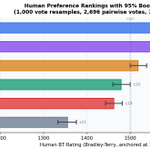
VBench requires 6,230 videos per model eval. Scores cluster near the ceiling.
Yes-bias makes every model look good. Rankings don't match what humans prefer.
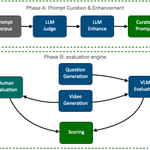
We built WorldJen to fix this. 🧵
Everything is open source:
📄 Paper: arxiv.org/abs/2605.03475
💻 Code: github.com/moonmath-ai/World…
📊 Dataset: huggingface.co/datasets/ik66…
(420 videos + 2,696 human votes with confidence labels)
🌐 Project: moonmath.ai/worldjen/
3,754 adversarially curated prompts. Yours to use.

1
1
70
If you're building or evaluating generative video models, WorldJen is the
benchmark you actually want.
Human-preference-aligned. Scalable. Open.
Built by @moonmathai
1
59
Karthik Inbasekar retweeted

Farewell to Prof. Michael Rabin, godfather of Israeli computer science
A pioneer of modern computing, Rabin shaped algorithms, cryptography and AI foundations, mentored generations and remains the only Israeli to wi...
ynetnews.com/health_science/…

Karthik Inbasekar retweeted
The community invested enormous efforts in optimizing attention, but the large `nn.Linear` layers that surround attention? Largely untouched!
Introducing LiteLinear: a drop-in video DiT acceleration that compress nn.Linear layers via calibration-aware low-rank decomposition + quantization. Targets both FFN and attention projection linears (Q/K/V/O) without retraining
We are releasing LiteLinear support for both @nvidia Hopper and @AMD Instinct, together with a proof of concept on @Lightricks LTX-2 FFN:
22.5% faster transformer compute
11.5% peak memory reduction
7.6% faster end-to-end inference
Blog: moonmath.ai/posts/litelinear…
Code: github.com/moonmath-ai/LiteL…
Karthik Inbasekar retweeted
📢Announcing the 2nd Generative Media TLV meetup, April 15th. Tel Aviv.
Speakers:
@OPatashnik Tel Aviv Uni
Essam Qeys , @DecartAI
@ingeration , @Lightricks
no fluff !
Sign up: luma.com/pnrjjkyf
Karthik Inbasekar retweeted
🧑🏭 LiteRunner 🧑🏭
MLOps-Style Tracking Without Touching the Code (New Tool)
TL;DR: LiteRunner adds lightweight tracking to any CLI command without changing the model, saving params, outputs, and metrics locally and in W&B so every run stays reproducible and organized.
Code (open source!): github.com/moonmath-ai/LiteR…
Blog: moonmath.ai/posts/literunner…
Contributions are welcome 🙌
More background:
When running video generation experiments with diffusion models, the workflow quickly turns into bookkeeping. Every run starts with hand-editing long CLI commands, quoting paths, swapping flags manually, and each run produces a different combination of config, output videos, metrics, and debug data. Output files end up scattered across multiple folders and machines with no central record, sometimes even overwriting each other. Moving those files and recording runs becomes tedious, and inevitably the one run that wasn’t properly recorded turns out to be the one that matters. Revisiting an old experiment often means digging through notes just to figure out whether it used seed 10 or 42.
When you own the code, you can wire in an MLOps tool to solve this. But often you’re just a user of someone else’s model, and modifying their source just to get proper tracking isn’t practical. That’s when the idea comes up: instead of changing the model code, bring MLOps-style logging to arbitrary CLI commands, so experiments can be tracked without touching the original implementation.