

Anarcho-Capitalist | Orthodox Libertarian | Nuclear Energy | Hoppe & Block Appreciator | Austrian Economics | Approach Moral Reality and Искусство | NAPtist
Joined July 2022
- Tweets10.5K
- Following1K
- Followers1.9K
- Likes52.1K





Kasimir retweeted

I disagree with but can understand not voting.
I can't understand advertising that you're not voting or discouraging others from voting.
Spiritually sick behavior
Kasimir retweeted

GOP is dying for an excuse to come back into the fold of respectable politics - that’s why they are deliberately alienating and dividing the base
If you think they are traitors deliberately throwing the game, you obviously cannot hurt them by throwing it first

Do you want to be shot in the head, or the leg?
Don't listen to advice from petty criminals masquerading as rebels. They are a PsyOp to accelerate your doom.
We will not win by voting, so we should vote to live another day.


I follow Scott from Fabian Liberty not just because he's a good pal and a proper AnCap, but also because he keeps pulling up posts from various hoes, that I typically ignore, to use as teaching moments. Kind of amusing to see stripper name also reach that level of relevance. 🥳

It's interesting how online pundits, actually believe their own bullshit in this weird audience capture/donor psychosis.
They become puppets to the donor class that purchased them and their audience. They don't even lash out to feign being a real boy.
By having no principles they lose sense of reality & their own identity becoming a caricature of their former selves.
Destiny is completely replaceable by AI. He's a human LLM for his audience and buisness partners.
This is NOT exclusive to the left. It's rampant in libertarian spaces, on the right, etc.
Just fascinating to see how there's barely anything human left in these people. You can almost feel the hollowness in their eyes from a tweet.

Without the wasteful Fed, US citizens would have liberated Cuba a long time ago, voluntarily.

Communists won’t recover from this.
youtu.be/IwYrAfpL0MQ?is=-Hs0…

It was a hyperbole. Note that due to the cowardice of the human rat hybrid behind @The_PFBC_Media, who fears unblocking me far more than he fears showers, I could not reply directly. Cheers!

I want to live in a community where the people who are "just asking questions" don't just get answered, but get evicted to starve in the wilderness. The easier to figure out and more obvious the reality they question, the less they should keep on the way out.


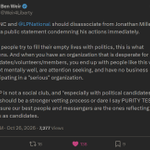
The New Libertarian Party should indeed be built, this time based on principles of private ownership and not socialist democracy.
It should indeed have Purity Tests: an actual political identity. A meaningful distinction. A proper understanding of the Non-Aggression Principle.
Our political nominees should be private owners that care about consistency in their own messaging.


Kasimir retweeted

Cranks try to “out” @imshin who shares life in Gaza, proudly posted by Gazans on their social media.
It’s an antidote to relentless disinformation by our media and online Palestinianism.
They hate it for one reason only: It show them their lies.
Follow her.
#TheGazaYouDontSee
Kasimir retweeted

TRANSLATION:
First Round
Abstentions: 33.5 million (21%)
Blank votes: 2.3 million (2%)
Invalid votes: 3.7 million (3%)
Voter turnout: 125.3 million (79%)
Other candidates: 9.5 million (8%)
Second Round
Abstentions: 30.4 million (21%)
Blank votes: 1.4 million (1%)
Invalid votes: 2.7 million (2%)
Voter turnout: 128.1 million (81%)
Lula: 64.1 million (51.8%)
Flávio: 59.7 million (48.2%)
Between abstentions, blank votes, and invalid votes, they somehow found 5 million additional votes.
Add that to the 9.5 million votes cast for other candidates in the first round, and you have a pool of approximately 14 million new votes.
Flávio gained 4 million votes, going from 56 million to 60 million.
Lula gained 10 million votes, going from 54 million to 64 million.
All figures are rounded.
Of this pool of 14 million votes, Flávio received 29%, while Lula received 71%.
And this happened despite the fact that 10 million of those 14 million votes came from voters who had supported other candidates with more right-leaning political profiles.
The whole thing is so extraordinary that it is extremely difficult to believe.
It’s as if, in just three weeks, voters who had signaled a turn to the right suddenly made a sharp turn to the left.
It’s hard not to think about those two extra hours.

*Primeiro Turno*
Abstenção 33,5 mi (21%)
Brancos 2,3 mi (2%)
Nulos 3,7 mi (3%)
Comparecimento 125,3 mi (79%)
Outros 9,5 mi (8%)
*Segundo Turno*
Abstenção 30,4 mi (21%)
Brancos 1,4 mi (1%)
Nulos 2,7 mi (2%)
Comparecimento 128,1 mi (81%)
Lula 64,1 mi (51,8%)
Flávio 59,7 mi (48,2%)
Abstenção, Brancos e Nulos eles acharam 5 milhões de votos.
Soma isso com 9,5 milhões de votos de outros, ficou um universo de 14 milhões de votos novos.
Flavio achou 4 milhões de votos, veio de 56 milhões para 60 milhões.
Lula achou 10 milhões de votos , veio de 54 milhões para 64 milhões.
Números arredondados.
Do universo de 14 milhões de votos, Flavio achou 29% e Lula 71%.
Isso com 10 milhões destes 14 milhões de votos vindo de outros candidatos com perfil mais a direita.
É tudo tão incrível que é muito difícil de acreditar.
Como se os eleitores em 3 semanas, tivessem dado seta para direita e agora deram para esquerda.
Difícil não pensar nessas duas horas a mais.
IP is Intellectual Parasitism,
It is not surprising that proponents of this lifestyle do not want their ideas cross-examined, and try to obfuscate any analysis focusing on contradictions.
The post I am responding to illustrates a recurring problem: people would rather express their misconceptions than engage with the actual idea. Rand and Rothbard both struggled with this reality.
"Instead of Austrianism (Austrian Economics) slotting under Objectivist ethics in the narrow scope of economics, Zulu is *subordinating* Objectivism under Austrianist philosophy."
Austrian economics integrates observations from reality in the same way Objectivism does. People act to achieve ends. Those ends may be consistent with the requirements of human life, or they may evade them. Economics describes available means. It does not prescribe ends. Objectivism supplies the normative standard. The two address different questions. They do not form a hierarchy.
Take a simple case. The judgment "I ought to survive, therefore I ought to eat" sets a condition (nourishment). Economics then identifies which methods of allocating scarce means best satisfy that condition.
"At the heart of this worldview is the idea of "scarcity." This is a post-Kantian, collectivist, materialist, anti-production, primacy of consciousness idea that negates the fundamental human problem of how to survive. It starts by assuming a static quantities premise; i.e., "the goods are here.""
This misstates the Austrian view. One of the first observations of Austrian economics is that certain actions are mutually exclusive. A physical resource cannot occupy two places or serve two incompatible uses at the same time. Using a resource for one purpose precludes using it for another. That is an opportunity cost. It follows from the law of identity (A is A).
Scarcity is an integration from observation. Within any given area, some resources are closer, easier to extract, or more suitable for a given use than others. Relative location and the physical properties of the world make rivalry possible over particular units of resources.
"But, unlike a paradise of unlimited goods, these proponents say, in real life there are only so many goods yet fewer people to have them."
This is not the claim. The observation is simply that using a particular scarce resource for one purpose excludes its simultaneous use for another purpose.
"So other people's wishes to command the scarce goods "come under conflict" with other people's wishes, and the way to resolve this conflict is to assign boundaries to these goods so we can all get along with each other."
Every system of resource allocation resolves conflicts over rivalrous uses by assigning boundaries. The distinctive claim of the Austrian school and Anarcho-Capitalist Natural Law is that the assignment can be made without logical or performative contradictions.
"Rand's philosophy takes a completely different approach."
It does not. I know of no passage in which Rand denies that physical resources are subject to opportunity costs. She must necessarily submit to the law of identity and avoid contradictions. If Rand contradicts her own foundations in a statement, that statement can be classified as an error and ignored.
This is why Objectivism should not become Randianism, even if the author erroneously claims otherwise.
"She starts with the individual and asks: what does man need in order to survive, i.e., in order to sustain himself? What she observes is that all living organisms live by a process of self-sustaining action. They act to gain values from their surroundings to maintain their lives."
This description of the end does not specify the means, except that the means must be consistent with reason and free of contradictions.
"As you can see, there are already two main differences to these approaches: Rand says that the fundamental problem is that of survival, and that values, to be gained, must be acquired through action."
This is not a difference. Praxeology describes the same mechanism of action. It simply refrains from evaluating the ends. A complete philosophy therefore requires a theory of values, which Objectivism supplies.
"By contrast, (Austrian Economics) ignores the problem of survival"
It does not. Economics is a tool for analyzing means, comparable to a measuring instrument. A tape measure reports distance. It does not tell you whether the distance is relevant to survival. Requiring a descriptive tool to supply normative conclusions confuses the two domains.
"and treats values / goods as if they are already here, with the only problem being how to distribute them."
Goods and values are distinct. Goods are physical aspects of reality. Values are judgments about what promotes or hinders a person's life. The economic value of a good depends on the actor's ranking of ends and on opportunity costs. These concepts should not be conflated.
"Note the definition that Zulu offers for property. He defines property rights by their consequence and through negation (both logical errors)."
The definition is not a logical error. It is reached by elimination. Every alternative either produces a formal contradiction or a performative contradiction in argumentation. This is the same method used to establish foundational axioms by Rand, as inspired by the arguments of Aristotle.
"He says that ownership is the right to exclude because he starts from the collectivist premise of people claiming their whims on static quantities."
This is incorrect. Ownership is the right to exclude because that is what distinguishes it from mere possession. The definition follows from the nature of rivalrous resources and from the requirement of non-contradiction.
This is an individualist principle. On an unowned island, Crusoe is the first to emborder a stick. If Friday later claims the same stick, the facts of who acted first are ascertainable. The firstcomer has a claim that does not depend on collective whim. Collective whim can ignore reality at its peril and become an engineering problem.
"This is absurd if you actually looks at reality. Simple examples of restaurant owners who invite people into their property or a person lending his book to a friend demonstrate that property is not always *literally* excluded from the use of others."
In both cases the owner voluntarily suspends the right to exclude under known conditions. The owner retains the power to reassert it ("Leave" or "Return the book"). The examples illustrate the exercise of the exclusion right, not its absence.
"Rand's definition of property is correct because she doesn't start from the false scarcity premise. Man, I believe she writes this explicitly, starts with NOTHING. Neither abundance nor scarcity, which is a false dichotomy. He starts with *zero* values and must generate action to gain values from the outside world."
The term "values" is used in more than one sense here. Man starts with no material values already in hand. He must act on existing physical resources. The phrase "generate action" adds no clarity beyond "man acts." Treating action itself as a substitute for tangible resources risks treating effort as sufficient to establish a claim over resources already owned by someone else (such as the effort of a thief).
"How does he know though which values are indeed values? How does he know how to gain values? Knowledge is not automatic, so he must think to guide his actions. This, together with action, is the primary problem of survival, which are both problems that (Austrian Economics) glosses over (because fundamentally it rejects consciousness—but that's for another time)."
Nothing in praxeology contradicts the claim that knowledge is not automatic and that thought guides action. Praxeology simply does not evaluate the ends or the methods of cognition. Those are tasks for ethics and epistemology. Requiring a descriptive science of action to supply a full theory of values confuses categories.
"Thus Rand reaches the definition of property, which is the right to use or dispose of earned things according to one's judgment. Note, it is the right to use—not the right to exclude."
The right to use is a consequence of the right to exclude. Without a justified right to exclude others, "use" collapses into mere possession.
""Use" presupposes a mind that decides how to use. You can use the object yourself or you can let someone else use it. Hence "exclusion" is not essential to the concept."
Exclusion is essential because it is the only feature that distinguishes ownership from mere possession. A thief can use and dispose of a stolen good, yet the thief cannot exclude the original owner without contradiction.
"It can be one result of how you decide to use an object, but not more than that. The essential characteristic of property is that you earn it and get to decide how to use it."
If this were sufficient, a thief could claim ownership over stolen goods on the ground that he decides how to use them. Ownership is not mere possession. The thief is a latecomer and therefore lacks the justified right to exclude the original owner.
"The idea of exclusion and scarcity, however, dispenses with the mind,"
It does not. The claim has not been demonstrated.
"and reduces the issue of property to physical distribution, as if humans are nothing but animals (or 5-year-olds) fighting over the same finite resources."
Physical resources are locally limited by the opportunity costs of their use. One cannot perform two contradictory actions with the same unit of a resource at the same time. That constraint does not eliminate the role of the mind. It is a fact the mind must take into account when choosing.
"Now because "use" is mind-dependent, the issue of property in a social context is not how to draw boundaries around goods, but whether or not *one's consent of usage is respected by others*."
This restates the problem of drawing boundaries.
Some people will have a bad philosophy, or will choose evasion over reason. Making such people respect one's boundaries is an engineering problem, not a problem of law or philosophy.
"If you physically take an object that's mine, that's not theft if I gave you my consent to use it. It is only theft if I *did not* give you my consent."
Taking an object is theft when the owner has excluded the taker and the taker proceeds anyway.
"The implementation of property rights is an epistemological problem, not a metaphysical one."
Epistemology is downstream of metaphysics. The primacy of existence entails that knowledge depends on the nature of what exists. The concept of ownership exists as distinct from possession via the firstcomer principle (which is derived by negating alternatives).
"Thus physical possession cannot be the basis of property rights (this is concrete-bound and dumb, actually, with all due respect)."
The position defended here is not a possession ethic. It is an objective assignment rule based on the firstcomer principle. The person who first emborders an unowned resource acquires the right to exclude others from it, even if the resource is held for later use.
"Since this is already long, I'll offer only a brief comment on IP."
The debate concerned IP. Treating the topic as an afterthought is notable.
Interesting how by simple substitution the "brief comment" can be entirely negated.
Intellectual Parasitism does not exist in a non-market context. If the parasite lives in a remote isolated community, they do not harm your ability to survive. But markets are a different story, once the parasite starts telling you how to use your body and your resources, at threat of violence, that is when they threaten your survival. Specialized production becomes more difficult the more Intellectual Parasites are nearby.
That is the nature of IP: intellectual parasitism. Using obfuscation, mysticism and special pleading to rule over other people and their resources.
In practice, it is one of the strongest levers of control of the State-Corporate leviathan. If the project of liberty is to have any hope, IP must be abolished.
Intellectual Parasitism Delenda Est!

This debate is a perfect illustration for why I attack Austrianism.
Some Objectivists maintain that Austrian econ is compatible with Rand's philosophy. Well, here we have a case of a person, @PunishedZulu, who (somewhat) genuinely attempts to infuse Austrianism with Objectivism.
But notice what happens here. Instead of Austrianism slotting under Objectivist ethics in the narrow scope of economics, Zulu is *subordinating* Objectivism under Austrianist philosophy.
This is why I keep arguing that Austrianism is not merely economics; it is a worldview.
At the heart of this worldview is the idea of "scarcity." This is a post-Kantian, collectivist, materialist, anti-production, primacy of consciousness idea that negates the fundamental human problem of how to survive.
It starts by assuming a static quantities premise; i.e., "the goods are here." But, unlike a paradise of unlimited goods, these proponents say, in real life there are only so many goods yet fewer people to have them. So other people's wishes to command the scarce goods "come under conflict" with other people's wishes, and the way to resolve this conflict is to assign boundaries to these goods so we can all get along with each other.
Rand's philosophy takes a completely different approach. She starts with the individual and asks: what does man need in order to survive, i.e., in order to sustain himself? What she observes is that all living organisms live by a process of self-sustaining action. They act to gain values from their surroundings to maintain their lives.
As you can see, there are already two main differences to these approaches: Rand says that the fundamental problem is that of survival, and that values, to be gained, must be acquired through action.
By contrast, Austrianism ignores the problem of survival and treats values/goods as if they are already here, with the only problem being how to distribute them.
Note the definition that Zulu offers for property. He defines property rights by their consequence and through negation (both logical errors). He says that ownership is the right to exclude because he starts from the collectivist premise of people claiming their whims on static quantities.
This is absurd if you actually looks at reality. Simple examples of restaurant owners who invite people into their property or a person lending his book to a friend demonstrate that property is not always *literally* excluded from the use of others.
Rand's definition of property is correct because she doesn't start from the false scarcity premise. Man, I believe she writes this explicitly, starts with NOTHING. Neither abundance nor scarcity, which is a false dichotomy. He starts with *zero* values and must generate action to gain values from the outside world.
How does he know though which values are indeed values? How does he know how to gain values? Knowledge is not automatic, so he must think to guide his actions. This, together with action, is the primary problem of survival, which are both problems that Austrianism glosses over (because fundamentally it rejects consciousness—but that's for another time).
Thus Rand reaches the definition of property, which is the right to use or dispose of earned things according to one's judgment. Note, it is the right to use—not the right to exclude. "Use" presupposes a mind that decides how to use. You can use the object yourself or you can let someone else use it. Hence "exclusion" is not essential to the concept. It can be one result of how you decide to use an object, but not more than that. The essential characteristic of property is that you earn it and get to decide how to use it.
The idea of exclusion and scarcity, however, dispenses with the mind, and reduces the issue of property to physical distribution, as if humans are nothing but animals (or 5-year-olds) fighting over the same finite resources.
Now because "use" is mind-dependent, the issue of property in a social context is not how to draw boundaries around goods, but whether or not *one's consent of usage is respected by others*. If you physically take an object that's mine, that's not theft if I gave you my consent to use it. It is only theft if I *did not* give you my consent. The implementation of property rights is an epistemological problem, not a metaphysical one. Thus physical possession cannot be the basis of property rights (this is concrete-bound and dumb, actually, with all due respect).
Since this is already long, I'll offer only a brief comment on IP.
One does not have IP in a non-market context. If someone copies your creation and you both live in a small, isolated community, this does not harm your ability to survive. But markets are a different story. In a market context we don't self-subsist, we specialize. Specialized production becomes the method of human survival in markets.
This means that we create *in order to sell our creation on the market*. If someone physically takes our creation or copies it without our consent, he has robbed our specialized advantage, robbed our time and effort, and robbed our final product. To allow copying of property of any kind—physical or intellectual—without the creator's consent, is to advocate for the destruction of markets.
I will end here, but at some point I will flesh out this argument in more detail.
The lie is that @Lieboisout did not know what a CROSS EXAMINATION entails, and that it was weird to him to be treated like a witness at court: interrogated by a prosecutor. I understand how that can be traumatic but that is the exact purpose of CX!
Intellectual cowardice.

You can watch LiquidZulu dismantle Michael Liebowitz here:
youtu.be/QSYHSWXYIsk
Kasimir retweeted

The reason why we use fiat.
Trilion game, ep 22 11:01
thx for @KasimirFreeman for recomending me the show