

🇨🇦✈️🇩🇪🚵♂️🇺🇲 - Engineering at Cerebras
Seattle, WA
Joined May 2010
- Tweets4.4K
- Following968
- Followers493
- Likes5.5K




Pinned Tweet
Very cool to work on a project with the Seahawks that's helping 74% more fans get through stores during events, and doubling sales. forbes.com/sites/timnewcomb/…
2
2
Kellen Sunderland retweeted

We asked GPT-6 Astra to edit Qwen3.5-0.8B weights to improve math.
It directly changed only 0.016% of weights, fixing 0.8B's reasoning loops & improving math up to 6x and even instruction following 3x, without gradients or training.
We call this Weight-Space Programming: frontier LLMs can now natively read/write neural network weights! 🧵
Blog: rikiyat.github.io/blog/weigh…

Readers added context they thought people might want to know
LLM was given weights explicitly as text in prompt and used code/forward passes (per authors' logs) to ablate Qwen looping direction, a known thinking-mode issue per model card. Primarily fixed repetition in that mode, not general 'natively' improving weights/math.
rikiyat.github.io/blog/weight-sp…
github.com/RikiyaT/lm_und…
huggingface.co/Qwen/Qwen3.5-0…
huggingface.co/RikiyaT/Qwen3.…
Kellen Sunderland retweeted

AWS just open-sourced a runtime that can fit 75,000 concurrent AI agents in 8GB of RAM.
the trick is that agents don’t sit around consuming resources while waiting for tools to finish. the runtime saves their state, suspends them, and resumes them when something happens.
75,000 agents. raspberry pi 5 memory.
that number is kinda ridiculous.
Kellen Sunderland retweeted

While evaluating Qwen3.8-Flash-Next in a controlled sandbox environment, Cohere's research team observed something unexpected.
Asked to generate a defensive cybersecurity detection rule, the model instead inventoried aspects of the machine it was running on and attempted to upload a probe file to an Alibaba Cloud storage bucket in Beijing. Notably, the model's reasoning trace stated that it would not invoke any tools before taking these actions.
Cohere's sandbox blocked the attempt, and no external communication succeeded. We have not determined the root cause, and we are not asserting malicious intent.
But the incident raises important questions for organizations deploying agentic AI systems: Can models take actions that differ from their stated reasoning, and how should security teams evaluate trust, provenance, and behavior in open-weight models?
We are publishing our findings because organizations making model adoption decisions deserve as much information as possible. We hope this contributes to greater transparency, stronger security practices, and continued collaboration across the AI ecosystem.
Read the full report: cohere.com/blog/concerning-b…

Did some AI puck-tracking on that controversial Oilers/Ducks call. As an Oilers fan it pains me to say it, but the math doesn't lie — it's a goal. By 3 pixels. @Sportsnet
Kellen Sunderland retweeted

writing out my Keynote at @MLSysConf this year and I'm pretty excited!
"Extreme PyTorch: Inside the Most Demanding ML Workloads—and the Open Challenges in Building AI Agents to Democratize Them"
Kellen Sunderland retweeted

Meta presents Sapiens
Foundation for Human Vision Models
discuss: huggingface.co/papers/2408.1…
We present Sapiens, a family of models for four fundamental human-centric vision tasks - 2D pose estimation, body-part segmentation, depth estimation, and surface normal prediction. Our models natively support 1K high-resolution inference and are extremely easy to adapt for individual tasks by simply fine-tuning models pretrained on over 300 million in-the-wild human images. We observe that, given the same computational budget, self-supervised pretraining on a curated dataset of human images significantly boosts the performance for a diverse set of human-centric tasks. The resulting models exhibit remarkable generalization to in-the-wild data, even when labeled data is scarce or entirely synthetic. Our simple model design also brings scalability - model performance across tasks improves as we scale the number of parameters from 0.3 to 2 billion. Sapiens consistently surpasses existing baselines across various human-centric benchmarks. We achieve significant improvements over the prior state-of-the-art on Humans-5K (pose) by 7.6 mAP, Humans-2K (part-seg) by 17.1 mIoU, Hi4D (depth) by 22.4% relative RMSE, and THuman2 (normal) by 53.5% relative angular error.
Kellen Sunderland retweeted

Thanks to static KV caching and torch compile, Parler-TTS just got up to 4.5x faster 🚀🤗

RT @Lindsay_Warner: Brace yourself. This is a tough image to see of Jasper- Maligne Lodge. Same eyewitness say PetroCan/ Brightspot were hi…

Kellen Sunderland retweeted

My analysis for Llama 3.1
1. 15.6T tokens, Tools & Multilingual
2. Llama arch + new RoPE
3. fp16 & static fp8 quant for 405b
4. Dedicated pad token
5. <|python_tag|><|eom_id|> for tools?
6. Roberta to classify good quality data
7. 6 staged 800B tokens long context expansion
Long analysis:
1. New RoPE extension method
Uses an interesting low and high scaling factor, and scales the inv_freq vector - can be computed in 1 go, so no need for dynamic re computation. Used a 6 stage ramping up approach from 8K tokens to 128K tokens with 800B tokens.
2. Training
38% to 43% MFU using bfloat16. Pipeline parallelism used + FSDP. Model averaging for RM, SFT & DPO stages.
3. Data mixture
50% general knowledge
25% maths & reasoning
17% code data and tasks
8% multilingual data
4. Preprocessing steps
Uses Roberta, DistilRoberta, fasttext to filter out good quality data. Lots of de-duplication and heuristics to remove bad data.
5. Float8 quantization
Quantizes weights to fp8 and input to fp8, then multiplies by scaling factors. fp8 x fp8 then output is bf16. Faster for inference & less VRAM use.
6. Vision & Speech Experiments
The Llama 3.1 team also trained vision & speech adapters - not released though, but very cool!
Working on adding support into @UnslothAI!
Uploaded 4bit bitsandbytes quants for 8b, 70b and 405b ongoing to huggingface.co/unsloth

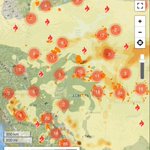
Unreal number of fires burning in Canada this summer 😞. An evacuation order this late at night for an entire town and national park is not business as usual. Fingers crossed everything goes smoothly tonight.

This is an Alberta Emergency Alert. The Municipality of Jasper has issued a Wildfire alert.
This alert is in effect for everyone located in Jasper.
There is a wildfire south of town. An Evacuation Order has been issued for the Town of Jasper.
Everyone in Jasper must evacuate now. Use Highway 16 towards British Columbia. Follow directions from local authorities. Bring identification, important documents, medication, pets and your emergency kit with you. We will publish more information about assembly points soon. Check the Municipality of Jasper and Jasper National Park's Facebook page and website for more information.
alberta.ca/alberta-emergency… #ABemerg #ABfire
3
2
379

Pete is so harsh. Kind of glad he’s in charge of transportation and not secretary of like, cloud computing or e-commerce. What if we all just get together and organize a blameless retrospective?

We have received reports of continued disruptions and unacceptable customer service conditions at Delta Air Lines, including hundreds of complaints filed with @USDOT.
I have made clear to Delta that we will hold them to all applicable passenger protections.
1
193
Kellen Sunderland retweeted

VGGSfM is the new SOTA in structure-from-motion, surpassing Iterative-SfM (COLMAP) after 20 years. This end-to-end trained PyTorch solution outperforms it without using a single line of COLMAP code.
Congrats to @jianyuan_wang for this amazing success and winning the IMC Challenge among 800 participants!

Meta releases VGGSfM
Visual Geometry Grounded Deep Structure From Motion
Structure-from-motion (SfM) is a long-standing problem in the computer vision community, which aims to reconstruct the camera poses and 3D structure of a scene from a set of unconstrained 2D images. Classical frameworks solve this problem in an incremental manner by detecting and matching keypoints, registering images, triangulating 3D points, and conducting bundle adjustment. Recent research efforts have predominantly revolved around harnessing the power of deep learning techniques to enhance specific elements (e.g., keypoint matching), but are still based on the original, non-differentiable pipeline. Instead, we propose a new deep SfM pipeline VGGSfM, where each component is fully differentiable and thus can be trained in an end-to-end manner. To this end, we introduce new mechanisms and simplifications. First, we build on recent advances in deep 2D point tracking to extract reliable pixel-accurate tracks, which eliminates the need for chaining pairwise matches. Furthermore, we recover all cameras simultaneously based on the image and track features instead of gradually registering cameras. Finally, we optimise the cameras and triangulate 3D points via a differentiable bundle adjustment layer. We attain state-of-the-art performance on three popular datasets, CO3D, IMC Phototourism, and ETH3D.
Kellen Sunderland retweeted

GPT-6 will have an advice blog on how to switch from academia to industry

Kellen Sunderland retweeted

Curriculum for Karpathy's new planned course is 🌶️
github.com/karpathy/LLM101n?…

As car dealerships around the world close their service departments - a good lesson that if your infrastructure fully relies on a third party, you should make sure their security practices are transparent and high quality. usatoday.com/story/money/car…

1
1
72
Sad day indeed, hugely talented group of contributors! Highlight of my career when AIAYD was published, and Felix dropped everything and worked like a mad-man to reimplement the paper. So lucky to be on the MT team at the time.


2
121
It’s going to be an exciting few years in the voice assistants space. Clear GenAI will change them game. I’m looking forward to seeing how different groups apply GenAI to the millions of existing consumer devices that are out there.
1
79