

0-$500M+, Halter GTM Advisory, CRO @openspace.ai, Sr. Director of AMER @Autodesk Construction Cloud, 🦺 VP of Sales @PlanGrid (ADSK M&A), cofounder of @Getable
USA
Joined March 2010
- Tweets6.6K
- Following1.2K
- Followers1.4K
- Likes24.9K









Kevin Halter retweeted

"You can be disliked, you need to be respected, and if your sales leader is beloved by everybody, you’ve got the wrong guy.
I want someone who will call me on my sh*t and make me better.
You cannot win without conflict, and leaders who need to be popular avoid conflict and end up avoiding the right decisions."
Love to hear your thoughts @maggie_hott @pedroh96 @austin_rief @vxanand
Kevin Halter retweeted

Here's something fascinating happening in the apartment market right now.
The cheapest, oldest apartments (Class C) are getting crushed right now.
But ONLY in cities that just delivered tons of new apartments.
Let me show you the numbers:
Denver: Class C rents down 13.9%
Naples: Class C rents down 13.5%
Austin: Class C rents down 13.3%
Phoenix: Class C rents down 10.5%
San Antonio: Class C rents down 7.2%
Dallas: Class C rents down 6.5%
What do all these cities have in common?
They just absorbed a massive wave of new apartments.
But here's the twist...
In cities that DIDN'T get a big supply wave?
Class C rents are actually RISING.
20 cities saw Class C rents go UP more than 3%.
19 of those 20 cities had supply BELOW the national average.
So what's going on?
It's basically musical chairs.
When a brand new luxury apartment opens up, where do those renters come from?
They don't appear out of thin air.
They move from slightly older apartments.
Those apartments now have vacancies. So they drop their rents to compete.
That pulls in renters from even older apartments.
And down the chain it goes.
Eventually it hits the oldest, cheapest apartments at the bottom.
And here's why they get hit the hardest:
People living in Class C apartments are already spending a huge chunk of their paycheck on rent.
To fill empty units, landlords have to cut prices A LOT.
Sometimes enough to attract people who couldn't afford market-rate apartments before.
It's like a waterfall effect.
The water (new supply) at the top pushes everything down.
But here's the important part:
This proves that building new apartments - even "luxury" ones - reduces rents all the way down the spectrum.
If it was just an affordability crisis, you'd see Class C rents falling everywhere.
In high-supply cities AND low-supply cities.
But we're not seeing that.
We're seeing a perfect split:
Lots of new apartments = falling Class C rents
Few new apartments = rising Class C rents
New supply at the top creates relief at the bottom.
Also: wages have been growing faster than rents for 3 straight years.
More people can afford apartments today than before.
The bottom line?
This is what happens when you actually build housing.
Supply works.
(Chart and analysis from Jay Parsons - one of the sharpest real estate economists out there)

Kevin Halter retweeted

Brian Armstrong on what he learned about management from Balaji Srinivasan
“Balaji is a brilliant guy. He’s probably one of the top couple smartest people I’ve ever met in my life,” Brian begins. “He was briefly the Chief Technology Officer of Coinbase. He came in through an acquisition and did some amazing work. And he taught me how to manage a totally different type of person.”
Brian continues:
“Balaji is kind of unmanageable. He’s what some people might call a ‘free radical’ within an organization. He kind of bounces around, absorbing vast amounts of information — even things that aren’t his responsibility — and occasionally he would come back to me with these incredible insights.”
Brian gives one funny example:
“At one point he came back to me and said, ‘These are all the salespeople that are making more revenue than their salary, and these are all the people that are not.’ And the first thought I had was, ‘You’re not supposed to have access to anybody’s salary. How did you get that?’”
Balaji replied, “Don’t worry about it. I found it in some database that I wasn’t supposed to have access to.”
The next question Brian asked was, “How did you connect that all up?”
The previous week Brian asked the data team to connect Salesforce to Coinbase’s salary data so they could start running some reports to have more accountability. But it was supposed to be a three-week project.
Balaji responded, “Oh well I couldn’t sleep this weekend, and I just knew something felt off. So I had to code it up and put it all together.”
When the data team completed their analysis three weeks later, they confirmed that Balaji was 100% right.
“He was continually doing things like that,” Brian explains. “And he’s incredibly high in disagreeableness, which I learned from him as well. He would go into a team and ask, ‘Why isn’t this functioning well?’ And he would suffer no fools. He would not be afraid to go in there and turn half the people on a team — whether he had the permission to fire them or not… He was a very contrarian figure. I’d say about once a week someone would come into my office and say, ‘I can’t work with Balaji. He’s causing so much collateral damage.’ And I’d say, ‘Yes, but he’s also generating an enormous amount of value and I need you to learn how to work with him.’”
Brian knew Balaji wasn’t going to last forever at Coinbase because it was incredibly disruptive, but ultimately he taught Brian how to be a “turnaround CEO” when needed:
“In the past I was opting a little more toward trying to be liked instead of being clear about what we’re doing, where we’re going, and what the bar is. He helped me become a better CEO and have a little more disagreeableness.”
Video source: @stripe (2025)
Kevin Halter retweeted

I think this is the most extraordinary collection of talent, of human knowledge, that has ever been gathered together at the White House, with the possible exception of when Thomas Jefferson dined alone.



Kevin Halter retweeted

Healthcare spends on the wrong things, but won't fund the right ones.
Far too often, it's healthcare companies that direct care, and not your doctor...they don't often approve the things that are optimal.
Kevin Halter retweeted

Founders: Eat meals with your prospects.
The act of breaking bread together is baked in as a powerful relationship builder by millions of years of evolution.
If it's a face to face meeting, make it over breakfast or lunch or dinner. Even if it's coffee, get some cookies from the sweets case.
Eat together with your prospects.

Kevin Halter retweeted

12/12 The people do not pull to the side, nor should they.
Anyone worried about the future of American democracy should be concerned foremost with the elites’ bizarre belief that the road is theirs.
There's an off-ramp! How to find it? Read the essay: nytimes.com/2024/07/06/opini…
Kevin Halter retweeted

A great leader reminds everyone around them that it's okay to tell the truth, even if it's uncomfortable. That's how you build the strongest teams.

"You might get clubbed to death"
"Truths don't want to be heard"
"Important truths can be uncomfortable, awkward, exhausting, challenging..."
"But any high performing organization has to have mechanisms and culture that supports truth telling"
Bezos on company culture:
--
Found this valuable? Follow @useintro to learn how the world's most successful entrepreneurs built $100M+ businesses.
Kevin Halter retweeted

Bloomberg offers a perk for clients that is known as the “lose-your-job free trial.”
It works like this: if you are a paying customer who gets fired, you can request access to a Bloomberg terminal at no cost for some number of months.
The program helps explain one reason Mike Bloomberg has been so successful: he understood his real clients are the traders who use his product, not the firms that pay for it.
The idea was hatched early on during a bump in the market.
It was pretty straightforward: Wall Street is a volatile place where people are constantly getting fired and rehired. Mike wanted to help smooth out that process.
The Bloomberg terminal was one constant in the professional life of traders who were frequently forced suddenly to find new jobs.
The terminal’s vaunted message system in particular served as a communications lifeline, allowing continued access to the financial community.
The offer was as generous as it was unusual. It’s hard to think of another professional information system paid for by an employer which is offered for free to individuals after they are fired by the company footing the bill.
It’s worth unpacking because it sheds light on one of Bloomberg’s deep competitive advantages: it’s connection to the individual user.
The Holy Grail for many software and fintech companies is to establish a one-to-one relationship with users.
Bloomberg, like most vendors, is usually purchased by a company for the benefit of financial professionals like traders or portfolio managers.
By offering a free trial when people are fired, Bloomberg garnered goodwill and cemented a direct relationship with the individual user of the product.
When those same individuals went looking for their next job, many would insist that the new package include a Bloomberg terminal.
This is why Jeff Cohen, who headed terminal sales at Bloomberg in the 1990s, says that the real sales people at Bloomberg are the customers.
Jeff said that Mike figured out better than most other companies how to get paying customers to sell the product more effectively than any salaried employee could.
Over time the lose-a-job free trial has become a part of the Bloomberg culture. It is — like the legendary Costco $1.50 hotdog – both a brand marker and super effective marketing.
Officially, the brand name for the lose-your-job free trial program is Stay Connected.
Nobody on the Street calls it that, of course.
Jeff and I were talking about the program because we came across an old email from Nov. 20, 2002 sent out by Lex Fenwick who was running the company at the time.
The market was reeling from the dotcom crash. Amid widespread pessimism, Lex wanted the sales force to remind customers that if fired, Bloomberg would help them try to stay in the game.
Wall Street is portrayed in Hollywood films as a cut throat place. And there’s a lot to that.
But it’s also a place that remains to a surprising degree a relationship business.
(Part of a series of business lessons I learned from three decades working at Bloomberg LP)
@business

Kevin Halter retweeted

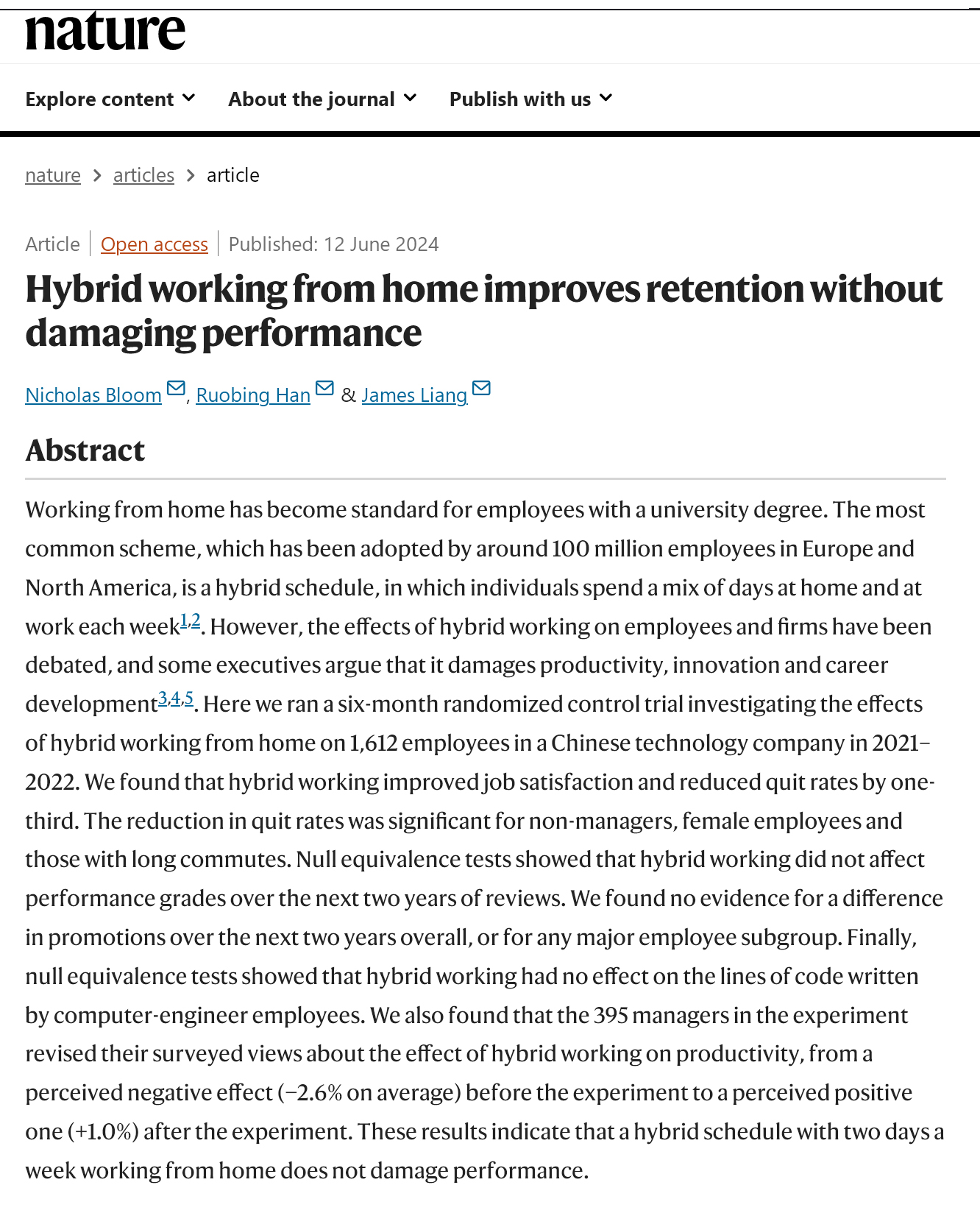
Hey managers: to keep your people, let them work from home 2 days a week.
Landmark experiment (1600+ ppl, 2yrs): random assignment to hybrid work
-Increased satisfaction
-Reduced quitting by 33% (especially for women & long commuters)
-No costs for performance or promotion rates
Kevin Halter retweeted

The idea of landing the plane requires runways to land on - and the airports are fresh out, to continue the metaphor.
Many, many startups will try to sell and find no buyers on the other side.


Landing The Plane: A Necessary Choice For Many Startups
How many Founders does it take to land a plane? None, they'll just pivot to a helicopter ride-sharing service.
Joking aside, there’s nothing more fun than being part of an incredibly successful Startup. The relentless ambition of passionate teams doing everything they can to ship code and scale is energizing.
And for most Startups, their goal is to join the ranks of “real” companies by growing large enough to eventually execute a well-received Initial Public Offering. Having their own ticker symbol etched in the annals of Wall Street drives many Founders, and as importantly, IPOs are a critical source of investment returns for the VCs that fuel the startup ecosystem. Without IPOs, VC math doesn’t math!
However, reality is sobering. Only a few percent of all Startups backed by Tier 1 VCs achieve the scale required for a successful public offering, and the numbers are much, much worse for the broader Startup ecosystem. So, what happens when it’s obvious that a Startup isn’t on a trajectory to capture hundreds of millions of dollars of high margin revenue which would allow them to go public?
The unfortunate truth is that once it’s clear that a Startup is going to struggle to achieve escape velocity, they need to work with their Investors to “Land The Plane.” This is typically very tricky because navigating a safe and controlled descent towards a positive outcome isn’t straightforward nor guaranteed. It often involves finding a strategic buyer that recognizes the value in the Startup's financial performance, technology, customer base, or talent pool. It often devolves into very heated debates about how to distribute a pool of money or stock that’s less than everyone is happy with. And it often requires a Founder to internalize what they’ve built and what their options are with crystal clarity rather than through their normal “eternally optimistic” lens.
And given the “Grand Reset” that’s happening within the Startup ecosystem (which I wrote about here: xitter.gq/fintechjunkie/status/1… ), everyone is embracing the reality that the ZIRP environment funded too many Startups that will never achieve escape velocity. The implication is that there are a lot of planes in the air right now that need to be guided to safe landings or they’ll most likely run out of fuel and crash.
STEP 1: AGREE TO LAND THE PLANE
While not the original destination, a strategic acquisition can be a win for a Founder and for a VC, even if the financial windfall isn't astronomical. Internalizing this is important for all parties because it takes alignment and coordination to pull off a safe landing. Benefits include:
Payment For Value Creation: In many cases, a strategic sale translates to some form of renumeration, whether it be in terms of cash or stock. Even if the financial returns aren’t great, any cash returned to Investors means they can return it to their LPs which is a major driver in raising additional money from them in the future. And if the payment is in stock, hopefully there will be some return in the future that offsets the time and money poured into the Startup.
The Mission Can Continue: Acquisition by a larger company often injects valuable resources, expertise, and market access that can accelerate a Startup’s mission. The startup's technology, service or product could gain instant exposure to a wider audience, potentially amplifying its original mission far beyond what it could have achieved independently. Founders witnessing their creation flourishing within a larger ecosystem can be incredibly rewarding, even if they're no longer “at the top of the food chain”.
Employee Success: A strategic buyer is likely interested in retaining the Startup's talent because these are the people who built what the acquirer is coveting. Many times, the Founders and Employees end up with great jobs at the acquirer and no longer feel the pressure of having to outrun the cash burn of an underfunded Startup. Employees are typically offered opportunities for growth that also come with great pay packages and real stability. Founders who prioritize their team's happiness can find solace in knowing they've secured great jobs for the people who believed in their vision. And it’s common for Founders to use the integration period to breathe, learn from past experiences, and potentially prepare themselves to build something even bigger.
Building a Strong Reputation: A successful acquisition, even at a moderate valuation, can solidify a Founder's reputation in the VC ecosystem. It demonstrates their ability to build something of value, attract interest from Investors, and navigate the complexities of a sale. This positive track record positions them for future success when seeking funding for their next venture. Investors are more likely to back Founders who can navigate “Landing The Plane” instead of “Fighting To Remain Independent” when the writing is on the wall that it’s time to sell.
STEP 2: PREPARE FOR A SALE
Preparing to sell a company isn’t as easy as it sounds. It’s not as simple as hiring a Banker and putting together a data room. Building awareness about what a Startup does within the prospective buyer community and cleaning up how it operates are critically important and time consuming steps in most successful M&A processes. This means that the time to sell a company is 6-12 months before it would run out of cash. Cutting it too close will almost always lead to a fire sale, an acqui-hire (with no value exchanged for the Startup’s assets) or a no-bid.
Building Awareness Within The Buyer Community: Most successful M&A transactions occur between known parties. If your first outreach to a potential strategic buyer is a Banker led M&A process then the odds of completing a transaction with that buyer is extremely low and diligence will be extremely long. Many times the buyer is a company that already interacts with the Startup in some form or fashion or has already expressed interest in the past. If the Investors and Founders of a Startup determine it’s time to sell, then the first step is to take stock of who already knows the company and whether or not they’re likely buyers. The second step is to determine who knows other potential buyers and put a plan in place for introductions in advance of launching a formal process. This can take many months or even many quarters depending on how the potential universe of buyers makes decisions. So starting early is critically important.
Cleaning Up How A Startup Operates: The truth that nobody in the Startup ecosystem wants to internalize is that most Startups are actually liabilities, not assets. If a Startup is burning money, then the cash-burn of the entity is a liability it wants a buyer to assume. If a Startup has a tech stack that doesn’t seamlessly integrate with a buyer’s tech stack, the integration and cut-over costs are liabilities that the Startup wants the buyer to assume. If employees would “die before they’d work for a big company”, then the acquirer is being asked to absorb the disruption of near guaranteed attrition.
Not all these issues can be solved before kicking off an M&A process, but the ones that can be addressed should. Reducing the burn of the entity is CRITICALLY important so making cuts to G&A and other “optional” areas should be done before pulling together a forecast of future performance. And talking to the leadership team about “who’s in and who’s out” can help negotiations down the road, especially if a Founder can get commitments from their team about the value of putting in “two years and one day” for the sake of everyone involved.
STEP 3: RUN AN ORGANIZED M&A PROCESS
Books could be written about the nuances how to set up an M&A process for maximum odds of success, but the high level generic advice consists of running a very organized process with a clean data room and financials, being prepared to tell a compelling story about the value of what’s been built, being realistic about what the real value is to each potential acquirer, and doing everything possible to get more than one buyer interested to generate leverage.
Conclusion:
“Landing The Plane” may not be the glamorous IPO envisioned by Founders and Investors, but by no means should it be considered a complete failure. It signifies the ability to internalize reality, adapt to market conditions, and secure some outcome for all stakeholders. Ultimately, a successful landing paves the way for another journey in the future. And a successful landing could return cash to and free up time for Investors to seek out the next potential rocket ship.

Kevin Halter retweeted

My theory: burnout has nothing to do with how many hours or how hard you work. It's caused by working for people you don't like, towards goals you don't believe in, in systems that grant you no agency.
Kevin Halter retweeted

In every business I've sold I've paid out bonuses to every employee that was there more than a year. Broadcast.com, 300 out of 330 employees became millionaires. Microsolutions, I paid out 20 pct to our 80 employees. HDNet wasn't as big , but paid out about 20pct of what I got to employees, Mavs wasn't a total exit but we paid out more than 35m dollars to employees.
And only HDNet had any layoffs right after the sale


Kevin Halter retweeted

“By 1985, virtually every Singaporean had a home.
‘He used to tell me that the symptoms of a backward city are: one, homeless people; two, traffic jams; three, flooding; and four, polluted air,’ Mr. Liu said of Mr. Lee, Singapore’s founding father.”

ALT The architect who made Singapore is public housing, the envy of the world. With a focus on affordability, community, convenience, and light, Liu Thai Ker replaced squalid slums with spacious high-rises. A recent spike and some sale prices, however, has saddened him.
Kevin Halter retweeted

If you believe innovation is an essential part of humanity’s progress, it’s easy to make the case that @ycombinator is one of the most important organizations ever created.
It’s the very opposite of zero-sum finance - many, many of these startups simply don’t exist without it. – at Alpine, UT
Kevin Halter retweeted

There’s just no way to conclude that car culture is capitalist.
“If we immediately switch to building our cities around people, instead of cars, this would boost the wealth of the United States by about seven trillion dollars per year.” mrmoneymustache.com/2023/04/…

Kevin Halter retweeted

70% of households in Paris no longer own a car. Commuting overwhelmingly now takes place on transit and by bike. I recall cycling in Paris 20 years ago and we were persona non grata. We took our lives into our own hands.
But not today - Mayor @Anne_Hidalgo is transforming the cost of urban living - household transportation costs have plummeted as folks have ditched their cars for bikes. Both air quality and the overall health of the population in the French capital has improved too. How did she do it? She rapidly built out infrastructure to increase transportation choice, instead of railroading everyone into a single occupancy vehicle.
By providing safe and comprehensive cycling infrastructure, she transformed mobility choices.
#WhatGreatMayorsDo
theguardian.com/cities/2023/…