

Blockchain Enthusiast | Crypto & NFT | Community manager | DEFI 🌜 @MidnightNtwrk - NightForce
Cardano/Midnight
Joined January 2022
- Tweets1.8K
- Following1.6K
- Followers1.8K
- Likes3.4K
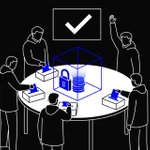


ShadowLabz takes the money before it takes the vote.
A DAO on ShadowLabz raises capital into on-chain escrow. Hit the goal and the DAO goes live — and the funds stay in custody until governance approves a spend.
Voting runs on Midnight zero-knowledge proofs: ballots stay hidden, while tallies and treasury movements stay verifiable. Its Discord bot lets members cast shielded votes without leaving their server.
The project came through Midnight's Build Club and was featured by Midnight at TOKEN2049 — a graduate now running confidential governance as a live product.
#MidnightNetwork

Balances hidden, amounts visible: the Sig Network partnership states its privacy line in the open.
The Midnight Foundation made the Sig partnership formal on October 28. The machinery is not the news — Sig already runs Ethereum accounts for Midnight contracts. The boundary, stated plainly, is: balances, identities and transaction histories stay shielded on Midnight, while amounts and timing on the Ethereum leg remain visible, as they would for any Ethereum account.
Developers also get something concrete: a Signet module to import into Compact and queue Ethereum transactions from their circuits, and an example ERC-20 vault covering deposit, withdrawal, swap and supply.
One use case shows the shape of it — positions on a prediction or perpetuals venue, taken through a pool. The venue sees the pool. The pool holds each client's record.
#MidnightNetwork

The full announcement is on the Midnight blog: midnight.network/blog/sig-ne…

I don't know who is more influential, but I choose the one on the right.
"I want to live in a world where the protocols preserve and protect your rights as a human, your agency as a human, your economic identity as a human."
— Charles Hoskinson


CZ is right: you can't prevent every leak.
But you can reduce what there is to leak.
Most breaches happen because a company stored too much about you in one place: your name, ID, address, balance and history.
Midnight is built to need less of that.
Your private data stays with you. Instead of handing over the document, you share a proof that the fact is true.
You can be verified without exposing your ID.
You can qualify without opening your full history.
You can transfer assets without making the sender, receiver and amount public.
Less data collected.
Less data stored.
Less data to steal.
When the cost of leaked data becomes impossible to ignore, organizations will embrace networks built with privacy from the start — and that is exactly what Midnight is building.

4 data leaks reported today:
1. Coinbase's vendor Amplitude exposed some users’ contact data (funds unaffected).
2. Bithumb (Korea) had user data leaks.
In TradFi, two securities firms in Korea leaked data:
3. Mirae Asset
4. Daishin Securities
You can't prevent a leak, but you can protect yourself.
Leaked exchange data (names, emails, phone numbers, addresses, ID documents, transaction history) is mostly used for phishing, SIM swapping, and social engineering.
Reduce info you share
- Use a unique email alias for each exchange (SimpleLogin, Apple Hide My Email, etc). A leak then can't be linked to your other accounts, and you can spot which service leaked.
- Share only what's required. Don't add optional profile details.
- Use a dedicated phone number (a VoIP or secondary SIM) for exchange accounts if you can, since leaked numbers are the main route to SIM swaps.
Lock down the account
- Use a unique, long password from a password manager.
- Turn on hardware security keys (YubiKey) or passkeys, or at least an authenticator app.
- Avoid SMS 2FA.
- Enable withdrawal address whitelisting and a withdrawal time lock if the exchange offers them.
- Set up an anti-phishing code, which puts a code you choose in every legitimate email from the exchange.
- Review active sessions and API keys regularly. Delete any API keys you don't use.
- Restrict API keys to withdraw-disabled and IP-whitelisted.
Defend against
- SIM swapping: Ask your carrier to add a port-out PIN or number lock.
- Phishing and impersonation: Assume anyone who contacts you about your account, "security issues," or "refund recovery" is a scammer, even if they know your name, balance, or recent trades.
- Exchange support staff don't ask for your password, 2FA codes, or seed phrase.
- Never click links in emails or texts. Go to the site yourself.
- "Wrench attacks": Leaked addresses plus holdings data have led to real-world extortion and robberies. Don't publicize your holdings, and keep large balances out of anything tied to your home address if you can.
If a breach is announced
1. Change the exchange password and any other account that reused it.
2. Check haveibeenpwned.com for your email address.
3. Revoke API keys and active sessions.
4. Review recent withdrawals and security settings.
5. Watch for phishing emails and texts that reference the breach, because scammers move fast after one.
Stay SAFU! 🙏

A Midnight stake pool could lower its commission at any time. It could never raise it.
That's the commission ratchet proposed in MIP-0016 (Draft), the NIGHT staking proposal. In the draft's terms, a pool may lower its commission at any time, effective the next epoch — and the acceptance criteria require that any attempt to raise it be rejected.
On those terms, the rate a delegator sees would be the worst that pool could ever charge them. Not because the operator promised. Because the protocol would refuse the change.
There would be no 'join cheap, raise later' move. Commission would be capped at a maximum of 1.00, and a stake address that never picks a pool would fall back to the network default: its straight share by reward weight, with no commission at all.
One honest caveat: NIGHT staking is a Q1 2027 roadmap item, and MIP-0016 is still a Draft under discussion — read this as proposed design, not a shipped feature. Even the exception the draft debates for a later phase, a raise allowed only on a much longer timeline of around ten epochs, would exist so delegators have time to react.
If it ships as written, the commission you delegate at is a ceiling, not a starting point.
#MidnightNetwork

Midnight's Korea Hackathon drew 38 teams building with Compact — and all three winners solve the same problem three different ways: proving something without revealing something.
JustEnough checks subsidy eligibility without personal documents. Safejeonse checks lease-deposit safety without other tenants' data. Veilance proves recycled content for EU rules without supplier secrets.
That's selective disclosure doing regulated work.
#MidnightNetwork

The October State of the Network post has the full results: midnight.network/blog/state-…

1,000,000 transactions.
Midnight's mainnet crossed the mark on 27 October — 1,019,963 on the count, and past 1,030,000 by this morning.
The pace behind it: 128 transactions a day on 27 September became 47,714 a day by 26 October.
The climb began after permissionless smart-contract deployment opened in September.
One honest gap: no active-address or per-app breakdown came with the milestone. The activity is real; who is driving it is not yet visible.
#MidnightNetwork

The live count sits on Midnight Explorer: midnightexplorer.com

Midnight's builder pipeline is starting to show its work. Build Club takes early ideas through eight weeks to pitch day; Night Sky backs teams with an MVP through investment and fundraising help. Shadow Labs went through the first and now has private, verifiable DAO voting live for the community to test. That's the loop working: idea, programme, product people can actually try. Build Club is taking applications for its next cohort. #MidnightNetwork

The full session is on Midnight's channel — Tom Humber walks through both programmes and Shadow Labs' live voting demo: youtube.com/watch?v=fsiqDUWs…
IOG replayed Midnight's Glacier Drop claim workload — 24,576 claim transactions with real scripts and real signatures — against Hydra 0.22.4 and Hydra as it stands today. The result: 1.9x faster, from 42 to 79 claims a second. On trivial single no-op scripts, the same replay showed 3.3x. The smaller number is the honest one, because real claims cost real validation. It's a fitting stress test for the distribution that settled 3.5 billion NIGHT in 9 days.

IOG's write-up has the full replay method, including why the real-script number is the one to trust: iog.io/news/hydra-v2-glacier…

Scott Collen's Midnight keynote asks whether privacy tech can pay for itself: sustainable businesses on recurring revenue, and liquidity that sticks around instead of drifting to the next yield. Watch that test over the next 3–6 months.

The full talk is on Midnight's channel — Collen walks through the funding approach, the NIGHT and DUST relationship, and why sticky liquidity is the hard part: youtube.com/watch?v=uxSBTlgS…
One wallet connection could cost you everything in it.
Seeing a lot of people share PTAH's Proof of Agent on my timeline, so I did an initial check with my own agent wallet.
To take part, they ask you to connect that wallet to their agent.
That's where I stopped. If their agent gets control over your agent wallet, what stops it from being instructed to spend everything in that wallet buying their token? That is a real path to losing all the assets in that wallet.
Maybe I'm missing something here, and I'm happy to be corrected. But until that part is clear, I'm not connecting mine.
#Ptahtrade

Turnkey joined forces with the Midnight Foundation to deploy developer-focused wallet infrastructure on Midnight: API-driven, non-custodial key management and SDKs, combined with Midnight's privacy technology, to cut the work of building embedded, non-custodial wallets inside DApps.
Turnkey's embedded wallets sign users in with passkeys, email or social login — self-custody without the seed-phrase lesson first.
Users keep control of their keys.
#MidnightNetwork

The partnership, in Midnight's own State of the Network update: midnight.network/blog/state-…
