

Investor in misunderstood small-cap, natural resources, 'digital resources', and DGI. NIAIA, DYODD. https://xitter.gq/t.co/QeL9ZiLHJY
United States
Joined February 2017
- Tweets11.7K
- Following1.4K
- Followers1.4K
- Likes11.2K




L.R. retweeted

Strathcona acquires Greenfire, bringing two oilsands bets together.
with comments from @Cole_Smead
$SCR $SCR.TO $GFR $GFR.TO
financialpost.com/energy/oil…

L.R. retweeted

Meridian Mining is pleased to report on the advancement towards a Final Investment Decision on Cabaçal with the awarding of the EPCM contract and advancing the selection of project finance partner(s).
Orders for long-lead items are placed, and off-site access upgrades are on track for 2026.
tinyurl.com/yuae5cky
L.R. retweeted

📢 News Release | $CNL $CNL.TO
CNL drills 154.30 m @ 12.66 g/t AuEq at Apollo’s Ramp Zone
Full announcement here: 👇🏼
collectivemining.com/collect…

@Energy_Fuels reports:
investors.energyfuels.com/20…
FID before end-2026
seekingalpha.com/article/492…

Beyond Uranium: Energy Fuels' Derisked Path To A Rare Earth Giant
seekingalpha.com/article/492…

1
73
L.R. retweeted

Capital is the new scarcity in mining.
Not ounces. Not pounds. Capital.
Look at the latest capital numbers for three of Canada’s flagship mining projects:
Red Chris block cave, BC ($NEM): US$4.2–4.8B in development capital (C$5.6–6.4B, 100% basis). That figure is already net of the C$500M federal grant. Add the grant back and the gross cost of the project is ~C$6.1–6.9B. The 2021 prefeasibility estimate was ~C$2.6B.
Windfall, Quebec ($GFI): now guided to the upper end of US$1.7–1.9B, up from C$790M in the 2022 feasibility study. The environmental approval is still pending.
Great Bear, Ontario ($KGC): US$1.43B of initial capital in the 2024 PEA. A full capital update is due in H1 2027 after detailed engineering, which Kinross says will account for inflation (Cape higher?).
These are world-class deposits run by excellent operators. But part of every one of those bills is the cost of building what isn’t there: transmission lines, gas pipelines, camps, and construction seasons cut short by winter and permitting delays.
In the right parts of Latin America, much of that already exists. Look at Aris Mining’s Marmato expansion in Caldas, Colombia: a new underground mine and a 5,000 tpd processing plant, with a total construction estimate of ~US$365M.* That includes building its own grid power line. For comparison, Windfall’s plant is sized at ~3,400 tpd. First gold at Marmato is scheduled for this quarter.
B2Gold’s Gramalote in Antioquia shows it at larger scale: a 6 Mtpa (~16,500 tpd) open pit operation with US$740M of initial capital in its 2025 feasibility study, 8% below its 2024 PEA.* Canada’s estimates are climbing. Gramalote’s went down.
At Guayabales ($CNL, @CollectiveCNL), our project sits beside the Pan-American Highway, hydropower lines run through the area, and the Marmato district has 500 years of mining history and a skilled local workforce. Our new 1.8 km adit access road was built by upgrading an existing path off the highway.
Infrastructure already in place is capital that never has to be raised.
Geology comes first. Infrastructure decides the bill.


#Elmet: Why This Irreplaceable Pentagon Supplier Is A Strong Buy
$ELMT #tungsten @TheElmetGroup
seekingalpha.com/article/495…


🚨@ParexResourcesis about to 2X production thru accretive acquisition of @FronteraEnergy assets + farming into 2 high-potential @ECOPETROL_SA fields.
Add a 5.7% #dividend yield, serious upside with income.
Election in 10 days 🚀
$PXT $PARXF
Don’t sleep on this. Link below👇


"Parex Resources: A Strong Buy Before Its Production Explosion"
🚀$PXT $PARXF #Colombia
seekingalpha.com/article/490…

83,259 boe/d in 3Q2026, up 54% sequentially or 89% YOY, faster than #Nvidia's 22% and 62% 😄
globenewswire.com/news-relea…

57
Consolidation In The Western #REE Industry: Why A Rising Oligopoly Demands A New Investment Playbook
seekingalpha.com/instablog/4…

L.R. retweeted

Even after $IVPAF fully ramps up Platreef, it will only get about 0.5-0.6 Moz PGM (2030 is the earliest time to get there). So, it does not have sufficient PGM torque.
This table is taken from a column by @LRL2017
seekingalpha.com/article/484…

L.R. retweeted
$CNL has just announced Apollo’s maiden mineral resource… a proud day for our team, but certainly not a moment to stand still.
What excites me is not simply the scale of this first estimate… it is the combination of scale, grade, a surprising large, high-grade open pit with a low strip ratio, the high-grade at the Ramp Zone, and the opportunity to keep growing.
We see a favorable backdrop in Colombia… and we are positioning Collective to seize that opportunity. We deliberately accelerated this maiden Mineral Resource so we could, in turn, accelerate the project’s path toward licensing—with submission of our environmental licence application now targeted for H2 2027. We are not waiting to finish discovering before doing the work needed to advance responsibly toward development.
And there is plenty more discovery work ahead… approximately 40,000 metres of additional drilling have already been completed since the March 31, 2026 database cut-off. None are included in today’s estimate.
With 13 rigs operating across Guayabales, we are pursuing that opportunity aggressively. Exploration, engineering and environmental work are advancing together… growing the resource while building the foundation for the project’s next chapter.
For our shareholders, our team and our partners in Colombia, today is a milestone worth celebrating. For me, it is also a powerful incentive to push harder.
newswire.ca/news-releases/co…

L.R. retweeted

Here is the idea, and once you see it you cannot unsee it.
Equities, bonds and commodities move together on a 30-to-40-year cycle, and the major turning points are linked. Strategically, equities and commodities are negatively correlated — a secular bull market in commodities is bullish inflation, which is bearish bonds, and it is inflation that sooner or later kills every bull market in equities. So these three great asset classes take turns. When commodities lead, they poison the ground financial assets grow in. When commodities sleep, financial assets feast. They do not thrive together, and they never have.
Chart 6 — The 110-year dance: S&P 500 vs CRB commodities


Dr. Copper Sends a Message.
Ignore at Your Own Risk.
It has always been supply and demand — and copper just made the point at full volume.
An all-time high, a deficit that widens every year, and the whole regime turning.
Read here: thierryvonarvy.substack.com/…


Energy Fuels $UUUU $EFR.TO "is trading at roughly the [conservatively-estimated] intrinsic value of its uranium assets alone, with the rest of its asset portfolio being valued at little to no cost."
seekingalpha.com/article/492…

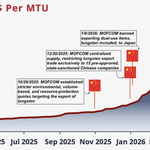
"European CIF spot prices for APT have skyrocketed from $83/kg to $340/kg—a 4x rise in 18 months... There are no signs that the bullishness in tungsten will be a transient phenomenon. China is tightening, rather than loosening, its grip."
seekingalpha.com/article/493…

L.R. retweeted

🚨Energy Fuels' Acquisition of Australian Strategic Materials Wins Shareholder Approval 🚨
Ross Bhappu, President and CEO of @Energy_Fuels, said: "Today's vote marks an important milestone for Energy Fuels, with ASM shareholders set to join a strong, well-capitalized business with a clear growth strategy.”
ASM’s rare earth metals and alloy-making capacity is a critical addition to Energy Fuels’ platform as the company works to build what they believe will be the West’s only integrated mine-to-magnet rare earth business.
The combination moves the company one step closer to offering customers a reliable allied-source alternative across the full supply chain.
Read the full details in our most recent press release: investors.energyfuels.com/20…
$UUUU $EFR #EnergyFuels #rareearths


L.R. retweeted

Trump’s Pipeline Wars: How Iran’s Gambit Exposed China
War is the continuation of politics by other means and Trump has moved that logic from the battlefield to the barrel.
The pipeline wars are his answer to Iran’s closure of Hormuz: a counter‑offensive that punishes Tehran, exposes China, and pulls Iraq, Syria, and Venezuela toward the American orbit as emerging allies.
Iran’s gambit was revolutionary bravado: slam shut the strait, choke off a third of seaborne oil, and dare America to blink. Iraq’s exports, long 90‑plus percent dependent on Hormuz—collapsed, and Baghdad discovered it was less an energy state than a client of a narrow waterway patrolled by a hostile regime and an American carrier group.
The Strait has been war‑gamed for decades. Trump tried diplomacy first. Now the world is watching what hard power looks like when the simulations go live.
His answer is to treat Hormuz as a flaw, not fate. Epic Fury broke Iran’s ability to escalate; the strategic move is what follows—build around Iran. Push Iraqi barrels toward Turkey’s Ceyhan.
Revive Mediterranean outlets. Bring back the Kirkuk–Baniyas concept: an old 1950s line from Kirkuk to Syria’s port of Baniyas, shuttered by war and neglect, now reborn as a 300,000–700,000 barrel‑per‑day artery with U.S. backing, American firms doing the studies, and sanctions eased just enough to lay steel. Iraq gets cheaper exports and diversification away from both Hormuz and Ceyhan. A post‑Assad Syria stops being a crater and starts being a corridor, earning hundreds of millions in transit fees, plus jobs and infrastructure. In practice, Syria and Iraq are being bound into an American‑centric energy system, precisely how fragile states become durable allies.
The deeper casualty is China. Beijing built its industrial machine on discounted barrels from Iran and Venezuela, moved by shadow fleets through long, vulnerable sea lanes. That is not diversification; it is dependency. Churchill warned that “safety and certainty in oil lie in variety of supply.” China concentrated risk in sanctioned regimes and contested waters, then called it strategy.
Venezuela shows the Trump doctrine at work. For years, Caracas was a major producer, enabler of state‑sponsored terrorism, and a willing ally of China.
The takedown of Nicolás Maduro was a seismic event largely ignored in polite foreign‑policy circles: a hostile petro‑regime toppled without occupation, then flipped into a grudging supplier to U.S. refiners. Oil long routed to China now flows to America, strengthening U.S. energy security and starving Beijing of friendly heavy crude.
This is Hegel’s dialectic in hard assets. Iran’s closure of Hormuz is the thesis. Trump’s strikes, pipelines, and Venezuela turn are the antithesis. The pipeline wars are the synthesis: chokepoints contested, transit states turned into allies, hostile producers pulled into an American system.
In 2026, the map matters again and Trump is redrawing it so America sits on the pipes while Iran and China sit on exposure.


The United States welcomes the signing of a historic MOU between the Governments of Iraq and Syria on the rehabilitation and reconstruction of the Iraq-Syria crude oil pipeline. This priority infrastructure project will advance security and stability through regional interconnectivity and prosperity. U.S. companies will play a key role in advancing construction.
state.gov/releases/office-of…

L.R. retweeted
For the record.
Kevin Warsh’s Quiet Regime Change at the Fed
Kevin Warsh is not a hawk. He is a pro-growth monetary reformer who wants to restore price stability, reject mission creep, and rebuild a constitutional central bank that uses modern data instead of stale models, Phillips curves, and Keynesian reflexes. Yes, Wall St consensus is wrong again.
Like Scott Bessent, Warsh understands that the Fed’s deepest problem is institutional sprawl. A central bank meant to preserve monetary stability has drifted into credit allocation, financial repression, and de facto debt management. His answer is to narrow the remit, shrink the balance sheet, and scrape away the layers of forward-guidance theater that turned FOMC language into a third policy instrument. The implicit logic of a smaller, quieter Fed balance sheet is more private credit creation, capital formation moves back into markets rather than remaining warehoused on a taxpayer-backed public portfolio.
Warsh also rejects the old Phillips curve intuition that strong growth and tight labor markets are inherently inflationary threats. He is not anti-growth, he is anti-fiscal dominance. In his framework, inflation comes from policy error, too much monetary accommodation for too much fiscal excess, not from prosperity itself. That is why he can be pro-AI, pro-crypto, and broadly supply-side at the same time. He sees productivity growth, technological innovation, and new forms of private capital formation as disinflationary forces when the nominal anchor is credible.
Just as important, Warsh appears to grasp the constitutional arrangement. The Fed is not supposed to moonlight as an all-purpose technocratic state. It is supposed to preserve the currency, provide monetary order, and leave the rest to elected officials and private markets. That requires price stability first, but it also requires better inputs, more modern data, more market signals, less faith in lagging aggregates and broken academic priors.
This is not hawkishness. It is a bid to replace an antiquated Keynesian institution that has come to act as if it were above the constitution with a narrower, pro-growth, market-facing Fed that stabilizes money, scraps pseudo-scientific forward guidance, and gets out of the way.

Kevin Warsh is about to make his first appearance before Congress as Fed chairman, and in two days of testimony he’ll have new US inflation data to discuss with lawmakers bloomberg.com/news/articles/…
