

Building new medicines @arpelos
Cambridge, MA
Joined November 2014
- Tweets163
- Following499
- Followers566
- Likes1.9K






Pinned Tweet
Kicking off 2024 by sharing a preprint of my PhD work! We report an engineered cytokine therapy that elicits some of the most profound anti-tumor immunity we have seen in our labs' preclinical work.
Preprint and walk-through below:

Local delivery of cell surface-targeted immunocytokines programs systemic anti-tumor immunity biorxiv.org/cgi/content/shor… #biorxiv_immuno
TLDR: our aCD45-cytokines are retained at the tumor/TDLN and trigger sustained STAT signaling that reprograms tumor-specific CD8s at the TDLN into a unique anti-viral effector state capable of mediating a potent systemic anti-tumor response.
I want to shout out these 2 awesome papers, which were really fundamental in helping us untangle the mechanism of the therapy:
pubmed.ncbi.nlm.nih.gov/3658…
pubmed.ncbi.nlm.nih.gov/3809…
The gene signature showed clear signs of activation (upregulation of granzymes, tnf, ifng, tim3; downregulation of tcf7) but low levels of exhaustion (e.g. downregulation of tox). Overall, it looked more like an acute anti-viral response rather than canonical anti-tumor.

We then looked for abscopal responses by inoculating MC38 or B16F10 tumors on both flanks but only treating one. Excitingly, we saw aCD45-Cyt therapy was able to control both sides. Triggering this type of response without ICB combination suggests a truly systemic response.

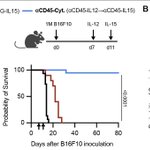
We tested aCD45-Cyt therapy in both MC38 and B16F10 and saw CR rates >90% in both cases. One of the most compelling aspects is the low dose required for efficacy: on a cytokine basis, the total doses given did not exceed 2ug.

To leverage this, we developed a tx strategy (termed "aCD45-Cyt") using both aCD45-IL15 and aCD45-IL12. We first treated tumors with aCD45-IL12 to trigger an initial wave of antigen release and followed it a few days later with aCD45-IL15 to amplify newly primed CD8s in the TDLN.
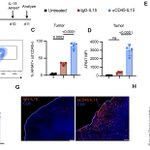
In vivo, we found that CD45 targeting was able to retain cytokines at the tumor and tumor draining lymph node (TDLN) while minimizing systemic exposure (in serum or on PBMCs). This gave us hope that we could isolate the cytokine's effects to the sites of the anti-tumor response.

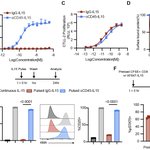
We generated an aCD45-IL15 fusion and tested it in vitro. CD45 binding dramatically slowed down native cytokine internalization and this longer surface half-life led to extended and sustained downstream pSTAT signaling. We saw the same behavior for an aCD45-IL12 fusion.

In this work, we engineered cytokines that were targeted to the immune cell marker CD45. We picked this target as our retention strategy for two reasons: 1) it does not get internalized when bound and 2) it is abundantly expressed on immune cells (ie a target with high capacity)
Recently, our labs have engineered cytokines for intratumoral retention after local administration, with 2 of these approaches now in the clinic. The translation of intratumoral therapies will hinge on their ability to elicit "abscopal" effects (ie activity in non-treated tumors)
However, these first-gen cytokine therapies triggered dose-limiting toxicities that still hinder their clinical utilization. We have been trying to engineer our way out of a narrow therapeutic window for 2+ decades. If you want to learn more:
onlinelibrary.wiley.com/doi/…

Long before checkpoint blockade (ICB) was in the clinic, cytokines were the original immunotherapy, with IL-2 being the first IO agent to show clinical activity against advanced disease (in the 1990s).

Luciano Santollani retweeted

At @pillar_vc, we’re open-sourcing all the knowledge and knowhow of building biotech companies.
Today, we’re releasing the @pavecomp + Founder-Led Bio Community compensation study.
🧬90 companies
🧫3.7k salary data points
✅industry-wide benchmarking
founderledbio.com/biotech-co…

