Pinned Tweet
The biggest thing I learned building this: being right about the future isn’t the same thing as being right about the investment.
A network can win while the token sucks. An incredible company can still be a terrible investment at the wrong price

SycoLand retweeted

Aaaaaahhh! @LandSyco

New track #Shining w/ my brother @Grievesmusic OUT NOW !!
Go run that up 🪓🕸
LINK : youtu.be/4WeVUzJXyms?is=-_3e…
A lot of this future economy still looks inevitable. The harder question now is who actually gets paid once capital, power and infrastructure stop being cheap.
Updated the DCA map after running all 88 holdings back through my Current Entry framework.
Saudi Arabia's East/West pipeline is still shut after the drone attacks. That's one of the major bypasses around Hormuz and had been moving roughly 4 million barrels a day.
If this drags on, something like 4% of global oil supply could be at risk. Add the Houthi position around Perim Island and the Red Sea side gets uglier too.
So the physical scarcity thesis just got stronger again.
The same thing making those long term theses stronger is also adding inflation pressure, keeping rates higher and making already extended commodity trades less attractive to chase.
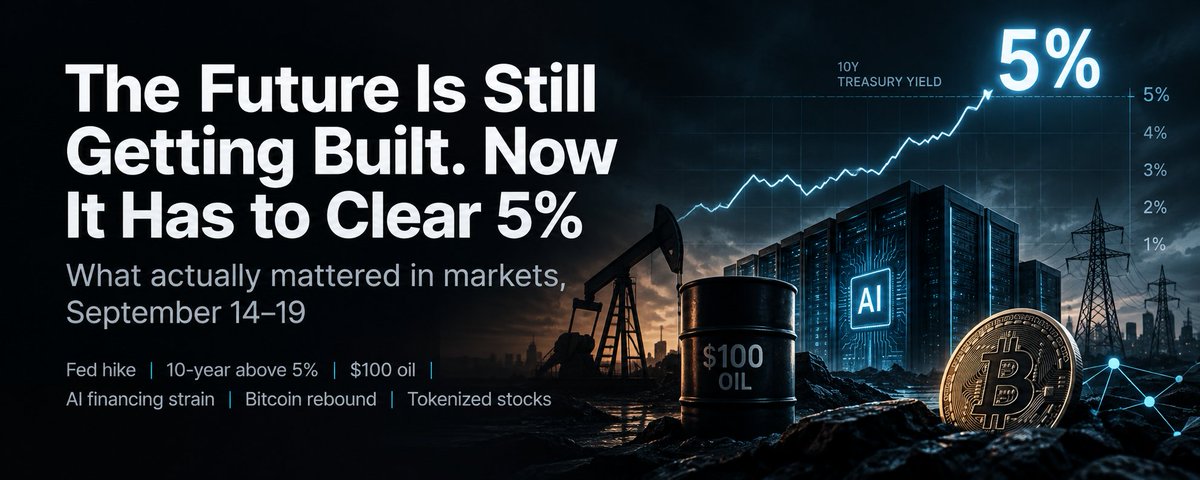
The 10-year is still sitting right around the 5% neighborhood and we're heading into the September 15-16 Fed meeting with another hike heavily priced.
Crypto is soft this weekend, not imploding. Total market cap is around $2.63T, BTC around $77K, ETH around $2.5K and SOL around $101.
Below is the 5 Systems look through analysis and rankings.
Productive core / rates / income:
STIP stays the lone A.
It's one of the few positions where this ugly macro setup actually improves the current entry case. More inflation risk makes short-duration inflation protection more useful.
SGOV stays B+ because getting paid around 4% to sit in very short Treasuries makes every risk asset compete harder for the next dollar.
ISRG stays B+ on quality and valuation reset. BND and IEF stay B because improved yields are useful, but renewed tightening risk still matters.
Independent monetary reserves:
BTC stays B+.
The liquidity backdrop got a little worse, but BTC is still the strongest native monetary claim in crypto and nothing over the weekend changed that enough to move the tier.
PAXG stays B.
Gold's hedge role arguably got more important again, but it has already repriced a lot.
Stronger hedge case doesn't automatically mean better entry.
Physical bottlenecks / power / materials:
This is where the weekend strengthened the long-term thesis the most.
BWXT, EME and NEE stay B+.
ETN, CCJ, LEU, MP and ALB remain solid staged-entry names.
But XLE, FCX and COPX are still chase-sensitive.
Oil scarcity can be completely real while XLE is still a mediocre next-dollar buy.
Copper can be one of the biggest bottlenecks of the next decade while FCX can still be too expensive at a specific moment.
Compute / data / AI:
Oracle remains one of the more interesting B names after giving us much better evidence that AI demand is actually turning into shareholder-level value capture.
Nvidia is still one of the highest-quality assets in the entire portfolio strategically, but it's only a C on current entry.
That's valuation, financing conditions and opportunity cost talking. Not me suddenly deciding Nvidia sucks lol.
Tesla stays C too. Cybercab moving into early real-world service strengthens the autonomy thesis, but scaled robotaxi economics are still unproven.
Settlement / financial infrastructure:
ETH and SOL stay B.
Most of the more speculative DeFi and settlement names stay C/D because a 10-year around 5%, plus meaningful yield sitting in short Treasuries, puts a much higher hurdle in front of speculative liquidity.
This looks more like a liquidity/opportunity-cost problem than some broad failure of the crypto thesis.
Basically the weekend made the macro environment worse for long-duration assets and speculative liquidity while making the case for inflation protection and physical scarcity even stronger.
Stronger thesis doesn't equal better entry.
That's the whole point of this map.
A great asset can be a bad buy today.
And sometimes the exact thing making the long-term thesis stronger is also what makes you want to stop chasing the damn thing.

Week ending Sept. 12 Market Recap
The same forces making AI, power and infrastructure more valuable are also making them more expensive to build and finance.
That’s the tension underneath this whole week.
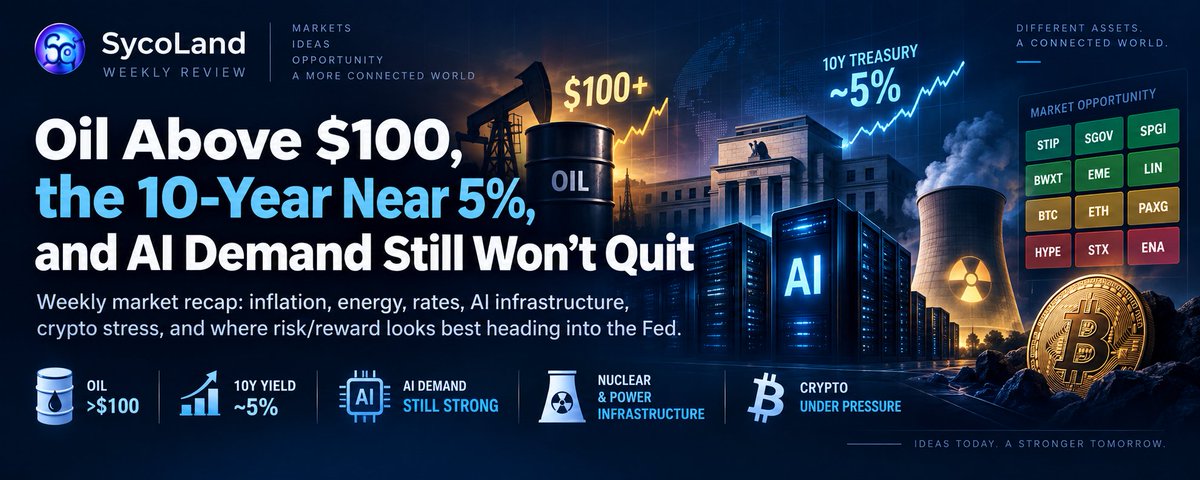
TLDR from the Labor Day weekend chaos:
AI demand got stronger while the physical and financial constraints underneath it got worse.
Oil pushed toward $100. Gulf and Saudi energy infrastructure entered the attack set. Jobs surprised strong. The 10Y stayed near 4.8%. Broadcom proved custom AI silicon is very real while Nvidia pushed deeper into the ecosystem with Hugging Face. Copper hit records. AI power demand kept exploding. And Liquid gave us a ~$320M reminder that native BTC and wrapped/sidechain BTC are absolutely not the same risk.
The bigger thing tying all of it together:
The machine keeps getting bigger. The bottleneck keeps moving.
Full breakdown 👇


The interesting part isn’t just that a shitload happened over Labor Day weekend. It’s that AI demand got stronger at the exact same time energy, materials, shipping and financing became harder constraints.
That collision is what matters here.


Aug 24-30 2026, Weekly Market Report
Nvidia, AI infrastructure, power, nuclear, Hormuz, rates and crypto all looked like separate stories at first. They really weren't. The full article has all the details and charts.
The TLDR:
AI demand is still ripping, but the question is shifting toward who actually captures the economics as custom silicon grows.
That demand needs an absurd amount of power and physical infrastructure. Chips are only one bottleneck now.
Crude is adapting around Hormuz better than LNG, but renewed U.S.-Iran escalation means the system is being tested again. More broadly, countries are starting to trade some efficiency for redundancy and energy security.
The Fed is the counterweight. All of this has to be financed, and expensive money can pressure valuations even when the underlying fundamentals are great.
Crypto gave us the same systems lesson from another angle: supposedly separate networks can still depend on the same weak plumbing underneath them.
And somehow SPY is still near the highs.
So heading into September:
AI demand is alive.
Hormuz is live again.
Money is still expensive.
Markets are still holding up.
Now we find out whether the rest of the system can keep up.
Because the biggest bottleneck probably isn't one thing.
It's the entire chain.

AI is still ripping, yields are pushing higher, oil is back in the geopolitical crossfire, and stocks are sitting near the highs anyway lol. Six charts made this week a lot more interesting than the headlines alone.
Yesterday I wrote that expensive capital could become a problem even if AI demand stayed strong.
Well... Nvidia just answered half of that question.
Demand is absolutely not slowing.
Nvidia reported $96.2 billion in quarterly revenue, up 106% from a year ago. Gross margin held at 75%, operating income reached $63.7 billion, and Data Center revenue came in around $89 billion.
Management is guiding the next quarter to roughly $108 billion even while assuming no China Data Center compute revenue.
And it isn't just Nvidia telling us demand is huge.
Anthropic reportedly committed about $45 billion over six years for roughly 460 megawatts of AI compute capacity in West Virginia.
Think about the physical scale behind that for a second.
GPUs are only the beginning.
Those systems need data centers, electricity generation, transformers, transmission, cooling, copper, natural gas, nuclear fuel, construction and eventually an enormous amount of capital to finance all of it.
The second chart attached is a custom AI infrastructure composite I track using NVDA, ORCL, NEE, CCJ, XLE, ETN, TSM, CEG, EME and MLPX.
Basically semiconductors, cloud infrastructure, utilities, nuclear, energy, grid equipment and the infrastructure needed to actually build and power AI.
I prefer looking at the whole chain instead of pretending Nvidia exists in a vacuum.
From that perspective, tonight was pretty damn strong.
But the other side of Nvidia's filing is where things get more interesting.
Its supply and capacity commitments jumped from $119 billion last quarter to $279 billion, largely as it locks in memory and manufacturing capacity.
Across supply agreements, cloud contracts, future leases, investments and capital spending, disclosed future commitments now reach roughly $366 billion.
Maximum gross guarantee exposure is another $108.5 billion, mostly tied to a major OpenAI infrastructure project.
To be clear, that does NOT mean Nvidia is about to lose $108 billion, and not every dollar of those commitments is equally hard or irreversible.
But Nvidia is increasingly doing more than selling chips.
It is securing supply years in advance, extending payment terms to large customers, investing throughout the ecosystem, supporting infrastructure projects and helping assemble financing platforms intended to mobilize hundreds of billions of dollars.
Accounts receivable also climbed to roughly $63 billion, while days sales outstanding moved from 45 to 60 days.
Again, that doesn't mean customers suddenly can't pay.
But it does mean the financial architecture underneath the AI boom is becoming a much bigger part of the investment question.
And today's macro data makes that even more relevant.
Core PCE is still running around 3.3%. Underlying private demand remains fairly strong. Corporate profits jumped sharply.
So there still isn't an obvious reason for capital to suddenly become cheap.
That's the tension I'm watching now.
AI demand looks stronger than ever.
The physical buildout looks stronger than ever.
But satisfying that demand requires an increasingly ridiculous amount of capital, and Nvidia itself is becoming more financially intertwined with the system buying its hardware.
I don't think that's automatically bearish at all. If anything, tonight strengthened my view of the physical AI buildout.
But business quality and investment quality are not always the same thing.
A company can dominate a technology cycle while financing, margins, customer concentration, capital commitments and valuation determine how much of that success ultimately reaches shareholders.
AI clearly isn't running out of demand yet.
Now I want to know how expensive it becomes to keep feeding it.
Sources: Nvidia Q2 FY27 results and filing, BEA, Reuters.


One thing that caught my attention today was how cleanly the market showed the difference between demand and financing.
Oil dropped hard, with Brent falling almost 4% below $89. Treasury yields eased. Stocks recovered a bit.
That sounds like relief, and it is.
But then the housing data landed.
New home sales fell more than 10% in July. Mortgage rates are still around 6.8%. Consumer confidence slipped to a seven month low, and only about 5% of surveyed consumers now say they plan to buy a home in the next six months.
People didn't suddenly stop needing houses.
Land didn't disappear. Builders didn't forget how to build them.
The financing hurdle just got too high for a lot of people.
I think there is a useful parallel here with the AI infrastructure boom.
AI demand can be completely real while the cost of building the physical system underneath it becomes a problem.
Think about everything that has to be financed.
GPUs. Data centers. Power plants. Transmission. Transformers. Cooling. Natural gas infrastructure. Nuclear. Construction. Land.
You can have enormous long term demand for all of it and still run into trouble if capital becomes expensive enough.
That is why tomorrow should be interesting.
We get PCE inflation, revised GDP and corporate profits in the morning, then Nvidia reports after the close.
Basically two questions back to back:
Is inflation cooling enough to take some pressure off financing?
And is AI demand still strong enough to justify the extraordinary amount of capital being poured into the buildout?
Bitcoin added another interesting piece today too, breaking above $80,000 after climbing roughly 28% this month.
I'm not going to pretend one rally proves a giant monetary theory lol.
But Bitcoin and gold increasingly reacting to some of the same concerns around the dollar, sovereign debt and monetary policy is worth watching.
For now I think today's message is pretty simple.
The demand story still looks alive.
The question is whether the financial system can fund the physical buildout cheaply enough to keep it moving.
Tomorrow gives us a much better answer.


8/24/26 Monday's Market Recap.
AI may have found another bottleneck.
It isn’t chips.
It isn’t power generation.
It’s permission to connect to the grid.
Texas has paused new data-center approvals through part of its grid-interconnection process while reliability is reviewed, adding a new constraint to the AI infrastructure buildout: political and grid-access risk.
That matters because the AI capex story is becoming increasingly physical.
The stack already depends on:
• Semiconductors
• Electricity generation
• Transmission
• Transformers and switchgear
• Construction capacity
• Financing
• Strategic materials
Now add:
• Permitting
• Grid interconnection
• Community acceptance
This does not necessarily weaken the AI infrastructure thesis.
It may actually increase the value of scarce assets that already have access to power, transmission capacity, permits, generation and existing grid infrastructure.
But it does raise the hurdle for new projects.
A data-center announcement is not the same thing as an operating data center.
Projects can still be delayed by power shortages, transmission congestion, local opposition, financing costs and regulatory approval.
That distinction matters as investors try to determine how much of today’s enormous AI capital-spending commitments will actually become productive infrastructure.
Elsewhere Monday:
Treasury yields eased as expanded buybacks improved market plumbing, but the government’s underlying financing requirement remains enormous.
Oil fell after Washington’s Iran sanctions escalation stopped short of the most disruptive scenario, although the Strait of Hormuz risk remains unresolved.
Gold pushed to a three-month high as investors continued seeking protection from fiscal, currency and geopolitical uncertainty.
And crypto regulation produced more political activity, but no meaningful legislative breakthrough.
The larger question now is whether Texas is an isolated case or an early sign of a broader constraint across major U.S. data-center markets.
Wednesday should give us a much better read.
Nvidia earnings, inflation data, revised GDP and durable-goods numbers arrive together.
The AI trade is no longer just about demand.
It is increasingly about whether the physical world can keep up with it.

The Iran/Hormuz story just became more than an oil story.
The U.S. has formally widened its Iran sanctions perimeter into 5 additional sectors:
• aviation
• digital assets
• gold
• shipping
• technology
That matters because the pressure is no longer only physical.
It is increasingly financial.
The mechanism now looks like this:
Iran -> shipping/logistics -> insurers & counterparties -> banks/dollar access -> third-country trade
And if the dispute pulls China further in, a second chain opens:
China -> trade/financial retaliation -> rare earths & strategic materials -> semiconductors -> AI infrastructure
That is the part investors should not miss.
An Iran sanctions package can eventually affect data centers, grids and semiconductor economics even when those businesses have no direct exposure to Iran.
The 3 charts attached tell the story well:
Brent: still elevated and holding a high-risk regime, but not breaking into a fresh panic spike today.
XLE: energy equities remain in a strong uptrend near recent highs, but today’s package is not creating an obvious new blowoff leg by itself.
10Y yield: still near the top of its recent range, which matters because the bigger transmission may be inflation and financing pressure rather than crude alone.
That combination is important.
It suggests the sanctions regime has clearly escalated, but the market is still treating this as a high-friction risk, not yet a confirmed new supply-collapse event.
Hormuz itself is also becoming harder to analyze in simple binary terms.
The Strait can remain partly open physically while becoming progressively harder to use legally, financially and operationally.
A physical chokepoint can become a financial chokepoint.
And the transmission can travel much farther than crude:
shipping -> refined fuels -> freight -> inflation -> long rates -> infrastructure financing
So this is now an:
energy + financial-plumbing + China + supply-chain risk
It is NOT yet a global financial fracture.
That higher-severity scenario would require something like:
• major Chinese bank/refiner designations
• Beijing retaliation
• rare-earth or semiconductor restrictions
• insurer withdrawal
• actual tanker detention/confiscation
• another material drop in physical throughput
That’s what I’m watching next.


These 3 charts are the most useful way to read today’s escalation.
Brent = is the market pricing a fresh physical supply shock?
XLE = how is direct energy exposure behaving?
10Y yield = is the bigger risk inflation and financing pressure?
Right now the answer looks like:
elevated risk, strong energy trend, still tight financing conditions, but not yet a full panic repricing.
Also important: major Chinese banks were not sanctioned in today’s package. That keeps the highest severity U.S. China financial fracture scenario in WATCH, not confirmed event territory.
The market enters this week at a real decision point.
Last week wasn't simply risk-on or risk-off.
Broad equities weakened as long Treasury yields stayed elevated. Yet gold strengthened, Bitcoin surged, crypto breadth improved, metals broke higher and the productive core stayed technically healthy.
That divergence matters.
I track six weighted synthetic composites across the future-economy stack. Their levels are reference units; what matters is percentage movement and market structure.
MONDAY MARKET MAP
Settlement / major crypto: ~25% above its August base and ~40% above the June washout. The breakout is real, but it is now testing spring resistance. Next test: can old resistance become support?
Web3 infrastructure: ~35% above its August base and ~75% above the June capitulation low. It broke the prior May swing-high structure. Breadth is improving beyond BTC, but price participation is not durable token value capture.
Decentralized AI / data / compute: ~25% off its August trough, but still fighting a declining long-term trend. Participation improved; the larger structure is not fully repaired.
Public AI / quantum / power: ~10-12% above its summer low and sitting on support ahead of Nvidia. It enters Wednesday neither broken nor euphorically extended.
Metals / strategic materials: ~35% above the July washout and one of the strongest reversals on the board, now approaching spring resistance.
Productive core: still the cleanest trend - higher highs, higher lows and rising support near recent highs.
The market is discriminating, not broadly rejecting productive assets.
Now the week tests why.
1. DEMAND - NVIDIA
Nvidia reports Wednesday.
The key question is whether accelerator demand, hyperscaler spending and the AI buildout remain strong enough to justify the capital committed.
Nvidia increasingly acts as a sensor for:
chips -> servers -> data centers -> power -> cooling -> grids -> construction -> materials
2. COST OF CAPITAL
Wednesday brings PCE inflation, revised GDP, corporate profits and durable goods. Jackson Hole follows Thursday-Saturday.
AI is capital intensive. Data centers, utilities, grids, fabs and industrial infrastructure all compete for financing.
Strong AI demand can coexist with weaker investment returns if long-term rates stay high.
Growth determines future cash flows.
Rates determine what investors pay for them today.
3. PHYSICAL CONSTRAINTS - HORMUZ
Iran has blacklisted 45 tankers and threatened fines, detention and cargo confiscation.
No detention under the new blacklist has been verified, but vessel-specific enforcement raises risk to shipping, insurance and the workaround system keeping Gulf exports moving.
The transmission reaches beyond crude:
shipping -> refined fuels -> freight -> inflation -> long rates -> infrastructure financing
Put that beside AI's own chain:
compute -> electricity -> transmission -> cooling -> construction -> materials
The harder question is not simply "Will AI win?"
After chips, power, grids, materials, construction and financing take their share... WHO RETAINS THE RETURNS?
The charts are already offering clues:
Productive assets remain healthy.
Metals are breaking higher.
Settlement crypto has repriced sharply.
Web3 breadth has improved.
Decentralized AI is participating but still repairing.
Public AI is waiting at support for confirmation.
WHAT I'M WATCHING
* Nvidia: demand, margins and infrastructure needs.
* Rates: whether inflation cools enough to relieve financing pressure.
* Crypto: whether the breakout holds.
* Physical bottlenecks: whether metals hold and Hormuz remains friction rather than disruption.
By Friday we should know more about whether the next leg belongs mainly to visible technology - or increasingly to the bottlenecks underneath it.
Technology determines what becomes possible.
Economics determine who earns the returns.


Why this week matters:
Tuesday: housing + consumer confidence
Wednesday AM: PCE inflation, income/spending, GDP revision, corporate profits + durable goods
Wednesday PM: Nvidia earnings
Thursday-Saturday: Jackson Hole
Ongoing: Iran sanctions, Hormuz tanker enforcement and actual shipping flows
Several of the market’s biggest current questions get tested almost simultaneously:
AI demand × inflation × growth × cost of capital × physical supply constraints.