
I am Ted Gibson and I run a language lab at MIT. I tweet about psycholinguistics, cognitive science, language research, linguistics, and words.
MIT, Cambridge, MA
Joined May 2013
- Tweets4.8K
- Following945
- Followers12.3K
- Likes5.3K
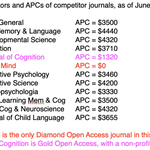





Open Mind is MIT Press’s Diamond Open Access Cognitive Science journal.
We now have our first Impact Factor: 2.9 as of June 2026
Submit your papers to Open Mind
direct.mit.edu/opmi

Ted Gibson, Language Lab MIT retweeted

Very grateful to have received the Gibson/Fedorenko Award at #HSP2026, and sorry I couldn’t attend this year. HSP feels like my academic home, so I’m especially touched. Thank you to the community, organizers, and donors who make it possible! @LanguageMIT @ev_fedorenko
Ted Gibson, Language Lab MIT retweeted

MIT researchers @_coltoncasto @ev_fedorenko have found a "satellite" component of the brain’s dedicated language network in the cerebellum, a region better known for coordinating movement.
Learn more 👉mcgovern.mit.edu/2026/01/22/…
@NeuroCellPress paper 👉cell.com/neuron/fulltext/S08…

ALT Six fMRI scans showing activity in the cerebellum during language tasks.
Ted Gibson, Language Lab MIT retweeted

Could not be more excited about Colton's @_coltoncasto work! A deep dive into the linguistic cerebellum, and a discovery of an area remarkably functionally similar to the core left-hemisphere language areas, including in its selectivity for language. Go Colton and team!

The cerebellum supports high-level language?? Now out in @NeuroCellPress, we systematically examined language-responsive areas of the cerebellum using precision fMRI and identified a *cerebellar satellite* of the neocortical language network!
authors.elsevier.com/a/1mUU8…
1/n🧵👇

Ted Gibson, Language Lab MIT retweeted

It's fascinating that you can explain *so much* with dependency distance (effects in language production, comprehension, cross-linguistic differences in word orders, the difficulty of 'legalese'...). Highly recommended!

New book! I have written a book, called Syntax: A cognitive approach, published by MIT Press.
This is open access; MIT Press will post a link soon, but until then, the book is available on my website:
tedlab.mit.edu/tedlab_websit…
Ted Gibson, Language Lab MIT retweeted
I may be a *little* biased but this 📘 is GREAT! If you ever found language structure interesting, but were turned off by implausible+overly complicated accounts, this book is for you: a simple and empirically grounded account of the syntax of natural languages. A must-read!
New book! I have written a book, called Syntax: A cognitive approach, published by MIT Press.
This is open access; MIT Press will post a link soon, but until then, the book is available on my website:
tedlab.mit.edu/tedlab_websit…
Chapter 10: The rational inference or “noisy-channel” approach to communication in language. See e.g., Levy (2008); Gibson et al (2013).
Chapter 9: Language and thought: Language is independent of thought. See Fedorenko et al (2024, Nature).
But Sag et al 2020 show that a transformational account of auxiliary verbs doesn’t even make the right predictions. So I adopt a dependency-grammar version of what Sag et al argue for (with no transformations).
Chpt 7 and 8: Comparison with other frameworks. Prominently, Chomsky's arguments for the impossibility of learning depend on the existence of transformations in the grammar, which he believed were necessitated by e.g., the auxiliary verb system in English.
Chapter 6: A case study of Legalese. Part of what makes legalese so hard to understand is the long-distance dependencies.
Chapter 5: Evidence from cross-ling word orders showing that harmonic word orders (similar head-dependent directions, which are ones with shorter average dependency lengths) lead to grammars that are more common. This summarizes work in Futrell, Levy & Gibson (2020, Language).
Chapter 4: Evidence from language production and comprehension showing that people are sensitive to head-dependent distance. This started with my own work on the dependency locality theory (DLT) in Gibson (1998, Cognition).
Chapter 2: Preliminaries from cognitive science, about human language and methods to investigate it.
I speculate that LLMs, similar to children, learn a DG representation for the input that they are exposed to, leading to impressive syntactic competence. I see the DG representation as a computational level of explanation, with the LLM providing an algorithmic level.
Chpts 1 and 3: Dependency grammar, a formalism independently discovered by: Tesnière (1959); Hays (1964); Mel`čuk (1988); Hudson (1984). Each of these researchers wanted to make the simplest grammar formalism in order to cover all grammar phenomena in human languages.
If you want a hard copy, you can buy it here:
penguinrandomhouse.com/books…
Try the code MITP30 to get 30% off
or READMIT20 to get 20% off (if the first code doesn’t work anymore)
Please write a review on Amazon.com or Goodreads
New book! I have written a book, called Syntax: A cognitive approach, published by MIT Press.
This is open access; MIT Press will post a link soon, but until then, the book is available on my website:
tedlab.mit.edu/tedlab_websit…
Ted Gibson, Language Lab MIT retweeted
The @PNASNews paper by @ev_fedorenko @LanguageMIT + former @mitbrainandcog @ScienceMIT postdocs Sammy Floyd and @OlessiaJour 👇
pnas.org/doi/10.1073/pnas.24…
