

CA, 19 yrs in finance. I explain global events and what they mean for India: oil, rupee, rates, markets. Sourced, simple, no hype. Views personal.
New Delhi, India
Joined September 2009
- Tweets3.8K
- Following679
- Followers409
- Likes12.9K




Think of a kitchen in a small Indian town. Ma keeps one eye on the gas cylinder and one eye on the news. For eight months, a narrow strip of sea far away has decided how much that kitchen spends.
That strip is the Strait of Hormuz. Since the US and Israel struck Iran on 28 Feb, ships carrying oil have been moving through it scared and slow. Here is what the last one month looked like, in plain words.
October: the worst month at sea
- UKMTO, the UK body that tracks ship safety, counted more than 30 attacks on ships around Hormuz in October. Highest in the whole war.
- One container ship was hit on 13 Oct and sank the next day.
- Week after week, traffic stayed about 70% below pre-war levels.
- Oil kept climbing. On 30 Oct, Brent (the world's main oil price) was near $118 a barrel.
- In India, Business Standard reported the oil price our country pays hit a 15-year high. Rupee was near 95 to a dollar.
Week of 2 to 6 Nov: the big turn
- 3 Nov, US midterm elections. Democrats won both the House and the Senate. Markets read it as: pressure on Washington to end the war.
- Brent fell more than 13% in the week, to $98.32. Steepest weekly fall since Covid in 2020.
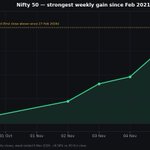
- Nifty jumped 8.58% to 25,030. Sensex 8.82% to 81,028. Best week since Feb 2021.
- Rupee rose six sessions in a row and closed Friday at 93.91, strongest in about six months.
But the sea did not get the message
- UKMTO: in the week to 4 Nov, 11 ships were attacked, 3 sank. Traffic still about 65% below normal.
- On 5 Nov a seafarer was killed in a tanker blast in the Gulf.
- Friday night, Trump said the US did "minor strikes" and knocked out "a little bit of an anti-aircraft device... in about 15 minutes, maybe five." Iranian media reported blasts at Suza on Qeshm island, right in the strait.
What it means for your wallet
Short term: cheaper oil and a stronger rupee mean India pays fewer rupees for every barrel. That eases pressure on petrol, diesel, transport and food bills.
Long term: none of it is locked in. Oil is near $98 only because people expect peace. If ships keep getting hit, that hope can vanish in one week.
We have seen this before. In 2013 the rupee fell hard when foreign money ran away. In 2020 oil crashed when the world stopped. Both times, the swing was big and fast, and ordinary families felt it last but longest.
My reading?
Markets have priced peace. The sea has not. Prices moved on an election result in America, while tankers in Hormuz still sail in fear. That gap is the real story. Hope is good. A seat-belt is also good.
So the question is simple: will petrol prices follow the peace that markets are celebrating, or the ships that are still sinking?
@JavierBlas @moneycontrolcom you both track this daily. Which signal are you watching more this week: Brent, or Hormuz traffic?
@grok confirm this
#Hormuz #OilPrices #Rupee

Japan upgrades Okinawa's 15th Brigade to a full division for a Taiwan contingency (Taipe!
Times):
Quietly huge shift in Okinawa: Japan is upgrading its 15th Brigade in Naha to a full division this year and permanently stationing
Type 16 combat vehicles there for a Taiwan contingency. Is Tokyo's postwar pacifism officially history? US10Y(-) IN10Y(+) @CFR_org
#Macro
Iran selectively reopens the Strait of Hormuz to China, India, Qatar, and Iraq (ISW - China & Taiwan Update, CBS News):
Selective tollbooths in the Persian Gulf? Iran just announced the Strait of Hormuz is reopening only for ships from China, India, Qatar & Iraq-even as 2 tankers hit mines nearby. Does selective access split the global oil market in two? US10Y(+) IN10Y(-) @CSIS #Macro
OpenAI has closed about $11B in a funding round that may still grow toward $20B, per Bloomberg and CNBC. Midterm voters backed anti-data-centre rules in 40 of 41 local ballots; OpenAI's CFO still says keep investing. Google is taking Crusoe's unfinished Wyoming site and plans a $17B campus. Thinking Machines Lab is closing in on a claimed $5B Accel-led round at a $40B valuation. Groq is seeking an $8B valuation in a new raise, per Bloomberg.
-- OpenAI: $11B closed so far; up to about $9B more possible in coming weeks (CNBC)
-- Ballot measures: 40 of 41 backed limits or rejected pro-build votes (Ballotpedia/CNBC)
-- Google-Wyoming: $17B campus plan after buying unfinished Crusoe project (TechCrunch)
-- Thinking Machines: claimed $5B at $40B valuation, Accel lead; company declined comment (Business Insider)
-- Groq: seeking $8B valuation vs $3.15B in August (Bloomberg, investor documents)
-- India: MNRE minister Joshi says AI data centres add 26.3 GW power demand by 2031-32 (ET Energyworld)
#AI #ArtificialIntelligence #OpenAI #DataCenters #India

Geopolitics & Markets | 7 Nov 2026, ~8:00 AM IST
Global:
UPDATE: Trump confirms a limited US strike on Iranian air defences at Qeshm (Suza). He told reporters: "We do minor strikes. They built a little bit of an anti-aircraft device, and we knocked it out in about 15 minutes." This is the first US kinetic action since the midterm losses. Iranian media had reported two projectiles after aircraft were heard; damage is still unconfirmed.
Unverified: Iran state media claim a US MQ-9 was downed over Qeshm on Saturday (after Friday's MQ-1 claim).
No new UKMTO dated 7 Nov. Weekend Brent is about $97.76–97.85.
India:
Global Times says tunnel-boring-machine export licences for "legitimate civilian" projects would be approved, with Chinese dual-use licensing from 18 Nov. That follows Goyal's line that India will make its own machines. Bullet-train kit risk stays until licences clear. Source
The weekend session is closed. The oil floor near $98 holds if Monday opens on escalation risk; keep ECB hedges on.
Watch: China TBM licensing 18 Nov | OPEC+ 29 Nov
Bottom line: The first confirmed US shot since the midterms is framed as defensive and small, so the deal track is still alive, but the Hormuz risk premium is not gone into Monday.
There it is.
India just had its strongest equity week in almost six years.
Nifty 50 rose 8.58% — from 23,053 on 30 Oct to 25,030 on 6 Nov — reclaiming 25,000 for the first time since late February. Sensex climbed 8.82% to 81,028. FPIs bought a record Rs 45,960 crore in the week even as global AI stocks sold off.
My view: softer oil and foreign cash flipped the tape; that flow can reverse if crude or Fed risk returns.
#Nifty #Sensex #FPI #Rupee

7 Nov 2026
Data as of: 7 Nov 2026, 08:16 (dashboard timestamp)
Borrowing / Rates
- HUDCO plans to raise over USD 3 bn through the RBI forex window and expects a lower cost of funds. Terms are not stated (ET BFSI, single source).
- India's 10-year government bond had its best week in 7 years as oil fell (Economic Times, single source).
- Uday Kotak sees another 50-75 bps repo rate hike (Prop News Time; Daily Jagran). This is his personal view, not an RBI signal.
Global / Markets
- The rupee closed 56 paise higher at 93.91/$, its biggest one-day gain since 12 Oct and a six-month high, helped by cheaper oil and foreign inflows (Rahnuma Daily; Financial Express; Reuters). Forex reserves fell USD 2.69 bn to USD 717.05 bn as RBI sold dollars (Moneycontrol; NewsBytes).
- Brent was near USD 99 on 6 Nov and on track for its biggest weekly fall since 2020 as the Iran war premium fades (Univest; Coinpaper; EnergyNow).
- The Bank of England raised its rate to 4%, its first hike in over three years (Around Prague; Pound Sterling Live). Fed's Daly says more US rate hikes are likely needed (Bloomberg).
Power sector
- The government approved USD 1.53 bn in viability gap funding (a government top-up that makes projects viable) for 92 GWh of grid-scale battery and pumped-hydro storage.
Peer
- HUDCO says H1 growth picked up and asset quality improved. It is targeting about 2% spreads and a 3% NIM (TradingView, single source).
Action / Watch: Treasury could check the terms of the RBI forex window (who is eligible, and the all-in cost against a normal foreign loan (ECB) plus hedge) before HUDCO's USD 3 bn deal sets the benchmark. Also watch Monday's bond auction cut-offs and whether Brent holds below USD 100.
Bottom line: Cheaper oil and returning foreign money have pulled down the rupee and bond yields this week. In my view, that makes this a good window to lock in domestic funding, but the UK and US central banks are still hiking.
Geopolitics & Markets | 6 Nov 2026, ~11 PM IST
Global:
Democrats took House and Senate (3 Nov).
Markets priced a path to cool the Iran war;
Brent fell about 12-17% on the week, sharpest slide since Apr 2020.
Oil near $96.84-$99.86 Fri after Thu settle $98.29 (+$3.67 on tanker hits).
Iran sent a nuclear proposal to the US via Qatar;
Rezaei says Hormuz stays shut and talks stay off until Washington meets Tehran's seven conditions.
Trump still weighing further strikes vs accepting the status quo.
UKMTO: about 5 vessel incidents since Sunday.
India:
Rupee closed 93.91 (+0.60%), six-month high since 22 Apr, best Asian currency in November. FX reserves $717.06 bn week to 30 Oct (-$2.7 bn, eighth weekly fall).
Rates & Liquidity:
10y G-sec 7.1898% (+2 bp d/d, -22 bp week), best week since Oct 2019
1y OIS 6.33% (-39 bp week); market now prices about 50-75 bp of hikes vs ~125 bp before the oil slide
Cheaper crude and a firmer rupee ease domestic bond and hedged ECB pressure; indicative AAA PSU funding should track the 22 bp G-sec rally. Hormuz still closed, so keep some oil-spike hedges.
Watch:
OPEC+ 29 Nov 2027 quotas | Trump strike-or-status-quo call | Democratic Congress seats Jan 2027
Bottom line: Midterms and the oil crash just bought India a funding window; Hormuz and tanker hits still set the floor under Brent.
WTI at $95 by year-end? Still a fat oil bill for India.
Brent sat near $98 this weekend. Diesel and gas feel it first. 🛢️🇮🇳
Seat belt sign still on.
Trump says the US knocked out a new Iran anti-aircraft setup near Hormuz. Markets spent the week pricing peace.
🔹 Trump (Fri): called it "minor"; Iran built "a little bit of an anti-aircraft device" — knocked out in ~15 minutes (Reuters via Arab News)
🔹 Iranian state media: two projectiles hit Suza, Qeshm, after aircraft heard (IRNA via Reuters)
🔹 Brent Fri ~$97.8–98.3; week ~−17% — steepest since Covid 2020 (Reuters)
🔹 Rupee Fri ₹93.91 (+56 paise), six-month high; week ~+1.2% (Moneycontrol)
🇮🇳 For India
Cheaper oil eases the import bill and helps the rupee — short relief for petrol and EMIs.
Qeshm sits on Hormuz. One "minor" hit that snowballs, and the bill climbs again.
We've seen this before: calm after a scare, then the next spark.
My reading? A one-week oil crash is not the war ending.
Will this stay "minor", or does Hormuz get expensive again?
#Iran #OilPrice

RBI Governor Sanjay Malhotra said near-term rate cuts are "off the table." Yet India's 10-year yield just hit its lowest since Sept 29. Is the bond market now reading oil more than the RBI? — Business Standard, 7 Oct & 5 Nov
The Philippines has been under a national energy emergency since March over Gulf supply disruption. Is energy security now Asia's biggest economic risk, India included? — Al Jazeera, 2 Nov
Trade analyst Steven Okun told Al Jazeera "Tariffs don't change" whoever controls Congress. Will a new Congress shift US trade policy for Asia, or barely at all? — Al Jazeera, 2 Nov
After the vote, European defence stocks fell up to 5.2% while Ørsted jumped 7.3%. Did one US election just reprice Europe's sectors? — Euronews, 4 Nov
The Bank of England hiked on Nov 5, the RBI hiked in October, and markets see a December Fed hike as more likely than not. Is the world entering a new rate-hike cycle? — MoneyWeek, 5 Nov; Business Standard, 7 Oct; Trading Economics, 6 Nov
J.P. Morgan AM's Tai Hui says divided government could keep US deficits "much more controlled or limited." Could gridlock in Washington turn out well for bond markets? — Investing.com/Reuters, 4 Nov