

Music engineer | dark club experiments classical instinct, machine-made sound Mozart meets Machines https://xitter.gq/t.co/lZc9c9OTwh
Miami, FL
Joined April 2020
- Tweets1.4K
- Following386
- Followers87
- Likes12K




Pinned Tweet
Treating Generative Audio: Pure Mathematical DSP vs Neural Vocoder Fatigue.
Direct A/B and Delta phase-null tests inside the PHARMAKON 2.0 monitoring bay.
Generative AI music from Suno and Udio sounds impressive for the first thirty seconds... until your ears fatigue from metallic 5 kHz sibilance and blurred sub-bass phase.
We built the antidote:
- 15 MB standalone architecture (pure NumPy & SciPy)
- 4-stem separation in 3 seconds flat
- Tanh analog tape warmth & 16 kHz harmonic silk
- Real-time 60 FPS CRT Lissajous phase scopes
The core repository is open on GitHub through this weekend before we move into private licensing:
github.com/alex-gerek/PHARMA…
Stop accepting digital plastic. Treat your audio.
#Suno #SunoAI #Udio #UdioAI #AudioEngineering #DSP #MusicProduction #StemMastering #LexGerek
PHARMAKON PRO: Native DAW Plugin Sneak Peek.
Here is a first look at the real-time C++20 DSP engine running live inside Cockos REAPER.
We chose REAPER for this demonstration to show zero-latency bridging, instant docking, and seamless integration into professional master bus workflows:
- Native VST3 / AU / CLAP architecture with sub-millisecond processing.
- Real-time 60 FPS CRT vector scopes (phase correlation, dynamic crest factor, and stereo field).
- Zero GPU overhead, zero external dependencies, and instant parameter recall.
- Hardware-modeled analog tape saturation and 4-band stereo matrix mastering.
Our full engineering whitepapers and deep-dive technical articles will be published on tech media platforms mid-week (Tuesday / Thursday).
For now, here is a preview of the audio engine processing "Pure Voltage" live on the master bus. Native plugin release lands this coming week.
#ReaperDAW #VST3 #AudioEngineering #DSP
To the 134 brave souls who actually ran `git clone` in their terminal and fought Python virtual environments this week: we see you, we respect the dedication, but we decided to show mercy.
Let's be realistic: when you are working on a track, the last thing you want to do is install Python runtimes, manage pip dependencies, or debug terminal path errors.
We packaged the entire PHARMAKON 2.0 studio console into a standalone, portable Windows edition:
- Zero installation, zero Python, zero command line.
- Download the zip (139 MB), extract it anywhere, and launch.
- Drag and drop your audio file directly into the browser console.
- Instant 4-stem DSP separation in ~3 seconds on an ordinary laptop CPU.
- Built-in analog tape saturation, sub-bass phase alignment, and True-Peak brickwall ceiling.
Direct download link:
github.com/alex-gerek/PHARMA…
(And for those waiting for the real-time C++20 DAW plugin with 60 FPS vector scopes: the commercial PHARMAKON PRO release is landing this week).

SPECTRAL GEOMETRY VS GIGABYTE WEIGHTS: FAST DETERMINISTIC DSP FOR VOCAL ISOLATION
Author: Lex Gerek (Sound Architect / Audio Engineer)
Studio: Lazuli Pictures × PHARMAKON Studio Console
1. THE PROBLEM: INSTRUMENT BLEED & NEURAL BLOAT
Modern stem demixing has predominantly migrated to heavy deep learning architectures (HTDemucs, MDX23, BS-Roformer). While they produce impressive results in offline studio environments, they introduce severe production friction:
- Downloading 2 to 6 Gigabytes of PyTorch weights.
- Prohibitive GPU requirements (CUDA or Apple Silicon).
- Pervasive phase artifacts (diffusion warble, smudged drum transients).
The main headache for producers working with generative audio (Suno v3.5/v4, Udio 1.5) is acoustic bleed: rhythm and lead guitars aggressively leak into the vocal stem because distorted electric guitar overtones share the exact same frequency zone as human vocal formants: 300 - 3800 Hz.
Does clean stem separation truly demand a multi-gigabyte server cluster?
No. By leveraging classical time-frequency geometric distribution and inter-channel statistical coherence, stem demixing executes via pure deterministic mathematics in ~3 seconds on a standard laptop CPU.
2. THE 4-STEM DSP PIPELINE
In PHARMAKON 2.0, stem separation operates as a zero-phase pipeline across the STFT complex plane:
Stage 1. Infrasonic & Sub-Bass Isolation (< 120 Hz):
Steep 4th-order Butterworth crossover. All acoustic energy below 120 Hz is consolidated into a pure True-Mono stream: M = 0.5 * (L + R), guaranteeing 100% mono punch and zero subwoofer phase cancellation.
Stage 2. Harmonic-Percussive Source Separation (Ono 2D Median Filter):
Decomposes spectrogram magnitudes into:
- Continuous horizontal harmonic formants (vocal sustains, guitars, chords).
- Broadband vertical transient spikes (snare attack, kick punch, cymbal hits).
Stage 3. Wiener Mask & Phantom Center Vocal Dome (300 - 3800 Hz):
Isolates the phantom stereo center and applies a smooth Wiener formant dome covering 300 to 3800 Hz. Off-axis guitars and stereo width instruments are cleanly filtered out.
Stage 4. The Residual Stem (Other):
Strict phase-null subtraction:
Other = Full_Mix - (Bass + Drums + Vocals)
Summing all 4 stems reconstructs the master file with exact floating-point precision to 0.0 dB without phase distortion.
3. BENCHMARK: PURE DSP VS DEEP NEURAL MODELS
- Processing Speed: ~3 Seconds (PHARMAKON) vs 45-120 Seconds (Demucs).
- Download Footprint: 0 MB (Embedded DSP) vs 2-6 GB PyTorch weights.
- Hardware: Standard Laptop CPU vs High-End CUDA GPU.
- Transients: Crisp, punchy drum attacks vs Blunted, smeared attacks.
- Artifacts: Zero Neural Hallucinations (Deterministic) vs Diffusion warble and chirping.
4. EXPERIENCE THE ALGORITHM
- Free Standalone Console (PHARMAKON 2.0): Download portable zero-install package (139 MB):
github.com/alex-gerek/PHARMA…
- Professional Real-Time DAW Plugin (PHARMAKON PRO): VST3 / AU / CLAP for Ableton, REAPER, Logic, and FL Studio with 60 FPS CRT scopes (Launching Tuesday).


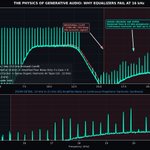
Why EQ Fails on Generative Audio: The Physics of Dead Air Above 16 kHz
The most common advice given to producers trying to fix dull audio generated by Suno or Udio is:
"Just slap an EQ on the master bus, boost a high shelf at 16 kHz by +8 dB, and your mix will instantly breathe."
It seems intuitive: the track sounds claustrophobic, so boosting high frequencies should open it up.
In practice, it sounds terrible. Instead of silky air and vocal shimmer, you get harsh metallic screech, digital grain, and abrasive hiss.
Why does an equalizer fail on generative audio? The answer lies in signal mathematics.
The Fundamental Principle: An Equalizer Only Multiplies
An equalizer is a frequency-selective multiplier. It multiplies the amplitude of energy already present at frequency f by a gain factor K:
Output(f) = Input(f) × K(f)
A +8 dB shelf represents an amplification multiplier K ≈ 2.51. If the acoustic signal at frequency f is physically zero (Input = 0), the equation yields zero:
0 × 2.51 = 0
An equalizer cannot synthesize a single missing harmonic. It can only increase the volume of information already present in the recording.
The 15.5 kHz Brickwall Cliff
To optimize compute budgets and model sizes, generative vocoders render audio using low sampling rates (often 32 kHz with a 16 kHz Nyquist ceiling) or apply steep anti-aliasing cutoffs at 15.5 kHz.
Viewing raw generative audio in a spectral FFT analyzer reveals an unnatural vertical cliff: • Full acoustic energy below 15 kHz. • At exactly 15.5 kHz, energy plunges off a precipice with a slope exceeding ~1400 dB / Octave, dropping into a -85 dBFS digital void.
Above 15.5 kHz, there is ZERO acoustic signal: no cymbal overtones, no vocal breath, and no room reverberation decay. Only low-level quantization noise and diffusion phase jitter remain.
Boosting a high shelf at 16 kHz simply pulls that -85 dBFS noise floor up to -77 dBFS, converting dullness into ear fatigue.
The PHARMAKON 2.0 Solution: 4X Polyphase Harmonic Synthesis
Instead of equalizing dead air, PHARMAKON 2.0 physically synthesizes replacement harmonics from intact donor bands:
Donor Band Selection (8 - 13 kHz): We isolate the upper-mid acoustic band using a zero-phase 4th-order equivalent bandpass where musical information remains untouched by the vocoder cutoff.
4X Polyphase Upsampling (192 kHz): Generating 3rd-order harmonics on a 12.5 kHz donor yields frequencies up to 37.5 kHz. At standard 48 kHz, this creates severe foldover aliasing at 10.5 kHz (|48 - 37.5| = 10.5 kHz), and down to 6.6 kHz on 44.1 kHz (|44.1 - 37.5| = 6.6 kHz). Running in a 192 kHz polyphase domain extends the Nyquist limit to 96 kHz, mathematically eliminating aliasing.
Asymmetric Taylor Polynomial: Signal is routed through: y = x + 0.65x² - 0.25x³ The quadratic term generates musical even 2nd harmonics (2f), while the cubic term produces odd 3rd harmonics (3f), reconstructing a continuous dense air taper across 16 - 22 kHz. Soft pre-filtering tanh(2.2y) × 0.45 tames high-frequency crest spikes.
8th-Order Equivalent Zero-Phase Isolation (filtfilt): A 4th-order Butterworth highpass filter processed forward and backward via filtfilt yields an 8th-order equivalent response (-48 dB/Octave) with zero phase rotation, preventing comb-filtering cancellations when blended into the master bus.
Headroom Notice: Harmonic air injection introduces a minor peak energy rise (+0.2 to +0.5 dB). In the PHARMAKON pipeline, this is naturally handed off to our 4X True-Peak Limiter stage (Article 05) to ensure absolute broadcast ceiling compliance.
Key Takeaway:
We do not believe in fighting AI audio artifacts with another heavy, hallucinating diffusion model.
Clean physics. Pure deterministic DSP. Zero latency on CPU.
Stop multiplying zero. Treat the signal.
Open-source repository & studio console: github.com/alex-gerek/PHARMA…

PHARMAKON // The Inner Circle & Acoustic Architecture
Sound is not a dataset. It is physical tension, room air, and emotional weight.
Over the past year, generative audio flooded the landscape with digital plastic: phase-smeared subwoofers, harsh 5 kHz resonance, and watery neural artifacts. The industry tried to fix it with 4 GB black-box neural networks that take minutes to render and destroy the stereo field.
We built the antidote.
PHARMAKON 2.0 is an ultra-fast hardware-grade mastering console running on pure mathematical DSP (NumPy & SciPy). No PyTorch bloat. No cloud latency. 15 megabytes of uncompromised phase coherence. It separates stems, realigns sub-bass phase, and reconstructs 16 kHz analog silk in 3 seconds flat.
The Philosophy: Private Luxury Sensuality
We don’t believe in mass-market utility. PHARMAKON was conceived like a bespoke analog console in a private nocturnal studio: brushed metal, 60 FPS phosphor scopes, and the warmth of real non-linear saturation.
Access Model (Starting November 1st):
Freemium Tier: 3 to 5 master renders per day. Full access to the surgical rack and real-time monitoring.
The Inner Circle (Private Tier): Unlimited processing, direct access to future unreleased DSP modules, and priority consultation on complex mix restoration directly with Lex Gerek.
The core source code remains open on GitHub through this weekend only. On Monday morning, the doors close as we enter private licensing.
Step inside while the preview remains active:
github.com/alex-gerek/PHARMA…
Sound Architect
#AudioEngineering #DSP #MusicProduction #LuxuryAudio #SoundDesign #Suno #Udio #Antigravity #LexGerek

Behind the console: Raw studio vocal vs PHARMAKON 2.0 [2-Min Video]
A little context on the audio in this playthrough:
That’s my own voice tracked in the studio. And let’s be completely honest: I am not an opera singer. If you listen closely to the raw take, you’ll hear my heavy breath control, some rough room edges, and moments where I’m dragging slightly behind the tempo.
I left all those human flaws in on purpose. Because anyone can make an over-produced, hyper-tuned sample pack sound decent. The real test of an analog surgery console is whether it can take an imperfect, unpolished vocal recording and give it warmth, weight, and acoustic dignity.
In this clip, watch how the monitoring switches:
The Raw Vocal: harsh upper mids, raw breath spikes, spiky digital room capture.
PHARMAKON Master: smoothed out with our tanh tape saturation, 16 kHz harmonic air, and tight low-end management.
The Delta (Residue): you can clearly hear the isolated sibilance and harsh room venom that was stripped away without touching the heart of the performance.
Note on availability:
The repository is currently open for public inspection, but only through the weekend. We are in active discussions regarding a potential acquisition of the tech, and the architecture will likely be pulled into a private commercial license by Monday.
If you want to review the pure DSP engine while it’s accessible, check the link in the profile before the doors close.
Listen with headphones. Feel the difference.
#Suno #SunoAI #Udio #UdioAI #Antigravity #GoogleAntigravity #AudioMastering #StemMastering #DSP #SoundDesign #MusicProduction #AudioEngineering #LexGerek
What if Mozart lived in the era of Paul Mauriat?
Imagine two waveforms on a single timeline: Line 1 is Mozart — sacred fire, counterpoint and classical tension. Line 2 is Paul Mauriat — velvet analog strings, 1970s cinematic melancholy and hypnotic elegance.
We didn't just rearrange the old piece. This is Volume II. Two centuries forced into one breathing master track.
Video edit by Antigravity.
Mastered via PHARMAKON DSP.
Watch until the book closes.
#neoclassical #cinematic #lexgerek #antigravity
I am a sound engineer. My job is to make music sound fucking phenomenal.
In today's world, audio is drowning in digital harshness: piercing sibilance that hurts your ears, muddy phase-smeared sub-bass that collapses club sound systems, and cold, sterile digital crunch.
When a track drops in a club, or hits someone's headphones at night, there are no excuses. The bass must hit like a freight train. The highs must feel like liquid silk. The mix must breathe.
That is why we built PHARMAKON 2.0 PRO.
It is a studio mastering console combining the analog soul of Abbey Road 1974 with the raw precision of Blade Runner 2049.
- Dual 60 FPS Phosphor CRT Oscilloscopes
- Psychoacoustic De-Harshing
- Phase-Coherent Sub-Bass Monofication
- 1974 Tape Saturation
- Surgical Punch-In Repair with 35ms Cosine Crossfade
Free and open source. Link to GitHub in the replies.
nobody asked why. directed our first 35mm neo noir film in collaboration with lazuli pictures. shot across late night tokyo jazz clubs and kyoto dawn gardens. music and sound design by lex gerek. watch the full master in high fidelity.
#jazz #darkjazz #antigravity

sound is not an abstract thing
in the air it is an invisible elastic wave air compressing and expanding over and over
the microphone diaphragm moves from this pressure turning motion into electric voltage
and our oscilloscope turns that voltage into a glowing trail of electrons across the glass
and when it comes to the kick and sub bass in techno you literally see the physics of their relationship under a microscope
when they are in phase and in love you hit pause right on the kick transient
the kick wave surges up and the sub bass wave surges up at the exact same microsecond
on screen they fuse together into a single massive mountain of energy
that is when the magic happens in the warehouse
the subwoofers push the entire room forward as one solid wall of air and you feel that heavy punch straight in your chest
when they are out of phase and at war
the kick pushes the speaker cone forward while the bass pulls it backward
on screen you see the tragedy happen in real time
the wave collapses flattens out and turns into a thin fragile thread
they ate each other
amplifiers are burning kilowatts of electricity but the room is silent
the bass is dead
you see with your own eyes why the dancefloor stopped moving
we do not just listen to sound anymore
we look directly into its anatomy
coded in the lab with antigravity
#antigravity #sounddesign #techno #musicproduction #dsp
some tracks belong in stadiums
this one belongs in an underground concrete warehouse at 3am with zero phone signal and strobes cutting through the fog
track 11: "Underground Sway" (132 bpm)
hybrid cut: real footage meets ai video, sequenced and edited with antigravity
hypnotic slow groove or frantic peak tempo which one pulls you onto the floor faster
#techno #darktechno #antigravity #electronicmusic #sounddesign
A real modular rave in real time.
Not a single live performance can ever be repeated twice down to the microsecond.
Fired up the legendary 1996 ReBirth RB-338 on Windows 11, locked it to 132 BPM, and let dual TB-303 analog filters talk. Every knob turn recalculates the math on the fly.
Pure physical addiction. Acid never died.
Download the modern Windows & Mac build here:
pixeldrain.com/l/Vq5L3h1N
#LexGerek #ReBirthRB338 #TB303 #AcidTechno #TR808 #ModularSynth #SoundDesign #MiamiAcid #132BPM #LiveSession
Shot almost like a private home video, using personal photos with my girlfriend Sophie as reference.
Track 10: "Close to the Skin" (from the album Center of Gravity).
Zero dilution. Warm ocean air, quiet Miami waterfronts, and a heavy 132 BPM sub-bass pulse vibrating straight through warm skin. When the night stops being innocent.
Turn the volume up and listen together:
lexgerek.bandcamp.com/album/…
#LexGerek #CloseToTheSkin #CenterOfGravity #MiamiWaterfront #Techno #Sophie #SubBass #HighFashion #Miami #ElectronicMusic

Let’s cut the polite bullshit: the music industry doesn't run on theory.
It runs on raw attraction.
Nobody buys analog gear, cranks a modular synth, or tunes a 132 BPM sub-bass just to get a polite handshake. Great music has always been about desire: that first physical jolt down your spine, the first bassline that gave you a hard-on, and the body you want pressed against the speakers in the dark.
If your sound doesn't provoke lust, adrenaline, or obsession, you’re just making elevator music.
Now good night. The door is locked, and I'm heading back to bed next to my girl.
#LexGerek #CloseToTheSkin #Attraction #SoundDesign #SubBass #Techno #Desire #CenterOfGravity #Miami

Evgeny Kissin Rachmaninoff Prelude Op 3 No 2 in C Sharp minor youtu.be/SCm9O2KNEX4?si=JeOH… via @YouTube