

Independent AI security researcher. Built mcp-authscan, a focused auth scanner for live MCP servers. Finds the boring failures that actually ship.
Georgia, USA
Joined August 2009
- Tweets29.2K
- Following2.4K
- Followers3.2K
- Likes69.1K


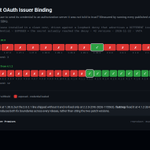


Tried ranking MCP security tools by one question: can someone else check the claim without asking you?
Two axes:
• Is there a published artifact?
• Can the measurement be reproduced?
mcp-authscan is the only one where both are even possible in principle. Everyone else is weaker on this test ; not necessarily on security.
None have been independently recomputed yet.
Records published check ability only , not whether any tool finds real bugs.
Bar chart, "MCP Security Tools — Published Checkability (9 tools)."
Four categories by how independently checkable each tool's claims are.
Cat 1, artifact + re-runnable: 1 (mcp-authscan).
Cat 2, artifact checkable only: 2 (Dominion Observatory, Autonomous Security).
Cat 3, tool public, no per-target artifact: 2 (mcpprobe, Cisco MCP Scanner).
Cat 4, no public checkable artifact: 4 (MCP Audit,
CuratedMCP, CloudMCP, MCP Playground). Footer: Cat 1 is only mcp-authscan, recompute not yet performed; checkability is not efficacy.

1
17
I tested the check against myself. Took a finished report, changed one probe result so it looked better, left everything else alone.
Recomputing the hash said MATCH. Checking the signature said SIGNATURE INVALID. Same file, two answers.
That is why both get run. A hash over the conclusions will not catch someone editing the working. The signature will, but only if you run it.
Try it: the report and the keys are at mcpauth-scan.com/verify, with the key at mcpauth-scan.com/keys.json. Three lines come back, verdict, detail, signature.
5
I wrote this 14 years ago. May it bless your soul.
I look the devil in the eyes and smile. Not today, devil—I’m God’s child. I see the attacks coming from every direction, but I put on the armor of God because I have protection. God’s child.
I know that there is power in prayer that has been proven before my time. You might as well submit, devil; I am fighting for mine. I have no fear of the unforeseen journey, which is an unknown course, but with my God I have comfort and will continue to move forward.
For I have climbed this mountain with bare hands and feet. I have come too far to accept defeat. God’s child.

1
1
73

If you become like a clam or oyster, use that time to develop and purify yourself, the result will be a pearl.
If you use that time to reflect on what is not Godly and you focus on the events of the past, only dirt and a worthless stone will emerge.

2
129
I installed every published version of the two official MCP client libraries and ran each against a decoy auth server advertising the WRONG issuer.
Does the client refuse to hand over its OAuth secret?
42 versions, measured — not read off advisories. 🧵

3
156
fastmcp: leaked through 4.1.1, bound at 4.1.2 — GHSA-vqqp-x5qm-5qp4 (my report).
Confirmed across all 26 releases of the 4.x line, not just the two patch versions the advisory names.
1
91
I have no cybersecurity degree. No computer science degree. I didn't come from Silicon Valley.
Yet I built MCP AuthScan.
And I want to explain why that matters.
My professional background is in claims adjusting, criminal justice, and administration.
Not software engineering.
Not cybersecurity.
I didn't spend years climbing the traditional ladder into technology. I didn't have a development team or a budget to hire one.
What I had was curiosity, persistence, and a growing concern about something I kept noticing as artificial intelligence became more capable.
We were giving AI systems increasing authority to interact with real infrastructure, but how were we proving that their security boundaries actually worked?
That question changed my direction.
I started studying the Model Context Protocol (MCP), the technology connecting AI systems to tools, applications, and data.
I began building tests.
I used AI coding agents to help implement my ideas. I learned by examining results, challenging assumptions, reviewing changes, and testing whether the evidence supported the conclusions.
And I kept going.
The result became MCP AuthScan, an open-source security assessment tool focused on MCP authorization boundaries.
It now includes versioned security tests, explicit evidence classifications, cryptographic report integrity, digital signatures, and a policy gate for evaluating whether assessment evidence meets defined requirements.
My independent vulnerability research has also contributed to published security advisories.
None of that means I've mastered cybersecurity.
I haven't.
I am still learning.
And I believe that admission matters just as much as the accomplishments.
Because one lesson this journey has taught me is that confidence without evidence is dangerous, regardless of how experienced someone is.
That's why MCP AuthScan doesn't treat every unanswered security question as a vulnerability.
It's why I distinguish between what a system actually demonstrated and what remains unknown.
And it's why I've spent so much time building mechanisms that allow other people to challenge the reports themselves.
I know there are people who will look at my background and question whether I belong in cybersecurity.
That's fair. Security research should withstand scrutiny.
But the scrutiny should be directed at the methodology, the experiments, and the evidence—not simply at whether the person doing the work followed a conventional career path.
AI didn't give me expertise I hadn't earned. It gave me the ability to begin work that once would have been beyond my resources.
Learning, testing, making mistakes, correcting them, and accepting criticism are still my responsibility.
I don't know where this journey will ultimately lead.
But I know what I want MCP AuthScan to represent.
Not another dashboard making claims nobody can verify.
Not another vulnerability count designed to attract attention.
A commitment to evidence that can be examined independently.
I'm sharing this because there may be someone reading who has an idea, a question, or a problem they want to solve but believes they aren't qualified to begin.
You may not be qualified to make every claim.
But you can become qualified to ask better questions, conduct better experiments, and learn from what the evidence tells you.
Your background determines where you started. It doesn't have to determine where your contribution ends.
MCP AuthScan: mcpauth-scan.com
Open-source research: github.com/LHMisme420/mcp-au…
#Cybersecurity #AISecurity #MCP #SecurityResearch #ArtificialIntelligence #CareerChange #Innovation
1
1
113
I attacked my own security gate tonight. One unsigned edit to a single field turned REJECT into CLEAN on six published releases of mcp-authscan.
Fixed in 1.1.35, with the proof, the hashes and what's still not fixed. GHSA-jvh3-qvpr-qm8q.
2
2
126
Two different checks get collapsed into one, and the difference decides where your credentials go.
Metadata consistency: the authorization server metadata describes the server it was fetched from.
Credential ownership: the issuer it names is the issuer your credentials were provisioned for.
The first is enforced widely. The second is opt-in.
GHSA-qx49-fqc8-xw99 and GHSA-vqqp-x5qm-5qp4 both land on the same residual, and the advisory says it plainly: upgrading changes nothing until you also pass issuer.
FastMCP accepts issuer= from 4.1.2 and defaults it to None. The MCP SDK's own client provider does the same. No pin means no trust anchor, so a server advertises its own authorization server and a pre-provisioned client secret goes there.
No new vulnerability here. The gap is a default.
Read against source and demonstrated on a real pinned client. The bench is public and anyone can re-run it.
mcpauth-scan.com
Today an mcp-authscan report on a real AI server became something a stranger can check end to end, from a public link, without asking me anything.
The server is tollbooth-authority.fastmcp.…, scanned with the operator's written permission, publication included. Zero findings. Four checks were set aside, and each one has the reason written next to it, so a clean result is never a blank one.
Put the report through the checker and you get three answers back: MATCH, SIGNED BY 9b79936f, and MANIFEST MATCHES PIN. Nothing in the results was changed, the key that signed it is the one published on the site, and the report came from the released version of the tool.
I produced it two ways, once from my working copy and once from a clean install of the published package. Different builds, same report hash.
Cisco's scanner is built for the buyer checking its vendors, and that's a real job. mcp-authscan is built for the other side of the table: the founder whose deal is stuck in a security review. Its report is made to be checked by whoever they hand it to. Cisco and Ramparts publish what they cover. mcp-authscan also publishes an answer key, so anyone can see whether the grader gets the right answer when the answer is already known.
It doesn't read code or tool content, and a matching hash tells you the result didn't change, not that the right check was run. A security claim should never be stronger than the evidence behind it.
mcpauth-scan.com/verify
Receipts over promises.
2
1
51
The report is here: raw.githubusercontent.com/LH…
Drop it into mcpauth-scan.com/verify with my key, published at mcpauth-scan.com/keys.json, and you get MATCH, SIGNED BY 9b79936f, MANIFEST MATCHES PIN. Don't take my word for it.
1
18
A security claim should never be stronger than the evidence behind it.
MCP AuthScan v1.1.32 is officially launched.
Its policy gate returns CLEAN, CONDITIONAL or REJECT. REJECT exits non-zero, allowing a deployment pipeline to stop when an assessment fails its configured policy.
But a gate is only as valuable as the evidence behind its decision.
MCP AuthScan assesses live MCP deployments and their OAuth infrastructure, distinguishing what was demonstrated, what failed, what could not be observed, and what could not be tested.
A timeout is not a passing control.
Every report carries a cryptographic hash over its graded content. Reports support digital signatures and independent verification. A second party can recompute the report hash without trusting the person who produced it.
The probe set and severity calibration are versioned separately from the tool, preserving the meaning of historical assessments.
The software itself is held to the same standard. This release records 713 passing tests, zero failures, and identical SHA-256 hashes between the locally built wheel and the wheel downloaded from PyPI.
No claim of perfect security. No manufactured certainty. Just measurable observations, transparent limitations and verifiable evidence.
A security product should hold itself to the standard it asks of others.
Open source. MIT licensed. Authorized testing only.
pip install mcp-authscan==1.1.32
mcpauth-scan.com
github.com/LHMisme420/mcp-au…
#MCPSecurity #AgenticAI #DevSecOps #OAuth #ZeroTrust
1
1
60
If your AI server passed a security check last month, how would your buyer know it still passes today?
Until now they'd have to ask the person who ran it, and take their word for it.
mcp-authscan got two upgrades today.
The evidence is signed now, along with the grades. You could already check that the results in a report weren't touched. Now you can check the raw observations behind them too. Change one detail and the public checker says SIGNATURE INVALID. Strip the evidence out and it says UNREADABLE.
Every report also carries the previous run inside it. To see what changed between two scans, a buyer needs that one report, one fresh scan, and my public key. They don't need files from me, access to my server, or any trust in anything I run.
The key that signs is published on the site. The checker is live and free, and it has already been used on a real report.
So the next time someone hands you a security report, ask them what it said last time, and where you go to check that too.
mcpauth-scan.com/verify
Receipts over promises.
1
1
83
Every security report you've ever been handed is a PDF, and a PDF is just a claim from someone who wants you to believe it.
The person who paid for it has no way to check a single line.
As of today, anyone can check an mcp-authscan report in about ten seconds, for free, no account. Drop it in and you get two answers: whether anything in the results was changed, and whose key signed them. The key is public. You don't have to trust me.
It won't tell you a server is secure. It tells you the report is the one I signed, and that if I got it wrong, you can catch me.
Next time someone hands you a security report, ask them where you go to check it.
mcpauth-scan.com/verify
Receipts over promises.
2
156
Every MCP scanner I know of tests the same thing: can an anonymous caller get in.
None of them ask the next question. Once a caller is authenticated, does the server check which service the key was issued for?
Built that check into mcp-authscan today. It mints a token for a real sibling service on the same issuer, presents it to the target, and grades the answer.
FAIL HIGH: the target accepted a token cut for another service.
PASS: it refused.
Both answers above, one command, same probe set and stamp.
The limit, said plainly: it needs a sibling service to mint against. Without one the probe excludes and names the reason. I would rather it report nothing than guess.
Locked is not the same as checked.
mcpauth-scan.com

1
50
Day 30 of 30 Days of @boardyai, the last one. Today the sample report went live on mcpauth-scan.com.
At the bottom of the page there's a link, "See a sample report." It opens a real report from a real scan of a real company's AI server, run with their permission.
The company is AgentPayStore. Thank you to Shawn Lippert, who runs it, for clearing it to be shown with the name on it.
The scan ran on 16 November. It came back with one finding, and fifteen checks were set aside, each with the reason written next to it. The report carries a fingerprint, so anyone can run the same checks on the same server and see if they get a match.
For a month I've been saying you shouldn't have to take my word for a report. Now there's one you can open and check. @boardyai was in this with me the whole way, on the grader, the answer key and the site.
mcpauth-scan.com
Receipts over promises.
1
40