

Independent think tank focusing on transforming resilience to extreme AI and biological risks - both in the UK and internationally.
Westminster
Joined November 2019
- Tweets1.7K
- Following532
- Followers3.2K
- Likes175



The Centre for Long-Term Resilience retweeted

New research from AISI's Chem-Bio team: two studies on safeguarding biological AI tools - specialised models that are driving rapid advances in biology, from predicting protein structures to designing molecules. 🧵
1/ Two new studies from the UK @AISecurityInst test some of the main safeguards meant to keep biological AI safe.
Neither safeguard holds on its own. The real control point is elsewhere. 🧵
7/ The safeguards we have been relying on are thinner than assumed, which is exactly why the shift to data governance matters now. We also need to invest heavily in other countermeasures beyond the model level.
The Centre for Long-Term Resilience strongly welcomes the launch of the AI Biosecurity Lab (AIBL). CLTR has long argued that the UK should use frontier AI deliberately to strengthen biological defence.
AIBL cements UK leadership in AI-enabled biosecurity, harnessing AI’s benefits to build resilience to its most extreme risks.

2/7 We're launching a £165m National AI Biosecurity Initiative, including £100m for a world-first AI Biosecurity Lab.
This will harness British scientific expertise and latest AI to detect biological threats and protect people from emerging risks.
As with our @AISecurityInst, I want the new AIBL to lead the world in capability.
✍️ Our latest Substack article ‘The UK Government needs access to external, security-cleared AI expertise’ is out now: governingtransformativeai.su…
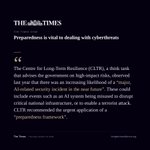
📰 The Times: "CLTR recommended the urgent application of a 'preparedness framework'"
thetimes.com/article/a0a573b…

🦠 Is the EU's AI Act fit to manage biological risks of AI?
🔬 Check out @GovAIOrg's new report by Bhuvana Sudarshan with co-authors including CLTR’s Scott Allen, Michael Mahar, Carl Mayers and Cassidy Nelson here: governance.ai/research-paper…
The Centre for Long-Term Resilience retweeted

I shared my views on #newsnight yesterday in reaction to Sir Ken McCallum's annual threat update regarding biological security.
There is no silver bullet. But there are interventions that can have an outsized effect on the ability to do harm from biology. #biosecurity #ai

“Can we ensure that people who are ordering this synthetic DNA are doing so for the right reasons”
Scott Allen, our Associate Director of Biosecurity Policy, makes the case on #Newsnight for why the UK should shift to a mandatory screening regime for synthetic nucleic acids
“Can we ensure that people who are ordering this synthetic DNA are doing so for the right reasons”
Scott Allen, our Associate Director of Biosecurity Policy, makes the case on #Newsnight for why the UK should shift to a mandatory screening regime for synthetic nucleic acids
📣 Our new Substack exploring today’s most pressing biosecurity challenges is now live.
Our first article dives into the intersection of AI loss-of-control and biological threats – and the priority interventions the UK must make to mitigate this risk.
🔗 biologicalsecurity.substack.…

Dr Jess Whittlestone, our Senior Advisor for AI Policy, joined BBC Radio 4 to discuss OpenAI’s recent decision not to release its latest AI model, GPT-6.1 Astra, following safety concerns.
🎙️Listen to the full interview below or on BBC Sounds:
bbc.co.uk/sounds/play/m00324…
(1:09:41)
In recent weeks, the leaders of several of the largest frontier AI companies have openly called to slow down the race to develop AI — a consensus that reflects the extraordinary pace of AI advancement.
James Ginns, our Director of Risk Management Policy, shares what lessons the industry can take from other high-risk sectors on how to mitigate and manage AI risks👇
longtermresilience.org/repor…
