






Over the last three months, Strategy traded more dollars a day than JPMorgan, Visa or Bank of America. More volume means deeper liquidity, and that is what options run on: tighter spreads, better fills, more strikes. For covered call sellers on MSTR, that is more income kept and less lost to the spread.

Michael Saylor’s Strategy daily trading volume has surpassed the entire TradFi industry.
...they want $MSTR banned from MSCI.

This also means all the BTC treasury companies are about to be in the profit and before the next major leg up to the $140k-$150k range.
$300 a month into Bitcoin, started five years ago, is worth $33,735 today on $18,000 put in.
Steady buying wins because it takes the timing out of your hands.
Five people bought the same dollar amount of Bitcoin every month, starting one to five years ago. The one who started two years ago is still slightly under water. The one who started five years ago is far ahead, and nobody in that row bought the bottom on purpose.
Time in the plan did the work. Pick an amount you can keep paying through the ugly months and let the calendar do the rest.
Education only.
By @LuxWire
Copying Strategy's playbook is not the same as copying Strategy's timing, and two of its biggest followers are paying for it.
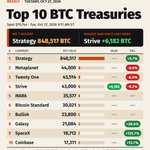
Metaplanet sold 10,000 BTC last quarter to prove it could turn coins into cash, then bought 11,000 back at a higher price, which pushed its cost per coin up. Strive has bought every week this month, including 6,182 more last week, but its early buys cost far more than Bitcoin trades for today.
Strategy built its stack at much lower prices, so the same dip that sinks the followers barely dents the leader. Neither one is a crisis. The difference is that the leader can sit and wait, and the followers need Bitcoin to climb back first.

Most people hate debt because the only kind they've ever met is a credit card. Card accounts that get charged interest pay 22.36% a year on average at US banks. Nothing you buy on a card grows that fast, so that debt just eats you alive.
Debt managed well is a different animal. Last year the money that would have gone to federal tax withholding went into Bitcoin instead, and this June the bill went on a 36 month IRS payment plan. The IRS charges 7% interest plus a 0.25% monthly penalty while the plan runs, so the plan costs 10.25% a year on the full tax. Bitcoin is up 27% since that day.
The rules for leverage are simple. The rate has to be lower than what I expect the money to earn over the life of the loan. The payments come out of income, never from selling the asset. And the balance stays small enough that a bad year for Bitcoin doesn't change anything.
Next April comes the next step: asking the IRS to roll the new year's tax and the remaining balance into one longer plan.
Nobody runs Bitcoin's rulebook from an office.
Every reachable node in this morning's scan checks every block on its own.
If a miner pays itself more than the scheduled new coins plus the block's fees, those nodes throw the block out.

Index funds are buying Bitcoin treasury companies, and nobody at Vanguard had to change their mind about Bitcoin for it to happen.
Vanguard's international small cap ETF (VSS) listed 4,501,600 Metaplanet (3350.T) shares as of Sep 30, worth ¥1.18B ($7.5M) at Monday's ¥263 close. The fund's July 31, 2025 holdings showed 1,436,100 shares, so the stake is 3.1 times bigger.
That is not a conviction call. VSS tracks an index, and the shares come with the weighting rules. A treasury company that grows into an index picks up a buyer that does not trade on headlines, and that buyer sits inside ordinary retirement accounts.
Bitcoin just became a default ingredient in a single ticker portfolio, not a side bet you have to go looking for.
VanEck launched the Wealth Builder ETF (WBMO) on the NYSE on Tuesday. It is an actively managed fund of funds holding global stocks, bonds and real assets, with a 2% target for Bitcoin (range 1% to 5%) held through a spot Bitcoin ETP. Real assets target 7.5%. The net expense ratio is 0.26% after waivers, 0.33% gross. It packages VanEck's Wealth Builder model portfolio, which until now was available only to advisors.
For Bitcoin, 2% sounds small. The point is who ends up holding it. Someone who would never open a crypto app now owns Bitcoin by buying one balanced fund. Small default allocations are how an asset stops being a bet and becomes plumbing.
Bitcoin Fact #22: Nobody needs to own a whole Bitcoin, because each one splits into 100 million units called satoshis. Under the hood the software never touches fractions, since it stores every balance and every payment as a whole number of satoshis. #BitcoinFactOfTheDay
Bitcoin Fact #21: Bitcoin cuts its own new supply in half about every four years, and no committee gets to call an emergency meeting and change that. The last cut came at block 840,000 on the evening of April 19, 2024, Eastern time, when the reward for mining a block dropped from 6.25 to 3.125 Bitcoin. #BitcoinFactOfTheDay
Scorecard for today, October 27, 2026
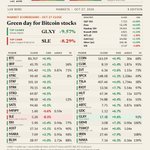
Bitcoin barely moved, yet the miners and treasury stocks ripped higher almost across the board, with Galaxy leading the charge on the morning it posted a big profit.


Brazil's crypto license deadline is Friday, and the date that matters more is the one after it.
Resolution 520 from the Banco Central do Brasil (BCB) is the rulebook that turns crypto exchanges and custodians into firms the central bank licenses and supervises, the same way it oversees banks and payment companies. It took effect on Feb 2, 2026. Any firm already operating that day gets a maximum of 270 days to apply for authorization, which lands on Fri Oct 30.
File on time and you keep operating while the central bank reviews you. Miss it and you have 30 days to shut down.
OKX filed on Oct 16. Brasil Bitcoin says it filed on Oct 15 through a related company, Brasil 8. Bybit said on Oct 20 that it had filed through Bybit Brasil, and says it put R$30M ($5.6M) into that unit's capital. That number is the real story. Under this rule a foreign exchange cannot serve Brazilians from offshore. It has to park real money in a local company the central bank can inspect.
Here is the second order effect. Resolution BCB 589 says that from Nov 6, 2026, banks, payment institutions and other firms the central bank authorizes may not carry out or enable crypto trades with crypto firms that are not authorized to operate in Brazil, except where the rule allows it. Firms with an application on file already have to send the central bank daily custody totals and monthly proof of reserves, and from Jan 1, 2027 that duty no longer ends when the first phase of the review closes.
So the squeeze does not come from a raid. It comes from the banks. An offshore exchange without a filing loses the local rails that move reais in and out, and the new wording no longer spares firms still in review. That is where Brazilian customers feel it.
A filing is not a license. Three things to watch: which big names are missing from the filed list after Friday, whether any bank or payment app cuts off an exchange around Nov 6, and how the central bank sets the format and timing for proof of reserves.

Choosing not to vote is like shilling the latest crypto token: it advances neither your interests nor anyone else’s. This applies only to American citizens.