
Chief Economist @NEF. Formerly: Head of Economics @NEF; PhD @Cambridge_Uni; Policy Advisor @oxfamgb; Analyst @GoldmanSachs
Cambridge
Joined July 2010
- Tweets487
- Following459
- Followers1.1K
- Likes84

GDP has outperformed expectations, but today’s data is still relatively low when compared to pre-2008 financial crisis trends. It also relies on some factors that may be one-offs, such as tax consultancy use in the run up to the budget and recovery from the JLR cyber-attack [1/3]
15 organisations, including @NEF, have laid out recommendations for @RachelReevesMP on how a green financial system can be achieved to power sustainable economic growth financeinnovationlab.org/ins…
Bank of England will adjust haircuts on collateral accepted to start including risk of energy price shocks on mortgage repayment. Will also include risks from more frequent & severe flooding. More ambition needed but shows necessary direction of travel [1] bankofengland.co.uk/markets/…
Great to see @GordonBrown highlighting how Europe's fiscal rules will trap the continent in stagnation by prohibiting urgent and vital investment [1/2] theguardian.com/commentisfre…
@NEF has been working on this issue for many years. For details on Europe's fiscal rules and the problems they are creating, please see our recent paper with @etuc_ces etuc.org/sites/default/files…
166
Great to see the @FT exploring green interest rates, which @NEF has been advocating. They'd lock in lower finance costs for green investments, are already offered by Japan and China's central banks, and are supported by Macron and some ECB board members ft.com/content/558c81d3-c305…

1
199
More details of how the policy would work in practice can be found here: neweconomics.org/uploads/fil…
68
Economists are pushing, as @NEF has, for central banks to offer a lower rate of interest for green lending, so reducing costs for renewable energy and loans for home insulation, etc, without spending public money. (But state investment in net zero is also still a key priority)

📣 From the pages of @lemondefr, economists & industry leaders urge the @ecb to introduce a dual interest rate to boost investments in the #greentransition.
This call aligns with our coalition of NGOs who have been advocating for this policy for years.🤝
lemonde.fr/idees/article/202…

No change in inflation between Jan & Dec despite the energy price cap going up. Bank of England expects inflation to return to 2% target by May. A potential recession is now a greater threat than inflation, and the Bank of England should cut rates sooner rather than later [1/4]
I've written a blog on Labour ditching its £28bn investment pledge & why it is not economically responsible to stick to arbitrary debt targets if this means years of stagnant/falling living conditions & failing to tackle climate change neweconomics.org/2024/02/lab…

I spoke to @greenCB about the FCA's anti-greenwashing measures. The FCA needs to tighten its proposals. Meanwhile, the Bank of England should follow other central banks in setting up a green lending programme with lower interest rates for green investments greencentralbanking.com/2023…

National insurance is a problematic tax as it exempts investment income and pension-age individuals, and has an extremely low high-pay tax rate. But any relief offered to households via a rate cut should be funded by removing these distortions [1/5]
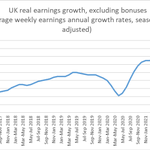
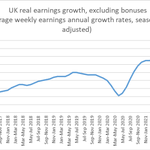
So households continue to have a few months of above inflation pay. But as unemployment rises over the following years (Bank of England forecasts rise to 5.1% by Q4 2026), one suspects this period of wages clawing back some lost ground won’t last long [1/2]
1
1
193
The economy stagnated in Q3. Some argue that without growth the government can’t afford to invest. The opposite is true. Without investment in people, housing, energy, and public services, the UK economy will struggle to boost living standards and prosperity (a thread 🧵) [1/10]
Firstly, North Sea oil and gas is sold on the international markets, so, as acknowledged by the regulator (North Sea Transition Authority), new licences will do little to boost the UK’s energy security [2/9] ft.com/content/0d647ba7-7cc2…
1
83
Great job going @NEF 👇

✨VACANCY: We're looking for a new Comms Officer!
If you're a creative communicator with a passion for social and economic justice, we need you to join our team. Find out more and apply below👇🏽
And share to help us find the right person.🔄
neweconomics.org/about/work-…
532
Liz Truss arguing she was brought down by the “left wing economic establishment”… (otherwise known as the international capital markets…!) lol
📢Great job opportunity going @NEF 📢 If you're passionate about fixing Britain's broken public services, apply to be our next Head of Social Policy 👇 neweconomics.org/about/work-…
193
Instead of spending £45bn on tax cuts predominantly benefitting the richest, we could be properly funding Covid catch-up education (£10bn), a housing insulation scheme (£12bn), social care (£20bn), and a Future Skills Scheme. neweconomics.org/2021/10/ups…

Corporation tax is a tax on profits, and failing to increase it scuppers our ability to capture some of the revenue from companies doing well in this difficult economic period, and use it to help other firms struggling with rising bills. [1/5]
The Bank of England was in a difficult position, but I think it made the wrong call. The BoE can’t affect most of the causes of current inflation, and risks of a wage-price spiral feel low, given household real earnings (excluding bonuses) have collapsed.

