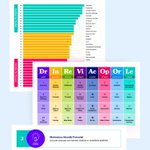
If you're motivated by Make an Impact, people describe you as someone who cares about the work and the outcome, and they notice that the same old routine bores you.
Being told things are fine exactly as they are never sits well.
Make An Impact is one of 32 Motivations that form the WHY behind your thoughts, decisions, and actions — and that’s the game-changer, especially in your work!
Motivations > Personality
👉 Personality tests describe how you behave.
👉 Skills assessments show what you can do.
🔥 Motivation Code reveals WHY!
Your MCode is how you’re naturally motivated, driven to win, and wired to succeed. It’s your competitive advantage. It’s your secret sauce.
Your unique motivational ranking explains:
→ How you are wired for work.
→ What you need to be successful.
→ What causes you to struggle.
→ Who you are at your best.
Have you discovered your MCode yet?
Take the assessment at motivationcode.com/discover-…
When Take Charge is one of your top Motivations, you step up to the plate when a group gets stuck over who makes the decisions or what to do next.
Waiting for consensus just doesn't feel right, and people either find that steadying or overbearing depending on how the moment goes.
Take Charge is just one of 32 Motivations that make you who you are and explain the WHY behind how you think, communicate, interpret the world around you, make decisions, solve problems, and act.
Your unique ranking of these 32 Motivations reveals:
💡 Why some activities energize you while others leave you feeling drained.
💡 Why you naturally excel in some areas yet struggle in others, even when using the same skills.
💡 Why you work so well with some people, but have difficulty collaborating with others.
Do you know what does and doesn't motivate you?
Find out at motivationcode.com/discover-…
If you're motivated by Design, you notice when something is right before you can explain why.
Signing off on work that functions but looks and feels like less than it should or could be sits badly with you.
Where Design sits in your ranking of 32 distinct Motivations tells you how this core Motivation impacts your energy levels and engagement.
If it's at the top of your ranking as one of your strongest motivational drivers, it means it's one of the Motivations that fuel everything you do.
If it's at the bottom, work that taps into this Motivation will barely capture your interest — and that definitely doesn't lead to you showing up at your best.
Discovering your unique blend of Motivations means finally understanding the "WHY" behind your successes and struggles.
Think of them as the hidden forces that energize or drain you.
Find out what motivates you at motivationcode.com/discover-…
Most personality and strengths assessments rely on hypothetical questions: "In situation X, which option sounds most like you?"
You pick the "least bad" answer because none of the options quite fit, the assessment turns those force-picked answers into a profile, and the profile feels plausible to you while not being specific enough to change anything about how you live or work.
The MCode assessment is built differently.
We ask you to share four stories from your own life — moments of meaningful achievement, the kind where you were doing work you loved, in your element, at your best. Then you answer questions about what specifically made each of those moments fulfilling, and rank your answers on a satisfaction scale.
That's the raw material. From your stories, our proprietary algorithm identifies the motivational patterns underneath what fulfilled you, and produces a report that's deeply specific to you because it was built from you.
No personality typing. No predefined boxes. No subjective questions. No sort-of-accurate results.
Just personalized insight drawn from your own life.
Discover your MCode and see what an assessment built on your own stories produces:
motivationcode.com/assessmen…
You can have an incredible personal brand and be working within your strengths, and still feel unengaged at work or in your work.
If you've taken Sally Hoshead's Fascinate Test, you've probably refined your personal anthem, positioned yourself sharply in interviews and pitches, and gotten better at securing the introduction, deal, or opportunity you wanted.
But if you're still wondering why the work itself feels draining — why sometimes you go all in and other times struggle to care — it's because you don't yet have language for what motivates you.
Building a personal brand around what you're great at is smart, but only if the work you're doing aligns with the intrinsic motivations that give you life, fire you up, and make the work feel deeply satisfying and fulfilling.
1/2
The truth is, you can be captivating to the people around you in a role that drains you.
So yes, the polished positioning Fascinate can help you create gets you in the door. Whether you'll thrive once you're inside depends on whether your role taps into what naturally motivates you to engage, persist, and perform.
And that's exactly what the MCode assessment does best.
→ You share four personal achievement stories — moments in your work or life when you were fully engaged, doing something you loved, feeling alive, and at your best.
→ You rate your satisfaction with each story's details on a 1-10 scale.
→ Motivation Code's proprietary algorithm identifies the motivational patterns in your stories and experiences that show what energizes you, what drains you, and what conditions have to be true for you to do your best work.
MCode has more 65+ years of motivational science and research, the evaluation of more than 1.8 million achievement stories, and decades of use in hiring and team-building behind it.
So, use Fascinate for personal branding and positioning guidance. Then, add MCode for the motivational intelligence that tells you which roles will keep you engaged after the branding has done its job.
See how you can use The Fascinate Test and the MCode assessment together:
motivationcode.com/compariso…
2/2
Companies pour enormous effort into transformation through new structures, new systems, and new strategy decks, and the biggest gains come from something more basic: how well the team works together.
McKinsey found that transformations anchored in team-centric approaches can improve organizational efficiency by up to 33%.
When you build change around how people collaborate rather than around the org chart, the whole operation runs better. But what makes a team-centric approach work is what most efficiency plans never account for.
A team runs well when the people on it understand how each other are wired, and it grinds when they don't.
Motivation is the natural wiring that determines what drives a person, how they think, how they make decisions, and how they solve problems.
When those differences go unspoken, they turn into friction, duplicated effort, and the constant low-grade drag of people talking past each other — and that drag is where a lot of a team's efficiency disappears, and no new system or restructure gets it back.
Giving a team language for how each person is wired changes how they operate day to day.
→ People stop misreading each other, and they start dividing work in a way that plays to what each person does best.
→ Collaboration gets faster because the guesswork about how to approach each other is gone.
MCode makes that possible at the team level.
Our assessment maps what motivates each person on a team, giving everyone a shared picture of how their colleagues are wired to work.
People can see where their strengths overlap, where friction is likely to surface, and how to work with each other's differences instead of tripping over them.
When a team you were on clicked, do you know what made the collaboration work?
When Meet Requirements is one of your top Motivations, your first question on a new project is what success looks like to the person asking.
Vague direction feels like a setup, and you'll keep asking clarifying questions long after everyone else has started working.
Meet Requirements is just one of 32 Motivations that make you who you are and explain the WHY behind how you think, communicate, interpret the world around you, make decisions, solve problems, and act.
Your unique ranking of these 32 Motivations reveals:
💡 Why some activities energize you while others leave you feeling drained.
💡 Why you naturally excel in some areas yet struggle in others, even when using the same skills.
💡 Why you work so well with some people, but have difficulty collaborating with others.
Do you know what does and doesn't motivate you?
Find out at motivationcode.com/discover-…
Your Visionary is checked out during detailed planning meetings.
Your Optimizer feels sidelined during creative brainstorming.
Your Driver gets frustrated when the team "just keeps talking."
Your Relator struggles when everyone focuses on individual metrics.
You assume someone's not engaged. But the truth is a whole simpler — different project phases naturally favor different Motivations.
Initiation needs Visionaries.
Planning needs Orchestrators.
Execution needs Drivers.
Team cohesion needs Relators.
The tension isn't happening because someone's being difficult — it's happening because you're asking someone to operate in a phase that drains them while ignoring the phase where they'd naturally shine.
When you understand this pattern, you stop labeling people as "the problem" and start designing workflows that leverage everyone's natural strengths at the right time.
Do you know what project phases best fit you?
Want to multiply your team's output? Strategic pairing based on motivational patterns is your secret weapon.
Most project assignments are made based on availability or expertise. But when you understand how people are motivated to work, you can create partnerships that amplify each person's natural strengths.
MCode has identified 8 distinct Motivational Dimensions. Here's what happens when you strategically pair complementary motivations:
→ Pair someone motivated by achievement and excellence with someone motivated by building relationships. You get high performance balanced with team harmony.
→ Pair someone motivated by taking action with someone motivated by deep understanding. You get forward momentum backed by thorough analysis.
→ Pair someone motivated by influencing others with someone motivated by improving systems. You get persuasive communication combined with practical implementation.
→ Pair someone motivated by envisioning possibilities with someone motivated by orchestrating complex systems. You get innovative ideas transformed into actionable plans.
Instead of forcing people to work in ways that drain them, understand what energizes each person on your team, then create partnerships where both people operate in their sweet spot of flow — their zone of natural motivation — while compensating for each other's gaps.
The result is exponentially better than two people working independently.
Each person's strength gets amplified.
Each person's blind spots get covered.
The work flows naturally because you're working with people's intrinsic motivations, not against them.
Development is one of the most reliable ways to keep good people, and one of the easiest to get wrong. Send someone to generic training that has nothing to do with what drives them, and it reads as a box being checked rather than an investment in them.
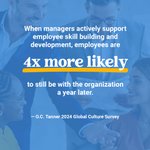
The O.C. Tanner 2024 Global Culture Survey found that when managers actively support employee skill building and development, employees are four times more likely to still be with the organization a year later.
A manager backing someone's growth signals that the person has a future worth investing in, and that signal alone changes whether they stay.
And when both the manager and the organization invest in an employee's development, they are nine times more likely to stay.
🤯 The number more than doubles when the support isn't coming from one person in isolation.
Development that's reinforced at both levels tells the employee the commitment is real and not dependent on having a good manager this quarter — and motivational intelligence is what helps you do it.
Motivation is the natural wiring that determines what energizes someone, how they think, how they make decisions, and how they solve problems.
✅ Growth that runs with that wiring feels like fuel, and the employee leans in.
❌ Growth that ignores it feels like one more obligation, and the gesture that was meant to retain them does nothing.
MCode gives managers what they need to develop people in a way that fits.
Our assessment maps what drives each person, so a manager can build growth around the work that energizes someone and the direction they're wired to grow.
That way, development stops being a generic perk and becomes something the employee feels was built for them, which is exactly what turns it into a reason to stay.
When development actually meant something to you, what made it worth it?
Most turnover gets blamed on things a raise or a new perk could fix. The deeper reason people leave is that no one ever understood what they wanted from the work itself.
The Work Institute found that 75% of employee turnover could have been prevented if companies had a better understanding of what their employees wanted.
The wants that drive people out aren't about better coffee or a bigger title.
1️⃣ They want to be seen, understood, and valued.
2️⃣ They want work that engages them, development that feels meaningful, and a role that matches how they're naturally wired to think, solve problems, and contribute.
Those wants trace back to what motivates a person, and motivation is specific to the individual.
It's what makes one person light up in a role that would drain someone else.
Most companies never get visibility into it, so they try to hold on to people with compensation and perks while the thing that would have kept them stays invisible.
By the time it surfaces in an exit interview, the person is already gone.
Understanding what drives someone changes what you can do while they're still on your team.
You can give them work that engages them, build development that stretches them in ways they find rewarding, and shape a role around how they're wired instead of asking them to fit a mold that was never built for them.
What made you want to stay in a role, or leave one?
There's a specific kind of professional who knows their strengths. They've taken the personality test, they've done the strengths inventory, and they can name what they're good at and how they're wired stylistically.
Yet, they're still unfulfilled in their work, and they don't know why.
That gap is where personality and strengths assessments stop being useful. They describe who you are and what you're good at. They can't tell you whether the work you're doing taps into what drives you to engage.
TRUTH: You can be using all your top strengths in a role that fits your personality and still find the work draining, because nothing about the role connects to what motivates you intrinsically.
The MCode assessment is built to surface that missing layer.
It identifies the underlying Motivations that pull your energy and effort, the ones that explain why you can love one project and dread another even when both use the same skills. It explains why a role you should love on paper drains you on Tuesday morning, and why a side project you have no business doing keeps lighting you up.
That layer is the why behind every other assessment you've taken, and it's the part that changes how you choose your work.
Discover your MCode and see what your personality and strengths results have been missing:
motivationcode.com/assessmen…
Generic management gives everyone the same pep talk, the same development plan, the same feedback approach. Personalized leadership understands that what energizes one person drains another.
Generic management creates:
→ Disengaged employees
→ Wasted potential
→ High turnover of top performers
→ Missed growth opportunities
Personalized leadership creates:
→ Psychological safety and belonging
→ Alignment between work and purpose
→ Genuine engagement (not just compliance)
→ Sustained high performance
The difference isn't more effort.
It's understanding what intrinsically motivates each person and leading accordingly — and the MCode assessment reveals exactly what does and doesn't energize your people, and gives you the language you need to personalize how you communicate with them!
We share the complete framework for motivationally-aligned leadership — for providing high-value, resonant feedback — in this quick, 15-minute, pitch-free training:
f.mtr.cool/8vn2jih6c1
When Make It Work is one of your top Motivations, a broken thing snags your attention the way a fresh opportunity snags everyone else's.
You'll volunteer for the mess nobody wants, and you'll be puzzled when people treat that as taking one for the team.
Make It Work is just one of 32 Motivations that make you who you are and explain the WHY behind how you think, communicate, interpret the world around you, make decisions, solve problems, and act.
Your unique ranking of these 32 Motivations reveals:
💡 Why some activities energize you while others leave you feeling drained.
💡 Why you naturally excel in some areas yet struggle in others, even when using the same skills.
💡 Why you work so well with some people, but have difficulty collaborating with others.
Do you know what does and doesn't motivate you?
Find out at motivationcode.com/discover-…
If you're motivated by Excel, your standards impress people until those standards apply to their work.
Hearing that something is good enough registers as a challenge rather than a relief.
Excel is one of 32 Motivations that form the WHY behind your thoughts, decisions, and actions — and that’s the game-changer, especially in your work!
Motivations > Personality
👉 Personality tests describe how someone behaves.
👉 Skills assessments show what they can do.
🔥 Motivation Code reveals WHY.
Your MCode is how you’re naturally motivated, driven to win, and wired to succeed. It’s your competitive advantage. It’s your secret sauce.
Your unique motivational ranking explains:
→ How you are wired for work.
→ What you need to be successful.
→ What causes you to struggle.
→ Who you are at your best.
Have you discovered your MCode yet?
Take the assessment at motivationcode.com/discover-…
Have you ever hired someone qualified who just... didn't work out under a specific manager?
Here's what's happened:
Managers unconsciously lead from their own motivational style. It shapes how they give feedback, set goals, define success, and communicate expectations.
👉 A Driver manager pushes for action and results.
👉 A Learner manager wants to understand root causes and explore options thoroughly.
👉 An Orchestrator manager coordinates resources and aligns cross-functional efforts systematically.
None of that is wrong.
But it creates invisible expectations.
When an employee's motivation doesn't align with their manager's style, both sides end up frustrated — and usually, the employee leaves.
Here’s an example of what I mean:
A Driver manager expects fast execution, but their new Relator employee wants context and connection before moving forward. The manager sees hesitation, and the employee feels rushed and undervalued.
Same job.
Different motivations.
Total mismatch.
We created a free training on how to assess manager-employee compatibility BEFORE you hire, so you can prevent the friction that leads to turnover.
motivationcode.com/webinars/…
If you've been through DISC training, you can probably sit down with someone's report and spot patterns:
→ "They're a high-D, so direct communication, don't dance around the ask, and move fast."
→ "They're a high-S, so change needs more runway, consensus matters, and they'll disengage if decisions feel rushed."
DISC does this well. It gives you a practical shorthand for the how of interacting with someone.
But what DISC doesn't tell you, and what consistently trips up managers who rely on it alone, is why each person needs what they need.
1/3
Two people in the same role, with the same DISC results — two high-Ds, for example — can be motivated in completely different ways, which means how they're wired to approach work, solve problems, make decisions, and communicate is completely different.
Maybe one is driven by measurable outcomes and personal achievement, and the other is driven by overcoming challenges and competition.
DISC calls them both "high-D," but the management style that will engage, inspire, and fuel one will fall flat with the other.
Motivation Code explains why.
The MCode assessment results live underneath the behavioral layer and surface the intrinsic motivations that drive people.
2/3
This motivational intelligence reveals:
✅ What types of work energize and drain someone.
✅ What environmental conditions will cause them to struggle or succeed.
✅ What they need to engage deeply and feel fulfilled by and satisfied in their role.
So use the DISC assessment for its quick behavioral reads and communication style insights, and add the MCode assessment to explain the why behind those results — why two people with the same profile respond so differently to the same leadership approach.
See a side-by-side comparison of DISC and MCode and learn how the two assessments complement each other:
motivationcode.com/compariso…
3/3