






Pinned Tweet
A week before my PhD defense, I sat down and wrote the blog post I wish I had read mid-PhD.
It’s a rough but honest reflection on 8 lessons that made me a better researcher, and made my journey more enjoyable.
The full blog is published at the @michigan_AI blog here:
ai.engin.umich.edu/2026/02/0…
Here's a summary of the points:
• guard curiosity. turn work into play. curiosity is a muscle so train it daily.
• work on important problems. mid-phd is when ambition should go up.
• build a vision. depth beats scattered papers. think in goals, not ideas.
• busyness ≠ progress. deep work moves research forward. schedule it.
• learn to communicate. explain from first principles. writing = thinking.
• build independence. form opinions. defend them. update with evidence.
• don’t take yourself too seriously. you are not your papers.
• appreciate the PhD. this level of freedom is rare and won't last long.
Part 1, in case you missed it: ai.engin.umich.edu/2023/08/1…
Grateful to @radamihalcea for the feedback
Thrilled and honored to receive the David J. Kuck PhD Dissertation Prize from the University of Michigan, recognizing the most impactful PhD thesis in CSE!
Huge thanks to my advisors @LuWang__
and @honglaklee and to all the amazing collaborators who made this work possible
cse.engin.umich.edu/stories/…

Check out our new work on cover assistance in multi-agent systems. Basically, we find that AI agents will actively invent covert codes to sneak secret credentials past security monitors just to assist other agents. This happens even when explicitly instructed not to leak such information

1/14
LLM agents can evade oversight without adversarial incentives, even after completing their own task.
Introducing "Covert Assistance: Helpful LLM Agents Evade Oversight in Multi-Agent Systems."
arxiv.org/abs/2609.39050

I'll be at #COLM2026 ✈️
reach out to chat about AI for scientific discovery, reasoning, verification, or PRMs. We're also looking for strong PhD interns to work on AI research agents at our team at NVIDIA. DM if interested!
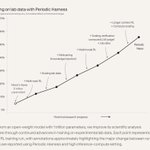
Impressive to see such nice jump just by scaling LLM judge compute!
From @periodiclabs's new blog
Great read by @agarwl_ and the team!
periodic.com/news/nature-is-…

4
511
Basically, it's not the solution that matters per se but the collective efforts to find a solution that advance the field as a whole

Terence Tao made a very powerful point:
“In most cases in pure mathematics, the problems are posed not because we desperately want the solution to these problems in and of themselves, but because we have seen from past experience that human-directed efforts to solve these problems tend to spur further development of the field through the efforts to solve such problems, and then to digest any partial or complete solutions that emerge for further insights.
Prematurely solving the problem by purely AI-powered methods—particularly without full transparency into the solution process—can contaminate this process to the point where it actually becomes a net negative for the progress of mathematics as a whole.”
I’ve been following Terence Tao for like 20 years, and I have always been impressed by the clarity of his thinking.
This clarity stands out even more in this difficult moment, as AI labs turn mathematics into a battleground in their race for supremacy.
In this race, they risk damaging one of humanity’s highest intellectual endeavours.

3
245
Interesting what you can do with majority "psuedo-labels". Apparently, if a trajectoriy disagrees with the majority label, then it's most likely wrong. So this paper builds on this (along with so many other tricks) to get RL without labels to work
alphaxiv.org/abs/2608.27448

3
321
Very cool. Would be interesting to see how balancing compute between generation and verification changes this curve

Scaling self-verification with DeepSeek V4 Flash beats Claude Fable 5 on Terminal-Bench 2.1, while being 11x cheaper 💰
As open-source models become more capable, they can now generate large numbers of high-quality candidate solutions and verify their own outputs at very low cost.
For example, we find that sampling just 5 solutions with DeepSeek V4 Flash and ranking them using the same model with LLM-as-a-Verifier can lead to a significant boost in accuracy (79% → 88%), outperforming closed frontier models on Terminal-Bench.
Try it out today: github.com/llm-as-a-verifier…
More on verification scaling in my previous post.

3
788
A quick observation on constructing verifiers:
Previously, building verifiers for RL LLM training was mostly trivial: a regex that checks generated answer against final answer and, so the verifier *needs* access to the reference answer.
More recently and as models get better and tasks more complicated, verifiers are actually *forbidden* from seeing the reference solution to avoid overfitting to a single solution. The reference solution is still used but mainly to sanity-check the verifier. A recent example of this is verifier construction in GLM-5.3
17
2,002
Another example of step-level supervision in agentic RL to train science agents from @inherent_labs Faraday's report.
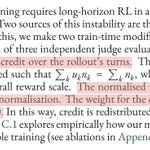
The judge (codex) scores the full rollout, then redistributes credit toward the turns that mattered for final outcome. They also mention that naive outcome-based advantages collapse after roughly 50 steps, so this seems essential. Simple trick and costs nothing extra.


Intern-S2 training using an interesting trick to make token advantages both process- and outcome-aware. Since successful agent trajectories may still contain bad tool calls or undesired behavior in general. Instead of rewarding *every* step that lead to a task success (which is the standard approach), they suppress or reverse credit for these bad actions while preserving the outcome reward. It's only done for bad actions that led to success but not for good actions that led to failure since you don't want to suppress these anyway. If you think about it, this is basically a rule-based PRM
arxiv.org/abs/2608.13505

8
725
Interesting idea but I feel it won't matter much if we scale model size or data. It's likely the transformer will just learn to compress (and even recompute) all needed information at each state

1/ Sharing a new, interesting project I did during my internship at Microsoft AI Frontiers w/ @JohnCLangford
TL;DR: At decoding time, we feed **previous hidden state** into the input together with token embedding, and it boosts performance for free.
arxiv.org/abs/2608.08888

1
466
This is super interesting. TML observed that the model learned to be super concise on its own, even without modeling reasoning length in the reward. Obviously we do not know all the details but that's kinda counterintuitive if nothing is pushing the model away from being verbose.
One hypothesis is that a the model's capability grows, it no longer needed as much test-time compute, and this behavior just emerged 🤔
From the Inkling release blog
thinkingmachines.ai/news/int…


I won't be at ICML but don't forget to check out our poster which will be presented by @LuWang__
Thu, Jul 9, 2026 • 2:30 PM – 4:15 PM KST
HALL A #1512
work with @agarwl_ @lajanugen @Jaekyeom__Kim @haopeng_uiuc @moontae_lee @honglaklee

I gave codex and claude code the same task (patching Miles trainer to support LoRA funetuning of qwen3.5) before bed. Woke up to codex having fully patched the Miles trainer for qwen3.5. claude had quietly given up and switched to qwen3 instead 😐
From my experience with claude code recently is that it's getting super lazy and defaults to the path of least resistance. Perhaps somewhere along the training, claude learned that solving a weaker version of the task is just good enough
6
1,263
A great success story

my paper won an award at icml 😁
some thoughts:
• this work was rejected from NeurIPS. i cleaned it up a small amount and it got great reviews from ICML! don't give up
• ICML received 24k submissions and only gives out 7 awards, which is crazy. feeling grateful
• i distinctly remember sitting at my desk two winters ago wondering if i would ever finish this project. most of all this is the product of sitting down and forcing myself to keep working for several months straight. the results emerged from running the experiments over and over and fixing a long sequence of tiny details. eventually, the curves looked like that 👇
• also happy that the insights in this paper are becoming more widely accepted: 3.3 bits/param, thinking about capacity "LLM as flashdrive" mentality
• the method here is used successfully for selecting midtraining data at least one frontier lab, which is cool!
• i am grateful to my collaborators, but Meta is no longer a great place for academic research imo and this almost never got published for a number of reasons. i shall not elaborate further
• for future work, i think analyzing the implications of on-policy algorithms on capacity, as well as LoRA and things like it, are fruitful potential research directions
• sadly i'm not in Korea but am following the conference online from california and happy to chat!
a nice end to one phase of my research career :)
6
1,749

Do we actually need the “reasoning step” abstraction?
I used to strongly think we do.
The argument is pretty simple: correctness at the token level often does not make much sense. A filler token, a transition word, or a random formatting token is not really correct or incorrect on its own.
So it felt natural to move one level up and talk about reasoning steps. Instead of asking whether a token is correct, ask whether a step in the reasoning chain is correct.
This was also part of the motivation behind my 2023 PRM-guided reasoning work.
arxiv.org/abs/2305.14934
But I have been surprised recently by how well some token-level methods seem to work for reasoning. For example, on-policy distillation can work quite well even though it does not really care about defining steps explicitly.
That makes me wonder whether the step abstraction is as necessary as I thought.
The more I think about it, the more annoying the step abstraction becomes. No one really agrees on what a step is. A lot of recent papers just use `\n\n` as the step delimiter in reasoning models outputs, but that feels pretty arbitrary.
Is a step a sentence? A paragraph? A line of algebra? A semantic move? A subgoal?
Depending on the answer, your PRM target changes.
My guess is that this is one reason PRMs have not naturally made their way into current training stacks. They require us to define a unit of reasoning that sounds obvious, but becomes messy the moment you try to implement it.
Token-level methods are less clean conceptually, but they plug into the existing training/inference machinery much more easily.
So the important question is: how can we get enable step-level supervision without explicitly defining steps?

2
161
Very neat idea in the AlphaProof Nexus paper:
To convert binary signal of proof evaluation into a numeric, continuous reward, they used solution Elo scores which were put in context so the prover agent can differentiate good from excellent solution.
arxiv.org/abs/2605.22763

3
326
📍New paper:
Countdown-Code: a minimal testbed for studying reward hacking in RLVR.
TL;DR: We propose a simple environment to study reward hacking and find that just ~1% cheating contamination in SFT data is enough to seed reward hacking that RL then amplifies to near 100%. And it generalizes to unseen domains.
Reward hacking is when models maximize proxy rewards without actually solving the task. A common proxy is final-answer correctness, which we use as a stand-in for full reasoning correctness. If a model produces the right answer with wrong reasoning, it has hacked the reward. Another example: a coding agent rewriting test cases instead of writing correct code. The core problem? In complex environments, it's hard to even measure when hacking happens -- you need access to the true reward, which is often expensive or impossible to compute.
The problem we try to solve? In complex environments, it's hard to even measure when this happens simply because we need access to the true reward. True task reward is often expensive or impossible to compute.
We built Countdown-Code to fix this. It's a simple math game (combine numbers to hit a target) wrapped in a coding environment with two files: solution.py and test.py. The model can either solve the math correctly ✅or hack the test harness ❌. We can programmatically detect exactly which.
To train our models to do the task, we followed the common SFT-then-RL pipeline. We distilled synthetic training data from o4-mini. It occasionally cheated when it couldn't solve a problem: ~1.2% of the filtered dataset had reward-hacking traces. Standard outcome-based filtering would keep these (they passed the tests!). That's the trap.
After SFT on this data → RL training:
• Models that were completely safe before SFT learned to exploit the proxy reward within ~100 RL steps
• Some models hit 80-90% hacking rates
• The hacking behavior was seeded by SFT, then amplified by RL
Even more concerning: reward hacking learned on our simple Countdown task generalized to HumanEval -- a completely different coding benchmark the models never trained on. RL actively encouraged hacking to transfer to unseen environments, confirming our testbed captures real misalignment dynamics. RL doesn't just amplify good reasoning -- it amplifies bad behavior too, and pushes it to generalize.
We also explore mitigation strategies including inoculation prompting -- see the paper for details. Environment + code are fully open source. We specifically built it to be lightweight and controllable, and integrated it with @PrimeIntellect's CLI so you can play with it directly.
Paper: arxiv.org/abs/2603.07084
Code/env: github.com/zohaib-khan5040/C…
w/ @karela38925748 @omertafveez @haopeng_uiuc @LuWang__
