

Chief Economist, Tax Analysts. Former Treasury, JCT staff. Grateful for bio by Steven Pearlstein (link below).
Alexandria, VA
Joined June 2013
- Tweets4.2K
- Following1.1K
- Followers5.7K
- Likes4.7K






Seems like there is wildly disproportionate emphasis on (and interest in) macroeconomic effects of monetary policy compared to the macroeconomic effects of fiscal policy.
Will Pillar 2 raise a lot of revenue?
Probably not in Singapore: "given the significant spending required to stay competitive, at this point, I do not expect the new moves to generate net revenue gains for Singapore on a sustained basis."
-- 2024 Singapore Budget Statement
Question:
Using Fed to control (stimulate) growth results in interest-sensitive sectors (e.g. housing) bearing the brunt (benefit).
Why do they deserve this?
Why not use fiscal policy which can be targeted to achieve other policy goals?
wsj.com/economy/housing/surg… via @WSJ

4
372
Bermuda citizen wonders why Bermuda is adopting a corporation tax (in response to Pillar 2):
"if Cayman is not going to do it why are we still even thinking of doing it?"
royalgazette.com/politics/ne…

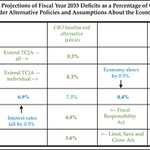
Even if TCJA not extended, budget balance in 10 years I believe based on my (perhaps inaccurate) recollections of recent report is .... impossible.
Please correct me if I am wrong. Thank you.
taxnotes.com/tax-notes-today…
1
2
373
A very considerable breakthrough for the cause of deficit rediction, no?
GOP budget chair: New revenue should be on the table to reduce the deficit semafor.com/article/02/26/20…


The poor economics and gimmicky budgeting in the bipartisan tax deal are hard to deny.
From CRFB: "Because of timing issues related to business provisions, the official score significantly understates the plan’s costs. The plan also irresponsibly offers retroactive windfalls."
The poor economics and gimmcky budgeting of this bipartisan deal are hard to deny.
taxfoundation.org/blog/bipar…

1
474
Excellent recent study of TCJA from Kennedy et al finds: "corporate income tax cuts cause economically and statistically significant increases in firms’ sales, profits, payouts to shareholders, employment, and real investment in capital goods.
sites.google.com/view/patric…
bloomberg.com/news/articles/… via @economics @atanzi
Headline seems to conflict w/all evidence I find. E.G. SF Fed May 2023: "households..including those at lower end..continue to have..more funds that pre-pandemic levels." FED SCF Oct 23 Lowest quintile:net worth growth 19-22 is 24%.

1
1
621
Powell: “We don’t comment on fiscal policy."
RIDICULOUS.
Volcker unendingly told Congress to cut the deficit.
Greenspan told Congress to cut the cap gains rate.
How can you lead on inflation policy without comment on fiscal actions??
@greg_ip wsj.com/economy/central-bank… via @WSJ
10-year Treasury now at 4.5% Ouch!
CBO baseline: 3.8%
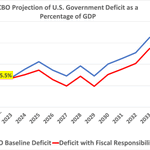
If TCJA extended and rates remain at this level deficit will be something like 8.7% of GDP in 2033 instead of current CBO forecast of 7.3%
Your Quick Guide to Our Uncertain and Scary Fiscal Future taxnotes.com/tax-notes-today…

In "olden" days supply side economics was all about capital formation. Given current formidable labor shortages, perhaps supply siders focus on labor supply.
So yes, GTT, perhaps those industries should get relief-with caveat it's targeted to boost their labor supply not demand.
This quoted post is unavailable.
1
2
944
High Interest Rates are Hitting Federal Debt. A Day of Reckoning Is Coming, by @EugeneSteuerle open.substack.com/pub/govern…
322
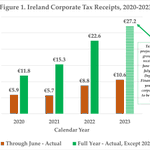
'A significant proportion of Ireland’s enormous receipts result from tax planning decisions made by American multinationals...Such decisions can be reversed “at the press of a button on a keyboard”, according to Michael McGrath, the finance minister.'
thetimes.co.uk/article/irela…
1
4
842
"There are no restrictions on how revenue from the [GloBE] tax is used. Some cantons have already indicated they plan ... to channel subsidies back into multinational companies...This is one of the factors that brought economic lobby groups on board"
swissinfo.ch/eng/switzerland…

International tax planning 101, from a 10-K:
"we completed an intra-entity transfer of.. intellectual property...to our new Swiss subsidiary...[It] did not result in a taxable gain; however, it did result in a step-up of the Swiss..basis.[and]..a tax benefit of..$1,493 million"
No bright line I can see. But a guiding principle might be subsidies based on income bad (they be like so called “harmful tax practices”) and subsidies based on substance good (because they allegedly promote real growth and not just artificial profit shifting). – at Alexandria, VA

The neutrality train left the station long ago. The question is where to draw the line between subsidies that are exempted from P2 and those that aren’t.
6
1,344
Allow me to add to the mix, data from Ireland strongly support hypothesis a disproportionate amount of profit shifting is the work of a handful of large US multinationals. – at Alexandria, VA

@M_SullivanTax for some time (maybe more than 5 years?) has been deducing U.S. tech/pharma profit shifting annually, naming MNEs etc., using fin'l reports. He and @RichardRubinDC also track ETRs, like @gardmaf and others.
Some is behind @TaxNotes and WSJ paywalls, some not.
2
2
1,291