






Trump is about to get a harsh lesson in who really runs America
Story by Thomas Kika
The executive-dominated political landscape in which President Donald Trump has reigned in the White House is a far cry from how the Founding Fathers envisioned the U.S. running, and according to a new breakdown from The i Paper, he will soon face a harsh lesson about who is really supposed to run the country.
On Sunday, veteran D.C. correspondent Nick Bryant published a new piece explaining how warped the structure of the U.S. government has become, culminating in Trump's ruthless second-term power grabs.
"This is not how the Founding Fathers intended the power dynamics of Washington to work," Bryant wrote. "Knowing George Washington would be the first incumbent, they granted the president significant authority – greater prerogatives, paradoxically, than those wielded by King George III in Britain. Congress, however, was supposed to be the dominant branch of government. The drafters of the US Constitution gave lawmakers on Capitol Hill the power of the purse, the authority to raise taxes, to advise and consent on international treaties, to approve presidential nominees, to conduct investigations, to impeach and remove a president and even to decide the outcome of a disputed presidential election."
He added: "The power ranking was clear. Congress would be first, the presidency would be second and the Supreme Court a distant third. Now, we have witnessed an upending. The executive is the most powerful branch. The Supreme Court, with its present six-to-three conservative majority, is second. Congress trails a distant third."
Bryant noted that the U.S. being engaged in a near-constant state of military conflict since 9/11 has made the concentration of power with the president even worse. The overwhelming obstructionism of Republicans during Barack Obama's presidency also worsened things, pushing him to exercise greater executive authority in order to get anything done at all.
Trump, though, has been the worst offender by a mile, engaging in wars, approving destructive new building projects and upending decades of federal policy on a whim, all without any attempt to get congressional approval.
Now, however, with Democrats poised to retake the House, and even possibly the Senate, in the midterms, Trump could soon face a tough lesson in the real power structures in Washington.
"All this could change, of course, if the Democrats win back the control of the House of Representatives, which seems likely, and the Senate, which now seems possible," Bryant wrote. "They would use the subpoena powers of Congress to investigate alleged corruption in the Trump administration. They could block new Trump Cabinet appointees, and haul existing administration officials more regularly before congressional committees. With a majority in the House, they could even impeach Trump for a third time, although the chances of removing him from office at the conclusion of a Senate trial, where Senators serve as jurors, is next to impossible. That needs a two-thirds majority vote, and would require Republicans to turn on the President."
1
27
Trump pardon talk turns serious as his lawyers study blanket clemency: report
Story by Bennito L. Kelty
President Donald Trump's offhand talk of pardoning everyone around him has moved from punchline to legal homework inside the White House.
White House attorneys are reviewing whether to hand out sweeping pardons to lower-ranking staffers, The Washington Sun reported Saturday, citing two people familiar with the discussion. One source said a pardon covering every junior official is unlikely, but Trump could instead issue blanket clemency for everyone involved in certain policy areas, such as deportations, military action or trade.
Also Read: Secret email puts White House fingerprints on Epstein memo: 'Someone needs to own this'
The scope would dwarf anything previously reported. Trump has openly mused about clemency for his top aides, but the talks now underway could reach the thousands of rank-and-file employees who have carried out his agenda.
Influential conservative groups, including the Heritage Foundation and American Moment, have urged the White House counsel's office to either draft pardons or set aside money to cover legal bills for junior staffers facing potential criminal cases, congressional investigations or lawsuits, The Sun reported.
That push picked up steam after Sen. Elissa Slotkin (D-MI) suggested earlier this month that congressional probes of Trump officials should give young Republicans pause before signing on for the administration's last two years.
"After listening to Elissa Slotkin threatening to go after young people who joined the Trump administration, President Trump should issue very broad preemptive pardons for anyone who worked for him or in his orbit," Mike Davis, president of the conservative legal group Article III Project, told The Sun.
Trump himself has laid the groundwork. "I don't want to see people that work for me go through years of nonsense, hire lawyers and everything else, all for nothing," he told Newsmax this month, dismissing his critics as "lunatics" on the left.
The Wall Street Journal reported in April that Trump had joked about pardoning "everyone who has come within 200 feet of the Oval," prompting then-press secretary Karoline Leavitt to tell The Journal to "learn to take a joke."
The White House and the Heritage Foundation did not immediately respond to The Sun's requests for comment
1
1
25
Who convinced Trump to restore Starlink access for Ukraine? UK reveals details
Story by Daryna Vialko
British Prime Minister Andy Burnham personally tried to negotiate with US President Donald Trump to fully restore access to the Starlink satellite communications system in Ukraine, according to the UK government.
Restoring Ukraine's full access to Starlink was the first issue discussed by the British leader and the head of the White House on October 23.
"The Prime Minister underlined the importance for Ukraine to have full access to Starlink so they can continue to defend themselves against Russia’s full-scale invasion," the statement said.
Burnham also praised US President Donald Trump's efforts to bring Russian leader Vladimir Putin to the negotiating table.
Following the call, the two sides agreed to work with international partners to stop the bloodshed.
Notably, Trump himself did not mention Ukraine when commenting on his conversation with Burnham.
The day before, the US president said he was willing to speak with SpaceX owner Elon Musk if Ukraine was experiencing problems with Starlink.
On October 22, The Wall Street Journal reported that Trump had called Musk and asked him to lift the restrictions. However, the US president neither confirmed nor denied that he had contacted the SpaceX owner.
On October 24, Ukrainian President Volodymyr Zelenskyy officially confirmed that Starlink connection speeds on the battlefield have been fully restored to the required speed.
That same day, Ukraine's Ministry of Defense announced that military Starlink speeds had been restored to more than 400 km/h.
It also emerged that US authorities have asked Elon Musk for years to alter Starlink operations in various countries.
1
14

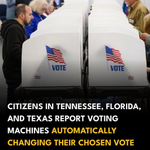
Early voters in several states say their touchscreen ballots registered a different candidate than the one they selected, fueling a wave of complaints as midterm voting continues ahead of the November 3 election.
In Nashville, Jackie Herrud told WSMV she ran into the problem while voting early at the Hermitage Library. “I kept punching for the Democrat, Jerri Green, and it kept punching back to Marsha Blackburn,” she said, describing three attempts before the machine accepted her intended choice.
Stella Parton, the singer and sister of Dolly Parton, raised a similar complaint. She wrote on Facebook that her selection at the same library kept defaulting to Blackburn, the Republican candidate for governor, and that it took her three corrections before the machine registered her actual vote.
Similar accounts have surfaced beyond Tennessee. In Texas, a voter identified only as Paige said on social media that her ballot repeatedly switched her choice from Democrat Jon Rosenthal to Republican Bo French in a Texas Railroad Commission race, a claim that has not been independently verified.
Election officials have pushed back on the scale of the problem. Tennessee’s Secretary of State’s office said it was aware of only one confirmed instance, even as two separate television stations named additional affected voters. In Texas, officials in Tarrant County reported a single machine irregularity out of 58,000 ballots cast on the first day of early voting.

If your site went down it is because of this.
My main game website shows 404 error code so if you are like me a Howrse player this is the reason.
reuters.com/business/php-pro…

2
293
Psychologist details the truth behind Trump's 'very severe problems' claim
Story by Thomas Kika
President Donald Trump made the rather alarming admission about suffering from some "very severe problems" with his health, and now, a psychologist has weighed in with evidence for what some of those problems could be.
Trump's comments came during a Rose Garden event at the White House on Thursday, while he was discussing his lifelong abstention from things like alcohol and smoking, claiming that it had spared him from the health problems that his friends have begun to struggle with in their old age.
"But if you don't drink, or if you don't take drugs, or if you don't smoke, there's no problem," Trump said. "I have other problems. I have some very severe problems. But those are not one of them. I don't want to add them to the list."
The comment sparked considerable alarm, given the mounting public concern about Trump's declining health and fitness for office. While the White House has publicly disclosed some health conditions that the president struggles with, it has also frequently shut down rumors about his health and insisted that he is in good condition for his age.
Dr. John Paul Garrison is a clinical and forensic psychologist with a specialty in body language, who also makes a series of YouTube videos in which he uses his professional insights to examine the behavior of public figures. Many of his recent videos have concerned Trump, with Garrison suggesting that the president is suffering a severe decline, possibly accelerated by a stroke.
Based on Trump's "severe problems" comment, Garrison examined some of his recent public appearances for evidence of what these issues might be, but also noted that the admission itself seemed to be the result of his recent issues with impulsivity. Shortly after making the comments, Trump already appeared to be "backpedaling," suggesting that he knew that he had said something he should not have. This loss of impulse control, Garrison has noted in the past, is consistent with certain forms of cognitive decline.
"As I've said on many videos recently, he is impulsive," Garrison explained. "He makes statements without thinking. And this is one of the rare times he's really talking about himself and providing information that people don't already have. So, immediately upon reflecting on it, when he took just a second to think about what he just said, now he's starting to backpedal."
While backpedaling, Trump also started to compliment members of the media, something he has very rarely done, preferring to attack them as "fake news." In that instance, while he was feeling vulnerable, Garrison suggested that this change in approach suggested that there was some truth to what he admitted.
"Another thing that I want you to pay attention to is how wide open his arms are when he said that. That does suggest, right now, as he's talking about this, he is very open," Garrison added. "He is very vulnerable as he's talking about this. And as I said, this was an impulsive decision to state this."
Moving on to footage from another event where Trump received an honor from firefighters, Garrison highlighted more of his "unusual behaviors," including his continuing struggles with involuntary spasms. Several times throughout this event, the president seemed to suffer from minor and "more significant" spasms, including one where he seemed to jerk backwards. Garrison also spotted a potential tell from Trump signaling when he suffers a spasm.
"Now, this behavior may just be a coincidence, but I have noticed it a number of times before there is a significant spasm," Garrison said. "Sometimes he does look out and look at cameras, or there may be somebody he's looking at off camera. But this look right here, I've seen a number of times before he has a noticeable spasm."

Trump’s trade war doomed workers to a whole career without a raise: economist
Story by Erik De La Garza
President Donald Trump’s tariffs could leave American workers paying higher prices without the wage increases needed to keep up, according to economist Justin Wolfers, who warned that the financial damage could last an entire career.
In his “Platypus Economics” Substack newsletter, Wolfers explained why Trump’s trade policies could have lasting consequences for workers even if they don’t trigger runaway inflation.
“Being 2% poorer for a year is a bad thing, but being 2% poorer for a whole career is far worse,” Wolfers said Friday.
The University of Michigan economist made the argument in a post titled, “The $7.26 Cappuccino Problem,” examining why inflation feels worse than official figures suggest.
Consumer prices rose 3.7% over the past year, while producer prices climbed 6.3%, according to figures Wolfers cited.
But he argued that Trump’s tariffs have created a different problem from ordinary inflation.
“With tariffs, your boss’s costs rise,” Wolfers explained. “It’s a different kind of shock. Economists call it a supply shock.”
Businesses may raise prices to cover those costs, he said, but that doesn’t mean they’re making more money.
“There’s no extra money to go around,” Wolfers said. “It’s a cost-driven shock.”
His conclusion was straightforward.
“So now what happens is prices rise, and wages don’t ,” he said.

Judge loses patience and threatens sanctions as Trump crosses the line in BBC lawsuit
Story by David Edwards
A federal judge warned President Donald Trump that he will face sanctions if he continues to disregard her orders in his $10 billion lawsuit against the BBC.
U.S. Magistrate Judge Enjolique Lett issued the warning Friday in a court order directing Trump to respond by Oct. 22 to the BBC’s request to force him to sit for a deposition
The warning came after months of Trump resisting discovery of evidence on several fronts, court records show. Lett wrote that the BBC filed five motions on its own rather than joint motions because of Trump’s “disregard” of those rules.
“The Court has admonished Plaintiff for his lack of participation to no avail. Going forward, the Court expects strict compliance with its … Order, the failure of which will lead to sanctions,” Lett wrote.
Lett had warned Trump in June, after he failed to give the BBC his side of a joint motion, writing that lawyers “are not permitted to disregard the Court’s orders and procedures” and that failing to respond “may result in sanctions including granting the relief by default,” meaning she could rule for the BBC without hearing from Trump.
Two days before that warning, U.S. District Judge Roy Altman, who was then presiding over the case, ordered Trump’s lawyers to explain why he should not sanction them for “their apparent disregard of court deadlines,” the docket shows. They missed the deadline to respond to the BBC’s motion to dismiss.
That same month, Lett rejected Trump’s bid to remove her, finding that he waited too long to raise the issue and “has only done so when a disputed discovery issue arose.”
The BBC said in a September filing that Trump produced one document on July 14 and had not signed his written answers under oath. Lett ordered him to produce the undisputed records by Oct. 21.
In July, Lett ordered the Donald J. Trump Revocable Trust to turn over tax returns, financial statements and ownership records for roughly 400 business entities, CNBC reported. Altman paused that order in August on the day the records were due, after the trust asked for relief and Trump moved to drop his claim that his businesses were harmed.
Trump filed the lawsuit in December, claiming a BBC “Panorama” documentary defamed him by splicing together parts of his Jan. 6, 2021, speech. Lett ruled in August that the BBC “is entitled to discover Plaintiff’s intention behind the speech.”
Trump agreed in July to sit for a deposition on Oct. 16, the BBC said in a motion filed Tuesday.
“[T]he President is no longer available for his deposition on October 16 due to other matters of national importance,” his lawyer Ian Corp wrote on Sept. 28, according to emails the BBC filed.
On Oct. 9, Trump’s lawyers told the BBC he had no availability before discovery closes Dec. 18, the motion said. They offered January 2027, but only if the BBC agreed to extend discovery.
“Plaintiff chose to file this lawsuit and, in doing so, he accepted the obligations of civil litigation,” the BBC’s lawyers wrote.
Lett also ruled Oct. 9 that the BBC could serve subpoenas on the president’s children Donald Trump Jr. and Ivanka Trump and son-in-law Jared Kushner by certified mail and by email to his lawyers, after the network said their Secret Service protection blocked service in person.
Lett will take up the disputes at a hearing on Oct. 22 in Miami, according to the docket.


Trump has a historic plan to punish the US: Nobel economist
Story by Nick Hilden
On Wednesday, Nobel Prize-winning economist Paul Krugman sounded the alarm about President Donald Trump’s plan to “punish” the U.S. during the final two years of his term. According to Krugman, Trump is preparing to take a page from two of history’s most terrible tyrants.
“By the middle of March 1945,” writes Krugman, “even Adolf Hitler knew that the war was lost. Soviet forces were within 45 miles of Berlin. American forces had crossed the Rhine and were well on their way to encircling the remaining German defenders. But Hitler didn’t believe that he had failed. He believed that he had been failed by the German people. So on March 19 he issued the ‘Decree concerning demolitions in the Reich territory,’ which has come to be known as the Nerobefehl or Nero decree. It ordered the destruction of Germany’s own infrastructure — supposedly to deny that infrastructure to the Allies, but the obvious purpose was to punish his own country.” While the order was never carried out, according to Krugman, it serves as a warning for how Trump will respond after his party takes a beating in the midterms – an effort the president is already ramping up.
Trump has put himself at the center of the midterm campaign, telling voters to “pretend I am on the ballot.” With the GOP poised to take major losses, Krugman notes that it’s unlikely Trump will be happy “when Americans show what they really think of him.” The president will almost certainly “claim that the election was rigged and try to overturn the results,” but assuming that fails, he’ll likely crank up the punishment. “Loss of Congress will limit Trump’s power, but by no means eliminate it,” writes Krugman. “Above all, he will retain immense capacity to inflict destruction on America, not to mention America’s allies.”
As an example of the latter, he points to recent news out of Ukraine. According to President Volodymyr Zelenskyy, the country hasn’t received warnings from its western allies about impending Russian missile strikes in several days. This could merely be due to some technical issue, but in Krugman’s estimation, “Anyone dismissing the possibility that Trump is trying to punish Ukraine for daring to deny victory to his friend Vladimir Putin must have slept through the past two years.”
Domestically, Trump is continuing his destructive spree of vanity projects. Krugman points to recent news that the administration suddenly cut down hundreds of trees in a D.C. golf course, attempting to remake it per the president’s whims. But its full transformation is “unlikely to happen given the political winds, and in any case there was no need to rush the destruction. This was almost surely an act of spite, a deliberate act of vandalism, undertaken precisely because Trump knows he won’t get his way. And while a few hundred trees are not in themselves that big a deal, they represent the shape of things to come. Think of the Kennedy Center, a national icon that Trump is destroying because he can’t put his own name on it, as the model for what is all too likely to happen to America over the next two years.”
Krugman warns that even if Democrats take congressional power, Trump’s destructive efforts will still be enabled by the “corrupt, partisan majority on the Supreme Court,” and by those in his orbit who are willing and “even eager to break the law.” But what Democrats must do, Krugman concludes, “is make it clear that everyone who aids and abets Trump in his Neroism can and will be held accountable to the full extent of the law. At this point, anyone who says something like ‘We should look forward, not back’ is making it significantly less likely that we will have anything to look forward to.”