
30+ years experience in Investment Portfolio Management Science E Book "A Study of Income Sustainability . . . " https://xitter.gq/t.co/o8jb41T1ig
Joined February 2019
- Tweets26.4K
- Following33
- Followers1.6K
- Likes2


9/ An investor can easily own small and large value stocks through low expense ETFs such as through Vanguard, Avantis, Dimensional, etc.
Read "Improving the 4% Rule” tinyurl.com/2th9m4r6

18
8/ Taxwise, an investor may exploit the "0%" tax rate applied to long term cap gains on share sales and "qualified" dividends paid from these assets ( a $99K allotment @ 0% for joint couple filers ) - this in taxable accounts.
23
7/ And who can argue with the solidity of the cash flows produced by some of the most well run businesses under umbrella of Berkshire H and many quality large cap value companies residing within the portfolios of large cap value ETFs - such as Vanguard Value ETF for example.
24
6/ This 5.5% income withdrawal rate is noteworthy in that it has been 38% higher than the conventionally advertised "4% rule" income withdrawal rate. Not many retirees would object to an extra 38% ( $7500 more on a $500K portfolio amount for example ) income generated !
34
5/ accompanied by higher portfolio ending balance over seventy-four rolling 20 year periods ( and even rolling 30 year periods ) since 1931 !
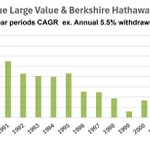
Because of it's superior cash flows, adding BRK boosts the withdrawal rate to 5.5%.
23
4/ Small and large value stocks ( academic based "size, value, and quality" factors ) are considered because research also shows that a 50/50 portfolio representative of the Large and Small cap value stocks has sustained a "5.0%" inflation adj annual withdrawal rate
25
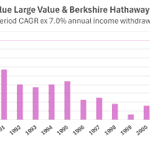
3/ Or using a popular "flexible" income withdrawal approach the portfolio has been able to maintain a "7.0%" annual withdrawal rate - again with higher terminal portfolio ending balances.

32
2/ Since 1986, a portfolio of small & large cap "value" stocks and Berkshire Hathaway has generated a fixed annual inflation adj. "5.5%" income withdrawal (share sales + dividends taken ), accompanied by portfolio growth, over 21 rolling 20 year periods

45
1/ A family may be able to achieve a higher than conventional withdrawal rate from a "gold standard" portfolio of equity based assets - assets held in highest regard by academia and the financial media
32
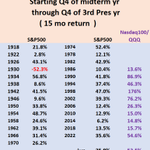
3/ S&P500 returns through Q4 of Pres term year starting from a daily basis "price low" made in Oct or November of the prior mid term year

89
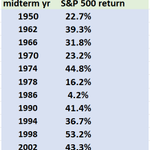
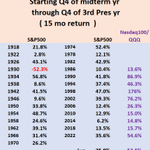
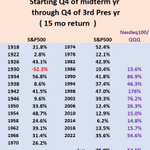
2/ Since 1918, the 15 month period starting Oct 1st in mid term election years has produced positive market returns in every period except 1930.
And since 1986, the Nasdaq100 index/QQQ has been positive over every return period

1
145
1/ In October, the market entered it's best 15 month returns period ( through December of 2027 ) of the "4 year Presidential term cycle" .
48
3/ In a majority of those periods, the S&P500 traded below the 200-day MA at some point in October or November of the mid term years
89
2/ Since 1918, the 15 month period starting Oct 1st in mid term election years has produced positive market returns in every period except 1930.
And since 1986, the Nasdaq100 index/QQQ has been positive over every return period

78
1/ In October, the market entered it's best 15 month returns period ( through December of 2027 ) of the "4 year Presidential term cycle" .
37
2/ Since 1918, the 15 month period starting Oct 1st in mid term election years has produced positive market returns in every period except 1930.
And since 1986, the Nasdaq100 index/QQQ has been positive over every return period

90
1/ In October, the market entered it's best 15 month returns period ( through December of 2027 ) of the "4 year Presidential term cycle" .
21
2/ Since 1918, the 15 month period starting Oct 1st in mid term election years has produced positive market returns in every period except 1930.
And since 1986, the Nasdaq100 index/QQQ has been positive over every return period

2
1,052