

Macro first. Markets explained. Rates, flows, cycles and the numbers behind every move. Data, not tips.
Mumbai
Joined January 2026
- Tweets1.5K
- Following190
- Followers1K
- Likes662





Market Node retweeted

CJP’s protest exposed something nobody is discussing.
The money.
I asked one simple question.
Who paid for all this?
A few months ago,
Abhijeet Dipke was in the US.
Then came a remark from the Chief Justice.
Then came a meme page.
Then came millions of views.
Then came coordinated amplification.
Bots.
Anonymous pages.
Influencers.
Reels appearing everywhere.
Suddenly, Dipke returned to India.
Permission was secured.
A protest site appeared at Jantar Mantar.
Tents went up.
Stages were built.
Food began arriving.
Then Sonam Wangchuk joined.
Celebrities appeared.
Political leaders followed.
Student wings mobilised.
The crowd grew.
The story changed.
What began as a NEET protest became a political spectacle.
So I stopped watching the videos.
I started calculating the bills.
The protest ran from 6 June to 20 July.
That is 45 days.
45 days of continuous operations.
Let us calculate the economic value.
Food and beverages: ₹13 crore.
Daily transportation: ₹3 crore.
Final-day mobilisation: ₹3 crore.
Stage, tents, sound: ₹2.5 crore.
Water and drinks: ₹2 crore.
Volunteer logistics: ₹1.5 crore.
Accommodation and boarding: ₹3 crore.
Senior legal services: ₹1.5 Crore.
Medical counters and emergency: ₹3 crore.
Banners and printing: ₹2 crore.
PR and digital production: ₹2.5 Crore.
Social-media operations: ₹3.5 crore.
Speakers and invited guests: ₹2.5 crore.
Administration and operations: ₹1.5 crore.
Technical support: ₹0.5 crore.
Contingency: ₹3 crore.
Special Fees: ₹5 Crore.
Subtotal: ~₹52 crore.
Then came 20 July.
Approx 50,000 people turned up.
As per Media.
50,000 people do not materialise from thin air.
They must be contacted.
Transported.
Directed.
Supplied with water.
Managed on the ground.
Another ₹5 crore.
Add the YouTube machinery.
Video teams.
Editors.
Content creators.
Social-media pages.
Real-time amplification.
Another ₹5 crore.
Add the wider digital amplification surrounding the final mobilisation: Another ₹5 crore.
Then came reports and visuals of celebrations and hospitality. Add: ₹1 crore.
The total Cost: ~₹68 crore.
Read that again.
₹68 crore.
This was not a few angry students carrying handmade placards.
This was an operation.
Money leaves fingerprints.
Logistics leave patterns.
Amplification leaves digital trails.
So who funded it?
If I answer that today,
my account may not survive tomorrow.
But one thing is difficult to ignore.
This was not spontaneous.
It was organised.
Resourced.
Planned.
The scale demands questions.
The logistics demand answers.
Someone financed this machinery.
This story is only beginning.
The funding trail is where I am headed next.
Market Node retweeted

🚨 BREAKING!!!
MODI CABINET Just DROPPED A BOMBSHELL On PAPER LEAK MAFIA 🔥🔥🔥
- Up To 10 YEARS JAIL + ₹10 CRORE FINE Now APPROVED For Anyone Who Dares Touch NEET Or Any Exam Papers!
- FAST-TRACK COURTS Coming To DESTROY These Scammers Forever!
Dear Youth Of India… Your Future Is Finally SAFE.
Those Who Played With Students’ Dreams Will ROT Behind Bars 🔥
This Is HISTORIC. I think the Government has Taken the Right Steps.
I hope we do not see a SINGLE PAPER LEAK IN INDIA EVER AGAIN !!!
#FI
Market Node retweeted
Who is Sonam Wangchuk?
Engineer?
Educator?
Activist?
Scientist?
Or something harder to define.
Some call him a visionary.
Some call him a fraud.
I went into his timeline.
Not his intentions.
Just the record.
You decide what it means.
Let's begin.
1966.
Born in Ladakh.
His father, Sonam Wangyal.
A Congress leader.
Former minister in the J&K government.
This is not a rags to riches story.
Mechanical Engineering.
NIT Srinagar.
No postgraduate degree.
No PhD.
1988.
He founded SECMOL.
An education NGO.
SECMOL's funders include.
Ford Foundation.
Rockefeller-linked entities.
Open Society Foundations.
DanChurchAid.
Operation New Hope.
A graduate fresher connected with so much international funding??
1992.
Rebecca Norman joins SECMOL.
A graduate of the School for International Training (SIT), Vermont.
SIT has received funding from USAID.
Ford Foundation.
Carnegie Corporation.
Rockefeller Foundation.
And Peace Corps volunteers.
And the ‘Peace Corps.’
What is the Peace Corps?
An alleged covert CIA Organization.
1996.
Wangchuk marries Rebecca.
And suddenly his career took off.
That same year.
Governor's Medal for educational reform in J&K.
2001.
Named Man of the Year by The Week.
Appointed education adviser to the Ladakh Hill Council.
2001.
Ashoka Fellowship.
2005.
Appointed to a national education body by the MHRD.
2007.
Collaboration with a Danish NGO.
2009.
3 Idiots releases.
Media reports link the film's character to him.
PLanted strategically.
2013.
Ice Stupa gains national attention.
Not his invention, by the way.
Ice Stupa was pioneered by Chewang Norphel in the 1980s.
The project received funding from Ashoka.
Rolex Awards.
Swiss partners.
Open Society Foundations.
International universities.
2017.
HIAL is registered.
2018.
Wangchuk receives the Ramon Magsaysay Award.
Now who is Ramon Magsaysay?
President of the Philippines.
A CIA funded.
During his presidency, he worked closely with Edward Lansdale.
Who ran psychological warfare operations for the CIA in the Philippines.
2018.
Ladakh administration allots roughly 54 hectares.
HIAL begins running programs.
Without UGC approval!!
2023.
Wangchuk leads protests for Ladakh statehood.
The same year the government plans rare earth extraction in Ladakh.
2025.
HIAL's land allotment is cancelled.
The Home Ministry cancels SECMOL's FCRA licence.
Citing violations under sections 8, 17, 18 and 19 of the Act.
Sonam Wangchuk started a hunger strike in Ladakh.
It ended in violent clashes.
4 people died.
2026.
He joins the CJP protest at Jantar Mantar.
Delhi Police removed him from the site.
It ended in violent clashes.
100s Injured.
Now you have the timeline.
Decide for yourself what it adds up to.

Market Node retweeted

This companies posted strong quarterly result:
1)POCL
2)ASIAN ENERGY
3)Utsaav CZ Gold
4)Shree Vasu Logistics


Market Node retweeted

🚨Michael Burry just said Elon Musk and Nvidia's deal is built on fake numbers.
Burry published a detailed breakdown calling the entire structure "Fugazi", his word for fake.
He is alleging that billions of dollars in Nvidia chips are being hidden off balance sheets, and that American retirees are unknowingly funding the whole thing.
Nvidia, the world's largest AI chip company sold $5.4 billion worth of its most advanced GPUs, the GB200, to a company called Valor.
Valor is not a real operating business. It is a special purpose vehicle, a shell company created specifically to hold these chips and nothing else. Nvidia also invested $1.9 billion of its own money directly into Valor on top of the sale.
Those 100,000+ chips are now physically inside xAI's data center. xAI is Elon Musk's artificial intelligence company, the one that builds Grok. xAI is using every single one of those chips right now to run its AI models.
But here is what Burry is flagging.
Neither Nvidia nor xAI owns those chips on paper. Valor, the shell company holds legal title. That means $5.4 billion in GPU assets do not show up on Nvidia's balance sheet as inventory.
They do not show up on xAI's balance sheet as assets. They are legally invisible to both companies.
Nvidia gets to book the $5.4 billion as a completed sale and record it as revenue. xAI gets full use of the chips without owning them. And the risk disappears into a shell company in the middle.
Now here is where American retirees enter the picture.
Valor needed $3.5 billion in debt to fund this structure. Apollo provided it. Apollo is one of the largest asset managers on earth with $1.03 trillion under management and $834 billion specifically in private credit.
Apollo raised the $3.5 billion, packaged it into debt securities, and sold those securities to Athene.
Athene is Apollo's own insurance company. It sells fixed and indexed annuities, retirement savings products, to ordinary Americans.
When a retiree buys an Athene annuity, they believe their money is sitting in safe, stable investments. That money is now inside a structure funding Elon Musk's AI data center.
The numbers inside Athene are most alarming.
Athene holds $74.2 billion in reserves. It has moved $217 billion in assets into a captive insurer based in Bermuda, meaning those assets sit outside normal US insurance regulation and oversight.
Of the entire portfolio, 34.7%, equal to $103 billion, is classified as Level 3 assets.
Level 3 is an accounting classification that means there is no observable market price for these assets. No outside party can independently verify what they are actually worth.
The leverage sitting on top of those unpriced assets is 16 times.
Burry's says:
Every step of this structure is technically legal and publicly disclosed. But the entire thing was deliberately engineered across 8 to 12 steps to move credit risk off balance sheets and away from any market pricing.
- Nvidia books the revenue.
- Apollo collects the fees.
- xAI gets the computing power.
- And retirees sitting at the bottom of a 16x leveraged Bermuda insurance structure, holding $103 billion in assets with no market price carry the risk without knowing it exists.


Market Node retweeted

🇮🇷 Every single stock on the Tehran Stock Exchange closed green today. Not one in the red.
First time in the exchange's history.
Iran's market is pricing in the deal before the ink exists. When a population that's been cut off from the internet for 5 months sees every stock go green on the same day, they know something is coming.
The Supreme Leader hasn't signed. The terms are still disputed. The market already decided.
Source: Middle East Spectator

Market Node retweeted
War is bullshit.
Behind closed doors, people in suits calculate power, contracts, and political survival. Fear rises, budgets blow apart, and money flows straight to the top.
The ones sent to fight are pawns, risking their lives in an artificial war designed for maximum extraction and profit.
The sooner you understand how the system really works, the sooner you understand the truth: it’s all corrupt from top to bottom & always has been.

Market Node retweeted
You think your net worth is safe because it’s parked in real estate and bank FDs.
History disagrees.
When systemic or geopolitical stress hits, traditional "hard assets" become dead weight. Here is the brutal reality of capital controls: 🧵👇
Market Node retweeted
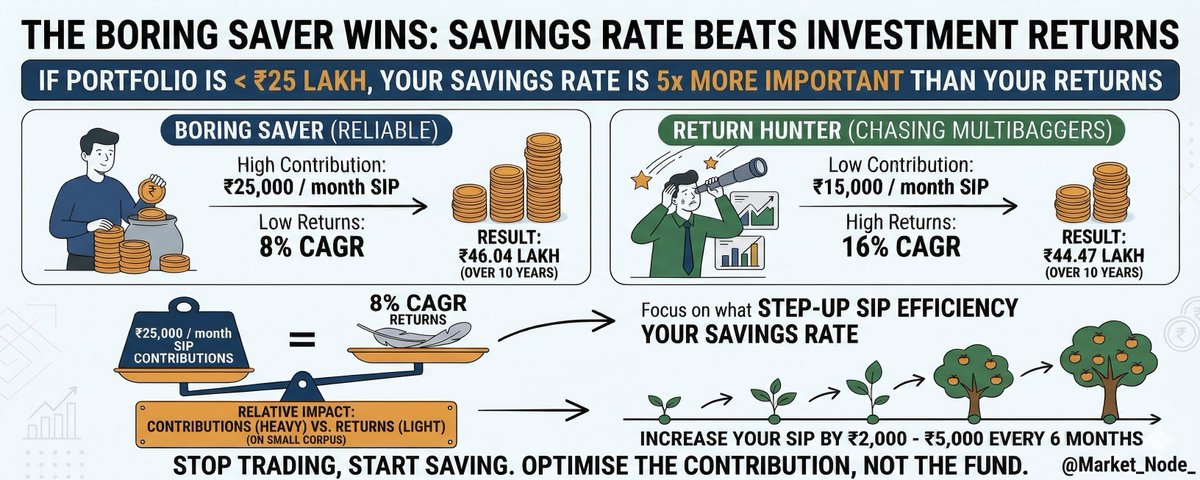
The "2.5% SWP = safe retirement" rule is a trap.
If you retire at 40, your corpus needs to last 50 years — not 25.
The math looks completely different.
Here's the blueprint most early retirement guides in India miss. 🧵
Market Node retweeted
Jack Dorsey just dropped a stark unemployment warning.
AI job losses are accelerating — and the shift from white-collar to blue-collar work in the US is no longer hypothetical. It's happening.
Here's what that means for markets, for India, and for the next phase of this AI-driven disruption.
➡️The Supply Shock in Services
When tens of thousands of laid-off tech workers, accountants, marketing professionals, and operations managers can't find knowledge work, they don't just sit idle.
They take what's available: cooking, cleaning, plumbing, carpentry, painting, appliance repair, electrical work.
The supply of hands-on service labor skyrockets. Wages for those jobs plummet.
Yes, it's a downgrade. But when survival is the priority, choice becomes a luxury.
The irony: the rich will benefit. The same laid-off American worker who used to manage cloud infrastructure will now be cleaning penthouses in Manhattan for $20/hour instead of earning $150K/year in tech.
This isn't about mocking blue-collar work. It's about recognizing the disruption AI is bringing — starting in the US, spreading globally.
➡️What This Means for India
If US companies are replacing white-collar workers with AI at scale, Indian IT services are next in the crosshairs.
TCS, Infosys, Wipro, HCL Tech — their entire model is built on labor arbitrage. Offshore teams doing work that US companies used to do in-house.
But if AI agents can write code, run QA, build dashboards, and automate workflows for $20/month instead of $50/hour for an Indian developer, what happens to the ₹10 lakh crore IT export industry?
The next quarter's earnings calls will tell the story. Watch for:
1⃣Margin compression (clients demanding lower rates)
2⃣Deal flow slowdown (fewer new contracts being signed)
3⃣Headcount reductions (utilization rates dropping as AI replaces billable hours)
Indian IT stocks have corrected 10–15% from their highs. That might just be the beginning if this labor displacement accelerates.
➡️What This Means for Markets
Here's the paradox markets are trying to price:
⚡️Scenario 1: Markets celebrate job losses, Corporate margins expand. Labor costs drop. Productivity surges. Earnings go up. Stocks rally.
⚡️Scenario 2: Markets panic over unemploymentConsumer spending collapses. Defaults rise. Economic growth stalls. Stocks sell off.
Both can't be true at the same time. One of these narratives is wrong.
Right now, we're in the awkward middle — "jobless economic growth."
GDP stays elevated because AI-driven productivity keeps output high. But employment craters because humans are being replaced, not redeployed.
This is the environment we're staring at in the medium term.
➡️The Market Is Range-Bound for a Reason
Nifty is trapped between:
1⃣Budget lows (25,400–25,500) — peak pessimism on STT hikes and policy uncertainty
2⃣Trade deal announcement highs (26,000–26,200) — peak optimism on US-India trade progress
The market can't break out because it doesn't know which narrative wins:
- Do corporate margins expanding from AI efficiency justify higher valuations?
- Or does rising unemployment and consumer stress justify a re-rating lower?
Until clarity emerges, this is a trader's market, not an investor's market.
Tight ranges. Mean reversion setups. Choppy two-way action.
Bulls can't sustain breakouts. Bears can't sustain breakdowns.
🎯The Bottom Line
AI isn't just replacing software jobs. It's triggering a labor market restructuring that will ripple globally.
White-collar workers shift to blue-collar work → service labor supply surges → wages compress → consumer spending weakens → corporate margins improve but aggregate demand falls.
For Indian IT, this is an existential threat. The offshore model was built on cost arbitrage. AI just undercut that advantage by 90%.
For equity markets, this is a valuation puzzle. If AI boosts productivity but crushes employment, do stocks go up or down?
The answer will determine whether Nifty breaks 26,200 or not.
For now, trade the range. Sell rallies near 26,000. Buy dips near 25,500.
And watch the US labor data closely. The first real spike in unemployment claims will be the trigger — one way or another.

BREAKING: Netflix is walking away from a deal to buy Warner Brother’s Discovery amid a multi-month bidding war.
Netflix stock, $NFLX, is surging over +10% on the news.
Netflix will now collect a $2.8 BILLION breakup fee.

Market Node retweeted
Some tech predictions this decade:
Crypto is going to take over the dollar
Everyone is going to live in the metaverse
NFTs are going to replace art
DOGE is going to save the govt trillions
I think it's perfectly fair (for now) to be skeptical about tech's AI forecasts

Market Node retweeted
BANKS IN THE U.S. ARE FLASHING RED SIGNALS. IS INDIA NEXT? 🚨
The viral "US Bank Collapse" analysis is terrifying: Hidden bad loans ("A/B Splits"), liquidity traps ("FHLB Liens"), and fake valuations ("HTM").
But before you panic about your HDFC or SBI FD, you need to understand the Indian equivalents.
I’ve mapped the US "death signals" to the Indian Banking Reality. Here is the truth 👇


Market Node retweeted
⚡ THE MATH OF RUIN
Most retail traders obsess over the "Win Rate." Professionals obsess over the "Drawdown."
The math is brutal:
Lose 10% ➡️ Need 11% to recover.
Lose 50% ➡️ Need 100% to recover.
Lose 90% ➡️ Need 900% to recover.
The Lesson: Stop losses aren't about "accepting defeat." They are about staying in the game.
If you dig a hole too deep, you will never climb out. 📉
#RiskManagement #TradingPsychology




Market Node retweeted

Goldman Sachs models Chinese copper smelter collapse probability at 6.4%.
The empirical number is 35%.
They're wrong by a factor of six. This is the most consequential pricing error in global commodities.
Chinese smelters refine 44% of the world's copper. In 2026, they earned $0 doing it.
The benchmark TC/RC: zero.
Spot charges: negative $65/ton.
They are paying miners to take their rock.
They survive on three byproduct pillars:
Sulfuric acid. 40% of revenue.
Gold recovery. 35%.
Cathode premiums. 25%.
Goldman treats these as independent. Normal correlation: 0.32.
Measured correlation during Chinese stress events (2015-16 devaluation, 2021-22 Evergrande, 2022 property cascade): 0.92.
Goldman's math: 0.4 × 0.4 × 0.4 = 6.4%
Correct math using crisis-regime copula: 35%
That's not a rounding error. That's a six-fold miscalculation of the tail risk that determines whether 44% of global copper processing stays online.
When all three pillars fail simultaneously, 30-50% of Chinese smelting shuts within 90 days.
2-3 million tons removed from a market running on fumes.
The surplus everyone models does not exist.
900,000 tons of visible inventory. Comfortable, right?
But 492,523 tons sit trapped on COMEX. All-time high. Section 232 tariffs. Cannot leave U.S. soil.
LME on-warrant stocks: 114,000 tons. Multi-year lows.
Strip the trapped metal and global liquid inventory covers 1.8 days of consumption.
Less than two days.
June 30, Commerce Department decides if the trap becomes permanent. 55% probability it does.
The three fastest-growing demand sectors are functionally price-blind:
AI infrastructure. Copper is 0.5% of data center cost. Microsoft doesn't delay a billion-dollar facility over a $25 million copper bill. Demand could hit 2.5 million tons by 2040.
Defense. Growing 14% annually. No general cancels weapons procurement because commodity prices rose. Triple current consumption by 2040.
Grid infrastructure. China deploys it as stimulus when the economy weakens. The bear scenario for China increases copper demand from the largest buyer on earth.
S&P projects a 10-million-ton annual deficit by 2040.
Supply can snap. Demand will not yield.
Here's the part that breaks every model built for normal markets:
The bear case for China is mechanistically identical to the bull case for copper.
Prices crash to $9,500 on the macro shock. Bears celebrate. Goldman's $11,000 target looks prescient.
Then within 90 days, supply destruction overtakes demand destruction.
Smelters shut in weeks. They're hemorrhaging cash at $0 fees with collapsing byproduct revenues. Rational operators preserve capital.
Downstream consumption contracts over quarters. Fabricators cut orders gradually. Grid projects continue. Defense procurement continues. Data centers continue.
The asymmetry is brutal: supply exits faster than demand.
The refined copper deficit that emerges forces prices to $18,000+ to incentivize emergency restarts and alternative sourcing.
The crash creates the squeeze.
LME positioning: 80th percentile long. Western funds playing the energy transition narrative.
SHFE positioning: widest net short since 2021. Chinese traders see the smelter math firsthand.
The West is long for the story everyone already knows.
China is short because they see what's coming.
One of them is using the right model.
Goldman year-end target: $11,000.
J.P. Morgan: $12,075.
Probability-weighted target using corrected correlations: $14,663.
Convexity scenario if three-pillar collapse triggers: $18,000-21,500.
Chinese production rose 9.7% through October 2025 despite zero processing fees. That's not resilience. That's byproduct dependency masking structural fragility.
CSPT has pledged 10% capacity cuts for 2026. That's 961,000 tons. If they execute, the market tightens. If they don't, the cash bleed accelerates the eventual snap.
Both paths lead to the same destination. Only the timing differs.
The mechanism is already in motion.
June 30 resolves it.
Read the full deep dive analysis on Copper - open.substack.com/pub/shanak…
